EAR 11 TEST 1
 Call Kai
 Learn
 Practice Test
 Spaced Repetition
 Match
 Flashcards
 Knowt Play
1/83

There's no tags or description
Looks like no tags are added yet.
84 Terms
system
DIFFERENT COMPONENTS THAT WORK TOGETHER AS ONE
Subsystems
Skeletal, nervous, circulatory
Reservoir of matter
stomach, lungs, muscles
Reservoir of energy
body temperature
Attributes of systems
blood pressure, cholesterol level
system state
suite of attributes measured at an annual check-up
Couplings
links postive and negative
Positive couplings
A change in one component results in the same type of change in the component it is coupled with
INCREASE —> INCREASE
DECREASE —> DECREASE
Negative couplings:
change in one component results in the opposite change in the component it is coupled with
DECREASE —> INCREASE
INCREASE —> DECREASE
positive feedback loop
+1 (+1) — elvis example
Positive = Reinforce/Amplify
negative feedback loop
+1 (-1) +1
Stabilize/Balance
Perturbation
a temporary disturbance
EX: volcanos, cooled down earth
Forcing
a persistent disturbance — CO2 rising
Stable equilibrium
system resistant to change
Unstable equilibrium
a system sensitive to change
Negative feedback loops balance the system
Unstable equilibrium
a system sensitive to change
positive feedback loops reinforce the changes
Albedo
sunlight(shortwave) thats being reflected — white is goat
components of earths atmosphere
Energy Balance
Atmosphere
Ocean System
Cryosphere
radiation absorbed
visible , shortwave , long wave = total radiation
output
longer waves
total radiation emitted
electromagnetiec radiation
form of energy, travels through space at the speed of light
wavelength
distance between 2 crests
frequency
number of wave crests that pass a point per unit time
Wein’s Law
the wavelength at which a blackbody emits the most flux of radiation decreases with temperature
PEAK FLUX, shorter wavelength, rise in temp
Hotter bodies emit shorter wavelengths than colder bodies
flux
the amount of energy or # of photons per unit time that pass through a given area
Same energy spread over a larger area = lower flux of energy
Stefan-Boltzman Law
the total energy flux emitted by a blackbody increases as the temperature increases
Total energy flux increases
The amount of energy emitted is higher for hotter bodies
v=c/lambda
velocity = speed/wavelength
higher freq
higher photon energy
lower freq
higher photon energy
Inverse square law
Solar flux (sun’s energy per unit area) decreases with increasing distance
Equator - more sun than poles
Greenhouse Effect
absorb and re-emit outgoing infrared (longwave) radiation
Clouds
Increase albedo (cool)
Water vapor = GHG (warm)

stratus clouds
Low thick clouds
reflect incoming radiation
cooling effect

cirrus clouds
High, thin, cold clouds, elongated ice crystals
absorb outgoing infrared radiation
Warming effect
Radiative Forcing
difference between the amount absorbed at surface and radiated to space
Energy lost from surface via
Evapotranspiration
Conduction/Convection
Re-emitted longwave
(infrared) radiation
Incoming Solar Flux
Amount reflect versus amount
absorbed (ALBEDO!)
pressure
Decreases exponentially with altitude
Force per unit area of gas (or liquid) on a surface
thermosphere
Above the stratopause, both ozone and heating rate increase
Mesosphere
Above the stratopause,
both ozone and heating rate decrease
Buoyancy
tendency of an object to float in fluid
hot rise . cool sink.
Pressure Gradient
high pressure to low
convection
Upward motion of warm air
subsidence
downward motion of cold air
horizontal movement
advection
spacial differences
occur because our spherical planet receives uneven solar heating across different latitudes, surfaces, and hemispheres
gravity
puts air down
friction
Drag of the ground slows winds down near the surface
rough = turbulance
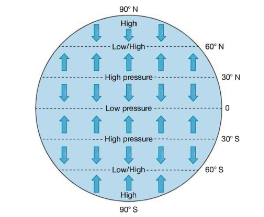
low pressure
cyclones

Intertropical convergence zone (ITCZ)
low-pressure belt that circles Earth near the equator where the trade winds of the Northern and Southern Hemispheres collide
high pressure
Divergence at surface
• Subsidence of cool air
• Converges aloft
• Creates overturning circulation
anti cyclones

Meridional Circulation
Cold air at poles (sinking) =
high pressure = divergence
at surface, convergence aloft
• 30-60° = Ferrel cells created
by mixing of cold polar air
and warm air from tropics
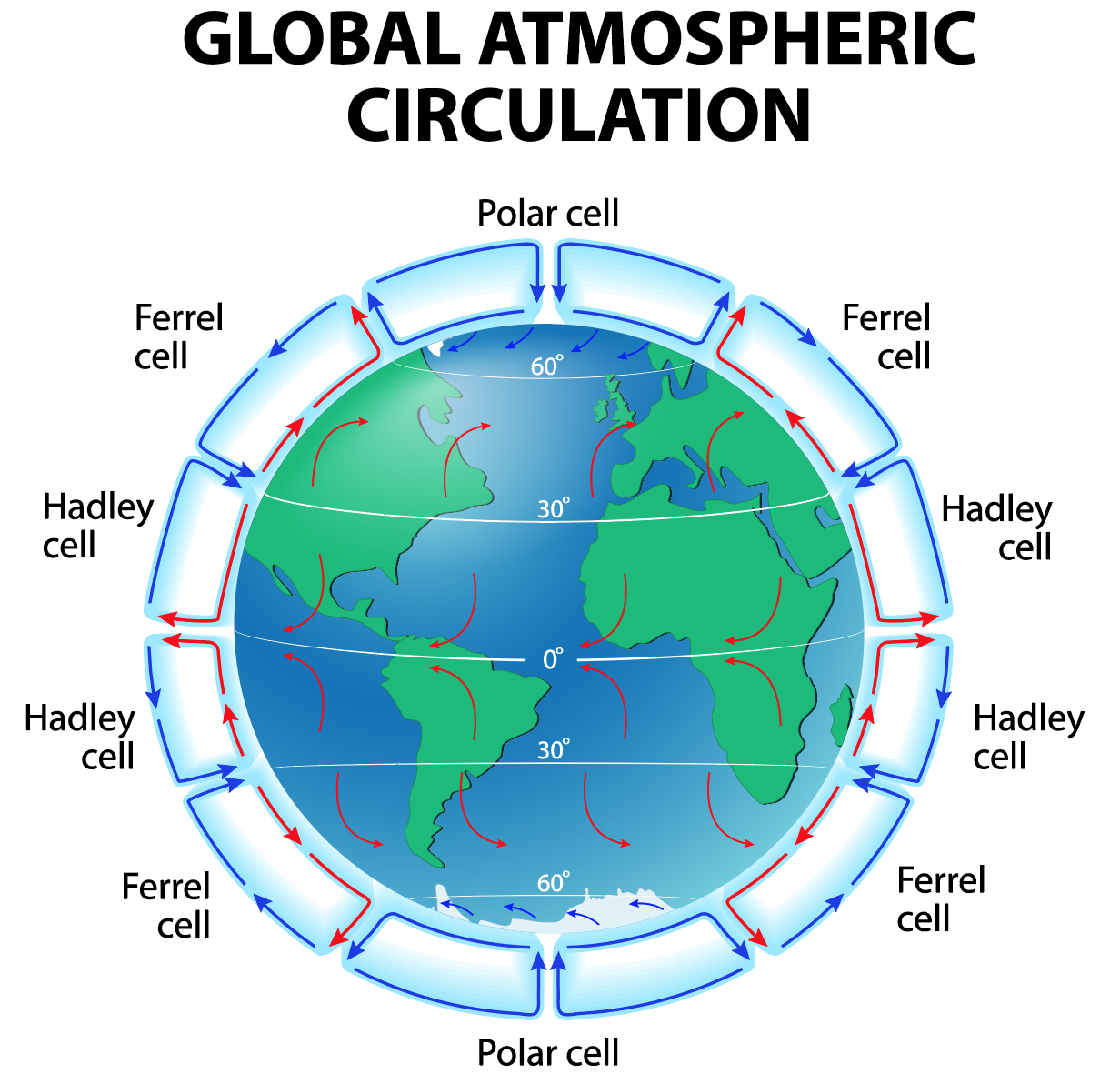
hadley cell
at equator
HOT AIR RISES, COOL AIR GOES DOWN
Circulation cells - overturning circulation cell
ferrell cells
Ferrel cell is a mid-latitude passive gear driven mechanically by the other two cells
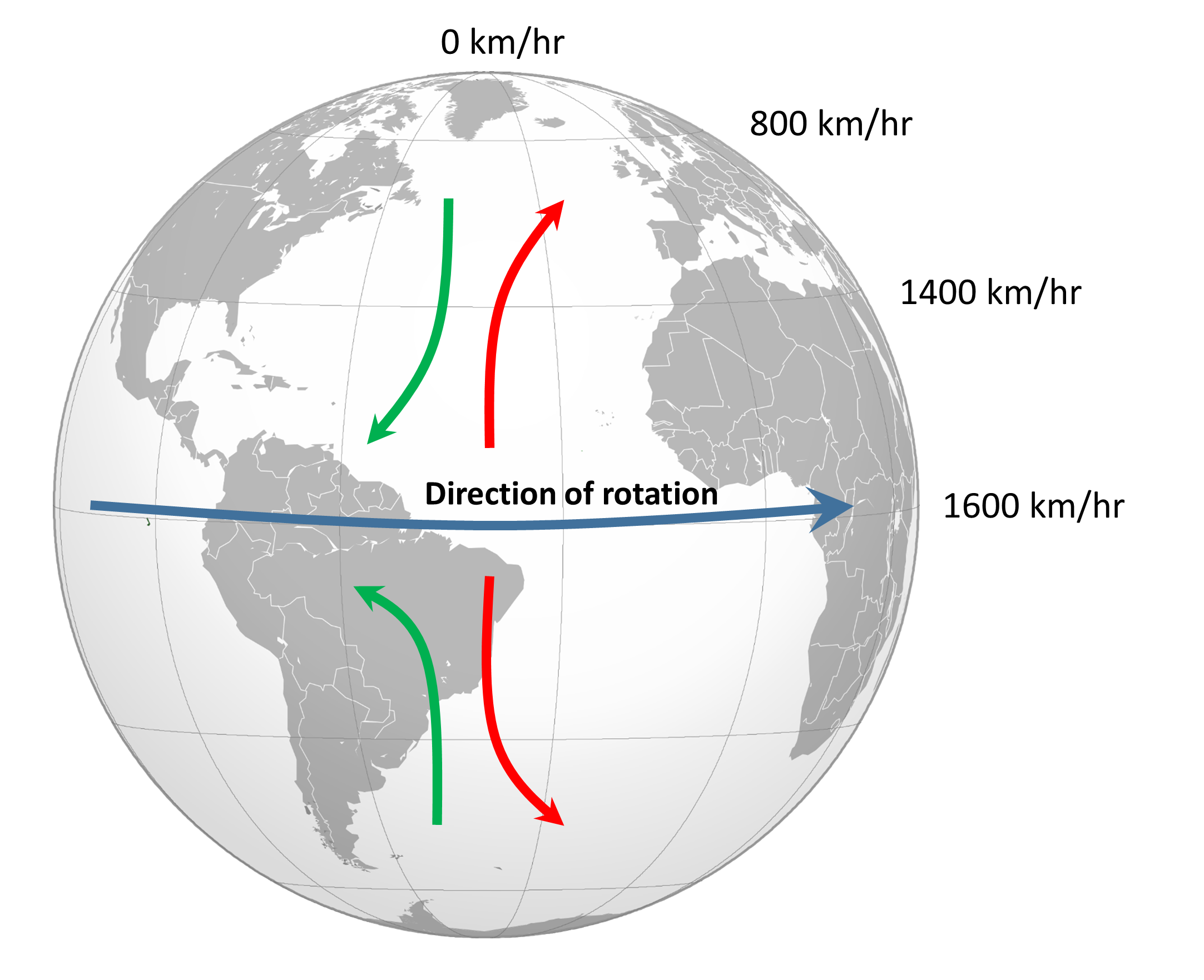
pressure at earths direction
coriolis effect
NORTHERN =RIGHT
SOUTHERN = LEFT
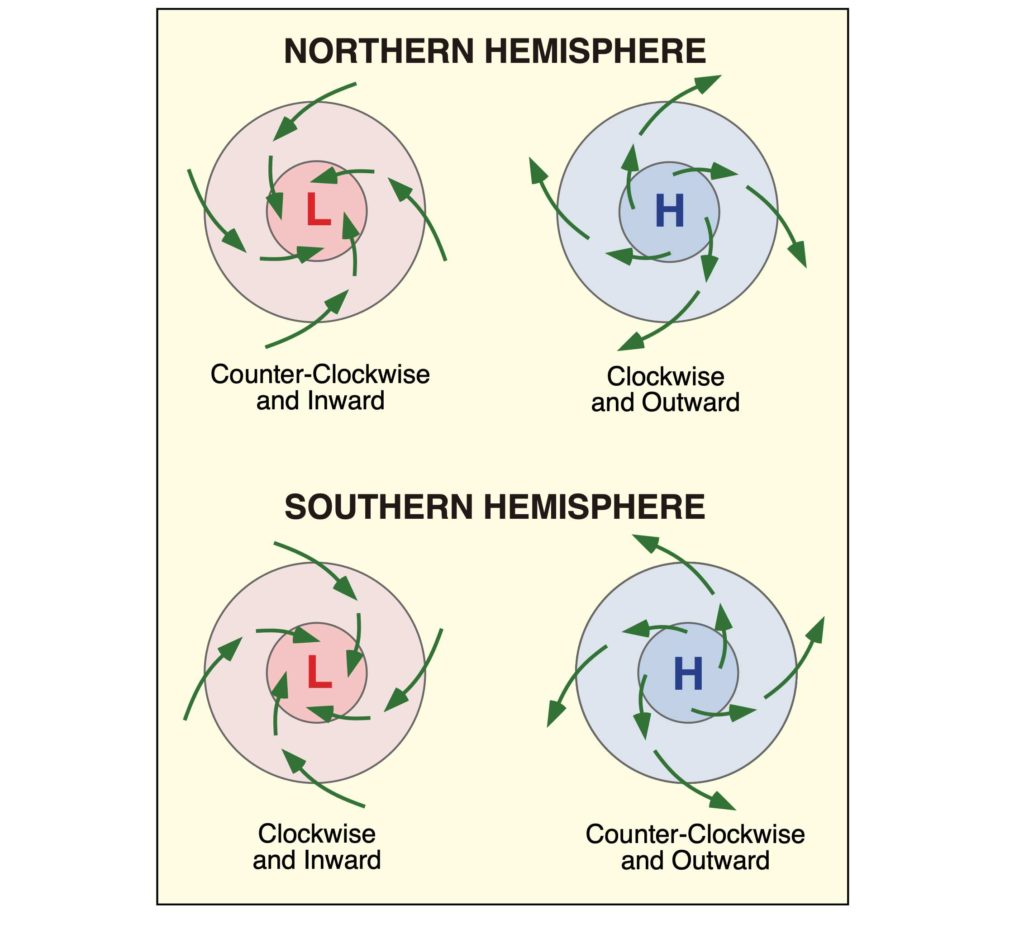
CYCLONE FORMATION
air flowing in
Air flows counterclockwise in N, clockwise in S

anticyclone
air flowing out
Air flows clockwise in N,
counterclockwise in S
Geostrophic winds
no friction, balance between pressure gradient force and coriolis
Surface ocean
wind-driven
circulation is driven by
• Wind stress
• Coriolis effects
• Ekman transports
Wind stress
Friction from wind over the ocean
causes wind-drift currents
mixed layer
influenced by atmospheric circulation
Thermocline
zone of max temperature change = by sun
Ekman Spiral
top moves 45 degrees , equals 90
GO FURTHER IN THE WATER< GREATER ANGLE
Friction moves the water

Western Boundary Currents
warm poleward flowing
Eastern Boundary Currents
cold flowing from poles to equator
Gyres
Clockwise in North
• Couterclockwise in South
combo
• Wind stress • Ekman Transport • Convergence/Divergence • Upwelling/Downwelling • Pressure Gradient Force and coriolis
Deep ocean
salintity and temp
North and Southernly winds at equator
divergence
westerlies and easterlies
convergence
salts are removed through
Evaporates
•Biological processes — marine life
• Chemical reactions at mid-ocean ridges —
• Sea spray
poles
deep water formation
Thermohaline circulation =
Sinking of salty, cold (dense)
waters + upwelling zones
Major mechanism by which
excess solar energy is
transferred poleward
Warm surface water
carried towards the poles
currents → cools, sinks, forms
bottom
sinking water displaces the older water around it
→ rises in upwelling zones → warm surface water
Wind-driven circulation results in areas of upwelling
areas of high productivity
DAYTIME LAND AND SEA BREEZE
Land HEATS faster than the sea, causing Low pRessure, which cool air over inland
NIGHT LAND AND SEA BREEZE
Land COOLS faster than sea , makes Hight Pressure, causes air over water
Continetality
land cools faster, faces seasonal changes
Summer Monsoons
Strong Solar , Low pressure, air goes up making cooler rain
Winter Monsoons
Weak Solar, High Pressure, makes dry air go to ocean — dry land
Orograpghic Effect Windward
Warm moist air goes up mountain, cools, and expands = rain
Orograpghic Efffect Leeward
After air passes peak , descends and warms up making dry air
global precipitation patterns
ITCZ seasonal shifts
• Land and sea breezes
• Continentality •
Monsoons
• Orographic Effect