COSC 325 - Mechanical Unit Guide Terms
 Call Kai
 Learn
Learn Practice Test
 Spaced Repetition
 Match
Match Flashcards
 Knowt Play
1/52

There's no tags or description
Looks like no tags are added yet.
Name | Mastery | Learn | Test | Matching | Spaced | Call with Kai | Chat |
|---|
No analytics yet
Send a link to your students to track their progress
53 Terms
Humidity
is the amount of moisture, or water vapor, in air
Relative Humidity
is the amount of moisture in air compared to the amount of moisture the air would hold at the same temperature when the air is saturated, or full of moisture
Dew Point & Unit of Measure
the air temperature at which water vapor begins to condense. F, C, or K
Filtration Purpose & Location in air systems
Circulating air is cleaned by filters in the return ductwork or in the heating and cooling equipment.
Indoor air quality (IAQ)
is the condition of indoor air as it relates to contaminant levels and air properties that affect the health and comfort of building occupants
ASHRAE
specifies the combinations of indoor thermal factors and personal factors that produce acceptable environmental conditions for most occupants.
Dry Bulb Temperature Units & How its measured
is the temperature of air as taken with a standard thermometer. Typically in F or C
Relative Humidity Units of Measurement
%, Current/Full Saturation * 100
Psychometric Chart
is a graph that defines the properties of air at various conditions.
Forced Air System
is a heating system that uses a fan to force air across a heat source to heat a building, includes a heating unit (furnace), a distribution system, and a number of controls.
Furnace
is the central element in a forced-air heating system,a self-contained heating unit that includes a blower, burner, heat exchanger or elec-tric heating elements, and controls.
Blowers/Fans
is a mechanical device that consists of moving blades or vanes that force air to travel through ductwork.
Propeller
is a type of air-moving device that consists of angled blades mounted on a central hub.

Centrifugal
is a mechanical device that consists of moving blades or vanes that force air to travel through ductwork.

Axial
is a type of air-moving device that consists of a blower fan that turns at high speed.

Direct Drive
is a motor-to-wheel connection that has a blower wheel mounted directly on a motor shaft
Belt Drive
is a motor-to-wheel connection that has a motor mounted to a frame, and the motor is connected to the blower wheel through a belt-and-pulley arrangement
Variable Frequency Drive (VFD)
is an electronic device that controls the direction, speed, torque, and other operating functions of an electric motor in addition to providing motor protection and monitoring functions
Heat Exchanger
is any device that transfers heat from one substance to another without allowing the substances to mix.
Unit Heater
is a self-contained forced convection heater that is not connected to any type of ductwork and contains a fan, a hot water coil, and controls in one cabinet
Duct Heater
is a unit heater that is in-stalled in a duct and supplied with air from a remote blower.
Air Velocity
is the speed air moves from one point to another through ductwork, a register, or a grille and is measured in feet per minute (fpm).
Airflow Rate
is the measure of the volume (in cubic feet) of air that pass-es a given point in one minute (cfm)
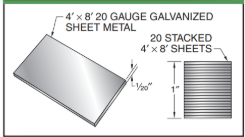
Gauge
is the number of sheet metal sheets that equal 1′′ when stacked together.
Plenum Space
The open area in a building used for air handling—typically the space between a structural ceiling and a drop-down/false ceiling, or under a raised floor. [1, 2]
Plenum
is a metal box or distribution chamber attached directly to the furnace or air handler
Registers
part of the forced-air distribution system in a building, located on the supply side of the system and distribute heated air to building spaces
Grilles
part of the forced-air distribution system in a building, are located on the return side of the system and return air from building spaces back to the furnace
Diffusers
Registers with unusual airflow patterns
hydronic heating system
is a heating system that uses water or other fluid to carry heat from the point of generation to the point of use
Circulating Pump
is a type of pump that creates a flow of water through a boiler, system piping, and terminal devices of a hydronic heating system, either return or supply.
Terminal Device
is a component at the end of a heating system that transfers heat from the hot water in a hydronic heating system to the air in building spaces
Steam supply system
a system of pipes, valves, traps, and strainers that pro-vide a path for steam to flow from a boiler to the point of use.
condensate return system
is a system used to return condensate to a boiler after all useful heat has been removed
Heat Pump
is a mechanical compression refrigeration system that reverses the flow of refrigerant through a system to move heat from one area to another.
Reversing Valve
is used to reverse the flow of refriger-ant through the system.
Auxiliary Heat
is controlled by a thermostat, On a call for heat, the reversing valve piston is in the heating mode position. The thermostat operates the compressor, which provides heat from the heat pump. When the heat pump does not raise the temperature in the building to the thermostat setpoint in a specified time, the thermostat calls for it, is used only when necessary
open-loop system
is a geothermal ground loop system that draws ground-water from a well directly into a building where it is used by heat pumps to heat or cool the building spaces and then returns the water to the earth through a second well. The second well is not connected to the first well.
closed-loop system
is a geothermal ground loop system that circulates water through piping in the ground to a water loop in order to exchange thermal energy, the ground loop water and building loop water do not mix.
defrost cycle
is a mechanical procedure used to temporarily reverse the refrigerant flow in a heat pump to melt frost or ice on an outdoor unit coil
Refrigeration
is the process of moving heat from an area where it is undesirable to an area where the heat is not objec-tionable.
Refrigerant
is a substance that moves heat by changing state from a liquid to a gas when absorbing heat and from a gas to a liquid when rejecting heat, low boiling point, types are R-22 and R410a
Balancing Valve
typically used to adjust flow rates into secondary piping loops, add resistance to flow to ensure proper flow to terminal devices
Operations and maintenance (O&M) plan
a written course of action with specific tasks related to the scheduling of repairs to equipment, production systems, and facilities
Distributed direct digital control (DDC) system
a building automation control system where each controller has its own central processing unit (CPU)
Building Automation System
allow buildings to operate optimally with minimal intervention from building personnel; Benefits include significant energy savings and improved control, comfort, security, and convenience.
Facility Management System (FMS)
is a system that uses microprocessors to control the HVAC equipment and other systems in a building
Input BAS
is a sensor or switch that indicates building or equipment conditions to a BAS controller. The information received allows a BAS controller to operate the HVAC mechanical system and provide alarm and trending functions.
Output BAS
is a device that sends a signal from a BAS controller. BAS components may be either directly wired to the controller or wired to an interface, such as a transducer or relay, which changes the value of the output signal. Components are either analog (positioning between 0% and 100%) or digital (on or off).
Operator Interface
is a device that allows staff to access and respond to BAS information. Types: client computers, laptops, cell phones, and tablets
350 SF/Ton
Cooling for Office Building
4 kW/ton
Heating for Office Building
400 CFM/ton
Airflow