Net+ Definitions
 Call Kai
 Learn
Learn Practice Test
 Spaced Repetition
 Match
Match Flashcards
 Knowt Play
1/185

There's no tags or description
Looks like no tags are added yet.
Name | Mastery | Learn | Test | Matching | Spaced | Call with Kai | Chat |
|---|
No analytics yet
Send a link to your students to track their progress
186 Terms
Interoperability
It is the property that allows for the unrestricted sharing of resources between different systems. This can refer to the ability to share data between different components or machines, both via software and hardware, or it can be defined as the exchange of information and resources between different computers through LANs or WANs.
Compatibility
It is designed to work with another device or system without modification.
Scalability
It can be easily expanded or upgraded on demand.
Maximum Transmission Unit (MTU)
It is the largest frame/packet that can be transmitted over frame/packet-based networks. Large packets can carry more information, but the processing time can take longer. Small packets are processed faster, but more need to be sent to transfer the same amount of data as a single large packet. MTU, therefore, is the optimal packet size for a given network.
Simplex
Simple and single allowing telecommunication in one direction only.
Half-duplex
A bi-directional mode of communication in which information can be sent in only one direction at a time.
Full-duplex
A bi-directional mode of communication in which the characters sent to the computer from a remote terminal are echoed back to the terminal for display. This transmission may occur in both directions simultaneously.
CSMA/CD
Carrier sense multiple access/collision detection is an access method that handles or responds to collisions on an ethernet network. It detects and responds to data collisions that have already occurred.
CSMA/CA
Carrier sense multiple access/collision avoidance is an access method that works in 802.11 environments. The protocol was developed to minimize the potential of a collision occurring when two or more stations send their signals over a data link layer. It is a proactive avoidance method.
Multiplexing
Multiplexing is a popular networking technique that integrates multiple analog and digital signals into a signal transmitted over a shared medium. Multiplexers and de-multiplexers are used to convert multiple signals into one signal. This term is also known as muxing.
VLAN
Virtual local area network. A VLAN is a logical group of workstations, servers, and network devices that appear to be on the same LAN despite their geographical distribution.
Node
It is a point of intersection or connection within a data communication network. In an environment where all devices are accessible through the network, these devices are all considered nodes. The individual definition of each node depends on the type of network it refers to.
Connection-oriented
In connection-oriented protocols, preliminary protocols are used to establish end-to-end connections. Connection-oriented protocols track conversations and are considered stateful protocols.
Connectionless
In a connectionless protocol, no preliminary protocols establish a connection. A connectionless protocol is a form of data transmission in which an IT signal goes out automatically without determining whether the receiver is ready, or even whether a receiver exists. This is why connectionless protocols can be described as best-effort delivery.
Physical topology
Physical topology refers to the actual layout of devices and cables in a network. It shows how different devices are physically connected to each other. Examples include star, bus, ring, and mesh topologies.
Logical topology
Logical topology refers to the way data flows within a network, regardless of its physical layout. It shows the path that data takes between devices.

PAN
personal area network. Covers a very small area, typically within a single room. Examples include Bluetooth-connected devices like a smartphone and a wireless headset.
LAN
local area network. Covers a small geographic area, such as a single building or campus. Commonly used in homes, schools, and offices to connect computers and devices.
CAN
Campus area network. A network that spans multiple buildings within a campus, such as a university or corporate campus. It is larger than a LAN but smaller than a MAN.
MAN
Metropolitan area network. Spans a larger area than a LAN, such as a city or a large campus. It connects multiple LANs within a metropolitan area.
WAN
Wide Area Network Covers a broad area, often a country or continent. The internet is the largest example of a WAN, connecting millions of devices worldwide.
Software-defined WAN
An approach for making WAN architectures easier to deploy, operate, and manage. It relies on virtualization, application-level policies, overlay networks, and onsite SD-WAN devices and software platforms.
Multiprotocol label switching
MPLS is a mechanism used within computer network infrastructures to speed up the time it takes a data packet to flow from one node to another. It enables computer networks to be faster and easier to manage by using short path labels instead of long network addresses for routing network packets.
Bandwidth
A general phrase that refers to the bit-rate measurement of a network communication system’s transmission capacity. The carrying capacity of a channel or the data transfer speed of that channel are additional terms used to characterize bandwidth. Broadly speaking, bandwidth refers to a network’s capacity. Physical and wireless communication networks both have bandwidth.
Throughput
The performance of tasks by a computing service or device over a given time period is referred to as throughput. It is a metric that compares the amount of work accomplished to the amount of time it takes to complete it, and it can be used to assess the performance of a processor, memory, and/or network communications.
Goodput
The degree of application-level throughput of communication in a computer network, that is, the amount of data that is transmitted, is known as goodput (a combination of good and throughput). The number of bits of data delivered per second by the network to a specific destination. Goodput may be seen as actual data transmission. The commonly used cables and connectors are: Coaxial cables (RG-58, RG-50), Twisted pair cables (Cat6, Cat5e, cat7), F-type, BNC, N-type, RJ45, RJ11, Subscriber connector (SC), lucent connector (LC), Straight Tip (ST), and Fiber optic cables.
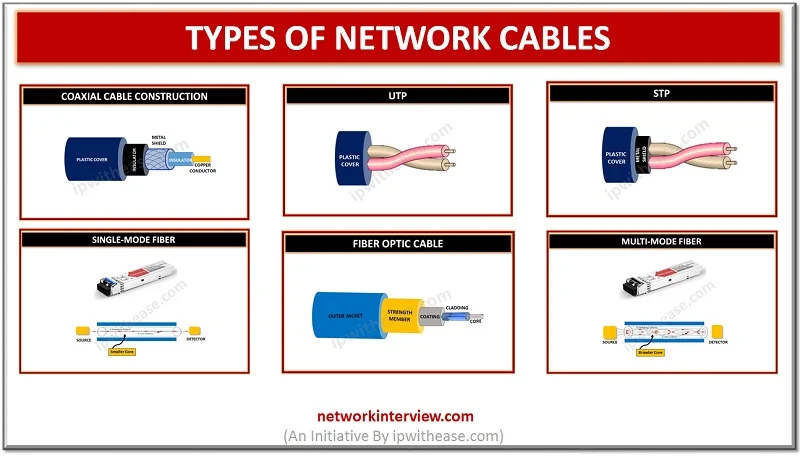
Coaxial cables (e.g., RG-58, RG-59)
These cables have a central conductor, insulating layer, metallic shield, and outer insulating layer. They are used for cable TV, internet, and telecommunications.
Twisted pair cables (e.g., Cat5e, Cat6, Cat7)
Consist of pairs of insulated copper wires twisted together to reduce electromagnetic interference. Commonly used in Ethernet networks.
Fiber optic cables
Made of glass or plastic fibers that transmit data as light signals. They offer high-speed data transmission over long distances with minimal interference.
F-type
Used for cable TV and internet connections.
BNC
Utilized in professional video and radio frequency applications.
N-type
Suitable for high-frequency applications like wireless communication.
RJ45
The standard connector for Ethernet cables in networking.

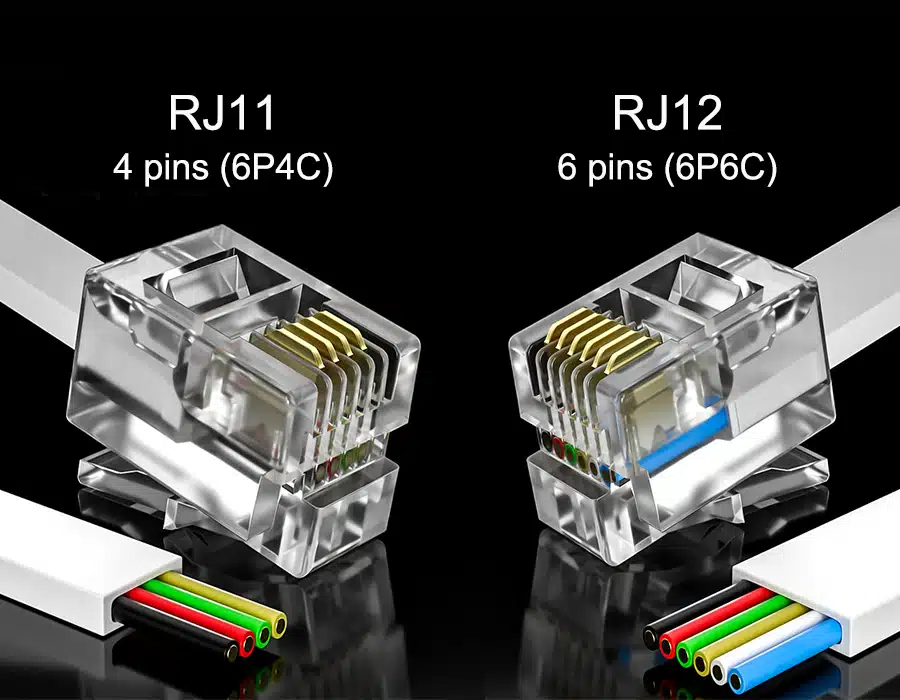
RJ11
Used for telephone connections.
Subscriber Connector (SC)
Known for its push-pull latching mechanism, commonly used in telecommunications.
Lucent Connector (LC)
A small form factor connector, ideal for high-density connections.
○ Straight Tip (ST)
Uses a bayonet-style coupling, often found in network environments.
APIPA address
The APIPA address has been a feature of Microsoft Windows operating systems since Windows 98. Abbreviated as APIPA, Automatic Private IP Addressing is aligned with the workings and operations of DHCP. Basically, what occurs is that if a DHCP server has a problem, goes down or crashes, and cannot allocate addresses for whatever reason, this APIPA address kicks in as a temporary backup. In DHCP client configurations, the DHCP client boots up and consults the DHCP server to configure its settings, and if the DHCP server is not reachable, APIPA enables the client to self-configure an IP address and subnet mask automatically. The range used for APIPA is 169.254.0.1 - 169.254.255.254. The subnet mask is 255.255.0.0, which provides 65, 534 usable IP addresses. APIPA then checks for the presence of the DHCP server in specific periods of time (that is, every five minutes). APIPA allows for limited connectivity to the local network. It does not offer Internet access or access to external, public web-based services. When the DHCP issue is resolved, APIPA stops, and hands over functionality to the DHCP server, now active on the network again. When a network administrator runs ipconfig /all in the command prompt and detects the use of an APIPA address, they immediately know that there is a DHCP issue on the network and can investigate and troubleshoot this issue further.
Virtual IP
These addresses are logical addresses. They do not relate to a physical network interface and are used for specific purposes. One of the protocols that use these addresses is network address translation (NAT), most especially in multicast (one-to-many) communications. VIP addresses may also be implemented for fault tolerance providing fail-over options for machines. In terms of mobility, a VIP address can be moved to any place on the reachable network without the need to change the address to another subnet configuration. This is a huge benefit in the application of a VIP address.
Network address translation
This is a translation mechanism for translating private IP addresses to public IP addresses—and vice versa. The LAN uses internal private addresses, and the NAT-enabled router provides a translation service to translate these internal addresses to external public ones. The NAT-enabled router handles translation for internal and external traffic. NAT allows a company optimally to use private/internal IP addresses. The company can form one single Internet connection and combine a number of connections. As an element of security, the use of NAT in a business or enterprise hides the internal addresses by providing a firewall between the inside and outside addressing configurations.
Port address translation (PAT)
PAT refers to a form of dynamic NAT whereby all the private addresses used locally are translated to a single public IP address using different ports. When multiple private IP addresses are mapped to a single public IP address via PAT, IP addresses are conserved. Additionally, PAT is a cost-effective, efficient means of configuring and handling network traffic. It is the most typically used form of NAT in current networking practice.
TCP/IP protocol suite
A set of communication protocols used for inter-network data transmission, essential for internet functionality.
Protocol Stack
A layered structure of protocols that work together to enable network communication.
Encapsulation
The process of wrapping data with the necessary protocol headers as it moves through the layers of a network model.
Segmentation
Dividing large data packets into smaller chunks for efficient transmission over a network.
Port number
A unique identifier used to distinguish different network services on a device.
Common networking ports
Predefined port numbers assigned to specific protocols, such as HTTP (80), HTTPS (443), and FTP (21).
Application layer protocols
Protocols responsible for end-user services, including HTTP, FTP, and SMTP.
Transport layer protocols
Provide communication reliability, with key examples being TCP and UDP.
Internet layer protocols
Handle addressing and routing, including IP, ICMP, and ARP.
OSI model
A conceptual framework used to understand network functionality across seven layers.
TCP/IP model
A practical networking model with four layers that enables internet communication.
Data transmission methods
Techniques like packet switching that allow efficient data transfer across networks.
Encryption
A security method that transforms readable data into an encoded format to protect it from unauthorized access.
DHCP relay
This is the process of forwarding DHCP packets between clients and servers. (This activity is akin to a baton being passed in a relay as part of a team sport, with DHCP packets as the baton. In the sport’s relay, members of a team take turns completing parts of a racetrack or executing a certain action.) A router or host is known as a DHCP relay agent, and it is their role to forward the DHCP packets, that is, requests and replies, between clients and servers when the DHCP server is on a different network.
IP helper/UDP forwarding
When a router is configured with an IP-helper address, it has the ability to accept a broadcast transmission and then forward it to a specific IP address using unicast data transmission. If the DHCP server is not on the same network segment as the DHCP clients, the routers on the client side need an IP-helper address to help the DHCP server carry out its functions and provide the network service to its clients and scopes. To accomplish this, forwarding support is enabled on the UDP application port of the router.
Global hierarchy
DNS is a global network system that collectively holds a database of domain names and IP addresses for the worldwide network. This system is structured as a global hierarchy that consists of DNS servers holding differing job roles and responsibilities in accordance with their position and level in the DNS hierarchy. The DNS hierarchy consists of the following elements
Zone transfers
When a DNS server passes on (transfers) part of its DNS database to another DNS server, this is called a zone transfer. The piece of the server’s database that is duplicated is called a zone. The DNS query is known as type AXFR. There are five types of DNS zones
Time to live (TTL)
A mechanism used to limit the lifespan of data on a network. Data is discarded if the prescribed TTL elapses. The idea behind having a TTL is to prevent any data packet from circulating indefinitely. When forwarding IP packets, the router decreases the TTL value by at least 1. When the packet TTL value reaches 0, the router discards it and sends an Internet Control Message Protocol (ICMP) message back to the originating host (Techopedia).
On-premises software
On-premises software is a type of software delivery model that is installed and operated from a customer’s in-house server and computing infrastructure. It uses an organization’s native computing resources and requires only a licensed or purchased copy of the software from an independent software vendor. (Techopedia)
Colocation (Colo)
When a person or enterprise rents space from a third-party data center to hold their organization’s hardware and servers.
Branch offices (Branch networking)
It refers to the manner in which data and information is distributed between branch offices, remote sites, and data centers and the elements that constitute this distribution.
Elasticity
In general terms, elasticity means the ability to change and adapt. When related to cloud computing, elasticity aligns with scalability. Elasticity and scalability refer to a system's capability to dynamically adjust to fluctuations in workload by autonomously allocating and deallocating resources, ensuring that the available resources consistently align with the current demand. Cloud providers incorporate this concept of elasticity and scalability in their service provision. The more adaptable a system is, the more customers will be drawn to and use the system being offered.
Infrastructure as code
IaC involves the management and provisioning of data center resources using machine-readable configuration files, rather than relying on physical hardware setup or manual configuration tools.
Automation/orchestration
When implementing automation, a single task is set up to run on its own automatically. An example of this is starting or stopping a service from running or directing an email to a very specific folder. Orchestration is where we combine these tasks, and the multiple tasks are orchestrated to manage a larger workflow or set of processes. The goal of orchestration is to streamline, manage, and control multiple processes to optimize data analytics or batch processing, for example.
Zero-touch provisioning (ZTP)
ZTP is a strategy for setting up network devices so that the device is automatically configured. Due to this type of provisioning, the time and energy spent on manual configurations and setup is greatly reduced.
Zero Trust architecture (ZTA)
This is a security model that assumes that all devices, users, and services are not inherently trusted, irrespective of whether they are inside or outside the corporate network's edge or perimeter. All users must be authenticated on each device that sits on the organization’s network in accordance with policy-based authentication, threat scope reduction, and the principle of least privilege access. In other words, policy-driven authorization is strictly adhered to and complied with at all times.
Secure access secure edge
This is a set of access technologies that negotiate access to cloud services and web applications. Zero Trust architecture is one instance of SSE technology. Another instance is the cloud access security broker (CASB). CASB is a point positioned between enterprise users and cloud service providers. It functions like a firewall that enables the organization or enterprise to extend their security control beyond the boundaries of their corporate network.
Sensor
A sensor is a device that changes a physical parameter to an electrical output. It is situated at the input port of a device, as in sensing data.
Actuator
As against a sensor, an actuator is a device that converts an electrical signal to a physical output. The sensor is situated at the input port to take the input, whereas an actuator is placed at the output port. An IoT device is made up of a physical object (a thing), a controller (a brain), sensors, actuators, and networks (that is, the internet). An actuator is a machine component or system that moves or controls the mechanism, or the system being controlled.
Note
Flow control
Part of TCP is to ensure the receiver is not inundated with or overwhelmed by the speed and transmission of data. An aspect of the protocol is to regulate and synchronize transmission so that two workstations or hosts of varying speeds work more beneficially in a communication session with each other. It ensures that a fast sender does not overwhelm a slower receiver.
Jumbo frames
The Ethernet standard IEEE 802.3d sets the frame size as 1,500 bytes. Anything more than this limit is called a jumbo frame.
Port mirroring
This is configured on a network switch to reserve a port and then sends a mirrored copy of anything passing through the reserved switch port (or an entire VLAN) to a network monitoring connection on another switch port.
Neighbor Discovery Protocol (NDP)
NDP is a protocol and method for gathering data and statistics from connected devices. The information gathered includes IPv6-related DNS, gateway configurations, the configuration of local devices, and connections on the network.
Link Layer Discovery Protocol (LLDP)
A vendor-neutral protocol for network device discovery and management.
Cisco Discovery Protocol (CDP)
A Cisco-specific protocol for discovering and sharing information between directly connected Cisco devices.
Contiguous networks
The word contiguous is defined as sharing a common border; touching. Therefore, when we speak of contiguous networks, we are referring to networks that can be logically grouped and share a similar classful IP addressing scheme. Here is a list of contiguous networks. These networks can be summarized in a routing table and presented as a single entry:
192.168.0.0/26
192.168.0.64/26
192.168.0.128/26
192.168.0.192/26
The networks listed as contiguous networks share a common border, so when data packets are transmitted, they do not pass through networks of a different class or subnet to reach each other.
Discontiguous network
A discontiguous network occurs when packets sent between at least one subnet must pass through subnets of a completely different network.
Stub network
A stub network is a LAN that does not interconnect to outside, external networks and where data packets transmit internally, or they are dead-end LANs that know of only one network exit or exit interface.
Standard static routes
These routes are made up of a destination network address or host, a subnet mask, and the IP address of the next-hop IP address.
Default static routes
These routes match all packets. They use the any any IP address. A default static route is simply a static route with 0.0.0.0/0 as the destination IPv4 address.
Summary static routes
These routes use a single summary route to represent multiple networks. The networks can be summarized in the routing table.
Floating static routes
These routes are used for redundancy and backup. They provide a backup path to a primary static or dynamic route, should a link go down or fail.
Basic Service Set
This term is used to describe the group of stations that may communicate together within an 802.11 network. The BSS may or may not include an access point. In some topologies, an AP provides a connection to a fixed distribution system, such as in the case of an Ethernet wired network.
Extended Service Set
An ESS is composed of one or more interconnected BSSs and their related local area networks. These interconnected WLANs integrate into LANs and appear as a single BSS to the logical link control sublayer of the OSI model.
Independent Basic Service Set
As the name suggests, an IBSS constitutes an ad hoc, self-governing, and self-contained network. All traffic flows are handled internally, and station-to-station traffic is filtered based on the MAC address of the receiver and intended destination.
Uptime/downtime
This term is used in the computer industry for when a computer is operational. Downtime is the time when it is not operational. Uptime is frequently measured in terms of a percentage/percentile. For example, one standard for uptime that is sometimes discussed is a goal called five 9s—that is, a computer that is operational 99.999% of the time.
Top talkers
The ability to view pairs of computers or devices using the most bandwidth can be viewed on some system logging software. These devices are referred to as top talkers. This ability may lead to the discovery of a trojan horse or to an abusive use of torrent software. These hosts send the most data, either from the organization’s network or into the organization’s network.
Top listeners
These hosts or devices receive most of the data in the network. They can be constantly streaming or downloading large amounts of data from the internet (or an unwanted server). These computers generate heavy traffic and lower the performance of the network because of consuming high bandwidth.
Acceptable use policy (AUP)
This policy defines how users should engage with information and network resources (that is, hardware and software) in the organization. It lays down the boundaries and rules for the use of internet access while on the company network, what may or may not be saved and stored on computer equipment, and what rules are in place for the personal use of company resources.
Bring your own device policy
This a policy that permits employees in an organization to use their personally owned devices to carry out work-related activities. The purpose of the policy is to balance fairness of use and access with the safety and security of company information and resources.
Cold site
A cold site is a disaster recovery site where a backup location or facility has in place the essential electrical and physical components of a computer network or environment. It provides sufficient space and infrastructure. However, this facility does not have computer equipment in place, for example, PCs, telephones, or copiers. It is a stripped-back version of a hot site.
Warm site
A warm site is where a backup location or facility has in place the essential electrical and physical components of a computer network or environment, providing sufficient space and infrastructure. A warm site is partially fitted with the hardware necessary pre-installed. A warm site is deemed the middle-ground option for disaster recovery but does not have the same operational capacity as the company’s primary site.
Hot site
A hot site replicates the company’s network and operations. It is essentially a duplicate of the company’s primary operations center and, therefore, can be brought into operation instantly, thus the inference from the word hot. Failover to this site can happen in minutes or hours, minimizing downtime and ensuring high availability.
Cloud site
A Cloud site is where a company’s infrastructure, software, platform, or services are managed or hosted via a cloud provider. By using multiple internet service providers (ISPs)/diverse paths as a redundancy solution, fast, reliable internet connections are more achievable. Companies are provided with local redundancy and diversity options.