evolution & classification
 Call Kai
 Learn
 Practice Test
 Spaced Repetition
 Match
 Flashcards
 Knowt Play
1/80

There's no tags or description
Looks like no tags are added yet.
81 Terms
Evidence for evolution
Comparative anatomy - morphological structures are similar, comparing them between different species
Fossil records - going back to extinct species to see how past species have changed over time
Embryology - development of young and how it occurs in very early stages, embryonic similarities can indicate shared ancestry
DNA analysis - comparing base sequences of DNA
Homologous structures - Divergent evolution
Structures that are very similar/the same but may look and function very differently due to different environments the structure has adapted to. Most likely because 2/+ species share a common ancestor.
Eg. the pentadactyl limb is very similar in bats, humans, and whales, but it is modified to be different because of the different environments/selection pressures/functions that each species evolved in/into. So it’s divergent evolution. One common ancestral structure → modified slightly per species. Evolving into different things
Convergent evolution - Analogous structures
Two species are not closely related (eg. their shared ancestor was very far back in time), but because of similar environments/selection pressures/functions, they develop the same structures. These are analogous structures. They are evolving into similar things.
Eg. insect wing vs bird wing. Evolved independently of a shared common ancestor, purely because both had to fly.
Analogous vs Homologous structures
H: Same basic structure between species because it was inherited from a common ancestor even if it is now modified between species due to different selective pressures/functions. Eg. pentadactyl limb
A: Similar basic function/appearance of the structure despite a lack of common ancestor. It was evolved independently between species due to similar function/selective pressures. Eg. insect vs bird wings
Lamarckian evolution
Changes in environment led to use or disuse of certain organisms
Organs that were used more often would increase in size over the organism’s lifetime. Organs that were not used would shrink
The changes acquired over the lifetime of an individual would be passed onto the offspring
^^ Proved false
Darwinian evolution
Organisms produce more offspring than are able to survive. Competition for resources because of overproduction
Individuals within population are not identical, but have variation in characteristics. Variation through random mutations in germline cells (because it will be passed down to offspring)
Characteristic already exists within the population, it becomes an advantage to help them adapt better & be better suited to the environment are more likely to survive in their environment
Because they survive, they reproduce. Those who do not have that advantageous variation die & do not reproduce. Because they do not reproduce, their variation is not passed down to offspring.
This is natural selection - mechanism of evolution
Over time, individuals with the advantageous variation will become the norm with the larger proportions.
Over many generations, natural selection leads to populations adapted to specific environments.
Selection pressures
Environmental factors (can be abiotic or biotic) that affect an individual’s chance of surviving and thus reproducing. They basically “select” which traits are more advantageous for that environment.
Density dependent factors
Finding mates
Availability of food
Availability of water, shelter, etc
Spread of pathogens
Presence of predators
^^Density-dependent factors are factors whose effect gets stronger as population density increases.
For example, if food becomes scarce, individuals that are better at competing for food may survive and reproduce more. Over time, traits that improve competition, disease resistance, or avoiding predators can become more common.
Density independent factors
Natural disasters
Pollution
Temperature
CO2 and O2 levels
Density-independent factors affect a population regardless of how dense or crowded it is.
With density-independent factors, the pressure comes from the environment rather than crowding. For example, if a sudden cold period occurs, individuals with traits that help them tolerate low temperatures may survive better and pass those alleles on.
^^ Abiotic factors always
Carrying capacity
Maximum size of population that an environment can hold/support over time due to its available land/resources and environmental conditions. The carrying capacity is usually determined by the resource in the shortest supply so it is dynamic and fluctuate. It can be influenced by the dependent and independent factors
Overproduction of offspring
More offspring are produced than the carrying capacity can hold, so some die off. This creates competition for resources, and individuals with more advantageous traits will survive to reproduce, allowing for natural selection.
Intraspecific competition
Competition between individuals of the same species for limited resources, usually because of overreproduction.
What is a gene pool
A combination of all alleles present in a reproducing population of a species.
What is the frequency of the allele
The frequency of an allele is how common that variation of the gene is in a given gene pool
Hardy Weinberg calculation of frequency of allele X
Number of copies of allele x in population/total number of copies of the gene in the population
Can use this to determine how alleles have changed over generations (evolution)
Why do allele frequencies change
Natural selection or random events
Stabilizing selection
Stabilizing selection favors the intermediate/average phenotype and selects against both extremes.
Example: human birth weight: very low and very high birth weights have lower survival than intermediate weights.

Directional selection

Directional selection favors one extreme phenotype.
Example: darker moths survive better in the industrial revolution due to the soot, so the population gradually becomes darker through natural selection
Disruptive/ diverging selection
Diverging selection favors both extremes and selects against the intermediate phenotype.

Example: birds with either very small or very large beaks do well, while medium beaks are less useful.
What is adaptive radiation
Adaptive radiation is when one ancestral species rapidly evolves into several different species, with each new species becoming adapted to a different ecological niche.
A classic example is Darwin’s finches on the Galápagos Islands. They came from a common ancestor, but different populations had access to different foods. Over time, natural selection favored different beak shapes, and they eventually became different species.
Conditions affecting equilibrium - Hardy Weinberg
Never Randomly Select Largepeople
Allele frequencies will remain the same if:
There are no mutations bringing in new alleles
There is random mating (non random mating is the norm, animals choose their mate based on preferred traits)
Natural selection cannot occur (eg. no overproduction, there is no favored advantageous phenotype)
Very large population (because small populations are more affected by genetic mutation or easier to wipe them out)
If this occurs, there is no evolution, which is very hard in the real world
Hardy-Weinberg genotype frequency
p= allele A q=allele a
In a gene pool, these are the only alleles. so p+q=1
Because there are two alleles, you square (p+q)²=1²
so, p²+q²+2pq=1
p²=AA , q²= aa , 2pq= Aa
Genetic drift
Random changes in allele frequency caused by some random event. Not natural selection because it doesn’t rely on a more advantageous phenotype
Random chance/Bottleneck effect
A random event can change allele frequencies by chance. For example, a population contains 20 beetles: 10 brown and 10 blue. A flood randomly kills 6 beetles, including 5 brown beetles and only 1 blue beetle. As a result, the surviving population contains a higher proportion of blue beetles, so the frequency of the blue allele may be higher in the next generation. This is genetic drift because the change occurred by chance, not because blue beetles were better adapted.
Founder effect
A small group starts a new population and, by chance, carries different allele frequencies from the original population.
Say, a large mainland population where only 10% of people carry an allele associated with baldness. A small group of 10 people leaves and settles on an island. By chance, 6 of those 10 people carry the allele. Because those few people are the founders of the new island population, that allele starts off much more common there than in the original population. As the island population grows, the allele may remain unusually common.
Speciation
Speciation is the process where one species splits into two or more different species that cannot reproduce together if they meet again, reproductive isolation. There are two different types that decide how that reproductive isolation begins.
Allopatric speciation
Formation of new species when populations are geographically separated, preventing gene flow and allowing genetic divergence.
Eg. A bird population gets split when some birds end up on a different island. Because the two populations can no longer mate with each other, their gene pools become more different over generations due to mutation, natural selection, and genetic drift. Eventually they become reproductively isolated, meaning they can no longer successfully interbreed.
Sympatric speciation
Sympatric speciation happens when new species form without a geographical barrier. The populations live in the same area, but something stops them from mating with each other.
Behavioral isolation = groups have different mating behaviors, so they do not choose each other as mates. For example, two groups of birds may have different mating songs or dances.
Temporal isolation = groups reproduce at different times, so they do not mate. For example, one group releases sperm in spring and another releases eggs in autumn.
Factors that determine biological fitness
Environment: fitness depends on the environment. A genotype that is useful in one environment may be bad in another. So a polar bear has high fitness in the Arctic, but much lower fitness in a desert.
Survival value: Traits that help an organism survive increase the chance that it reaches reproductive age.
Reproductive potential: Surviving is not enough. The organism also has to successfully reproduce and pass its alleles to offspring.
How well an individual survives and reproduces in its environment, allowing its alleles to be passed to the next generation.
higher biological fitness = more likely to be favored by natural selection
How do new species form?
Two populations of the same species split into two different species by being reproductively isolated from one another along with a divergence of traits leading to reproductive isolation (cannot reproduce with each other)
Differential selection
Exposure to diversifying selection pressures within the same species.
Allopatric speciation case study
Chimpanzees and Bonobos
They were both in the Congo, and millions of years ago they were the same species. However, there is a river separating the two populations, and in the separation, the environments are very different.
Chimpanzees are very buff looking and aggressive. This is because on their side of the river, there are a lot of gorillas. These gorillas were competitors for food, so the chimpanzee had to evolve to fight back and be more aggressive, so they evolved to be more aggressive and buff.
Bonobos had no sort of gorillas and no competitors for food, rather they thrived off of being more collaborative
Linnaeus’ morphological concept
Individuals of the same species tend to look more similar to each other than members of another species
Genus and species names
Genus names come first, species name comes second. Both are italicised
Genus
A group of closely related species that share a relatively recent common ancestor, meaning that their genomes are very similar
Species
Determined by the ability to interbreed and produce fertile offspring, but used to rely on morphological structures
Different species have different number of chromosomes
More closely related species will have more similar chromosome numbers, sizes, and karyotypes
Members of the same species share the exact same basic genotype (genome structure and gene set) except for the SNPs
Challenges to biological species concept
A mule is a horse x donkey, but they are infertile because it’s same genus different species as the parent. However, there has been FEW cases of them reproducing… so
Concept does not take asexual reproduction or the exchange of information between bacteria. Bacteria can exchange plasmids from one to another without going through reproduction.
Metacentric Chromosome
M(middle)eta. Centromere in the middle of the chromosomes, arms are equal lengths.

Acrocentric chromosome
Centromere is more at the top of the chromosome, causing the chromosome to have a short arm and a long arm
Karyotype of an individual
All of the individual’s chromosomes (after replication, so 46 chromosomes and 92 chromatids) visible with visible banding allowing to see the number, size, banding, and shape
Naughty snakes bother supper
Chimpanzee & human chromosomes evidence
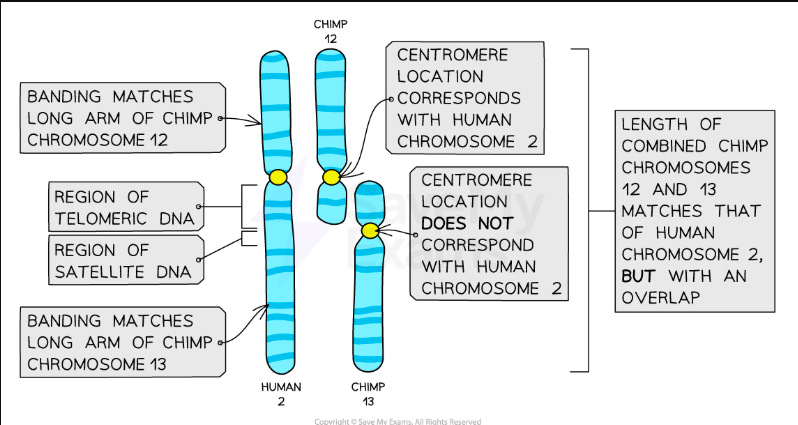
Chimpanzee and humans most likely share a common ancestor, given the evidence of the chimpanzee and human chromosomes. Chimps have 48 chromosomes, humans have 46. This is 2 chromosomes that must have been lost. The most likely theory is: Chromosomes in pairs 12 and 13 in a common ancestor fused to form the chromosomes in human pair 2, leaving the chimps with chromosomes 12 and 13.
Evidence:
Chimpanzee chromosomes 12 and 13, when placed end-to-end, match the length of human chromosome 2
The location of the centromere of chimpanzee chromosome 12 matches that of human chromosome 2
Human chromosome 2 contains a region of non-coding DNA (satellite DNA) that corresponds to the location of the centromere in chimpanzee chromosome 13; this could be a remnant of a centromere
The banding of the long arms of acrocentric chimpanzee chromosomes 12 and 13 corresponds to the banding of metacentric human chromosome 2
Human chromosome 2 contains telomeric DNA in the middle of the chromosome
Chimpanzee & human chromosomes evidence against
Theory: Chromosomes in pairs 12 and 13 in a common ancestor fused to form the chromosomes in human pair 2, leaving the chimps with chromosomes 12 and 13.
The length of chimpanzee chromosomes 12 and 13 combined is not a perfect match for human chromosome 2; there is a slight overlap
The location of the centromere of chimpanzee chromosome 13 does not match that of human chromosome 2

Selective breeding
Artificial selection of desireable traits by humans has led to rapid genetic changes (allele frequencies) in populations.
Eg. in canines (dogs). All dogs are part of the same species, but the variation in dog breeds arose due to selective breeding by humans resulting in rapid changes in genetic frequencies.
Dairy cows. Artificial selection = cows that have been bred that produce more milk.
How is selective breeding evidence for evolution
It directly shows how the selection of certain traits leads to changes in allele frequencies over generations which is the definition(ish) of evolution. Humans pick the phenotypes they prefer (so they select, they are the selection pressure) and then breed individuals with those phenotypes together, so they reproduce offspring with those alleles and those offspring interbreed and reproduce more offspring with the preferred alleles. Over time, the allele frequency has changed a lot and is now greater. Proves evolution
What is a polyploid
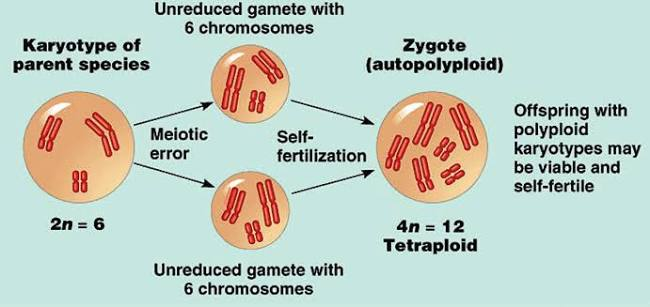
An organism with more than 2 sets of chromosomes (so not humans - we are haploids). This occurs through nondisjunction in meiosis/mitosis.
Alloploidy
Two different species reproduce. One species fails to produce gametes because of nondisjunction in meiosis so the two species reproduce and their offspring would have an uneven number of chromosomes. Then, by random chance, another gamete of the species that produced actual viable gametes combines with the hybrid species a + species b gametes, producing fertile offspring that can actually produce gametes since the chromosome number is even.

Autopolyploidy
A plant that produces its own male and female gametes attempts to produce gametes, but they do not reduce, so the gamete is diploid. Self fertilization occurs with a different gendered gamete that is also diploid, so you end up with a tetraploid with 4 sets of chromosomes. This offspring is fertile and viable.
Biodiversity
The variety of life found within an area
Levels of biodiversity
1) Genetic Diversity
The gene pool and the different number of alleles within it. Larger populations usually have larger gene pools = higher genetic diversity = better for withstanding against environmental changes/diseases etc.
2) Species Diversity
Consider individual species within the habitat. A healthy ecosystem will have a lot of different species (species diversity) and species evenness (even ratio of all different species).
3) Ecosystem Diversity
Number of different ecosystems within a geographical area. Eg. the rainforest has canopy ecosystem, river, rainforest floor within that geographical area. Within one biome there are different ecosystems. Basically different environments within one big environment.
Habitat
Physical conditions or place where an organism/species lives.
Eg. emperor penguins live on a slide of ice, their habitat is ice
Abiotic
Non living (sunlight, water, air, temperature) of an ecosystem.
Grass adaptations in sand dunes
Adaptations of grass in sand dunes. Form and function - abiotic components can drive evolution
Challenges in sand dunes: High salt concentration, low water availability, sand
Adaptions:
Waxy cuticle → reduces transpiration (water loss) to make up for the low water availability
Stomata pits with hairs → retains a lot of moisture in the air (makes up for water loss)
Rolled leaves → Less wind exposure so the wind can’t remove humid air around the stomata as easily
Mangroves adaptations to their environment
Challenges: Mangroves grow in waterlogged areas with soil that is anaerobic, and a very high salt concentration
Adaptations:
Glands that expel excess salt. If too much salt entered, it would mess with water potential and could dehydrate the plant.
Roots are coated in cork to prevent too much salt from being absorbed (same reasoning as the glands).
Root growing closer to the surface (not under the soil since the soil is anaerobic, so they will need more oxygen from other places so their roots are grown closer to the surface).
Root cells have a lot of minerals to decrease their water potential to ensure that they get a lot of water (via osmosis) into the roots.
Abiotic limiting factors affecting species distribution
Animals:
Water availability
Temperature
Can be different for different life stages
Plants:
Water availability
Temperature
Light intensities
Soil conditions (pH, minerals, salinity, structure)
Range of tolerance
Range of a certain limiting factor that an organism can survive in (abiotic factors
Abiotic factors determine terrestrial biomes

Rainfall and temperatures are the two main factors determining what biomes develop where.
Biomes along w/ rainfall and temperatures

Saguro cacti adaptations for hot deserts
Fat stems to store water to use during dry periods (common in the desert)
Smaller surface area due to lack of leaves = less opportunity for transpiration to save waterr
Wide root system allows for a lot of water to be absorbed across a large area before it evaporates/dries out
Stomata opens at night, not day, bc nights are much cooler so less water is lost thru transpiration.
Fennec fox adaptations for hot deserts
Nocturnal = active during the cooler times
Long hair to moderate body temperature between the changes of night & day
Large ears to radiate heat. Blood travels up to the ear, which is very large surface area + open, so it can be cooled down by wind, the cooler blood then circulates the rest of the body.
Hairs the bottom of paws allow it to walk over the hot sand comfortably
Light fur to reflect sunlight
Meranti tree in tropical desert adaptations
Grows very tall quickly to outcompete other trees for light. Even tho high light intensity, it is very dense, so still needs to compete against other organisms
Dense trunk = supports tall growth
Enzymes for photosynthesis with high optimum temperatures
Broad leave to disperse rainfall, and are always green and on all year round to maximise photosynthesis
Spider monkey adaptations for tropical rainforest
Long limbs to climb and swing through trees in the tropical rainforest (a lot of trees)
Active during the daytime when it can see best and find food
Tail that acts as a fifth limb for grasping and climbing trees etc. for food and getting away from predators
What is an ecological niche
Habitat = where you live vs Niche=how you live
How organism obtains food → What does it eat? Where does it get that food? When does it feed? For example, if two bird species specialize in eating different foods, they compete less with each other. That's what "specialisation reduces competition" means.
Zones/ranges of tolerance → Where can it live at its optimum (eg. for plants it’s soil, sunlight, temperature) and where can it not live. Eg. a polar bear range of tolerance optimum is very very cold environments w/ snow because it’s adapted for that, a tropical plant being there would be outside of its range of tolerance and die
How it interacts with other species → Including competition, if its predator or prey. For example, a bee's niche includes feeding on nectar and pollinating flowering plants.
Why is classification important
To help scientists that are studying the same animals, avoid confusion through multinational background of science
How are asexually reproducing species determined
There is no breeding happening, so they are left out of the species concept which is a limitation to the biological species concept.
Horizontal gene transfer
Plasmid contains the genes that’s resistant to the antibiotics, then joins with another bacteria that’s sensitive (not yet resistant) which is called conjugation. The plasmid is half given to the non resistant bacteria. Now both are resistant (this is what makes antibiotics less effective)

DNA barcoding
DNA markers in a specific region of the genome to identify organisms. Then, you look at the base sequences and the variability between the bases will allow to see species differences. More effective
Cladistics
An approach to classification using evolutionary relationships
Cladogram
Tree diagram drawn showing a prediction of how a species evolved. A node = new trait. Root = common ancestor

A clade
A group of species with a single common ancestor and a set of common traits or characteristics
Determining relationships
Molecular clock:
Size of population
Selection pressures
Genome size
Degree of randomness (how frequently the DNA is going to mutate)
This helps determine when species diverged. The more differences, the longer they would have diverged (so like it’s been a while since they had a common ancestor)
Sexual selection
Animals develop unique and “fancy” traits/behaviors to help them mate with others and reproduce. It is distinct from natural selection because the partner is selecting the trait, not the environment. It is more about making it to reproductive age and then are your alleles chosen or not
Intra-sexual selection
Competition between individuals of same sex to mate with opposite sex (usually males fighting with each other to prove they’re stronger)
Intersexual selection
One species (usually females) chooses an individual of the opposite sex. Pref for trait selects the trait → both trait + pref gets passed down to offspring → over time trait becomes more dominant
John Endler experiment with Guppies
Endler put guppies into different environments with different predators (none, mild, and ferocious) and observed how their colors changed
Pond A (no predators): Male became more brightly colored over time. Bc there were no predators, natural selection wasn’t as favored and traits for survival were less important than traits to reproduce. Sexual selection was more important because female chose more colorful males → colorful males reproduced more → allele frequency of bright colors/patterns increased
Pond B (mild, sporadic predator): Males could be fairly colorful, but the brightness/patterns were more limited because there was a predator. There was a balance between natural & sexual selection bc being too colorful made it very obvious to a predator so the guppy would be eaten before it could reproduce, but being just the right amount of colorful allowed them to mate and reproduce.
Pond C (ferocious predator): Males become less brightly colored and more dull & camouflaged. Bright males are easier for predators to see, so they were more likely to be eaten before they could reproduce. Natural selection dominated because the predator was so vicious, duller/less bright males survived, so reproduced more → allele frequency of less bright colors increased
Graphing population growth (unrealistically)
Exponential growth is under ideal conditions, where unlimited resources + favorable abiotic factors allow the population to grow exponentially

Graphing real world population growth
Sigmoid curves occur in environment with limited resources (natural populations) where the population fluctuates around the carrying capacity

Fluctuations in population sizes
Prey population increases, afterwards bc there’s more prey (food), the predator population increases too. Then, because predator population is so high, the prey population decreases. Because the prey population decreases, there’s less food, so the predator population decreases too. There’s a time lag

Determining population size of sessile populations
A quadrat can be used for an organism that doesn’t move (sessile) (eg. plants). If in a 1m by 1m quadrat there are 7 organisms, then one can predict the population of the entire area (eg. 1000 by 1000m) and multiply to get the estimated population. \
Obv limitations as it may not be the same in every area, but it’s efficient.
How to determine size of moving populations (Pitfall traps)
Pitfall traps - little traps used to sample small animals, insects, amphibians.
Issues: 1. Predation, things get eaten, also ethical issues with trapping things.
2. Organisms can climb, jump, get out easily.
Experimental weaknesses: If the cup lip is not slightly underneath the surface, little insects/animals will choose not to go into the cup and instead go around.

Capture-mark-release-recapture
Used to estimate population size
Eg. 20 fish from a pond are captured, marked, then released back into the pond
They are then given time to mix with the rest of the population
Later, 30 fish are captured and 6 are marked.
Since 6/30= 20%, we assume roughly 20% of the population is marked
We know there are 20 marked fish, so if 20=20% of the population, then the approximate population is 100 fish.
Formula used is Lincoln index (P) = M x N/R
Where P is the estimated population, M is number of individual captured in first sample (and marked), N is individuals captured in the second sample, and R is the total number of recaptured individuals that were marked
Lincoln index for measuring population growth limitations
Assumed a closed population: For the formula to be used, the population must have stayed stagnant so no new births, deaths, immigration, or emigration
Marks must stay on: If a marking falls off, the marked individual is counted as unmarked
Marks must not affect survival: Eg. marks cannot make prey stand out to predators
Marked organisms can reintegrate themselves fully back into the population before recapture
Equal chance of recapture: marked organisms shouldn’t be harder to recapture now
Large enough sample size: small populations can give more unreliable representations/estimates because they are more swayed by random chance and events