SAC 5
 Call Kai
 Learn
 Practice Test
 Spaced Repetition
 Match
 Flashcards
 Knowt Play
1/97

There's no tags or description
Looks like no tags are added yet.
98 Terms
Controlled Experiment
an experimental investigation of the relationship between one or more IV’s and a DV; all other variables are controlled.
Order Effect
an extraneous variable that occurs in a repeated-measures design in which a change in results is due to the sequence in which two tasks are completed
Experimenter Effect
an extraneous variable that occurs when there is an unintentional change in a participants behavior, and hence in the results due to the experimenters influence
Placebo Effect
a change in participants behaviour due to their expectations regarding the treatment they are receiving
Outlier
a piece of data that lies outside a typical range of scores and can skew the representation of that data set
Controlled Variable
any variable that is constant in research conditions
Dependent Variable
the variable that is observed or measured in an experiment; that which is affected by the experimental condition and is used to measure the effect of the IV
Independent Variable
the condition that an experiment systematically manipulates or changes in order to gauge the effect on the DV
Aim
a statement that explains what you are intending to investigate in an experiment or research investigation
Hypothesis
a testable prediction about the relationship between two or more variables
Primary Data
data obtained through new research such as fieldwork, observation or experimentation
Secondary Data
data sourced from other peoples research, obtained from journals or academic articles
Qualitative Data
data that describes change in the quality of behaviour; often expressed in words
Quantitative Data
data collected through systematic and controlled procedures, that are usually presented in numerical or categorical form
Objective Data
data that can be observed and measured
Subjective Data
Data based on an opinion; collected through observations of behaviour, or through participants’ self-reports
Beneficence
an ethical principal where research is considered through the scope of maximising benefits to society while minimising harm to others
Integrity
an ethical principle that involves the researchers commitment to honest conducting and reporting of research
Justice
an ethical principle that ensures fair treatment of all, from selection through to result collection
Non-maleficence
the implication that if potential harm/discomfort is involved, the harm/discomfort does not outweigh the potential benefits that could eventuate
Respect
an ethical principle shown through consideration of an individuals welfare, but also through the appreciation of their own uniqueness and freedom of expression
Confidentiality
describes a participants right to privacy with regard to access, storage and disposal of information about themselves that is related to the study
Voluntary Participation
ensures that a participant is willing to participate in, or be part of an experiment
Withdrawal Rights
refers to the right of a participant to leave a study at any time without pressure or negative consequences
Informed Consent Procedures
a researcher must obtain written permission from each participant involved in the study, stating that they consent to participating in the study and have been given all necessary information including their rights.
Use of deception in research
when participants are not fully informed about the procedures or aim of the experiment before it is conducted because knowing the purpose might influence their behaviour, they must be thoroughly debriefed after.
Debriefing
where participants are informed of a study’s true purpose and findings once the experiment has ended and information is given about counselling services if necessary
Strengths and Limitations of Controlled Experiments

Between Subjects Design
(independent groups design and matched participant design)
Participants are randomly allocated to either the control or the experimental condition and only experiences that condition
Strengths and Limitations of Between Subject Design

Within Subjects Design
(repeated measures design)
Involves all participants in the sample completing both the experimental and control conditions.
Strengths and Limitations of Within Subjects Design
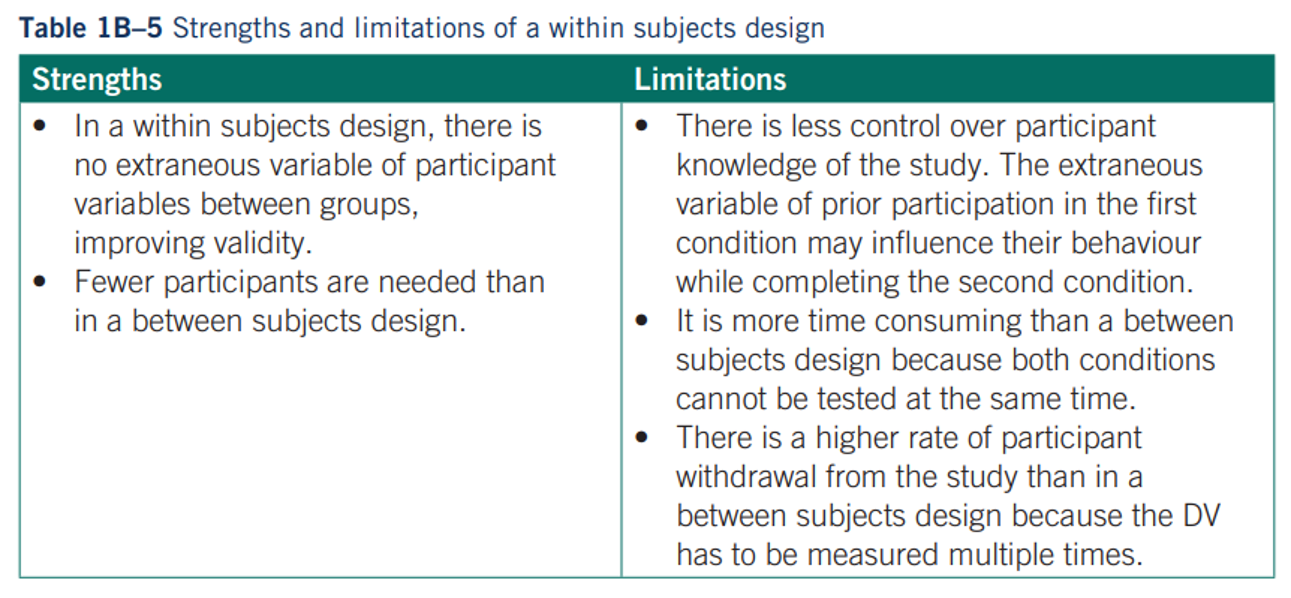
Order effects can be present (i.e., boredom, fatigue and practice effects).
To minimise the impact of order effects, counterbalancing can be used.
Mixed Designs
Involves a combination of a between-subjects design and a within-subjects design.
Strengths and Limitations of Mixed Design

Case Study
A case study is an investigation of a particular activity, behaviour, event or problem that contains a real or hypothetical situation and includes real-world complexities.
Strengths and Limitations of a Case Study

Fieldwork
A type of investigation methodology that involves collecting information by observing and interacting with a selected environment. Often this environment is a real-life setting rather than a laboratory-controlled setting.
Fieldwork may be conducted in a variety of ways, including:
•Direct qualitative and/or quantitative observations and sampling
•Participant observation
•Qualitative interviews
•Questionnaires
•Focus groups
•Yarning circles (culturally informed alternative to focus groups)
Each of which have their own strengths and limitations.
Strengths and Limitations of Fieldwork

Conclusion
A decision or judgement about the meaningfulness of the research results.
Population
The entire group of individuals belonging to a particular category that is of research interest
Sample
a group of participants selected from and representative of the population of interest.
Random Sampling
Every member of the population has an equal chance of being selected.
Stratified Sampling
involves breaking the population into strata, based on characteristics they share, and randomly selecting participants from each strata in the proportion they appear in the population
Experimental Group
The group exposed to the independent variable, where the IV is manipulated.
Control Group
The group not exposed to the independent variable; used for comparison
Extraneous Variable
A variable other than the IV that may cause a change in the results and therefore may have an unwanted effect on the experiment
Confounding Variable
A variable other than the IV that causes a change in the DV and whose effects may be confused with those of the IV of the study
Accuracy
How close a measurement is to the true value of the quantity being measured.
A lack of error or bias in a measure or score
Precision
How close a set of measurement values are to each other.
Validity
Refers to whether a measurement measures what it is supposed to be measuring.
Internal Validity
whether a study investigates what it set out or claims to investigate
External Validity
whether the results of research can be applied to similar individuals in different settings
Reliability
Refers to the extent to which an assessment tool can produce results consistently, each time it is used
Repeatability
How close successive measurements of the same quantity are when carried out under the same conditions.
Reproducibility
How close measurements of the same quantity are when carried out under different conditions.
Replicability
A term similar to reproducibility, applied to studies aiming to answer the same scientific question.
Random Error
Errors that affect the precision of measurement by creating unpredictable variations in the measurement process.
Systematic Error
Affects the accuracy of a measurement by causing readings to differ from the true value, in a consistent manner
Uncertainty
A lack of exact knowledge of the value being measured.
Generalisation
A decision or judgment about how widely the findings of a research study can be applied.
When the findings of an experiment are applied to the population of interest for the research
Personal Error
Errors made by the researcher, such as experimenter bias.
Chronic Traumatic Encephalopathy (CTE)
A progressive neurodegenerative disease linked to repeated impacts to the head. It gradually damages brain tissue and worsens over time.
Who is Most at Risk of CTE?
CTE is most commonly seen in people exposed to repeated head impacts, including athletes in contact sports such as football, boxing, rugby, soccer, ice hockey and wrestling. It is also seen in military personnel, survivors of domestic violence and people who repeatedly bang their heads.
History of CTE
CTE was first identified by Dr Harrison Martland in 1928 as "punch drunk syndrome". It was originally observed in boxers who later developed cognitive impairments, Parkinson's disease and dementia. The term "chronic traumatic encephalopathy" became accepted from the 1940s.
Physiological Basis of CTE
CTE occurs when tau protein builds up inside neurons and other brain cells. This disrupts communication between neurons and interferes with processes that keep cells healthy and alive
Tau Protein and CTE
In a healthy brain, excess tau is broken down and removed. In CTE, repeated head injuries appear to trigger tau aggregation, causing the protein to accumulate and spread throughout the brain over time.
Effect of Tau Accumulation
The build-up of tau protein damages brain tissue, kills neurons and causes widespread brain atrophy (shrinkage) and reduced brain volume.
CTE and Alzheimer's Disease
CTE is often mistaken for Alzheimer's disease because both disorders involve abnormal accumulation of tau protein within the brain
Causes of CTE
Repeated head impacts appear necessary for the development of CTE. The exact amount of trauma needed is unknown. Risk may also be influenced by the timing, location and severity of injuries, as well as lifestyle factors.
Progression of CTE
CTE is a progressive disease that worsens over many years. Researchers have identified four stages, with symptoms becoming more severe as tau pathology and brain degeneration increase
Diagnosing CTE
There are currently no conclusive tests that can diagnose CTE in a living person. Diagnosis is difficult because CTE symptoms are similar to those of other neurological disorders such as Alzheimer's disease
Treatment of CTE
CTE is currently incurable and irreversible. Treatment focuses on managing symptoms and improving cognitive and behavioural functioning through medication, therapy and healthy lifestyle habits.
Lifestyle Strategies for CTE
Good nutrition, physical activity, mental engagement and social engagement may help improve wellbeing and functioning in people with CTE.
Preventing CTE
Prevention is currently the best defence against CTE. Strategies include reducing head injuries, changing sporting rules, encouraging symptom reporting, tracking concussion history and following safe return-to-sport guidelines.
Protective Gear and CTE
Helmets help prevent skull fractures but may not prevent concussion or CTE because they cannot stop the brain moving inside the skull during acceleration and deceleration.
Why is Emerging Research into CTE Important?
Researchers still do not fully understand CTE. Ongoing research helps improve understanding of the disease, its causes, diagnosis, treatment and prevention.
Current Areas of CTE Research
Researchers are investigating:
How to reduce tau accumulation
How to detect tau build-up
How to diagnose CTE in living patients
Damage to white matter and blood vessels associated with CTE
Emerging Research into Medications
Scientists are testing medications that may block a neurotransmitter linked to abnormal tau accumulation after head injury. Animal studies have shown promising results, with human trials being the next step.
Emerging Research into Diagnosis
Researchers are investigating MRI, PET scans, genetic testing and biological markers to help diagnose CTE earlier in living patients. They are also developing agreed diagnostic criteria based on repeated head impacts and clinical symptoms.
Applying Knowledge of CTE
A retired athlete with a history of repeated head impacts who develops worsening cognitive, behavioural or neurological symptoms may be showing characteristics of CTE, a progressive and fatal neurodegenerative disease linked to repeated brain trauma.
Neurological Disorder
A disorder of the nervous system that affects the central nervous system and/or peripheral nervous system. There are more than 600 neurological disorders.
Classification of Neurological Disorders
Neurological disorders may be classified according to the location affected, the type of dysfunction or the cause of the disorder.
Why are Neurological Disorders Important to Study?
Neurological disorders are a major cause of death and disability worldwide and are expected to become more common as populations grow and age.
Causes of Neurological Disorders
Neurological disorders may result from acquired brain injury, congenital conditions, injury, trauma, nutritional deficiencies, substance use, poisoning, disease, viruses or infections
Characteristics of Neurological Disorders
Neurological disorders are generally long-lasting and may affect language, movement, vision and cognition
Contemporary Research
Current or emerging research that aims to improve understanding, treatment and prevention of disorders.
Scientific Method
A research process involving hypothesis formation, testing, observation, measurement, recording and retesting to produce reliable conclusions.
Benefits of Contemporary Research
Contemporary research may lead to treatments that are more effective, less invasive and more accessible than previous treatments.
Limitation of Contemporary Research
New research has often not undergone the same level of long-term scrutiny and replication as older research, so conclusions may not yet be definitive.
Acquired Brain Injury (ABI)
Damage to the brain that occurs after birth at any stage of life. It may be sudden or develop over time.
ABI is an umbrella term that includes TBI, aphasia, concussion and stroke.
Biological Effects of ABI
Changes to physical functioning, including movement, sensation, coordination, speech and other bodily processes.
Impaired sensory functionind
muscle weaknesses
poor balance
tremors
arthritis
headaches
fatigue
seizures
chronic pain
slurred or slowed speech
bladder problems
hormone imbalance
sleep disturbances
Psychological Effects of ABI
Changes to mental processes such as memory, attention, thinking, emotions and behaviour.
memory loss
slowed thinking
confusion
poor attention and concentration
reduced ability to plan, organise and problem solve
inflexible thinking
poor judgement
lack of initatiove or motivation
anxiety
depression
emotional instability
irritability
short-temperedness
personality changes
impaired self awareness
celf-centredness
negative self talk
Social Effects of ABI
Changes to communication, relationships, independence and participation in everyday activities.
impaired social skills
impaired ability communicate with others such that others can understand them
socially inappropriate behaviour
difficulty following social rules and coventions
aggressive verbal or physical behaviour
difficulty relating to tohers
loss of confidence or self-esteem
impulsivity
isolation
poor ability to manage conflict
losing touch with friends or changed relationships
Traumatic Brain Injury (TBI)
Brain damage caused by sudden physical trauma from an external force. Common causes include vehicle accidents, falls, sporting injuries, workplace accidents and violence.
How TBI Causes Damage
A forceful impact can cause the brain to collide with the skull despite being cushioned by cerebrospinal fluid. This may result in bruising, swelling, bleeding, tearing and increased pressure within the brain.
Concussion
A mild TBI resulting from an external force to the head or body that causes the brain to bounce in the skull
Symptoms of Concussion
Headache, fatigue, poor coordination and temporary loss of normal brain functioning. Usually there is no loss of consciousness and no obvious structural brain damage.
Recovery from Concussion
Most people improve over several weeks with rest and recovery. One concussion increases the risk of future concussions. Multiple concussions have been linked to Alzheimer's disease and CTE.