Maxillary and Mandibular Molars
 Call Kai
 Learn
 Practice Test
 Spaced Repetition
 Match
 Flashcards
 Knowt Play
1/60

There's no tags or description
Looks like no tags are added yet.
61 Terms
Molar Names
First: 6 year molar
Second: 12 year molar
Third: wisdom teeth
Molar function
Grinding
Molars differ from other teeth
-Crowns are larger
-Occlusal surface 3-5 cusps
-Multirooted
Maxillary Molars crown
-four well developed cusps, 2 buccal and 2 lingual
Maxillary Molars roots
-trifurcated roots(3)
-two on the buccal -MB widest
-on on the lingual - longest and biggest
Maxillary First Molar eruption
6-7 years
Maxillary First Molar lobes
5 - 2F and 3 Lingual
Maxillary First Molar overview
-longest tooth in max arch
-4 functional cusps but a fifth one
-3 roots: Mesiobuccal, Distobuccal and Palatal
Maxillary First Molar Buccal aspect
-all roots can be seen from this aspect
-deep depression buccally on the root trunk (between CEJ and furcation)
-buccal groove divides two buccal cusps, ends in buccal pit
-roots inclined distally, distal root is straighter
-ML cusp can be seen between 2 buccal cusp
-CEJ irregular on buccal
-crown is a trapezoid

Maxillary First Molar cusps
-DB cusp more pointed(sharper) than MB
-DB cusp longer than MB
-DL smallest of functional cusps
-ML cusp largest of all cusps
Maxillary First Molar Cusps size
largest to smallest:
ML-MB-DB-DL
Maxillary First Molar Lingual aspect
-DL groove
-ML groove
-all 3 roots are visible
-wider on L than B

Cusps of Carabelli
5th cusps attached to the lingual surface of the mesial lingual cusp
Maxillary First Molar mesiolingual groove
separates the cusp of carabelli from the mesiolingual cusp
Maxillary First Molar Lingual root
-longest
-depression on L
-banana shaped
Maxillary First Molar Mesial aspect
-depression on M side of root
-MB root is broad

To access mesial furcation
needs to scale from lingual because MB root is wide mesially
Crest of curvature/Height of contour
Buccal: Cervical 1/3 (beer belly)
Lingual: Middle 1/3
Maxillary First Molar Distal Aspect
-decrease in measurement distally
-DB root is narrower at the base - narrowest of the 3 roots
-no depression on distal buccal root

Maxillary First Molar roots
-short root trunk
-CEJ irregular on buccal
-L, MB, DB roots (largest to smallest)
-Deep dev. groove groove on B between CEJ and trifurcation
-DB root - smallest, curves M
-dev depressions on all furcal surfaces
Root Trunk
Area from the CEJ to the furcation
Maxillary First Molar MB root
-obscures DB root from M
-extends beyond confines of crown
-curves D, concave on D surface
-broad root
-depression on M side
Maxillary First Molar furcation distance
M- 3-4mm
B- 4 mm
D- 5mm
Maxillary First Molar Occlusal aspect
-rhomboidal in shape
-wider lingual than buccal
-2 major and 2 minor fossae
-3 pits
-1 oblique ridge

Maxillary First Molar Major fossae
Central: triangular and mesial to oblique ridge
Distal: linear and distal to the oblique ridge
Maxillary First Molar Minor fossa
-mesial triangular fossa
-distal triangular fossa
Maxillary First Molar oblique ridge
two triangular ridges that cross the occlusal surface from the tip of the ML cusp to the tip of the DB cusp.
-ridge is reduced in height in the center
Maxillary First Molar primary grooves
-Central
-Buccal
-distolingual
-MMG
-DMG
-ML groove - cusp of Carabelli groove
-transverse groove of oblique ridge
Maxillary Second Molar Eruption
11-13 years
Maxillary Second Molar Lobes
4 (or 5) if there is a cusp of Carabelli
Maxillary Second Molar overview
-smaller crown
-more supplemental grooves and pits
-oblique ridge less prominent
Maxillary Second Molar Buccal aspect
-DB cusp smaller
-Buccal groove further distal
-noticeable difference between MB and DB size
-Roots more parallel and incline distally

Maxillary Second Molar lingual aspect
-DL cusp of crown is smaller than 1st molar
-DB cusp may be seen between MLI and DLI cusp
-5th cusp not usually present, no evidence
-narrower on L than B

Maxillary Second Molar occlusal aspect
-can be a rhomboid or heart-shaped
-smaller than first molar
-M-D diameter is 1 mm less
-DL cusp is less
-more supplemental grooves and accidental grooves and pits

Maxillary Second Molar roots
-Roots longer than the first but closer together
-root trunk longer than first
-buccal roots may be fused
-furcation harder to access because roots closer
Maxillary Third Molars Eruption
17-22 years
Maxillary Third Molars overview
-appears as developmental anomaly
-supplements the second molar
-shorter, smaller overall
-roots inclined to fusion and look like one root
-heart shaped occlusion
-varies more than any tooth in size, shape, position
-wrinkled occlusal surface
Anomalies
-Congenitally missing
-Impaction
-Peg shaped to huge crown
-roots: from 1 to many (7 or 8)
-Dilaceration: severe bent root
-Supernumeracy: 4th molar
Mandibular First Molar Eruption
6-7 years
Mandibular First Molar overview
-largest tooth in mand arch
-5 well dev cusps: 3B, 2L
-2 roots
-M-D crown greater than B-Li
Mandibular First Molar Buccal aspect
-CEJ dips toward furcation
-all 5 cusps are in view because lingual cusps are higher
-MB dev. groove with a pit
-DB dev. groove
-D cusp is small, more pointed
-MB cusp is widest cups of all
-trapezoidal in shape

Mandibular First Molar root from buccal
-Dev depression on both roots, maybe not distal to distal root
-Distal root shows little curvature
-Widely separated
-M longer and larger
-depression in root trunk on buccal
-Deep depression on furcal side of both roots
-M root: depression on its M side also
Mandibular First Molar Buccal and ligual furcation
Buccal: in line with buccal groove
Lingual: in line with Li groove
Mandibular First Molar bifurcation
-3 mm on buccal
-4 mm on lingual
Mandibular First Molar Lingual aspect
-2 lingual cusps are pointed: higher than B cusp
-ML cusp is wider
-Li flat compared to buccal
-CEJ straighter and higher than buccal

Mandibular First Molar Mesial aspect
-B-L root greater than distal
-MMR is higher
-Mesialmarginal groove
-CEJ higher on Li than B
-Buccal cervical bulge (ridge)
-Rhomboid: crown tilt to lingual

Mandibular First Molar occlusal aspect
-five functional cusps
-Pentagonal in shape
-3 pits: C, M, D
-4 Dev grooves
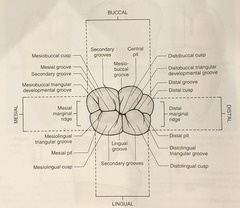
Mandibular First Molar Cusp size
largest to smaller:
MB-ML-DL-DB-D
Mandibular First Molar fossa
-1 Major: Central
-2 minor: M and D triangular fossae
Mandibular First Molar Grooves
-Central Dev Groove: zig zags
-MB and DB Dev Groove: forms Y
-Li Dev Groove: forms Y
Mandibular Second Molar eruption
11-13 years
Mandibular Second Molar overview
-Smaller than first, more symmetrical
-4 well dev functional cusps, 2 BU and 2 Li
-2 roots: shorter and closer
1 M(larger), 1 D
Mandibular Second Molar Buccal aspect
-B dev groove and B pit
-MB and DB cusp = in measurement
-roots incline distally
-root trunk longer, furcartion greater than first

Mandibular Second Molar Lingual aspect
-2 Cusps, lingual groove
-L cusp higher than B cusp
-depression on root trunk

Mandibular Second Molar Mesial aspect
-see prominent buccocervical ridge
-Mesial root somewhat pointed apically
-less broad than M root on first molar
-broader than D root

Mandibular Second Molar Occlusal aspect
-rectangular, groove pattern +
-B, L and Central grooves form maltese cross
-2 transverse ridges
-3 fossae, 3 pits

Mandibular Second Molar roots
-depression on furcal sides, inside of root
-depression on root trunk
-depression everywhere maybe not on distal of distal root
Mandibular Second Molar Right Vs Left
-M root wider and longer
-Crown tilt to D and lingual
-CEJ: M more dip, higher L than B
-Buccocervical ridge: more prominent toward mesial of the buccal surface
Mandibular Third Molar eruption
17-21 years
Most likely to be impacted
1- Md 3rd molar
2- Mx 3rd molar
3- max canine
Most likely missing
1- Mx 3rd molar
2- Md 3rd molar
3- Mx lateral incisor