quantum mechanical model of the atom
 Call Kai
 Learn
Learn Practice Test
 Spaced Repetition
 Match
Match Flashcards
 Knowt Play
1/19

There's no tags or description
Looks like no tags are added yet.
Name | Mastery | Learn | Test | Matching | Spaced | Call with Kai | Chat |
|---|
No analytics yet
Send a link to your students to track their progress
20 Terms
what does the quantum mechanical model do (in terms of electrons and light) and how does light help us understand electrons (think abt viewing them)
it explains the behavior of electrons and light specifically
we can describe the behavior of electrons as both waves and particles (waves are their natural form, but when we observe the electron we use light (photons) and this disturbs the wave into becoming particles)
what is electromagnetic radiation; what are the descriptions of the 2 things it is?
its energy that travels through space in electric and magnetic fields
Electric field: a region of space where an electrically charged particle experiences a force, (think proton and electron)
Magnetic field: a region of space where moving electric charges and magnetic dipoles experience a force. (think. the force between magnets)
We can describe these fields in the form of waves
what is light; what are the 2 things this is made up of; and what are those described as
light is electromagnetic radiation (EM) which is energy that are created through electrical fields (waves) and magnetic fields(waves).
these electrical and magnetic fields are perpendicular to eachother
these waves oscillate (move back and forth in a repeating motion
(visible light and “light” are not the same thing, visible light is only a small spectrum of the range from electromagnetic radiation while Light IS all electromagnetic radiation.

what speed does electromagnetic radiation move at; and what equation can we use that equals the speed
the speed of light is c= 3.00×10^8 m/s (in a vacuum where everything is steady)
all waves move at a speed equal to c= λ x v (wavelength)x(frequency) where c equals the speed of light
what are the components of a wave and their descriptions
Wavelength(lambda): the distance between equal spots on the wave (its measured in nanometers “nm”)
Amplitude: maximum field strength of the oscillating field (how tall each peak is)
Frequency (nu): number of wave cycles passing a point each second (S-1 or Hz “hertz”)
crest: the top peak of the wave
trough: the bottom peak of the wave

what is constructive interference and destructive interference
constructive interference: its additive, adding two diff waves with the same wavelength and frequency (waves in phase) will make the resulting wave larger
deconstructive interference; its reduced/ cancelled, so adding two waves opposite to eachother (waves out of phase) will cancel eachother out and make a straight line

what Is the equation to finding the frequency and wavelength of a wave, and if wavelength is high what is frequency and vice versa
λ= c/v (speed of light m/s divided by frequency hertz)
v=c/λ (speed of light m/s divided by wavelength nm)
if frequency gets big then wavelength gets small, they’re inversely proportional.
in regards to the waves on the electromagnetic spectrum, what is intensity in a wave, and how does it rise
intensity is how intense one wave is (like a signal), for ex. in a visible light wave, if the wave is intense then the light will be bright but if the wave is not that intense then the light will be more dim.
the range of intensity depends on amplitude, as amplitude increases so does intensity.

what is visible light considered, and what comes before and after it on the electromagnetic spectrum
visible light is WHITE and it is a continuous spectrum. meaning its a combination of the different colored wavelengths together.
ultraviolet rays come before visible light on the EM spectrum, while infrared waves come after it.
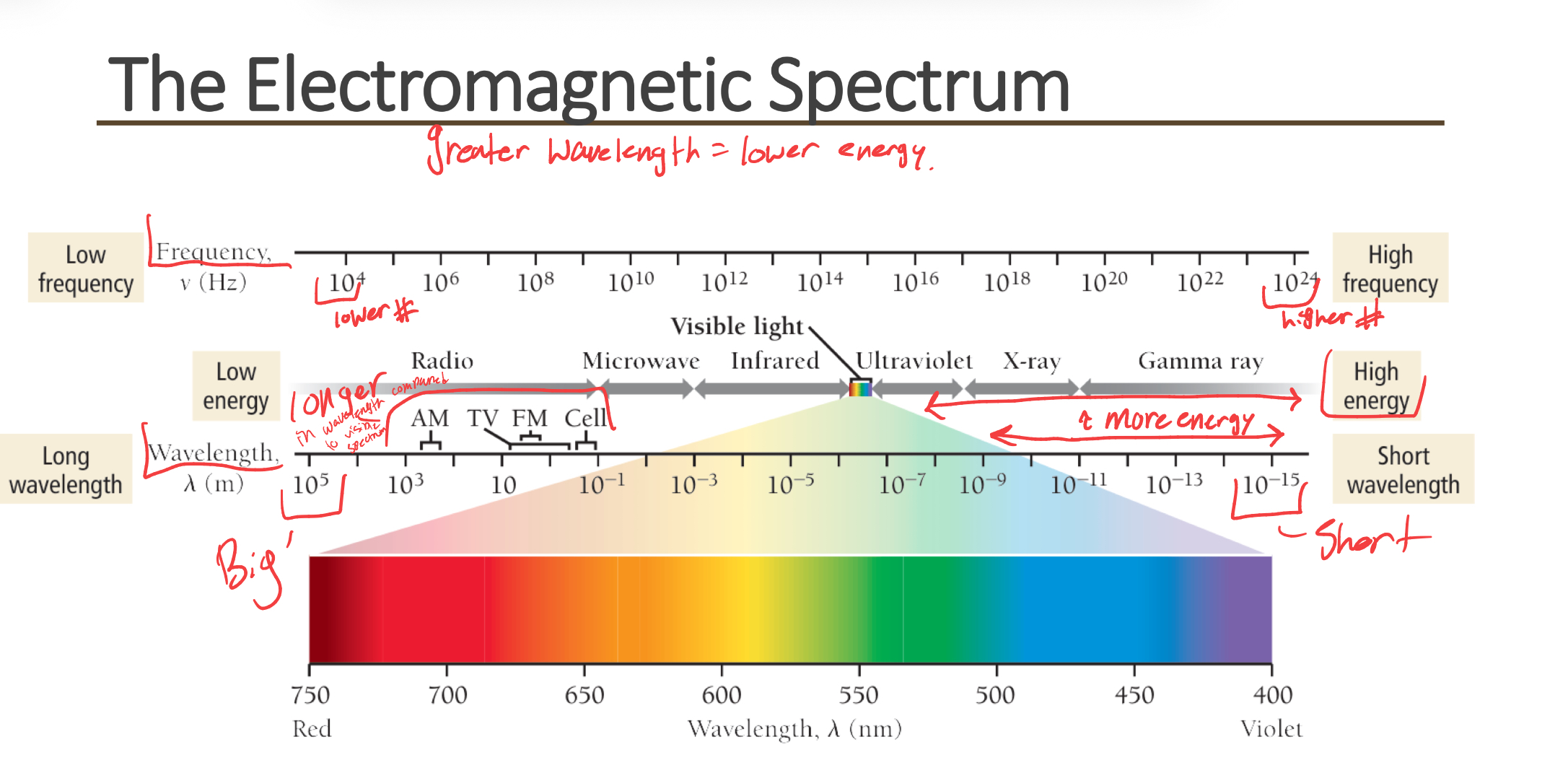
how do you read the electromagentic spectrum graph
the greater the wavelength the lower energy the wave contains,
and the greater the wavelength the lower the frequency

on the topic of light (not visible light, just light in general) what is light and what occurs when it hits an object. what is this effect called.
light is energy (called photons), and as light hits an object (shines on it), entering their atom; this causes electrons to be released from the atom, making it a photoelectron.
this effect is called the photoelectric effect
what did scientists deduce after viewing the effect of light hitting a surface and photoelectrons leaving; what was this deduction called (a name) and why can it not grow?
that when light (energy) hits the surface, there is a certain amount of energy the light needs in order to cause the electrons to be released from the surface.
(since light is made of particles) scientists conclude that in order for electrons to be released when a surface is hit with light, light needed ONE energy particle that would be strong enough to cause this reaction and that particle would be called a Photon.
even if we were to hit an object with several light waves (multiple energies) it would not give the electron reaction, only if the light contains photons would it work, and if it was several light waves with photons then the amt of photoelectrons being released would grow.

what does the photons energy depend on; and what is the formula for this
it depends on frequency, the higher the frequency of a wave, the more energy it contains. (also meaning its more energy per photon
formula to find the energy of a photon is
E=hv
energy = planks constant x frequency
what is the formula to finding energy when given wavelength
E=hc/wavelength
planks constant x the speed of light/ wavelength
what was Bohrs idea for the model of an atom; and what “number” was used to describe one of these traits (4 traits)
he states that the energy of an atom was quantized (specific amounts of energy)
he thought electrons travel in orbits around the nucleus
the amount of energy was related to the electrons position in the atom.
each orbit has a specific amt of energy (closer orbit is to the nucleus the more energy it contains)
the energy of each orbit is represented through an integer called “quantum number” (n)
what is emsission and absorption and they’re qualities
absorption: when an atom takes in a photon (when light with the correct amt of energy hits a surface it enters the atom)
the electron of the atom takes the energy and moves from a lowest energy state (ground state) to a higher energy state (excited state)
emission: an atom releases a photon
occurs when the electron couldn’t handle the excited state (unstable) so it moves back down to ground state by releasing energy (photon).

when a photon is absorbed or emission what occurs with the state of the electron (specifics) 2 points
when a photon is absorbed, depending on how many photons there are and how much energy is put into the atom, the electron absorbing the energy can rise several levels in the orbitals during the excited state.
in the case of emission when the electron is unstable, the electron is releasing energy (aka light) as it goes down the orbitals in levels.
in the electromagnetic spectrum there is a section of wavelengths that are visible light, what is the case regarding the absorption and emission of photons when the light wavelength hitting the surface is visible light (2 points)
in the case where the light wavelength has enough energy, the electrons in the atom Will absorb the photon and emit photoelectrons out.
since it is visible light waves, when we view the absorption to emission spectrum, we can visibly see the amt of absorption to emission is opposite to eachother. because whatever the atom absorbs it must release as well.

what are some rules in the case of absorption and emission
the more levels the electron travels the more energy its gaining or losing. so it if travels the orbitals going down by a lot of levels. then it is losing or emitting a lot of energy (in the case of wavelengths of visible light, more light will be visible the more electrons the photon travels down)
not all wavelengths are visible light, for example microwave wavelengths. when the wavelength hits the atom the electrons release microwave waves that are used to heat food.
