Chemistry - The mole
 Call Kai
 Learn
 Practice Test
 Spaced Repetition
 Match
 Flashcards
 Knowt Play
1/8

There's no tags or description
Looks like no tags are added yet.
9 Terms
Positive ions to memorise
Hydrogen - H+
Group 1 metals - X+ e.g Li+
Group 2 metals - X2+ e.g Mg2+
Zinc - Zn2+
Lead - Pb2+
Silver - Ag+
Aluminum - Al3+
Iron (II) - Fe2+
Iron (III) - Fe3+
Copper (I) - Cu+
Copper (II) - Cu2+
Ammonium - NH4+
Negative ions to memorise
Fluoride - F-
Chloride - Cl-
Bromide - Br-
Iodide - I-
Hydride - H-
Oxide - O2-
Sulphide - S2-
Hydroxide - OH-
Nitrate - NO3-
Sulfate - SO42-
Carbonate - CO32-
Phosphate - PO43-
What is the definition of a mole and Avogadro’s constant?
Mole - the amount of a substance in grams which contains the same number of particles as there are atoms in 12g of carbon–12.
There are 6.023 x 10²³ atoms of carbon in 12g of carbon-12 so a mole of any substance is 6.023 x 10²³ particles (Avogadro’s constant)
What is the equation to calculate moles of a substance?
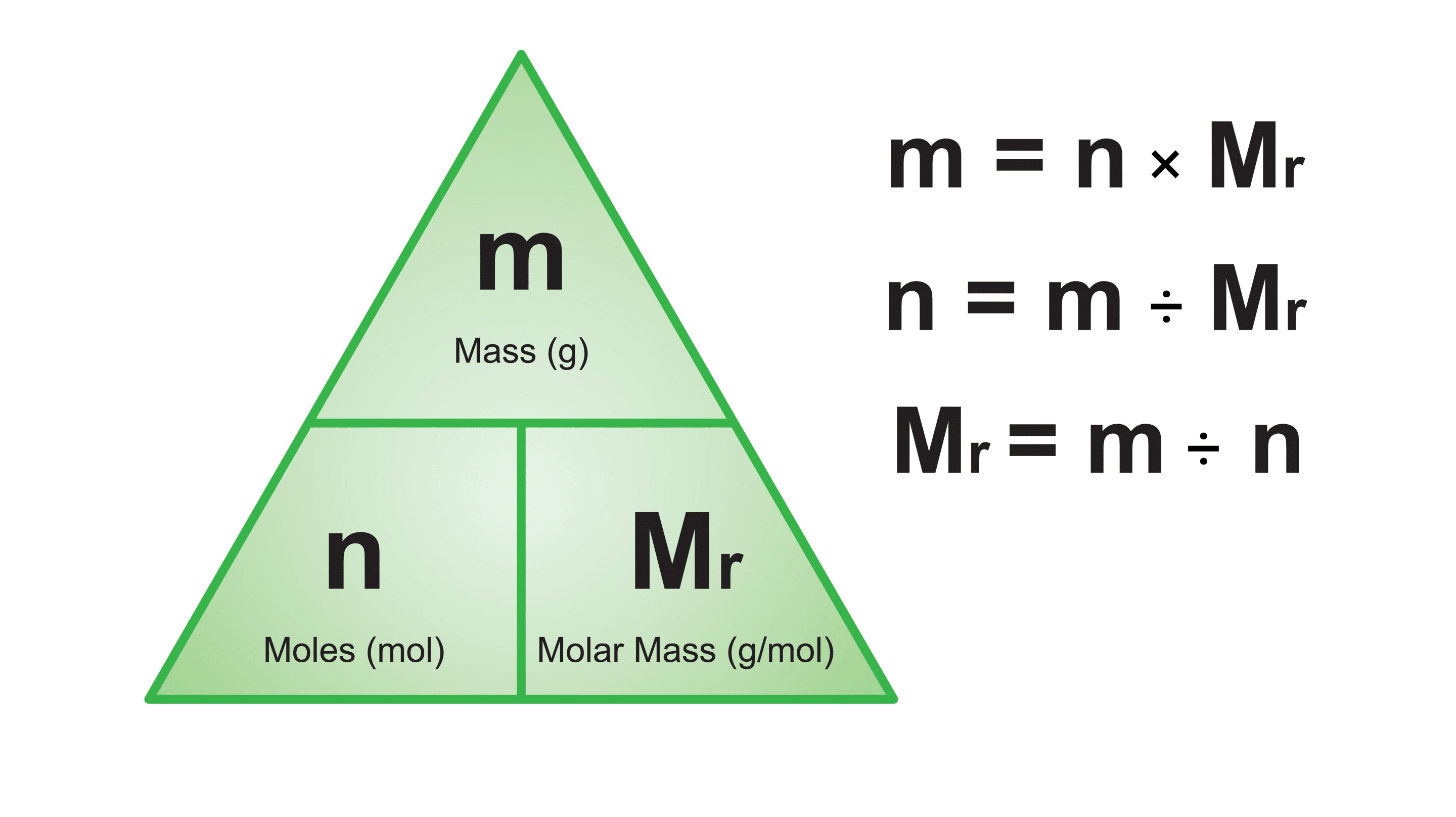
Moles = mass (in grams)/Ar
What is the ideal gas equation?
pV = nRT
p - pressure (in Pa)
V - volume (in m3) cm3 → m3 = divide by 106
n - moles of gas
R - gas constant 8.31 J mol-1 K-1
T - temperature (in K) K = °C + 273
What is an empirical formula?
Empirical formula - the simplest ratio of atoms of each element in a compound
How to calculate empirical formula:
Write down the masses of the elements
Convert mass into moles by dividing by Ar (moles = mass/Ar)
Divide all numbers by the smallest moles value
Adjust ratio to get whole numbers
What is a molecular formula and how is it calculated from the empirical formula?
Molecular formula - the actual number of atoms of each element in one molecule of a substance
Example:
Hydrogen peroxide has the empirical formula of HO. The mass of the empirical formula is 17. Calculate the molecular formula of hydrogen peroxide
Hydrogen peroxide usually has an Mr of 34
The empirical mass is 17 which is half of the Mr so molecular formula must be empirical formula x 2
Molecular formula = HO x 2 = H2O2
How do you calculate moles in a solution?
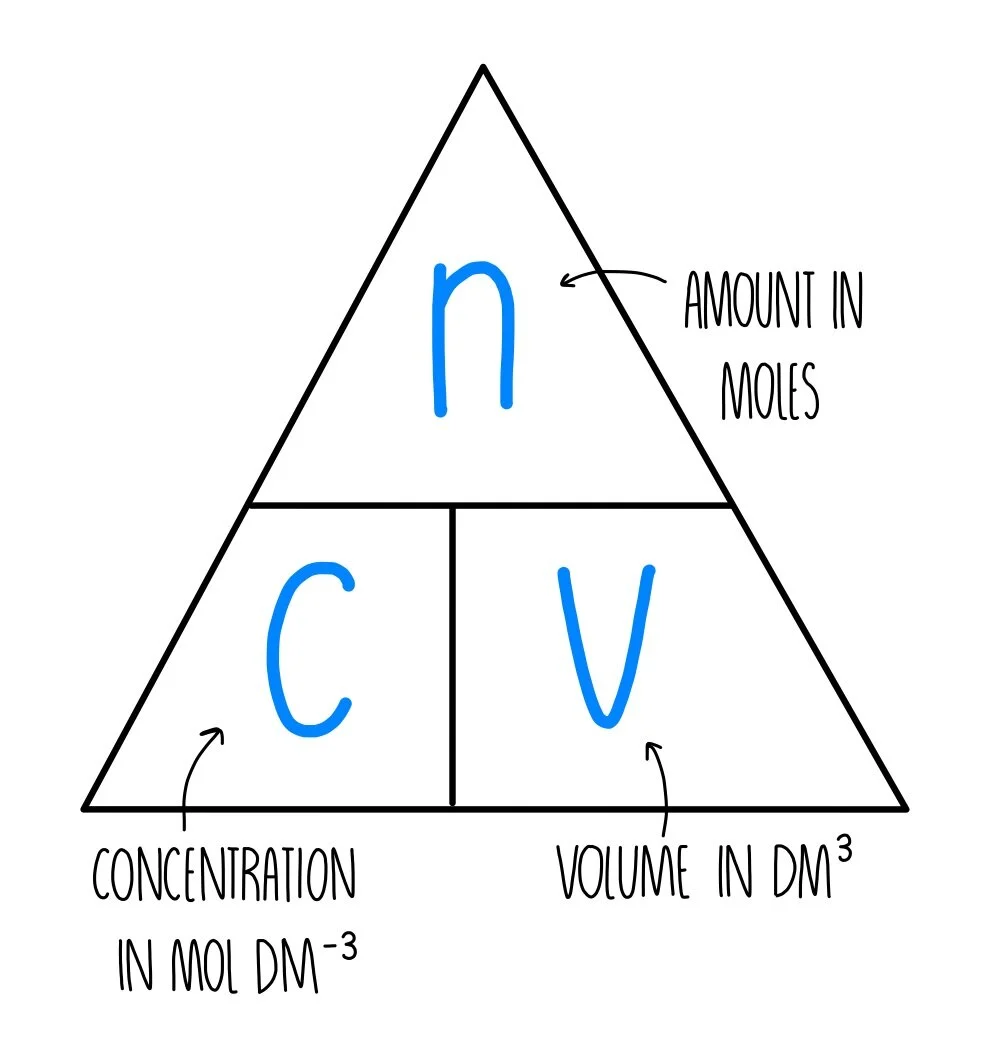
Moles = concentration x volume
Concentration - in mol dm-3
Volume - in dm3 (cm3 → dm3 = divide by 1000
How are titration calculations carried out in volumetric analysis?
Volumetric analysis - determines the concentration of an unknown solution using a solution of known concentration (standard solution)
In a titration, an acid and alkali react until neutralisation occurs
Calculate the moles of the known solution using: n = c × V (V in dm³)
Use the balanced equation to determine the moles of the unknown solution
Calculate the concentration of the unknown using: c = n ÷ V
Method: ① Calculate moles of known solution → ② Use mole ratio from the equation → ③ Calculate the required concentration
Example:
In a titration 15.0 cm3 of hydrochloric acid neutralised 25.0 cm3 of a 0.100 mol dm–3 solution of NaOH. What is the concentration of the acid?
HCl + NaOH → NaCl + H₂O (1:1 ratio).
Moles of NaOH = 0.100 × (25.0 ÷ 1000) = 0.00250 mol
Moles of HCl = 0.00250 mol
[HCl] = 0.00250 ÷ (15.0 ÷ 1000) = 0.167 mol dm⁻³