GOV 003 MC Midterm
 Call Kai
 Learn
 Practice Test
 Spaced Repetition
 Match
 Flashcards
 Knowt Play
1/48

There's no tags or description
Looks like no tags are added yet.
49 Terms
Converse Public Opinion Article Notes
Ordinary citizens don’t share the same political opinions with elites
Elites are more likely to have constraints
Constraints = given initial knowledge that an individual hold a specified attitude, that they hold certain further ideas and attitudes
As you move down the populous, these is less constraint
belief system
Idea-elements bound together by constraint
People have belief systems that aren’t actually ideological
centrality
one belief that is super central to your belief system
range
how much the system covers (can cover whole life or be narrow)
constraint static
knowing one position lets you predict others
constraint dynamic
change one element and others have to move to compensate
One word “heuristic”
info clue: party labels, your family, endorsements, incumbents, religion, or any other descriptive characteristic.
Converse calls this “ideology by proxy” bc taking cues from group leaders
Problem: heuristics are not always available, citizens may get by with less info, and if everyone follows an ideology than more partisanship exists
sources of constraint
Logical constraint - holding one belief makes you, by logic, hold another
Psychological constraint - core values lead to attitudes. Beliefs hang together because they come from the same value
Social constraint - socialization affects your attitudes (political socialization)
Converse beliefs most constraint is social, some is psychological and very little is logical
levels of conceptualization
Ideologues - 2.5%, very knowledgeable
Near-ideologues - 9%, use terms right but not completely accurate
Group interest - 42%, ideology by proxy
Nature of the times - 24%, what’s happening currently/swayable
No issue content - 22.5%, doesn’t know about policy
Affective Polarization Article Notes
Affective polarization - animosity between parties
Sorting - where parties become more pure and aligned with specific ideologies, demographics, and social identities
Polarization influences who we’re friends and romantic partners with
In-group favoritism vs. out-group animosity: do you like being in a group or excluding/hating those outside your group?
Public opinion allows you to determine
your own interests
Delegate model
public opinion → elected officials → policy
Policy should reflect public opinion but converse finds that gen pop often only know which party represents which policy
Is it rational to be informed?
Benefits: choosing right candidates, easier to coordinate
Cons: takes time, cognitive discomfort
Converse says political knowledge is spread unevenly and most never reaches people
Might not be true today because social media makes access to info easier
How does the delegate model survive?
We don’t need individual public opinion for policy making (protects against uninformed public)
Aggregation
if any individual is uninformed/misinformed, the system doesn’t respond to just one person’s thoughts
Issue publics
others can ride free, politicians pay attention to opinions of issue publics (focus on one issue; ex: the NRA)
Economic Theory of Political Action Notes (Downs)
Parties just create policy to get votes
Influencing other peoples’ votes makes you more powerful
Gov is susceptible to bribery bc they need to advertise to get votes so to get advertising for free they can sell policy
The amount of info you need to know about the gov is determined by: if the result isn’t greater than the cost, go off your expectations.
Incentive to become well-informed is pretty much nonexistent because the voting cost is low and no real consequence if you vote “wrong”
Gov can serve the people to a lesser extent bc the people are less informed
Lobbyist - fight for a policy to those greater than themself
Ideology does not equal
partisanship
If median voter is in center…
parties are more incentivized to take policy positions near the middle
Affective polarization
increasing animosity between political parties
How is affective polarization measured?
Feeling thermometers = rate how much you like your side and dislike other side, then see the difference
Social behavior (who you’re friends with)
Traits: viewing members of other party as “lazy” “immoral” “dishonest”
Secularism tends to be one of the biggest cleavages for…(the biggest voting block)
partisanship (those who are religious tend to be republican while those who aren’t tend to be democrats)
Consequences of affective polarization
A ton of misperceptions on how extreme the other party is on both sides
It’s believed but it hasn’t led to a desire for political violence
Does not add to political engagement
People don’t like when politicians talk about the other side
They still do it + create negative ads of candidates bc will get shared the most and get the most attention
Political Parties Spending Unlimited Money Notes (The Conversation Article)
Political parties can coordinate on what they spend with candidates now as of SC ruling in June 2026 (NRSC v. FEC)
Now, removing limits will apparently curb corruption
Less partisanship potentially if more spending comes from within parties vs. with donors
Small Donors (Brookings Article) Notes (La Raja)
Some say we need more small donations and less big ones by a few people
Small donors already contribute money and come from same demographic (white, older, wealthy, more educated)
Reform donation system through localism and pluralism
Limit donations out of district to <$25 (localism)
Allow parties to spend money on candidates without limits (pluralism)
Make sure everyone is voting
Logic of Elections
Fed 51 Madison; primary check on gov is dependent on the people (elections)
Theories of rational behavior
more rational not to vote, so why do people choose to?
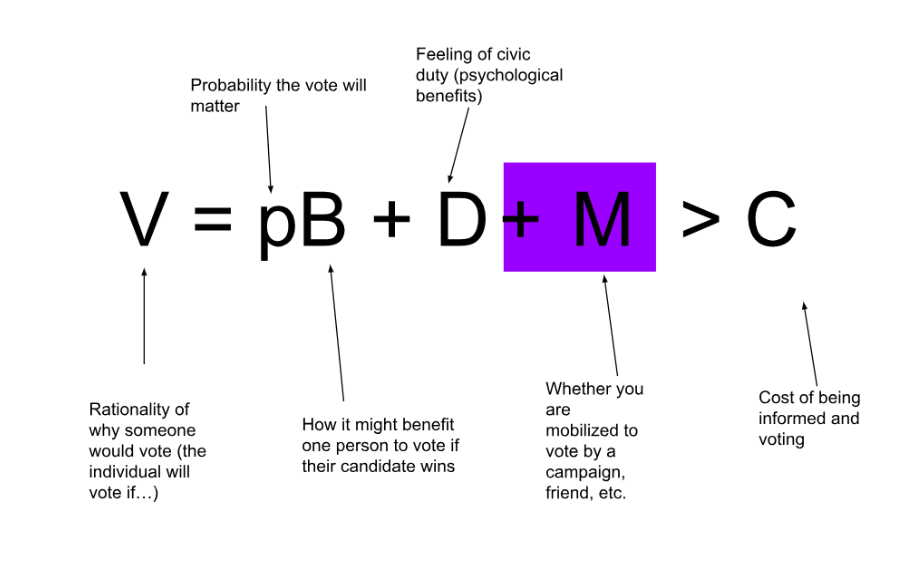
One person, one vote does not mean
equal influence
If everyone had perfect information…
every vote weighs the same
Except information is unequal and costly: people with resources to persuade others’ votes count more
People who consider themselves “strong” believers in one party tend to…
vote more
We have an unrepresentative electorate (white, older, wealthier, more educated)
Those who are overrepresented are more likely to be mobilized by parties, interest groups and campaign
People are more likely to vote in a…
presidential election rather than a midterm
Campaigns often do little to convince people to
switch their vote (not worth the effort)
Independents outnumber democrats and republicans, except…
not all of these people are truly independent
Most people who lean one way or the other are going to vote for that side
Negative campaigns often contain more
salient (more important) info about issues
Parties want to win, and they do that by recruiting enough people to vote for their candidates (solving collective action problems). How do they do this?
Parties need to appeal to the most amount of people
Make it easier for candidates to pool resources
Mobilize free rider voters to vote
Keep candidates accountable to voters by avoiding influence from outside groups
Federal Election Campaign Act (1971, 1974, 1976, 1979)
establishes FEC which monitors elections, sets contribution limits, public funding for presidential campaigns, disclosures, etc.
Bipartisan Campaign Reform Act (2002)
struck down in 2010, reforms contribution limits, bans soft money–for party building activities, not for any candidate–to parties, limited electioneering by corporations)
Really hurt party organizations and their ability to have power and resources
NRSC vs. FEC (June 2026)
Parties can coordinate the money they send to specific candidates now for their campaigns because political party coordination and expenditure limits by FECA violates the first amendment (political speech).
Parties are still limited on how much they can spend on a candidate, but limit is higher and can be coordinated with candidate
Effects of candidates not getting much money from their parties previously
they get money from outside groups instead which tend to be more ideological which thus tend to support more ideological candidates → polarization increases
Changes who the candidates are (parties used to recruit more moderate candidates who could receive more votes)
Disclosure
FECA requires that all contributions of $200 or more must be identified and all expenditures of $200 or more must be reported
Effects of NRSC vs. FEC (2026)
Effect one: decision is a democratic correction bc there’s a need to empower parties so candidates are more moderate and thus appeal more votes
Through limits, more ideological candidates runs due to outside spending
Effect two: turning political parties into conduits for big donors
Small donors don’t reflect all of gen pop: stronger ideologue, way more partisan
Who donates?
People who don’t donate tend to be more moderate while those who donate tend to be stronger ideologues
As money donated goes up, so does allegiance to an ideology
What did political machines do? (concern: strong parties = political machines)
Increased voter turnout by offering jobs, money, or other special privileges to people who voted their candidates
Selected party nominees
Very effective because parties could negotiate in a private way
How did the 1920s end the era of political machines?
Progressive era and reform to end corruption
Ending political machines, muckraking, secret ballots, populism, women’s suffrage, candidate-centered, limiting the power of parties
What is a candidate-centered system?
Means the individual decides how to run rather than the party. Money is given individually to candidates not just in line w/ a party position
As congress becomes more polarized, reps tend to just vote along party lines (in OG candidate-centered system this wasn’t the case)
Effects of limiting party power
Less ability to coordinate, limited solving of collective action problems, lower voter turnout due to free will, less moderate candidates
We have a two-party system democracy: why?
Duverger’s law - First past the post electoral systems tend to create two-party systems
Reduced competition to two candidates: lesser of two evils
The Spoiler Effect
Stealing votes away from a candidate who has similar ideas to one of the two main candidates representing one of two main parties. They steal votes away from one party so the other side wins.
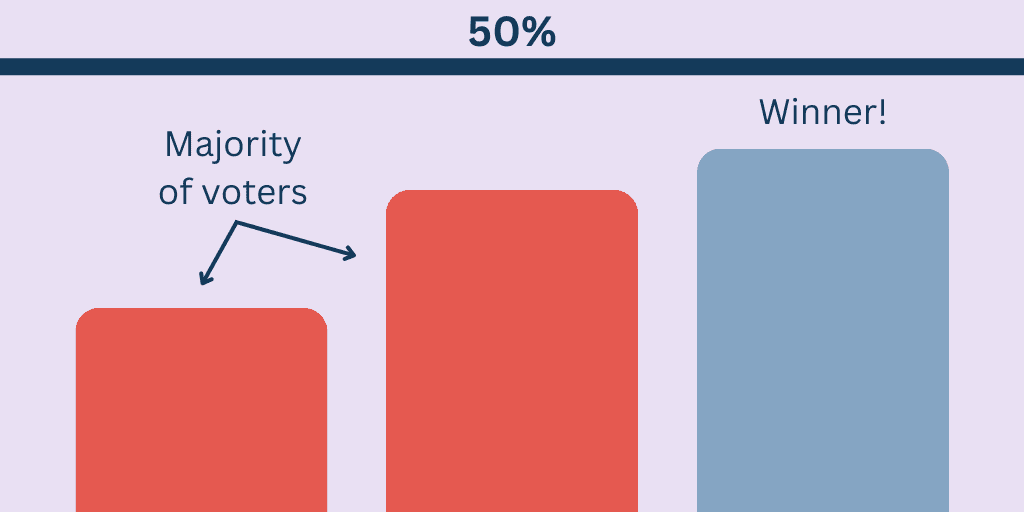
Features of proportional representation
Not winner-take-all, party-centered
If party gets some votes, then seats they get in legislature are proportional
Parties tend to recruit the candidates and committee selections
In this system, multiparty coalitions form to get bills passed
Limits transaction costs to an extent because need to work with other parties
Decreases conformity cost (parties don’t have to have a stance on every possible issue)