Chapter 26, virusses
 Call Kai
 Learn
Learn Practice Test
 Spaced Repetition
 Match
Match Flashcards
 Knowt Play
1/28

There's no tags or description
Looks like no tags are added yet.
Name | Mastery | Learn | Test | Matching | Spaced | Call with Kai | Chat |
|---|
No analytics yet
Send a link to your students to track their progress
29 Terms
what is a cirus
A virus is a small nucleic acid genome enclosed in a protein capsid and sometimes a membranous viral envelope. The genome may be single- or double-stranded DNA or RNA.
what happnes after a virus infects a host cell
it uses the host cell's molecules to make new viruses:
Virus enters host cell and releases genome, vial genome is DNA or RNA
then replicated by host enzymes
then transcribed by host enzymes, viral mRNA
then translated by host ribosmes, viral proteins,
then self-assembled by viral genome whcih makes new virus
With some viruses, the host cell bursts when the new viruses are released.
With some viruses, the host cell remains alive after the new viruses are released.
host range
the spectrum of cell types and host species that a virus is able to infect and successfully produce progeny virus from, affected by whether cell-surface proteins are present that viral surface pro- teins can bind to.
Phages
viruses that infect bacteria, can replicate by two alternative mechanisms: the lytic cycle and the lysogenic cycle
the lytic cycle
Virulent or temperate phage
Destruction of host DNA
Production of new phages
Lysis of host cell causes release of progeny phages
the lysogenic cycle
Temperate phage only
Genome integrates into bacterial chromosome as prophage, which
(1) is replicated and passed on to daughter cells and
(2) can be induced to leave the chromosome and initiate a lytic cycle
Retroviruses
a type of virus that stores its genetic information in the form of RNA instead of DNA and uses a special enzyme to copy that RNA into the host cell's DNA (reverse transcriptase)
reverse transcriptase
an enzymes used by retrovrisuses to copy their RNA genome into DNA, which can be integrated into the host genome as a provirus.
provirus
the genetic material of a virus that has merged into the DNA of a host cell
how did viruses evolve
Since viruses can replicate only within cells, they probably evolved after the first cells appeared, perhaps as packaged frag- ments of cellular nucleic acid.
how does baxcteria defend themslves against viruses
many ways, one way is the CRISPR-Cas system:
When a virus infects a bacterium, Cas proteins (such as Cas1 and Cas2) capture a small piece of viral DNA and insert it into the host's CRISPR array as a new "spacer"
The bacterial genome transcribes these stored sequences into pre-crRNA, which matures into guide RNA that pairs with a Cas protein.
If the same virus attacks again, the guide RNA matches the viral DNA, and the Cas protein acts as molecular scissors to cut and disable the invader.
Vaccines
they stimulate the immune system to defend the host against specific viruses.
epidemic
a widespread outbreak of a disease
pandemic
global epidemic
hwo do viruses enter plants
through damaged cell walls (hori- zontal transmission) or are inherited from a parent (vertical transmission).
Prions
slow-acting, virtually indestructible infectious pro- teins that cause brain diseases in mammals.
what is serpentinization and what molecules and ions are formed during the process
the result of the interaction of ocean water with rocks of the earth crust: H2, CH4, and H2S, OH-Ca2+ and Fe2+/Mg2+
the presence of the reverse gyrase gene in LUCA betrayed her life style, in what way?
LUCA lived in hot water, 70-90 centigrades, thermophiles
Thermophiles use the reverse gyrase enzyme to protect their DNA from extreme heat by introducing positive supercoils that prevent the DNA strands from melting apart
studies suggest that reverse gyrase was actually not present in LUCA, meaning LUCA was likely a mesophile or moderate thermophile rather than a hyperthermophile
reverse gyrase
a unique, ATP-dependent type I DNA topoisomerase that introduces positive supercoils into closed-circular DNA
Negative vs postive sense viruses
positive-sense viral RNA can act directly as messenger RNA (mRNA) for immediate protein translation, whereas negative-sense viral RNA is complementary to mRNA and must first be converted into a positive-sense strand before proteins can be made,
the negative sense virus must manufacture its own positive-sense strands inside the host cell
ebola virus
Family: Filoviridae
Genus: Orthoebolavirus
Species: Bundibugyo ebolavirus
Virus: Ebola virus (EBOV)
SS-RNA virus; single-stranded RNA
ebola virus, mutation and substitution rates
The mutation rate is very high because Ebola's replication enzyme lacks proofreading, generating millions of random genetic errors. The substitution rate is much lower because it only measures the small percentage of mutations that actually survive, stabilise, and get passed on to future generations.
Over 90% of Ebola’s random mutations are lethal to the virus itself. Strict biological filters constantly weed out these broken variations, keeping the virus's core structure remarkably stable over decades.
human virome
Virus-like particles in various parts of our body: oral cavity, nervous system, blood, skin, urinary system, semen, vagina, lung, gastrointestinal tract
Most viruses help to keep you intact; most of them have mellowed out to coexist, as you being dead does not benefit them; thus, we can’t notice them there
domain specific
viruses are domain speciif ceither, bacteria, archae, or eukaryotes except for rare exceptions there is no cross over, and every domain has it’s own virus genera
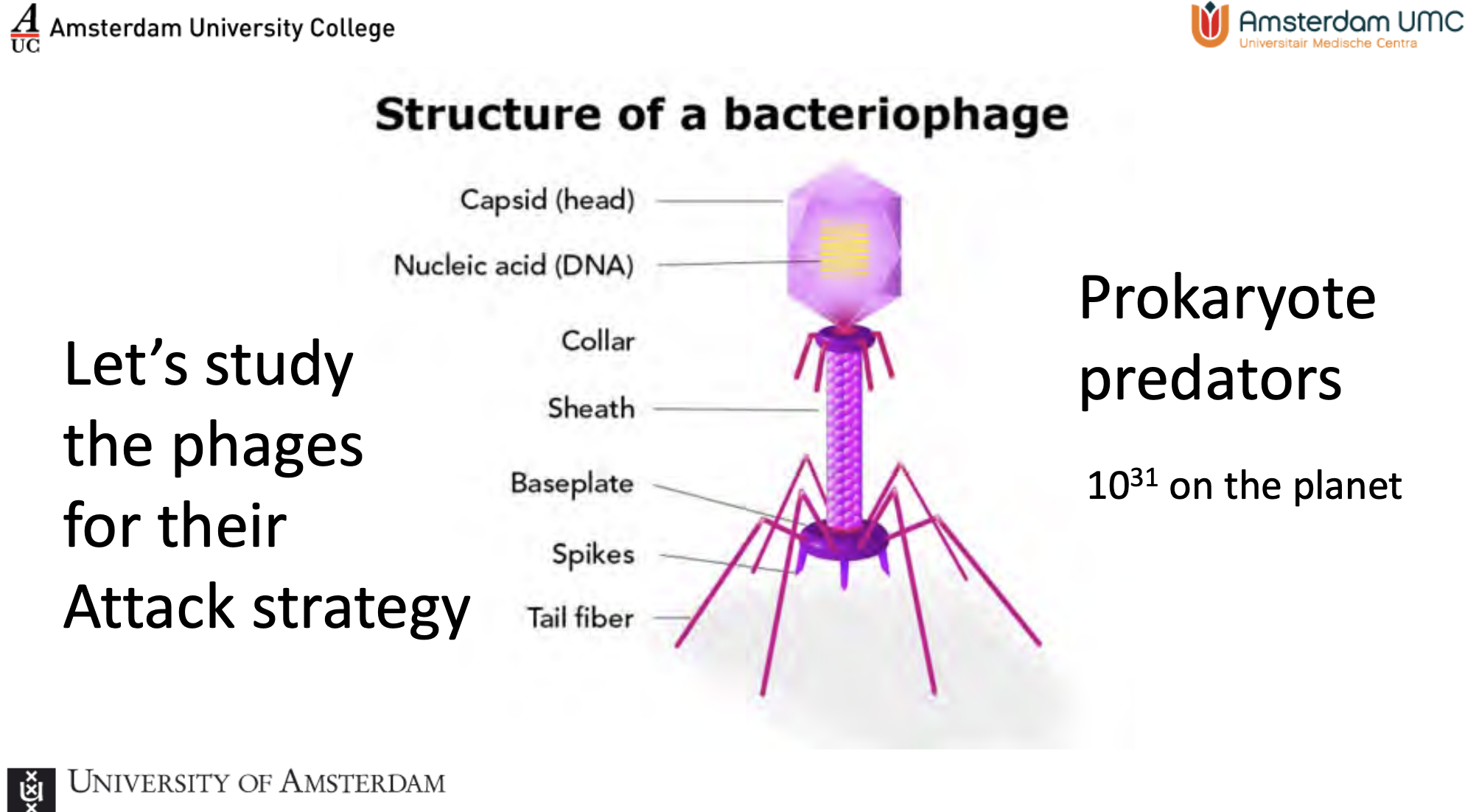
Structure of Bacteriophage
Capsid: head,
A protective protein shell that encloses and shields the viral genetic material from environmental damage.
Nucleic acid, holds DNA
The genetic blueprint (DNA or RNA) that contains the instructions to hijack the host bacterium and replicate new viruses.
Collar
A connecting structure that attaches the head to the tail and can help regulate tail contraction.
Sheath
A tubular "syringe" that contracts to inject the viral DNA into the bacterium.
Baseplate
The control center at the bottom of the sheath that triggers the injection mechanism once the virus hooks onto the host.
Spikes
Small projections that pierce the outer membrane of the bacterium to secure a firm grip
Tail fiber
Long, leg-like proteins that recognize and bind to specific receptors on the surface of the target bacteria.
restriction enzymes
cut DNA at specific, targeted nucleotide sequences
OCR protein
Overcome Classical Restriction protein
It inhibits bacterial restriction enzymes by mimicking DNA through the helical spin thsu acting as a distractor he restricting enzyme and inhibit its action (cutting DNA), so that phage can do it’s work
infection cycle of the T7 page
Class I: Early Genes (Infection & Host Takeover)
RNA Polymerase: The phage's own enzyme that takes over transcription from the host.
Protein Kinase: Inactivates the host's normal cell functions.
Ocr Protein: Overcomes the bacteria's classical restriction-modification defense system to protect phage DNA
Class II: Middle Genes (DNA Replication)
DNA Polymerase & Helicase/Primase: Replicates the phage's genetic material at a high rate.
Endonuclease & Exonuclease: Degrades the host bacterium's chromosome to use its parts for making new viral DNA.
Lysozyme: Inhibits Class I RNA polymerase to transition into the final stage of infection.
Class III: Late Genes (Virion Structure & Assembly)
Major Capsid & Tail Fibre Proteins: Form the physical shell, head, and legs of the new virus particles.
Terminase Subunits: Package the newly copied viral DNA into the freshly built capsids before the cell bursts to release them.
what is T7 phage
a bacteriophage (virus) that specifically preys on E. coli bacteria