OMFPR 14 - Radiographic Interpretation of Dental Caries and Perio Disease (Dr. Pabla)
 Call Kai
 Learn
 Practice Test
 Spaced Repetition
 Match
 Flashcards
 Knowt Play
1/148

There's no tags or description
Looks like no tags are added yet.
149 Terms
dental caries
What is the most common disease of the mouth?
dental caries
What is the most common disease of the entire body?
identification
What is the first step in treating dental caries?
Radiology and clinical exam
What are the best tools to identify dental caries?
- To detect carious lesions not readily apparent by clinical examination
- To evaluate the extent or size of a lesion that has been detected
- Monitor progress of chemical therapy
What is the purpose of radiographic examination?
bitewing
What is the preferred radiographic examination type to detect caries?
true
T/F: Caries visible on a pan should be large enough to be clinically apparent
extraoral
Do extraoral or intraoral bitewings have lower resolution?
caries lesion
Define the following:
The manifestation of a net mineral loss subsequent to an imbalance in demineralization-remineralization over time
Caries detection
Define the following:
Detection of radiolucency in relative density of enamel and/ or dentin
radiolucent
Does a radiolucent or radiopaque lesion indicate caries in enamel/dentin?
ICDAS
What is the caries classification system called?
0
The caries progression ICCMS scoring system is labeled in 4 stages. What is the sound stage?
RA
The caries progression ICCMS scoring system is labeled in 4 stages. What is the initial stage?
RB
The caries progression ICCMS scoring system is labeled in 4 stages. What is the moderate stage?
RC
The caries progression ICCMS scoring system is labeled in 4 stages. What is the extensive stage?
RA1
What stage of RA is a radiolucency in the outer half of enamel?
RA2
What stage of RA is a radiolucency in the inner half of enamel with or without involving the DEJ?
RA3
What stage of RA is a radiolucency in the outer third of dentin?
RB4
What stage of RB is a radiolucency in the middle third of dentin?
RC5
What stage of RC is a radiolucency in the inner third of dentin?
RC6
What stage of RC is a radiolucency in the pulp involved?
- Pit and fissure
- Proximal
- Cervical and smooth surface
- Root
What are four locations caries are often found?
bitewings (most favorable imaging geometry)
Proximal caries are best seen with which type of radiograph?
classic cone shaped lesion
What is the shape of the lesion for proximal caries?
towards enamel
The base of the "triangle" of caries is facing where?
towards DEJ
The point of the "triangle" of caries in enamel is facing where?
proximal
What type of caries is present?

proximal
What type of caries is present?

proximal
What type of caries is present?
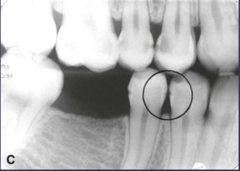
proximal
What type of caries is present?

RA1 (Caries in outer half of enamel)
What stage of caries is present?

RA1 (Caries in outer half of enamel)
What stage of caries is present?

RA1 (Caries in outer half of enamel)
What stage of caries is present?

RA2 (Caries within inner half of enamel)
What stage of caries is present?

RA2 (Caries within inner half of enamel)
What stage of caries is present?

RA3 (Caries within outer third of Dentin)
What stage of caries is present?
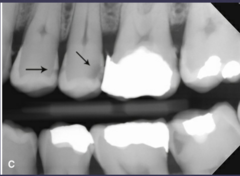
RA3 (Caries within outer third of Dentin)
What stage of caries is present?

RB4 (Caries within middle third of Dentin)
What stage of caries is present?

RB4 (Caries within middle third of Dentin)
What stage of caries is present?
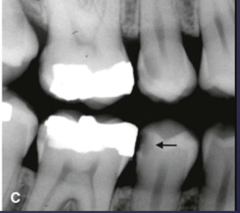
RC5 (Caries within inner third of Dentin)
What stage of caries is present?

RC5 (Caries within inner third of Dentin)
What stage of caries is present?

RC6 (Caries in contact with pulp)
What stage of caries is present?
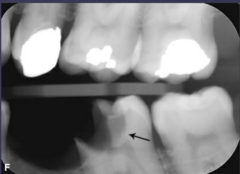
RC6 (Caries in contact with pulp)
What stage of caries is present?

clinically
How do you usually detect occlusal caries?
occlusal
What type of caries is present?
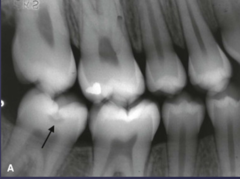
occlusal
What type of caries is present?

true
T/F: Incipient occlusal caries are difficult to detect
thin radiolucent line
How do moderate occlusal caries present?
large cavitation
How do severe occlusal caries present?
moderate occlusal caries
What type of occlusal caries is present?

severe occlusal caries
What type of occlusal caries is present?
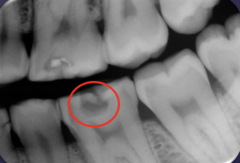
clinically
How are facial, buccal, and lingual caries usually detected?
SLOB rule and clinically
These are all facial/buccal or lingual caries, how can you tell what they are?
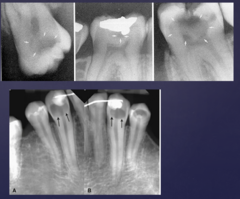
- Cementum
- Dentin
What two layers of the tooth are involved in root surface caries?
Gingival recession
What are root surface caries associated with?
root surface caries
What type of caries are these?

root surface caries
What type of caries are these?

true
T/F: Almost every tooth on these radiographs has proximal carious lesions
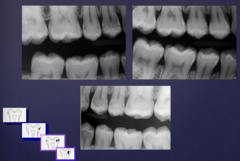
Recurrent caries
Define the following:
Caries at the margin of an existing restoration
recurrent caries
What type of caries are these?

Recurrent caries
What type of caries are these?

Recurrent caries
What type of caries are these?

recurrent caries
What type of caries are these?

Recurrent carries
What type of caries are these?

rampant caries
What type of caries?
Advanced and severe caries affecting a number of teeth. Associated with children and adults with poor diets and adults with decreased salivary flow.
rampant caries
What type of caries?

radiation caries
What type of caries is induced by loss of salivary gland function leading to xerostomia and usually affects the cervical region?
radiation caries
What type of caries? (pt has radiation)

radiation caries
What type of caries? (pt has radiation)

Cervical burnout (not carries)
What type of caries?

Cervical burnout (not carries)
What type of caries?

Cervical burnout (not carries)
What type of caries?

Cervical burnout (not carries)
What type of caries?

Mach Effect
What has the following characteristics:
- Visual perceptual artifact (differential stimulation and inhibition of neighboring receptors in retina)
- Edge enhancement effect
- A light shade that becomes even lighter, a darker shade that becomes even darker
- Differentiate from caries
Mach Bands (not caries)
What type of caries?

Mach Bands (not caries)
What type of caries?
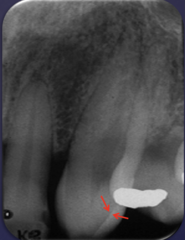
Mach Bands (not caries)
What type of caries?

Mach Bands (not caries)
What type of caries?

No, composite restorations
Are these caries?
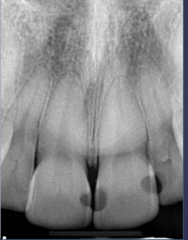
yes (recurrent caries)
Are there caries where the arrow is pointing?

attrition
What occurred where the arrows are pointing?

hypoplastic enamel
What is occuring at the arrows?
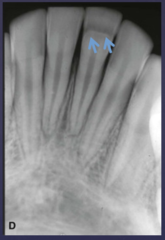
clasp from partial denture (would see clinically)
What is occuring at the arrow?

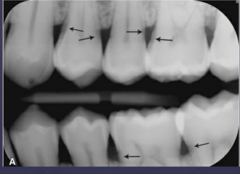
caries
The left arrow is showing what?

cervical burnout
The right arrow is showing what?
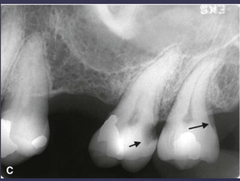
cervical burnout
Cervical burnout or caries?
caries
Cervical burnout or caries?

cervical burnout (disappears in enhanced radiograph)
Cervical burnout or caries? (same photo twice, lower is enhanced)

- Cementum
- PDL
- Alveolar bone
- Gingiva
The periodontium consists of what four elements?
- PDL space
- Lamina dura
- Alveolar bone
Radiographs can evaluate what three features?
Bitewing radiographs (vertical or horizontal)
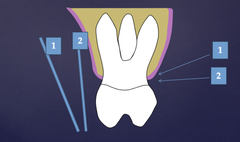
What radiographs assess crestal bone and minimize geometric distoration?
PA (25°)
#1 shows the beam geometry from which type of radiograph? (BW or PA)

BW (5°)
#2 shows the beam geometry from which type of radiograph? (BW or PA)
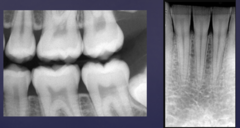
Yes
Does this show a normal appearance of alveolar crest?

Yes
Does this show a normal appearance of alveolar crest?

Yes
Does this show a normal appearance of alveolar crest?
CEJ
What is the alveolar crest parallel to in normal bone?
0.5-2mm
What is the normal height between the alveolar bone and CEJs?

lamina dura
There is a sharp angle between the alveolar crest and the ___________