Molars - Sample Question Pool
 Call Kai
 Learn
 Practice Test
 Spaced Repetition
 Match
 Flashcards
 Knowt Play
1/65

Earn XP
Description and Tags
Molar money molar problems
66 Terms
The largest cusp of the permanent maxillary teeth is the
A. facial cusp of the second premolar.
B. mesiofacial cusp of the maxillary first molar.
C. mesiolingual cusp of the maxillary first molar.
D. mesiolingual cusp of the maxillary second molar.
C. mesiolingual cusp of the maxillary first molar.
The permanent mandibular second molar differs from the permanent mandibular first molar in number of
A. cusps.
B. roots.
C. lingual grooves.
D. marginal ridges.
A. cusps.

Which of sketches illustrates the mesial view of the permanent maxillary right second molar?
A. 1
B. 2
C. 3
D. 4
D. 4
The ridges which together make up the oblique ridge of a maxillary first molar meet near the center of the occlusal surface on a level with the
A. tips of the mesiolingual and distofacial cusps.
B. depth of the central and distal fossae.
C. cusp of Carabelli.
D. marginal ridges.
E. central groove.
D. marginal ridges.
In a mesiodistal cross section, what is the direction of enamel rods in the cervical third of the crown of a permanent maxillary first molar?
A. They incline apically.
B. They slope occlusally.
C. They run horizontally.
D. They blend smoothly onto the root.
E. None of the above. Enamel rods are not evident in this
region.
A. They incline apically.
Viewed from the occlusal, which two teeth may have buccal convergence of the proximal surfaces?
A. Mandibular second premolar and maxillary first molar
B. Mandibular first molar and maxillary second premolar
C. Maxillary first premolar and mandibular second premolar
D. Maxillary second premolar and mandibular first premolar
A. Mandibular second premolar and maxillary first molar

Which of the sketches below best represents an occlusal view of a permanent maxillary left third molar?
A. 1
B. 2
C. 3
D. 4
E. 5
B. 2

Identify the permanent maxillary tooth sketched below.
A. Right first molar.
B. Left first molar.
C. Right second molar.
D. Left second molar.
A. Right first molar.
The cusp of Carabelli is normally found on which aspect of a molar crown?
A. Mesiofacial
B. Mesiolingual
C. Distofacial
D. Distolingual
E. Near the midpoint of the lingual surface
B. Mesiolingual
Generally, contact areas between posterior teeth are located in which directions from the center of the proximal surface?
A. Facially and occlusally
B. Facially and gingivally
C. Lingually and gingivally
D. Lingually and occlusally
A. Facially and occlusally
Identify the tooth. The distobuccal and distolingual cusps are not prominent. A greater portion of the occlusal surface is visible from the distal. The distobuccal root is often narrow and the lingual root shows little projection beyond the crown. This best describes the permanent
A. maxillary left second molar.
B. maxillary right third molar.
C. maxillary left third molar.
D. mandibular left second molar.
E. mandibular right second molar.
A. maxillary left second molar.
From the occlusal view, the permanent mandibular first molar has four major cusps. In increasing size, from small to large, they are
A. DB, DL, ML, MB.
B. D, DB, MB, ML.
C. DL, MB, ML, DB.
D. ML, MB DB, DL.
E. MB, ML, DL, D.
A. DB, DL, ML, MB.
Which line angle is most acute when a permanent maxillary second molar is viewed occlusally?
A. Mesiofacial
B. Distofacial
C. Mesiolingual
D. Distolingual
A. Mesiofacial
The occlusal outline of a permanent maxillary first molar contains two obtuse and two acute angles. The acute angles are the
A. mesiolingual and distolingual.
B. mesiofacial and distolingual.
C. mesiolingual and distofacial.
D. mesiofacial and distofacial.
E. distofacial and distolingual.
B. mesiofacial and distolingual.
Which cusp of permanent maxillary second molars becomes progressively smaller from first to second to third molars?
A. Mesiofacial
B. Mesiolingual
C. Distofacial
D. Distolingual
E. Cusp of Carabelli
D. Distolingual
The height of contour of the facial surface of the permanent mandibular first molar is located
A. in the cervical third.
B. at the center of the middle third.
C. at the junction of the occlusal and middle thirds.
D. at the junction of the cervical and middle thirds.
A. in the cervical third.
The occlusal outline of the permanent maxillary first and second molars is usually described as being
A. rhomboidal.
B. rectangular.
C. trapezoidal.
D. square.
E. triangular.
A. rhomboidal.
The height of contour occlusocervically is located within the middle third of the
A. distal surface of a permanent maxillary central incisor.
B. lingual surface of a permanent maxillary first molar.
C. facial surface of a permanent mandibular first premolar.
D. facial surface of a permanent mandibular first molar.
B. lingual surface of a permanent maxillary first molar.
Pits in the occlusal surfaces of premolars and molars are at the junction of the
A. marginal ridges.
B. inclined planes and cusp tips.
C. developmental grooves.
D. facial and mesial surfaces.
C. developmental grooves.
Deep concavities in cervical areas occur on which axial surfaces of permanent maxillary teeth?
A. Mesial surfaces of canines and first premolars
B. Mesial surfaces of central incisors and first premolars
C. Distal surfaces of second premolars and second molars
D. Mesial surfaces of first premolars and distal surfaces of first molars
D. Mesial surfaces of first premolars and distal surfaces of first molars
Which of the following permanent teeth has a mesiodistal measurement greater lingually than facially?
A. Maxillary canine
B. Maxillary first molar
C. Mandibular first molar
D. Maxillary first premolar
E. Mandibular first premolar
B. Maxillary first molar
The transverse groove of the oblique ridge of a permanent maxillary molar connects which of the following pits?
A. Distal and distofacial
B. Central and distofacial
C. Central and distal
D. Central and mesial
E. Central and lingual
C. Central and distal
The most reliable distinguishing feature of the mandibular third molar is the
A. fused and compressed root system.
B. short bulbous outline of the crown.
C. marginal ridge forming a small crown.
D. marked distal inclination of the root trunk.
E. great morphologic resemblance to first molar.
D. marked distal inclination of the root trunk.
When a mandibular posterior tooth is viewed from the proximal, the shape of the crown is
A. trapezoidal.
B. rhomboidal.
C. rectangular.
D. triangular.
B. rhomboidal.
The cusp of Carabelli on a permanent maxillary molar is located on the
A. distolingual lobe of the first molar.
B. mesiolingual lobe of the first molar.
C. mesiobuccal lobe of the first molar.
D. mesiolingual lobe of the second molar.
E. mesiobuccal lobe of the second molar.
B. mesiolingual lobe of the first molar.
On the permanent mandibular molars, the lingual height of contour is located
A. in the cervical third.
B. at the junction of the cervical and middle thirds.
C. in the middle third.
D. in the occlusal third.
C. in the middle third.
Which of the following permanent teeth would be expected to have the most variable occlusal anatomy?
A. Maxillary lateral incisor
B. Maxillary second premolar
C. Mandibular second premolar
D. Mandibular second molar
E. Maxillary third molar
E. Maxillary third molar
Which of the following is a distinct characteristic of a permanent maxillary molar?
A. Lingual pit
B. Buccal groove
C. Mesiobuccal cusp
D. Distolingual groove
E. Prominent distobuccal cusp
D. Distolingual groove
The largest cusp on permanent maxillary first molar is the
A. distobuccal.
B. mesiobuccal.
C. distolingual.
D. mesiolingual.
D. mesiolingual.
The lingual embrasures associated with the permanent maxillary first molars are relatively small. The reason for this is that the
A. maxillary second premolar and second molar are broader lingually than buccally.
B. maxillary first molar has a broader lingual surface than buccal surface.
C. maxillary second premolar is often rotated mesially.
D. arch curve is extreme in this region.
B. maxillary first molar has a broader lingual surface than buccal surface.
The height of contour of the facial surface of a permanent mandibular first molar is at
A. junction of the occlusal and middle thirds.
B. center of the middle third.
C. In the cervical third
D. junction of the cervical and middle thirds.
C. In the cervical third
How many primary developmental grooves are on the mandibular second molar when viewed from the occlusal?
A. 2
B. 3
C. 4
D. 5
B. 3

The sketch below represents the
A. mesial view of a permanent mandibular first molar.
B. mesial view of a permanent mandibular second molar.
C. mesial view of a permanent mandibular third molar.
D. distal view of a permanent mandibular first molar.
E. distal view of a permanent mandibular second molar.
D. distal view of a permanent mandibular first molar.
Which of the following permanent teeth is most likely to show an anomaly in radicular morphology?
A. Maxillary canine
B. Maxillary third molar
C. Maxillary first molar
D. Mandibular first molar
E. Maxillary lateral incisor
B. Maxillary third molar
The three major cusps that form the primary cusp triangle on a maxillary molar are the
A. mesiofacial, distofacial and mesiolingual.
B. mesiofacial, distolingual and mesiolingual.
C. mesiofacial, distofacial and distolingual.
D. mesiofacial, distofacial and cusp of Carabelli
A. mesiofacial, distofacial and mesiolingual.
Proximal contact of posterior teeth creates wear patterns which eventually
A. decrease contact areas.
B. decrease embrasure spaces.
C. increase interproximal spaces
D. increase ratio of the lingual to labial crown length.
B. decrease embrasure spaces.
When in its proper position in its segment of the curve of Spee, the crown of the mandibular second molar inclines
A. distally and buccally.
B. mesially and buccally.
C. mesially and lingually.
D. distally and lingually.
C. mesially and lingually.
Each of the following statements regarding the occlusal surface of a permanent maxillary first molar is correct EXCEPT
A. The tip of the mesiolingual cusp is located distally to the tip of the mesiobuccal cusp.
B. The tip of the distobuccal cusp is located lingually to the tip of the mesiobuccal cusp.
C. The occlusal surface is usually distinctly divided by a ridge from the mesiolingual cusp to the distobuccal cusp.
D. The mesial and distal fossae are joined by a well defined central groove.
E. The mesial border is broader than the distal border.
D. The mesial and distal fossae are joined by a well defined central groove.
Viewed occlusally, the proximal contact between maxillary first and second molars is located
A. lingual to a mesiodistal line bisecting the crowns.
B. facial to a mesiodistal line bisecting the crowns.
C. midway between facial and lingual surfaces
B. facial to a mesiodistal line bisecting the crowns.
The most constant and valuable trait in differentiating among maxillary first, second and third molars is the
A. height of cusps.
B. number of roots.
C. depth of central fossae.
D. comparative size of the cusp of Carabelli.
E. relative position of the distolingual groove.
E. relative position of the distolingual groove.
Which of the following represents the largest cusp of the permanent mandibular first molar?
A. Distal
B. Mesiofacial
C. Mesiolingual
D. Distofacial
E. Distolingual
B. Mesiofacial
Which of the following features would be of value in distinguishing between a maxillary and a mandibular molar?
A. Maxillary molars are wider mesiodistally than buccolingually.
B. Maxillary molars have buccal and lingual cusps located equidistant from the buccal and lingual surfaces respectively.
C. Maxillary molars have four functional cusps.
D. Maxillary molars have shorter roots.
B. Maxillary molars have buccal and lingual cusps located equidistant from the buccal and lingual surfaces respectively.
The smallest cusp of a permanent mandibular first molar is the
A. distal.
B. distofacial.
C. mesiofacial.
D. distolingual.
E. cusp of Carabelli.
A. distal.
The occlusal outline of a permanent maxillary first molar contains two obtuse angles and two acute angles. The acute angles are the
A. mesiofacial and distofacial.
B. mesiofacial and distolingual.
C. distofacial and distolingual.
D. mesiolingual and distofacial.
E. mesiolingual and distolingual.
B. mesiofacial and distolingual.
The permanent second mandibular molar differs from the permanent mandibular first molar in number of
A. cusps.
B. roots.
C. lingual grooves.
D. marginal ridges.
A. cusps.

Which of the following is the distal view of a permanent maxillary first molar?
A. 1
B. 2
C. 3
D. 4
D. 4
Which of the following are characteristics of a permanent mandibular first molar?
A. Two roots and two canals
B. Two roots and three canals
C. Three roots and two canals
D. Three roots and three canals
B. Two roots and three canals

The sketch below represents the
A. facial view of a permanent right mandibular second molar.
B. lingual view of a permanent mandibular right second molar.
C. facial view of a permanent mandibular left second molar.
D. lingual view of a permanent mandibular left second molar
E. lingual view of primary mandibular left second molar.
A. facial view of a permanent right mandibular second molar.

Which of the following sketches illustrates the occlusal view of the permanent mandibular right first molar?
A. 1
B. 2
C. 3
D. 4
E. 5
C. 3
Occlusocervically, the height of the mesial marginal ridge of a permanent mandibular first molar is the same as the height ofthe
A. triangular ridge of the mesiofacial cusp of a mandibular first molar.
B. Triangular ridge of the distofacial cusp of a mandibular first molar.
C. distal marginal ridge of a mandibular first molar.
D. mesial marginal ridge of a mandibular second molar.
E. distal marginal ridge of a mandibular second premolar.
E. distal marginal ridge of a mandibular second premolar.
The permanent molar with the shallowest central fossa is the
A maxillary first.
B. mandibular first.
C. maxillary second.
D. mandibular second.
E. mandibular third.
E. mandibular third.
The most obvious characteristic which distinguishes permanent maxillary first from second and second from third molars is the
A. fifth cusp.
B. height of the root trunk.
C. size of the distolingual cusp.
D. size of the crown and inclination of the roots.
E. number and distribution of accessory grooves on the occlusal surface.
C. size of the distolingual cusp.
On a maxillary molar, which of the following ridges is formed by the union of the distal ridge of the mesiolingual cusp and the triangular ridge of the distofacial cusp?
A. Cuspal
B. Central
C. Marginal
D. Oblique
E. Transverse
D. Oblique
Which of the following teeth have long axes positioned with their root apices facial and their crowns lingual?
A. Maxillary incisors
B. Mandibular incisors
C. Maxillary premolars
D. Maxillary molars
E. Mandibular molars
E. Mandibular molars

Which of the following is the buccal view of the permanent maxillary right first molar?
A. 1
B. 2
C. 3
D. 4
A. 1
Viewed from the occlusal, the greatest Faciolingual diameter of a permanent mandibular second molar is located in which third of the crown?
A. Distal
B. Mesial
C. Middle
D. None of these
B. Mesial
Which of the following molars most frequently have only 3 cusps?
A. Maxillary first
B. Mandibular first
C. Maxillary third
D. Mandibular third
C. Maxillary third
Which root of a permanent maxillary first molar is flattened mesiodistally and has root depressions on its mesial and distal surfaces?
A. Lingual
B. Distofacial
C. Mesiofacial
D. Mesiolingual
E. Distolingual
C. Mesiofacial
From the facial view, the maxillary first molar has its lingual root apex in line with which of the following?
A. Facial groove
B. Distofacial line angle
C. Distofacial cusp
D. Mesiofacial cusp
E. Mesiodistal diameter midpoint
A. Facial groove
When viewed lingually, the permanent maxillary first molar has its lingual root apex in line with the
A. distolingual groove.
B. distolingual line angle.
C. distolingual cuspal eminence.
D. height of the mesiolingual cusp.
E. mesiodistal diameter midpoint.
E. mesiodistal diameter midpoint.
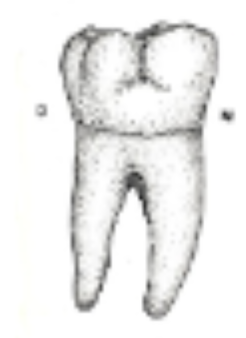
The sketch below represents the facial view of a
A. permanent mandibular right first molar.
B. permanent mandibular left first molar.
C. permanent mandibular right second molar.
D. permanent mandibular left second molar.
E. primary mandibular right second molar.
A. permanent mandibular right first molar.
Which of the following roots is most likely to have a concavity on either or both of its facial and lingual surfaces?
A. Root of a maxillary second premolar
B. Lingual root of a maxillary first molar
C. Mesial root of a mandibular first molar
D. Distal root of a mandibular second molar
E. Mesiofacial root of a maxillary first molar
B. Lingual root of a maxillary first molar
Which of the following is not characteristic of a maxillary first molar?
A. The central groove runs in a mesiodistal direction.
B. The mesial contact area is located towards the mesiofacial line angle.
C. The mesial surface has the deepest concavity found on the mesial surface of any permanent tooth.
D. The occlusal surface has a wrinkled appearance because of accessory grooves arising from the central groove.
D. The occlusal surface has a wrinkled appearance because of accessory grooves arising from the central groove.
The area of a tooth which is bordered facially and lingually by the crest of the cuspal ridges of facial and lingual cusps and mesially and distally by the crest of the marginal ridges is properly referred to as the
A. occlusal table.
B. clinical crown.
C. anatomic crown
D. occlusal surface.
A. occlusal table.
In the comparison of the rhomboidal and heart-shaped crown outlines of maxillary molars, the crown portion that differs most in contour and size is the
A. mesiofacial.
B. distofacial.
C. mesiolingual.
D. distolingual.
D. distolingual.
The largest and longest cusp in posterior teeth is the
A. mesiolingual of a maxillary first molar.
B. distolingual cusp of a maxillary first molar.
C. mesiofacial cusp of a mandibular first molar.
D. distofacial cusp of a mandibular first molar.
A. mesiolingual of a maxillary first molar.