isomerism
 Call Kai
 Learn
Learn Practice Test
 Spaced Repetition
 Match
Match Flashcards
 Knowt Play
1/20

There's no tags or description
Looks like no tags are added yet.
Name | Mastery | Learn | Test | Matching | Spaced | Call with Kai | Chat |
|---|
No analytics yet
Send a link to your students to track their progress
21 Terms
isomerism
isomers are molecules that have the same molecular formula, but have a different arrangement of the atoms in space
2 types: constitutional isomerism and stereoisomerism
constitutional isomerism
same molecular formula
different structural formula → different arrangement of atoms
3 types: chain isomerism, positional isomerism, and functional group isomerism
stereoisomerism
same molecular formula
same structural formula
different spatial arrangement of atoms → different 3-d orientation of atoms in space
2 types: cis-trans isomerism and enantiomerism
chain isomerism → constitutional isomerism
chain isomers differ only in the structure of their carbon skeleton
have similar chemical properties but different physical properties
positional isomerism → constitutional isomerism
positional isomers belong to the same homologous series with the same functional group at different positions of the same carbon skeleton
have similar chemical properties but different physical properties
functional group isomerism → constitutional isomerism
functional group isomers have different functional groups
have different physical and chemical properties ⇒ different homologous series
stereoisomerism
stereoisomers have the same structure and functional groups but differ in the way their atoms are arrange in space → atoms or groups are orientated differently to each other
cis-trans isomerism
for a molecule to exhibit cis-trans isomerism, the following 2 criteria must be met:
there is restricted rotation about a carbon-carbon bond ⇒ double bond or ring
two different groups (or substituents) bonded to each carbon with the restricted bond
cis-trans isomerism in alkenes
there is restricted rotation about the C=C double bond in alkenes ⇒ due to presence of the π bonds in the C=C double bond
cis-trans isomerism occurs only if there are two different substituents attached to each carbon atom of the double bond
an alkene with cis-trans isomerism can exist as a pair of cis-trans isomers
cis-isomer has the two identical groups on the same side of the double bond
trans-isomer has the two identical groups on different sides of the double bond
cis and trans isomers have different physical properties
cis-isomer:
higher boiling point because of its higher polarity
lower melting point because of its poorer packing in its solid state, giving rise to less extensive instantaneous dipole-induced dipole interactions between the molecules
cis and trans isomers generally have similar chemical properties
certain cis and trans isomers can differ in their chemical reactivities due to difference in the proximity of the functional groups
cis-trans isomerism in cyclic compounds
atoms joined in a ring are not free to rotate around the sigma bonds of the ring ⇒ ring takes the place of the rigid double bond
two substituents on adjacent (side-by-side) carbon atoms of a cyclic compound ⇒ cis-trans isomerism
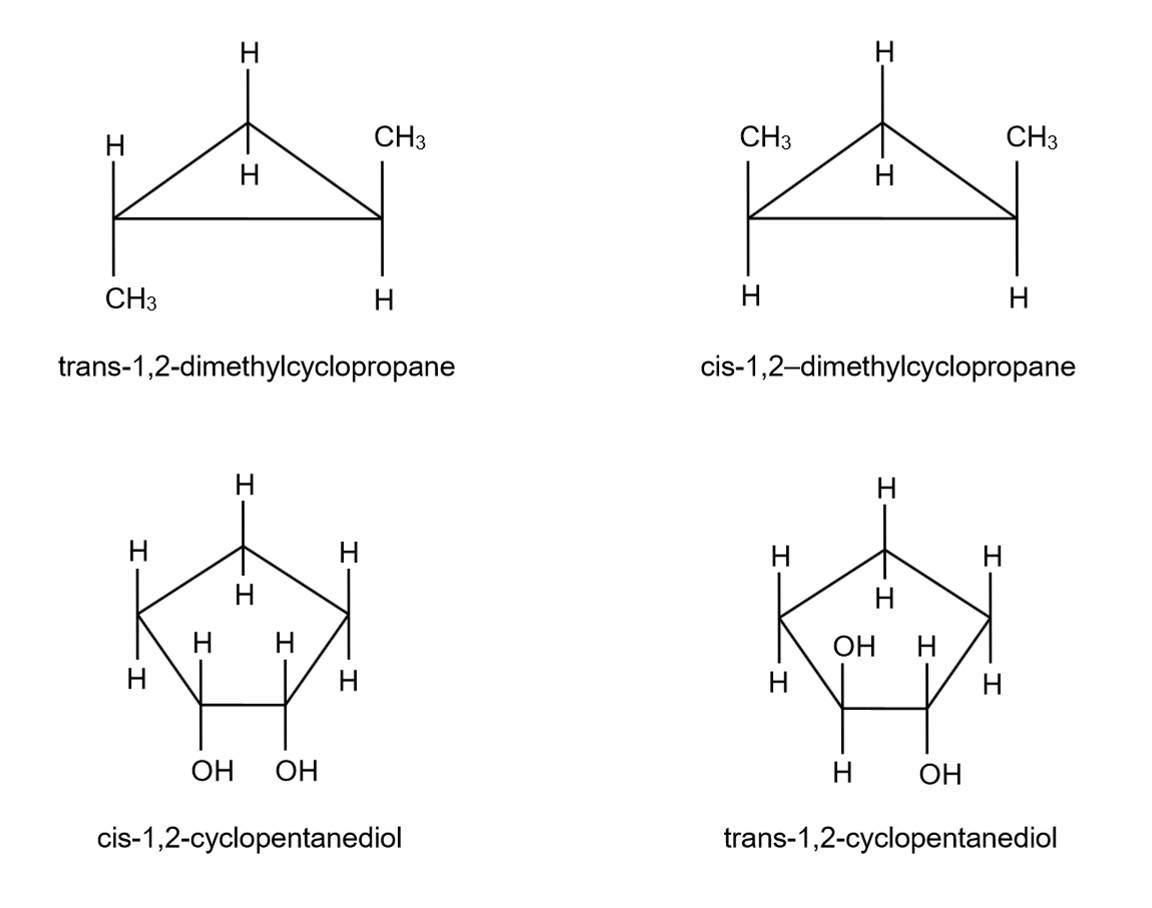
to identify if a compound can exhibit cis-trans isomerism
check that it has at least one double bond OR a ring
check that there are 2 different substituents bonded to each C where there is restricted rotation
cycloalkenes with 8 carbon atoms in the ring or less do not exhibit cis-trans isomerism ⇒ those with 8 or more carbon atoms can exhibit cis-trans isomerism
chiral molecules, achiral molecules and chiral centres
chiral: non-superimposable mirror images
achiral (not chiral): superimposable mirror images
enantiomers (chiral): non-superimposable mirror images of the molecule (itself and mirror image)
a molecule is chiral if it
has at least one chiral carbon atom
indicated by a *
bonded to 4 substituents/groups
no plane of symmetry
non-superimposable on its mirror image ⇒ definitive criterion for a molecule to be chiral

chiral centres
presence or absence of chiral carbons or centres is a useful but not a sufficient condition for a molecule to be chiral or achiral
a molecule can possess chiral centres and yet remains achiral
a molecule without chiral centres can still be chiral
plane of symmetry
a molecule with a plane of symmetry must be achiral, while a molecule without a plane of symmetry is usually chiral but not always
wedge-dash notation
the shape of the molecule is tetrahedral with respect to C atom → 109.5°
when drawing a pair of enantiomers, the three-dimensional structure should be represented using the wedge-dash notation:

chemical properties of enantiomers
enantiomers have identical chemical properties (dependent on functional group) except in their interactions with another chiral molecule
enantiomers show different rates of reaction towards other chiral molecules and have different solubilities in solvents that are chiral
physical properties of enantiomers
enantiomers have identical physical properties (identical structure) except for the direction in which they rotate plane-polarised light
optical activity
the ability of a substance to rotate the plane of plane-polarised light passed through the substance
polarised light is light that vibrates in only one plane, in contrast to ordinary light which vibrates in all planes
when polarised light is passed through certain substances, the plane of the vibration is rotated a certain angle, different for each substance
instrument: polarimeter
a sample which can rotate the plane of polarised light: optically active and contains chiral molecules
a sample containing only achiral molecules do not rotate the plane of polarised light and are optically inactive
enantiomers rotate the plane of polarised light in equal amounts but in opposite directions (clockwise or anticlockwise)
a mixture which contains equal quantities of each enantiomer (50% (+) and 50% (-) forms) ⇒ racemic mixture/racemate and is indicated by (d,l) or (±) sign
since the rotating capacity of one enantiomer is cancelled out by that of the other, the racemic mixture is said to be optically inactive ⇒ does not rotate plane polarised light
enantiomerism in cyclic compounds
chiral centres in cyclic compounds
to determine if a carbon atom in a ring is chiral, examine the connection of atoms in the ring from the carbon of interest
the carbon atom is chiral if we do not encounter the same sequence and type of groups when we go in one direction as compared to the other direction on the ring

determining the number of stereoisomers
in general, for compounds with chiral centres and/or double bonds:
maximum number of stereoisomers = 2n+m
n: number of chiral centres
m: number of C=C double bonds which can exhibit cis-trans isomerism
biological properties of stereoisomers
different stereoisomers exhibit different biological properties
most drugs are chiral → usually only one mirror image form of the drug provides the desired effect, while the other mirror image form can be less active, inactive and even toxic
to exert its biological action, a chiral molecule must fit into a chiral receptor at some target site → only one of the mirror images forms can fit properly into the receptor, and the other form is thus inactive
e.g.: thalidomide contains two enantiomers
(+)-isomer has the intended effect of curing morning sickness
(-)-isomer causes birth defects