4 - Applying Newtonian Mechanics
 Call Kai
 Learn
Learn Practice Test
 Spaced Repetition
 Match
Match Flashcards
 Knowt Play
1/39

There's no tags or description
Looks like no tags are added yet.
Name | Mastery | Learn | Test | Matching | Spaced | Call with Kai | Chat |
|---|
No analytics yet
Send a link to your students to track their progress
40 Terms
You are lying on your back on the slope of a grassy hill, watching the clouds go by overhead. Which is the best statement about the force of friction exerted on you by the ground in this situation?
A force of static friction pointing “up the hill”, parallel to the surface of the hill, is applied to you by the ground.
Frictional forces always act in a direction parallel to the surfaces that are interacting.
X sliding along the hill, so a force of static friction must be keeping you from sliding down the hill by pointing up the hill.
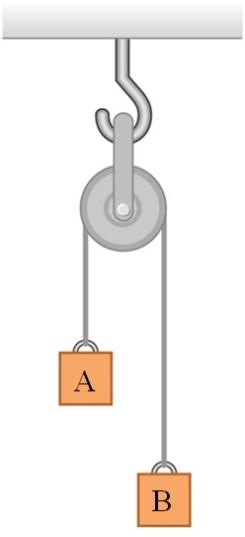
Blocks A and B have equal masses and are connected by a rope that passes over a frictionless pulley, as shown. At this moment, the system is at rest. Compare the magnitudes of the force of tension exerted on block A and the force of tension exerted on block B.
force of tension exerted on block A is equal in magnitude to the force of tension exerted on block B.
rope @ rest = force each block exerts on the rope must be equal in magnitude (2nd law)
if each block exerts the same magnitude force on the rope, then the rope must exert the same magnitude force on each block (3rd law).
X matter what is happening to either end of the rope. As long as the rope is not accelerating the tension will always be exactly the same at both ends of the rope.
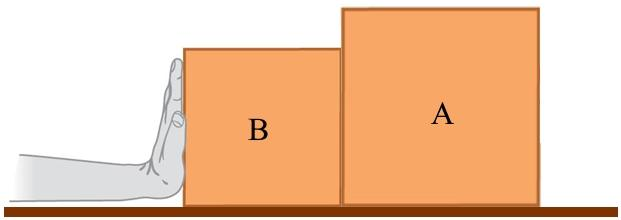
In the figure, a hand is pushing on block B to the right, causing both blocks to move to the right across a rough surface at a constant speed. Compare the force that pushes block B to the right to the force that pushes block A to the right.
The force that pushes block A to the right is smaller than the force that pushes block B to the right.
force pushing B is exerted by the hand, has to counteract kinetic friction & the force of A pushing back on B/total friction on both blocks
force pushing A is exerted by block B, has to counteract kinetic friction
You are standing in an elevator as it starts to move downward, accelerating for a moment. Which of these is true at that moment?
net force on you changes from 0 to downward as the elevator begins accelerating
Jack and Luis are pushing on opposite ends of a shopping cart. At the moment, the cart is staying at rest. We know that the forces each person exerts on the cart are equal in magnitude and opposite in direction. What is the reason this must be true?
Newton’s 2nd law tells us these 2 forces must be = & opposite
cart X moving = net force is 0
exerting = & opp forces on cart
X forming action-reaction pair
A box rests on a table. The normal force exerted by the table on the box is equal in magnitude to the weight of the box and points in the opposite direction. This is because ________________.
net force on the box is 0 = forces must be balanced, the box is in equilibrium.
You are about to check out at the grocery store and you put a box of cereal on the conveyer belt at the register. The cashier turns on the conveyor belt, causing the box of cereal to speed up momentarily. At this moment, what can we say about the frictional force acting on the box of cereal?
There is a static frictional force pointing in the box’s direction of motion, parallel to the conveyer belt.
box X slipping on belt
in direction of box’s accel = friction acting against sliding
EXPLANATION
The box starts at rest (or at a slower speed) and accelerates forward to match the moving belt.
The only horizontal force acting on the box is the friction from the belt.
Thus, the belt exerts a forward static frictional force on the box to pull it along and speed it up.
Miguel leans against a wall. Which statement is true about the forces Miguel and the wall exert on each other?
Miguel and the wall exert equal and opposite forces on each other.
impacts both objects = action-reaction pair

Blocks A and B have equal masses and are connected by a rope that passes over a frictionless pulley, as shown. At this moment, the system is in motion, with block B moving downward and A moving upward at a constant speed. Compare the magnitudes of the force of tension exerted on block A and the force of tension exerted on block B.
The force of tension exerted on block A is equal in magnitude to the force of tension exerted on block B.
rope moving @ constant speed = force is balanced, leading to no acceleration. (2nd law)
If each block exerts the same magnitude force on the rope, then the rope must exert the same magnitude force on each block (using Newton’s third law).
EXPLANATION
Constant Speed: The problem states that Block A moves upward and Block B moves downward at a constant speed. This means the acceleration ($a$) of both blocks is zero ($a = 0$).
Newton's First Law: For an object moving at constant velocity, the net vertical force acting on it must be zero (∑Fy=0).
Since the masses are equal ($m_A = m_B = m$), the tension pulling upward on Block A and the tension holding Block B both equal the weight of the blocks:
BOTH TENSIONS ARE =
A person is trying to pull a heavy crate across a room with a rope that is attached to the crate, but it doesn’t move. The tension in the rope ________________.
= at both ends of the rope
rope X accelerating = net force is 0, being pulled with = magnitude forces at both ends
EXPLANATION
The tension force ($T$) pulls the crate forward.
The static friction force ($f_s$) opposes the motion, pushing backward against the floor.
T-fs = 0 → T = fs
Static friction is a self-adjusting force. As long as the crate doesn't budge, increasing the tension in the rope simply causes the static friction force to increase by the exact same amount to keep the crate still.
The crate will only begin to slide if the tension in the rope exceeds the maximum static friction force (fs,max=μsN).

Stephanie pulls on a rope that is attached to a large crate. She is pulling the crate along at a constant speed as it slides across rough carpet. How does the magnitude of the force of tension exerted on Stephanie compare to the magnitude of the force of tension exerted on the crate?
force of tension on crate has same magnitude as tension force on her
moving @ constant velocity = X accel
forces must be = (2nd law, f= a)
tension forces will be = in magnitude (3rd law)
EXPLANATION
constant speed = 0 accel = 0 net force
0 net force → must be balanced (T=fk)
tensions at each end of the rope must be =, if they were diff forces rope accel away from itself (X POSSIBLE!)
force has to be same everywhere in the rope, and for fnet=0 forces have to balance out
Consider a car speeding up as it drives along a level road. Which of the following is an action-reaction pair (from Newton’s third law)?
The normal force exerted on the car by the road and the downward force exerted on the road by the car.
AR pair = pair of forces due to a single interaction
The mass of an object _____.
X a vector, has X direction
In general, when a car is driving along a straight road, the force of friction between a car tire and the road _____________.
can point either forward or backward, depending on what the car is doing.
gas pedal pushed down = static friction b/w road & tires pointing forward to help accel & X slide
brakes applied = static friction pointing backward = slow down
kinetic friction backward = stopping
EXPLANATION
Action: The tire pushes backward on the road.
Reaction: The road pushes forward on the tire.
That forward push from the road is the static friction force. It is the actual force that pushes the entire car down the street! Without that forward frictional force from the road (like on smooth ice), the tires would just spin in place and the car wouldn't move anywhere.
An object’s mass & weight are
proportional to e/o
mass = kg/oz
weight = force of gravity (N/lbs)
Michael leans on a shopping cart, causing it to start moving. Which statement is true about the forces Michael and the cart exert on each other?
exert = & opposite forces on e/o
causing the cart to accelerate forward.
Allison pulls her little brother, Brody, in a sled on a snow-covered path at a constant speed. Which of the following is an action-reaction pair (from Newton’s third law)?
The pulling force that Allison exerts on the sled and the pulling force that the sled exerts on Allison.
= & opposite → AR pair

Blocks A and B are connected by rope 1 and are pulled at constant speed across a rough surface by rope 2, which is attached to block B, as shown. Compare the magnitude of the tensions in ropes 1 and 2.
The magnitude of the tensions in the two ropes will not be equal
tension for rope 2 has to counteract total friction of A & B
EXPLANATION
rope 1 = only has to pull A against its friction
rope 2 = has to pull A & B against their frictions = greater tension force
Floating in deep space, you find yourself at rest next to a small asteroid. You reach out and tap the asteroid with a hammer. What happens to you in this process?
You will briefly accelerate away from the asteroid and then drift away at a constant speed.
asteroid & hammer exert = forces on e/o
holding hammer = causes accel away
Allison shoves her brother Brody away from her, causing him to fall down. Which of the following is an action-reaction pair (from Newton’s third law)?
The force that Allison exerts on Brody and the force that Brody exerts on Allison.
Josh punches his open left hand with his right hand. Which statement is true about the forces his two hands exert on each other?
The force that Josh's right hand exerts on his left hand and the force that his left hand exerts on his right hand are equal in magnitude and opposite in direction.
why? = for every action there’s an = & opposite rxn
While sparring, Katie punches Arman in the shoulder. Which statement is true about the forces Katie and Arman exert on each other?
The force that Katie exerts on Arman and the force that Arman exerts on Katie are equal in magnitude and opposite in direction.
Consider a car at rest, parked on level ground. The force of friction between a car tire and the ground _____________________.
is 0, 2 surfaces X trying to move past e/o
X friction needed to keep the care in place
Component Vector
is a projection of a vector in a specific direction, typically represented along the x and y axes in two-dimensional space. It helps in analyzing forces acting on an object by breaking them down into simpler, manageable parts.
Adding Vectors
tip to tail method, then find hypotenuse of a triangle made
Static Friction
is the force that prevents motion between two surfaces in contact, acting to keep an object at rest when no external force is applied.
direction = opp to where object would move w/o friction
Kinetic Friction
is the force that opposes motion between two surfaces in contact when an object is already in motion.
fsmax
is the maximum static friction force that can act between two surfaces before motion occurs, determined by the coefficient of static friction and the normal force.
threshold = force you must overcome to get an object moving
X always the actual friction aacting on an object
us & uk
us > uk
always harder to get something moving than it is to keep it moving
uk
coefficient of fk, measure of roughness b/w 2 surfaces
smooth surface = 0
ice on ice = low
brick on brick = high
During projectile motion, at which of the following positions does the projectile have zero speed?
never
speed of the vertical component does go to zero at the highest point where the projectile changes its direction, but the horizontal speed always remains constant and never goes to zero, so the resultant speed can never be zero
In a car that is speeding up, in which direction is the static friction exerted by the road on the tire pointing?
The static friction is exerted in the direction of the car's acceleration, which is the same direction that the car is speeding up.
inc speed = static friction force exerted by road = force causing car’s accel
A certain block on a horizontal frictionless surface would need a force of 2f applied to it to have an acceleration a. If 3 such blocks are stacked up, how much force should be applied to obtain the same acceleration?
6f
2nd law = magnitude of net force is m*a
3 blocks = mass 3x that of og blakc
require 3 times 2f force to produce same accel = 6f force
-The same sum of the forces is exerted on two different objects. The second object has twice the mass of the first object. Compare the acceleration of the two objects.
The acceleration of object 1 is twice the acceleration of object 2
A packing crate is sitting at rest on an inclined loading ramp. How does the magnitude of the static friction force component of the force exerted by the ramp on the crate compare to the other forces or force components exerted on the crate?
= to the magnitude of the component of the force that Earth exerts on the crate parallel to the inclined ramp
In general, how does the coefficient of static friction compare to the coefficient of kinetic friction for the same two materials?
The coefficient of static friction is greater than the coefficient of kinetic friction.
Suppose that C =A −B. Under what circumstances is the length of C is equal to the sum of the lengths of A and B
when A & B point in opp directions
Projectile Motion
combined horizontal & vertical motion of a launched object
horizontal → constant speed since X force in that direction
vertical → accel motion since gravity pulls down
can treat separately
anytime thrown/falling in air → free fall + moving sideways/horiz motion
Projectile Motion: X
isn’t affected by y
horizontal stay the same whole time
don’t accel in ax, ax = 0 & stays constant
horiz X affect vertical
Projectile Motion: Y
smaller at start → 0 at height/maxx height → largest on way down
accel in y direction only