alkene reactions

0.0(0)
Studied by 0 people
call kaiCall Kai
learnLearn
examPractice Test
spaced repetitionSpaced Repetition
heart puzzleMatch
flashcardsFlashcards
GameKnowt Play
Card Sorting

1/14

encourage image

There's no tags or description

Looks like no tags are added yet.

15 Terms

1
New cards

Purpose of alkene rxn

To go from an alkene to alkane, replace the ends of the alkene with two different substituents. Depending on the markonikov or anti markonikov, one will go to more substituted and the other goes to the less substituted.

2
New cards

Hydrohalogenation

  • Regioselective for Markonikov addition.

    • Halogen goes to more substituted carbon.

  • Carbocation intermediate (dip in reaction coordinate diagram).

  • Reaction with HX.

  • Watch for enantiomers formed (count unique substituents resulting, make sure not MESO).

    • Stereochemistry: both anti and syn (because carbocation is sp2 trigonal planar, so X can attack from either side of empty p orbital).

  • Remember to apply carbocation rearrangements to get PE product.


Steps:

  1. Double bond breaks, arrow from double bond to H (H going to less substituted carbon). Bond between H-X breaks, goes to X.

  2. X ion attacks carbocation (which is more substituted carbon).
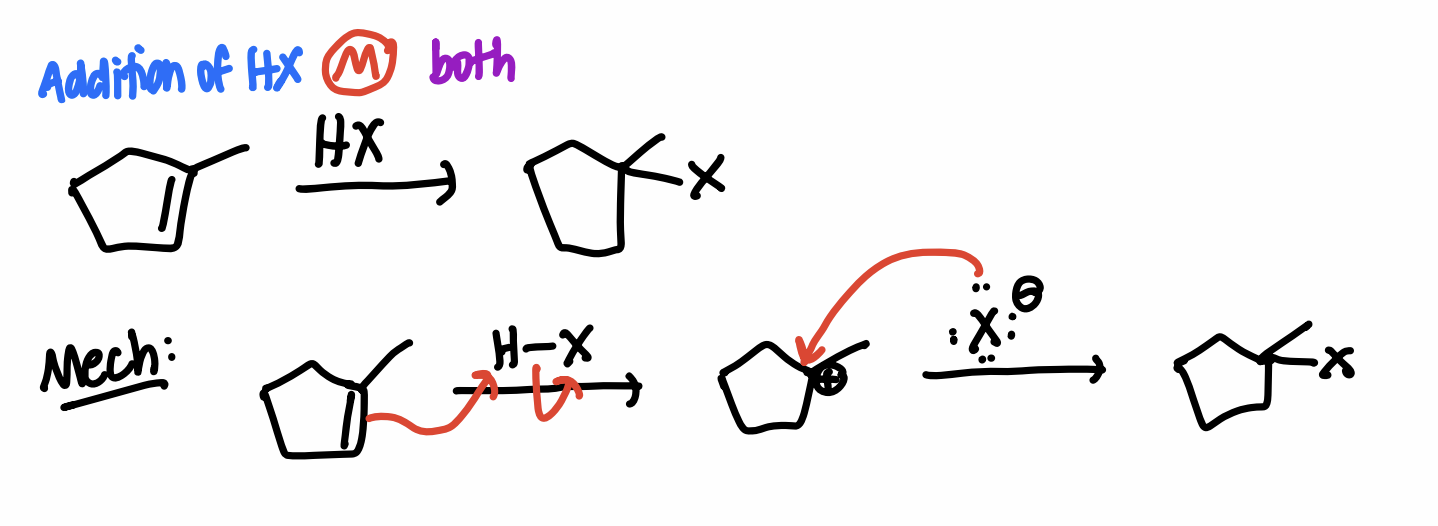

<ul><li><p>Regioselective for Markonikov addition.</p><ul><li><p>Halogen goes to more substituted carbon.</p></li></ul></li><li><p>Carbocation intermediate (dip in reaction coordinate diagram).</p></li><li><p>Reaction with HX.</p></li><li><p>Watch for enantiomers formed (count unique substituents resulting, make sure not MESO).</p><ul><li><p>Stereochemistry: both anti and syn (because carbocation is sp2 trigonal planar, so X can attack from either side of empty p orbital).</p></li></ul></li><li><p>Remember to apply carbocation rearrangements to get PE product.</p></li></ul><p></p><p>Steps:</p><ol><li><p>Double bond breaks, arrow from double bond to H (H going to less substituted carbon). Bond between H-X breaks, goes to X.</p></li><li><p>X ion attacks carbocation (which is more substituted carbon).</p></li></ol><p></p>
3
New cards
<p>Free Radical Addition of HBr</p>

Free Radical Addition of HBr

  • Occurs WITH peroxides ROOR unlike hydrohalogenation.

    • ROOR has oxygen-oxygen single bonds.

    • HBr without ROOR does markonikov hydrohalogenation.

  • Anti markonikov, Br goes to less substituted carbon.

  • Mixed stereochemistry, both anti and syn.

  • Produces radicals, not carbocations.

  • Remember IPT: initiation, propagation, termination

    • Initiation: Homolytic cleavage to generate 2 radicals (2 single head arrows to create 2 things with 1 electron).

    • Propagation: Radical reacts with a non-radical species, to form a new radical (and non-radical).

      • Self sustaining, happens many times.

    • Termination: two radical species react to form a non-radical species.
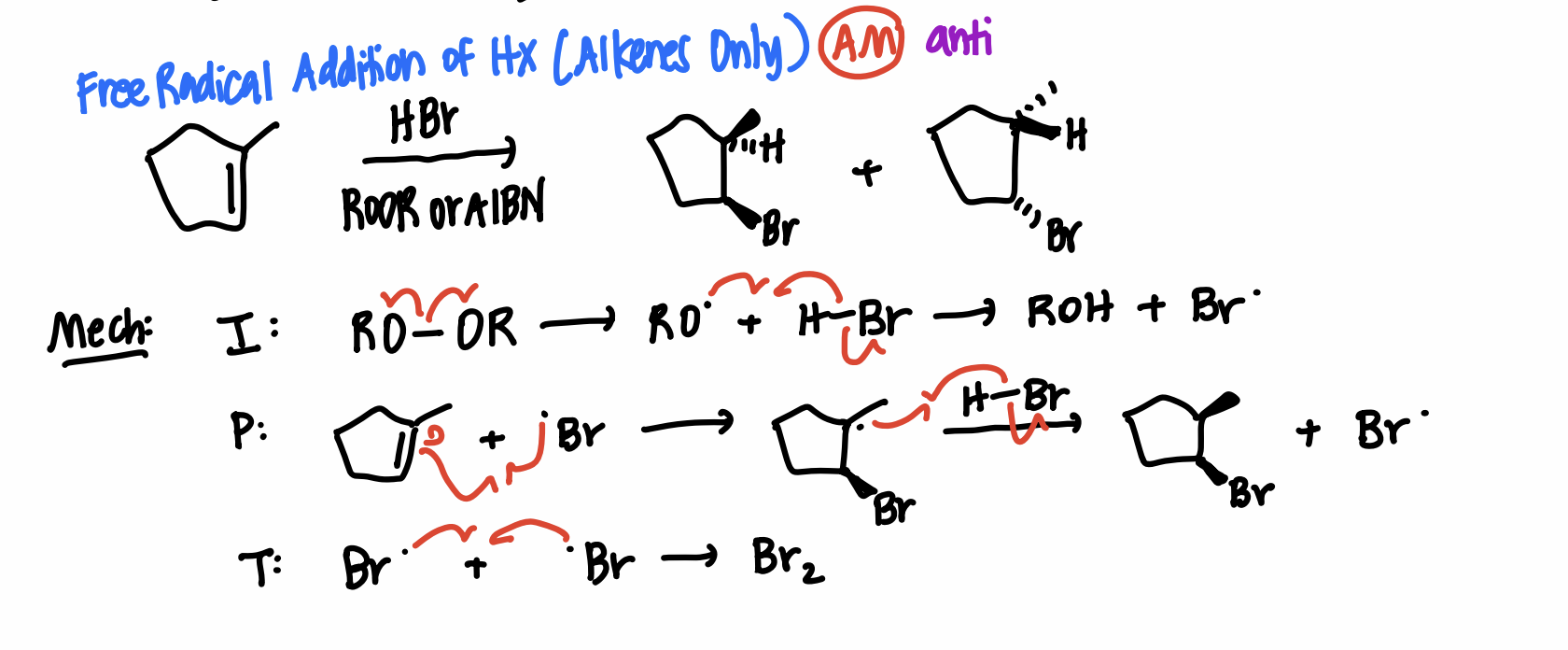

<ul><li><p>Occurs WITH peroxides ROOR unlike hydrohalogenation.</p><ul><li><p>ROOR has oxygen-oxygen single bonds.</p></li><li><p>HBr without ROOR does markonikov hydrohalogenation.</p></li></ul></li><li><p>Anti markonikov, Br goes to less substituted carbon.</p></li><li><p>Mixed stereochemistry, both anti and syn.</p></li><li><p>Produces radicals, not carbocations.</p></li><li><p>Remember IPT: initiation, propagation, termination</p><ul><li><p>Initiation: Homolytic cleavage to generate 2 radicals (2 single head arrows to create 2 things with 1 electron).</p></li><li><p>Propagation: Radical reacts with a non-radical species, to form a new radical (and non-radical).</p><ul><li><p>Self sustaining, happens many times.</p></li></ul></li><li><p>Termination: two radical species react to form a non-radical species.</p></li></ul></li></ul><p></p>
4
New cards

Halogenation (aka bromination or chlorination)

  • Br2 or Cl2, and CH2Cl2

  • Same thing on both substituents so neither markonikov or antimarkonikov.

  • Anti, so substituents on each end of the former alkene are opposite wedge/dash.

    • Products are 2 enantiomers.

  • Br2 is nonpolar, but the alkene polarizes it so it can split.

  • Step 1. 3 arrows. Arrow from lone pair on Br to one carbon of alkene, arrow from other carbon of alkene to other lone pair on Br. Br-Br bond to the Br not bonded to alkene. Creates bromonium cation and Br anion.

  • Step 2. Br ion lone pair attacks most substituted carbon, Br ring breaks.


<ul><li><p>Br2 or Cl2, and CH2Cl2</p></li><li><p>Same thing on both substituents so neither markonikov or antimarkonikov.</p></li><li><p>Anti, so substituents on each end of the former alkene are opposite wedge/dash.</p><ul><li><p>Products are 2 enantiomers.</p></li></ul></li><li><p>Br2 is nonpolar, but the alkene polarizes it so it can split.</p></li><li><p>Step 1. 3 arrows. Arrow from lone pair on Br to one carbon of alkene, arrow from other carbon of alkene to other lone pair on Br. Br-Br bond to the Br not bonded to alkene. Creates bromonium cation and Br anion.</p></li><li><p>Step 2. Br ion lone pair attacks most substituted carbon, Br ring breaks.</p></li></ul><p></p>
5
New cards

Halohydrin formation

  • Similar to halogenation, but 3 steps and with water.

  • Regiselectivity: OH goes to more substituted carbon. Markonikov.

  • Stereochemistry: anti products enantiomers

  • Step 1. 3 arrows. Arrow from lone pair on Br to one carbon of alkene, arrow from other carbon of alkene to other lone pair on Br. Br-Br bond to the Br not bonded to alkene. Creates bromonium cation and Br anion.

  • Step 2. 2 arrows. Lone pair on oxygen in H2O attacks more substituted carbon, and Br ring breaks.

  • Step 3. Br anion deprotonates extra H on water to get OH and Br substituents in product.


<ul><li><p>Similar to halogenation, but 3 steps and with water.</p></li><li><p>Regiselectivity: OH goes to more substituted carbon. Markonikov.</p></li><li><p>Stereochemistry: anti products enantiomers</p></li><li><p>Step 1. 3 arrows. Arrow from lone pair on Br to one carbon of alkene, arrow from other carbon of alkene to other lone pair on Br. Br-Br bond to the Br not bonded to alkene. Creates bromonium cation and Br anion.</p></li><li><p>Step 2. 2 arrows. Lone pair on oxygen in H2O attacks more substituted carbon, and Br ring breaks.</p></li><li><p>Step 3. Br anion deprotonates extra H on water to get OH and Br substituents in product.</p></li></ul><p></p>
6
New cards

Haloether formation

  • Similar to halogenation, same as halohydrin formation except with ROH not H2O.

  • Regiselectivity: OR goes to more substituted carbon. Markonikov.

  • Stereochemistry: anti products enantiomers

    • If the chiral carbon center has 4 unique subsituents draw enantiomers.

  • Step 1. 3 arrows. Arrow from lone pair on Br to one carbon of alkene, arrow from other carbon of alkene to other lone pair on Br. Br-Br bond to the Br not bonded to alkene. Creates bromonium cation and Br anion.

  • Step 2. 2 arrows. Lone pair on oxygen in ROH attacks more substituted carbon, and Br ring breaks.

  • Step 3. ROH lone pair deprotonates extra H on water to get OR and Br substituents in product.


<ul><li><p>Similar to halogenation, same as halohydrin formation except with ROH not H2O.</p></li><li><p>Regiselectivity: OR goes to more substituted carbon. Markonikov.</p></li><li><p>Stereochemistry: anti products enantiomers</p><ul><li><p>If the chiral carbon center has 4 unique subsituents draw enantiomers.</p></li></ul></li><li><p>Step 1. 3 arrows. Arrow from lone pair on Br to one carbon of alkene, arrow from other carbon of alkene to other lone pair on Br. Br-Br bond to the Br not bonded to alkene. Creates bromonium cation and Br anion.</p></li><li><p>Step 2. 2 arrows. Lone pair on oxygen in ROH attacks more substituted carbon, and Br ring breaks.</p></li><li><p>Step 3. ROH lone pair deprotonates extra H on water to get OR and Br substituents in product.</p></li></ul><p></p>
7
New cards

Acid Catalyzed Hydration

2 methods: Directly with H3O+, or with H2O and H2SO4 to get H3O+.


<p>2 methods: Directly with H3O+, or with H2O and H2SO4 to get H3O+.</p><p></p>
8
New cards
9
New cards
10
New cards
11
New cards
12
New cards
13
New cards
14
New cards
15
New cards



