MKT 302 Exam #2
 Call Kai
 Learn
 Practice Test
 Spaced Repetition
 Match
 Flashcards
 Knowt Play
1/64

There's no tags or description
Looks like no tags are added yet.
65 Terms
New Product Development Decision Process
Funnel: Many ideas are generated but they all eventually boil down to a few high-potential products
(1) Idea Generation
(2) Idea Screening: Is the idea consistent with our strategy
(3) Concept Development/Testing: Decisions about category and our fundamental entity
(4) Product Development
(5) Market testing
(6) Commercialization
Note: During this process we have to balance development costs and our probability of success
A smaller proportion reaches the next stage: At idea screening we lose 1/4, and concept testing to commercialization we loose ½ of our customers each stage
The cost of experimental marketing also goes up per idea at each stage.
Common Errors in New Product Development
Go Errors = “False Positive”—> Occurs when bad things are brought to market.
Harbingers of Failure
Drop Errors = “False Negatives” —> Occur when good products are discarded before they make it onto the market
Harbingers of Failure
A subset of consumers common in Go Errors, who consistently buy products that fail to resonate with the market
Enthusiastic early adopters are not always a good sign
Tend to cluster in particular zip codes that are generally rural and less wealthy
But there is still uncertainty
Oracle Reviewers = Some harbingers tend to be people who systematically review successful products shortly after product release.
Factors Leading to Go Errors
(1) Bonuses for Successful Outcome = Incentivizes wins, so employees push foward as long as success is possible
(2) Reluctance to Admit Failure
(3) Sunk-Cost Bias & Waste Aversion = Deciding based on costs already incurred rather than on future costs and benefits
(4) Confirmation Bias
(5) A Project Champion = “Champions for the project and spread optimism but are too passionate
(6) Belief Perserverance
Solutions to Go Errors
(1) Passion & Resilience
(2) Diversity = A team that includes non-believers and has a well-defined review process
(3) Need for “Exit Champions” = Managers with temperament and credibility to question a prevailing belief.
Test Market
Launching a new product in a small part(s) of that target market
Purpose
(1) Helps firms rehearse marketing strategies under realistic marketing conditions
(2) Particularly useful when products have a high risk of failing or jeopardizing the firm's reputation
Hazards of test Marketing
(1) Costly = Most estimates are usually around 0.5 to 1 million dollars.
(2) Representation = Hard to find perfectly representative test markets that also generalize
(3) Competition = Competitors can monitor performance and disrupt by offering price breaks, increasing their own advertising, or accelerating the launch of their product
Pre-Test Ads Measurements
Awareness Index = Hoe enjoyable is the ad, how strongly does the ad involve the viewer, how well branded is the ad…
Immediate Persuasion Score = How present is the ad in the news, how relevant is the ad’s, how is the ads presence differentiating the message, how credible is the ad.
Generating a Good Idea: Common Error
Going with the common intuition of the best sources are the customers.
Asking them to geerate ideas, brainstorm, think outside the box, etc.
Problems
(1) Ideas often are too far outside the company’s brand image or capabilities
(2) Sometimes customers are only capable of thinking of minor changes
They lack imagination or ideation that addresses their needs
Generating a Good Idea: Creativity Templates Basic Foundation
Listening to the voice of the product, instead of the voice of the consumers
Step #1: List the essential elements of a product (color or speed)
Step #2: Identify components & attributes of the product’s environment (ambient temperature or type of user)
Step #3: Manipulate these elements in a structured way to come up with new potential products
Step #4: Draw new product ideas out of current products
(a) Tap into existing skills/tech to reduce the chane of impracticality
(b) Products that have survived contain info about what works.
Generating a Good Idea: Creativity Templates
Subtraction
Multiplication
Division
Task Uniform/Replacement
Attribute Dependency Change
Temptation Bundling
Subtraction
Removing Components —> By taking something away, something is added
The common intuition that “more is better” can be costly and result in “feature creep” (complexity of using the product outweighing the benefits)
Generally the go-to method, the cheapest
Multiplication
Making Copies = Make one or more copies of an existing product component
The different copies serve different functions
i.e., adding new blades at different locations to produce a cleaner shave
Division
Two Forms of Division
Physical Division = Product is actually cut along a physical line
Preserving Division = Dividing products into smaller pieces, where each piece still possesses all the characteristics of the whole.
Task Uniform/Replacement
Assigning a new task to an existing element of the product or its environment
Could potentially remove an essential component and replace it with some existing component in the environement that performs a similar function
Attribute Dependency Change
Involves creating new dependencies between product attributes and attributes of its user or environment.
Some products do this naturally, but we can innovate by creating these relationships when they don’t ordinarily exist.
Temptation Bundling
Pairing something you want to do with something you should do
Idea of adding “wants” and “shoulds”
Service Marketing: Types of Services
Service as the Product
Insurance Policy, Massage, Flight
Service Accompanying a Product
Drive-Through Experience, Product Delivery, Customer Support
4 Traditional Features of Service
All of these are viewed as negative qualities that have to be overcome or solved by marketing
(1) Intangibility
(2) Heterogeneity
(3) Inseparability
(4) Perishability
Intangibility
Services can’t be seen, touched, or evaluated like physical goods
If service value is invisible, consumers may undervalue that good or service
The goal of marketing is to make invisible labor visible
i.e., Marriott Hotels, which let customers know when their room has been cleaned
Heterogeneity
Services are difficult to standardize
Different providers can deliver the same service differently
Marketers should create training with clear guidelines, enforce standardization, and hide automation
Inseparability
The customer and service provider often participate in producing the service together
Marketers, when customers are part of the service, should manage their participation
Perishability
Services cannot be inventoried for later use.
Becomes a particular problem when demand fluctuates
i.e., when a restaurant has steady demand, it is manageable, but when there is a demand spike, it gets chaotic
Marketers/service providers have to either shift demand or make excess demand easier to manager
Services vs. Goods: Similar Features
NOTE: Differences in the product/marketing of goods and services still exist, but it is smaller than it once was
(1) Services also have tangible results
(2) Some services are standardized
(3) Consumers are involved in the production of goods too
(4) Goods can also be perishable (although less so)
(5) Service production can be separate from consumption
(6) Some services can also be stored/inventories
Managing Customer Satisfaction: Idleness
Idleness is distressing to marketers because unoccupied time feels longer to the consumer than occupied time.
Ways to solve
(1) Manage the Experience of Waiting
Keep customers occupied (makes the wait feel like progress), distract from the wait, make the wait feel fair
(2) Make the Service Process Visible
“Blind Condition” vs. “Transparent Condition” —> Transparent got more satisfaction
(3) Benevolent Deception = Interfaces can display simulated progress to make waiting feel more tolerable
(4) Reduce the wait, not just the perception — Encourage mobile ordering, use designated pick-up areas.
Managing Customer Satisfaction: Surviving with Low Satisfaction
NOTE: The consequences of dissatisfaction depend on the competitive context and the firm’s value proposition
Overpromising: Managing satisfaction involves managing expectations. If you set higher expectations, it could create a higher bar for satisfaction
Bold promises might create a favorable bias in perceived quality when the consumption/service experience is ambiguous
Bold promises are dangerous when consumption/service is easy to evaluate
Make promises you can control: Concrete, controllable
Managing Customer Dissatisfaction: Service Recovery After Failure
Which Customers
Mildly dissatisfied customers are worth recovering; extremely dissatisfied customers may not be
Service Recovery Paradox = Sometimes, satisfaction after a successful recovery can exceed satisfaction before the service failure
Mild Service Failure
Expectation drops after failure; a strong recovery can exceed those expectations
Major Service Failure
Much harder to recover from, and recovery may not restore satisfaction.
Can trigger complaints or retaliation
Promotion
Means by which firms attempt to inform, persuade, and remind consumers about the products/brands they sell.
It represents the “voice of the company and its brands
It is here that we convert consumer propositions into taglines, slogans, ads, etc.
Who Articulates the Consumer Proposition
Creative Brief = A document that includes background info on the brand, category, target segment, budget, goals, etc., that is developed by manufacturers working with an ad agency’s account managers
The ad agency’s creative team interprets the creative brief and proposes a campaign
Common Misconception of Consumer Proposition
Commercials = Advertising = Marketing Communication
In reality, commercials are within advertising, which is within marketing communication.
Marketing Communications Mix & Advertising
Advertising, consumer promotions, events & sponsorships, PR, direct marketing, sales, trade promotions, word of mouth
Advertising = Print, mass media, social media, product placement, branded environment, packaging, signage, and many more
Consumer Promotion
Directed at the end user by the manufacturer
Coupons, rebates/refunds, games/contests/sweepstakes, gifts/premiums, samples, price-offs, loyalty programs
Coupons/Free Gifts
Coupons: A lot more coupons are distributed than redeemed, but unused coupons can still convey benefits
A study shows that even customers who receive coupons and don’t use them still spend more than customers who don’t receive them at all.
Common Assumption of Free Gifts: Free gifts that do not reduce the value of the product in any way can only increase sales.
Consumers are willing to pay less for the premium
People have a tendency to average: View a burger and an apple as having fewer calories than just a burger.
Takeaway: Don’t offer “crappy” free gifts
Events & Sponsorships
Events: Put on by specific brands
Sponsorship of Large Events (with heavy viewership) by popular brands
Sponsorships of places like stadiums (often will put brand names
Experiences: Can consist of things like interactive setups in public or even factory tours
Public Relations
A critical part of the marketing communications mix, appearing in various ways
Influencer Activation
i.e., Poppi Machines
Direct & Interactive Marketing
Catalogs, company websites & email campaigns such as these are primary examples
They have rich product descriptions
Catalogs Today

Sales Presentations & Trade Shows
Often used by B2B Brands
Marketing communications can include things like trade shows and fairs where the newest innovations are showcased for retailers and consumers
Great way to reach loyalists or specialized customers
very expensive
Common Marketing Communication Objectives
(1) Achieve Basic Awareness — Increase recognition
(2) Achieve Top-of-Mind Awareness — Increase recall
(3) Achieve an Information Goal — Increase awareness of a piece of information
(4) Achieve an Image Goal — Increase % agreement with “Brand X is contemporary”
(5) Achieve a Behavior Goal — Increase “retail inquiries”
Achieve Basic Awareness & Top-Of-Mind Awareness: Recall vs. Recognition
Basic Awareness:
Recognition: “Which of the following headache medications have you heard of”
Top-Of-Mind Awareness
Recall: “Name the first five headache medications that you can think of”
Marketers’ Interest in Memory
Many ads don’t intend to encourage immediate purchase
Many consumer decisions are purely memory-based
Achieve an Information Goal
Advertising has its roots in providing information —> Ads have evolved to achieve multiple motives (info, image, etc)
How Entertaining Should Ads Be:
In general, entertainment that precedes information about the brand is risky
Better to integrate the brand throughout, even if some entertainment must be sacrisficed
How Much Advertising is Required? — A Lot
Thomas Smith said 20 times
Common Sales Response Models: There are diminishing returns to advertising
Differ on whether there is an initial period with low returns to advertising, a minimum threshold level of advertising required to get on consumers’ radar.
As you spend more, you reach a wider audience, and your message is les focused.
Eventually, you start reaching people with attitudes and beliefs conducive to buying
Achieve Image and Behavioral Goal
Image Goal: Want to increase the percent of people who view the brand image as contemporary
Behavior Goal: Trying to encourage immediate action from consumers
The Truth Effect Experiment
With repetition, consumers can come to believe the claim that is being made
Situation: Older adults were shown a series of claims that were either true or false.
Each adult was presented with the claim and truth info either 1 or 3 times
End of Experiment: Participants were asked if shark cartilage is good for arthritis and if a teaspoon of sugar helps with hiccups
Results: People with 3 exposures had better recall than those with 1. People with 3 exposures were better able to distinguish true statements from false ones.
3 Days later: Participants brought back and presented with the same true/false claims
Results: Participants with 3 exposures were more likely to see EVERYTHING as true
Older adults can’t recall whether the statement was originally marked as true or false but still experience its content as highly familiar, leading them to accept it as true
Takeaways
Memory for content > Memory for context
Spread of disinformation can occur even when the initial message is from a low-credibility source
Message might not be immediately persuasive but can change with time
Methods to Debunk False Claims
The Bad Method: Repeating false information in order to debunk it, could lead people to misremember it
A Better Way: Emphasize what’s true
If you must repeat the myth:
Lead with the fact if its clear, pithy, and sticky — make it simple, concrete, and plausible
Warn beforehand that a myth is coming and mention it only once
Explain how the myth misleads
Finish by reinforcing the fact — multiple times if possible.
Encoding variability
Different ad executions but the same basic messages —> Repetition is particularly effective.
Helps to address the fatigue problem, and there will now be multiple ways to retrieve the memory
Sleeper Effect
Memory for content > Memory for context
Messages from low-credibility source could be not immediately persuasive, but with time get more.
Likeability Experiment
A benefit of familiarity
Mere Exposure Effect: Familiarity & Likeability
Participants uploaded photos of themselves months earlier, as part of a longitudinal study
In the control condition, GWBush would have been morphed with another participant’s face, just to rule out that morphing alone made a candidate more appealing.
If you asked them why they like who they like, they won’t say it’s because the candidate looks like them.
Product Placement
Because brand exposures can possibly have some effect even while not noticed or recalled, and because familiarity is a good thing, you see lots of money being spent on product placement
New Ad Media
Lots of new mediums
Native Advertising = Ads that look like editorial content (disguised within the medium)
Lots of legal/ethical issues
Must be clearly labeled and identified as an ad before the user clicks on the link
Influencer Marketing
Media Planning
After deciding how to convey the client’s consumer proposition, the advertiser works with media buyers and the client to develop a media plan for the campaign
(1) Selecting Desired —> Reach and Frequency
(2) Choosing Among Media Types
(3) Choosing a Specific Vehicle Within a Media Type
Reach
The percent of relevant persons or household exposed to a particular media campaign at least once during a specific time period
Frequency
The average number of exposures among those reached by the ad campaign
Reach vs. Frequency
Reach: Generally most important when launching a new product, an extension of a well-known brand, or when going after a poorly defined target market.
Frequency: Generally most important when there are strong competitors, a complex story, or high consumer resistance.
Does Pure Exposure to the Ad Actually Equal Watching the Ad?
No, exposure just means having the opportunity to see the ad
It’s is usually anywhere from 50% to 95% if people watching a program see ads run during that program
Gross Rating Points (GRPs)
Commonly used to gauge the strength of an ad campaign
Generally considered to be the common “currency” of media planning
Integrated Marketing Communications: Marketers want to meet consumers where they are
Can be used across a number of platforms
How to Compute GRPs
GRPs = Total Number of Exposures = Reach x Frequency
Different ways to get the same GRP
High Frequency, Low Reach
High Reach, Low Frequency
Determining Ad Interactions: Swim Lanes
Where we don’t know which medium to give credit to — Operating by ourselves in our own swim lane.
Marketers commonly measure the performance of each of their marketing activities as if they would operate independently of one another.
Could result in significant over- or underattribution of advertising revenues, because ads in one medium can exert a powerful influence on another.
Determining Ad Interactions: Dividing Credit
When we see multiple ads, the marketers, don’t know exactly which one was the successful one
Determining Ad Interactions: Billboards
Cons of a Billboard
Expensive
Heavily dependent on location, which can affect prices
Arguments in Favor — You can’t skip or avoid a billboard
High reach
High frequency
Considered OOH (Out-of-Home Advertising)
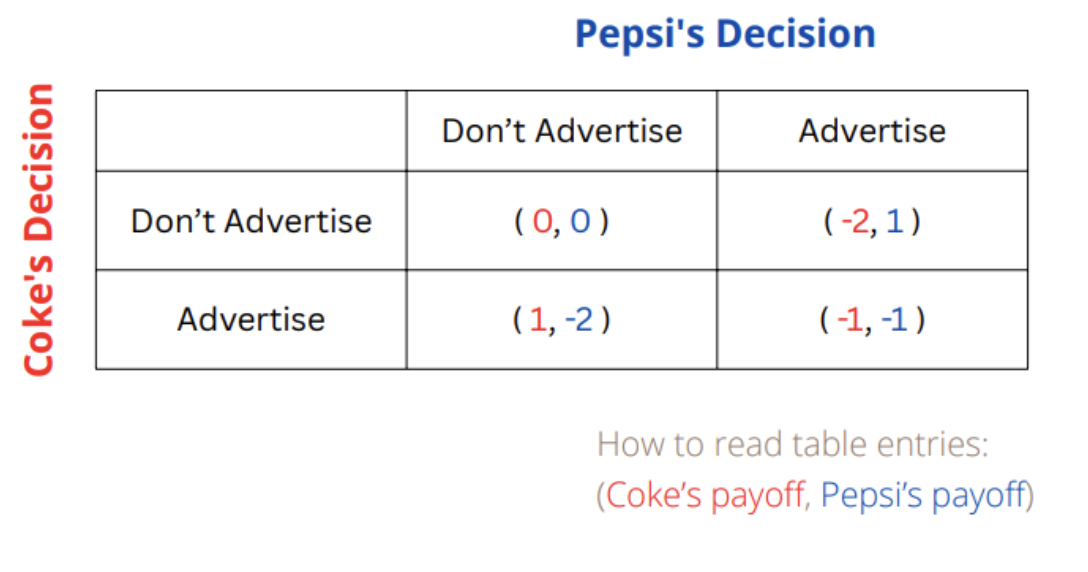
Super Bowl Experiment & Prisoner’s Dilemma
The Experiment: Comparing packaged goods that either did or din’t advertise during the Super Bowl.
A natural experiment, because viewership was based on citie’s affinity towards Super Bowl teams.
Randomness in which teams would end up at the Super Bowl, and therefore in which people would watch the Super Bowl.
Results:
There was a big boost in household spending on advertised goods in cities with teams in the Super Bowl
But no boost in championship-losing cities
Conclusion: Yes, it can be effective to advertise in the Super Bowl
Prisoner’s Dilemma: Ads are linked to an increase in sales when your close competitors are not advertising, and they are much less effective if a category competitor is also advertising
In a Super Bowl ad between two competing companies, both will have a dominant strategy of advertising, which will result in a bad equilibrium.
In reality, both would be better off if both didn’t advertise
Uncertainty Regarding ROI for Advertisement
Basic Intuition: Ads are, by design, targeted to specific customers and segments, not randomly assigned.
However, it is therefore hard to know whether targeted consumers would have bought the product without seeing the ad
This will lead to overestimates of ads’ ROI', because these people might have bought the product without the ad.
This leads marketers to spend more on ads.
Where Is The Overestimated Money Spent?
“Upfronts” — Broadcasters can sell up to 75-990% of their ad inventory for the upcoming year
Networks guarantee ads will reach a certain target audience size and provide “audience deficiency units” if they fail to meet that target.
The Nielsen Panel
A “peoplemeter” that created a way to measure viewership.
It was spread over 20,000 US homes
Each member of the home has their own remote, which they can then use to indicate when they are watching.
The portable meter picks up audio signals encoded into broadcasts, so it can detect if you’re close to a TV
Main Purpose: Measure viewers’ attention, knowing there are ways that they avoid ads.
(1) Zapping = Changing Channels
(2) Multi-Tasking = Diverting arttention to people & other media
(3) Physical Zapping = Leaving the room
(4) Zipping = Fast-foward through recorded programs
Pause Ads
Left: Full-screen or side-screen static image ads that appear on a connected TV (CTV) and streaming platforms when a viewer hits the pause button on their remote.
Successful Results:
27% increase in QR code scans
An awareness-focused initiative
More pull than push
People weren’t looking for jewelry while watching, but they still made a lot of sales.
Media Buying Online
Most online ads are sold by auction
Process takes under 200 milliseconds, and there are two main options: CPM and CPC
Online Advertising is Quite Successfull
Challenges for Measuring ROI
Hard to construct a full history of exposures and hard to merge
Massive data requirement
Customer may view ads online then purchase through offline channels, or vice versa
Ads may exhibit complentarities
CPM
“Cost per mile”/Cost per 1,000 impressions
Typical CPM = $1 - $15
Impressions are more expensive for prominent display, video content, and premium sites
CPC
“Cost Per Click”
Typical CPC = $1 - $5
Cpc often depends on the industry keywords advertised