APK 3110C Unit 3
 Call Kai
 Learn
Learn Practice Test
 Spaced Repetition
 Match
Match Flashcards
 Knowt Play
1/195

There's no tags or description
Looks like no tags are added yet.
Name | Mastery | Learn | Test | Matching | Spaced | Call with Kai | Chat |
|---|
No analytics yet
Send a link to your students to track their progress
196 Terms
what type of chambers are the atria?
receiving
what type of chambers are the ventricles?
pumping
which chamber has the thickest walls?
left ventricle because it has to pump blood to the entire body
what are cardiac muscle fibers like?
Highly oxidative, high capillary density, high # of mitochondria
______ hold cells together
desmosomes
_______ rapidly conduct cell action potentials
gap junctions
Cardiac excitation-contraction coupling includes __________________________________
calcium-induced calcium release
cardiac myocyte action potential
Phase 0: Na influx via fast Na channels
causes depolarization to about +52 mV
Phase 1: K & Cl leave while Na channels
close, causing partial repolarization
Phase 2: Ca enters & K leaves, causing a
plateau.
Phase 3: K leaves, Na & Ca channels close,
causing repolarization
Phase 4: -90 mV resting membrane
potential maintained via Na/K ATPase pump
Atherosclerosis
Plaque buildup, limiting blood flow
In the heart? "Coronary Artery Disease"
maximum possible heart rate is
250 BPM
intrinsic control of the heart
HR is 100BPM
Electrical signal spreads via gap junctions.
Observed in heart transplant patients (no neural innervation).
10 electrodes
12 leads
wiggers diagram
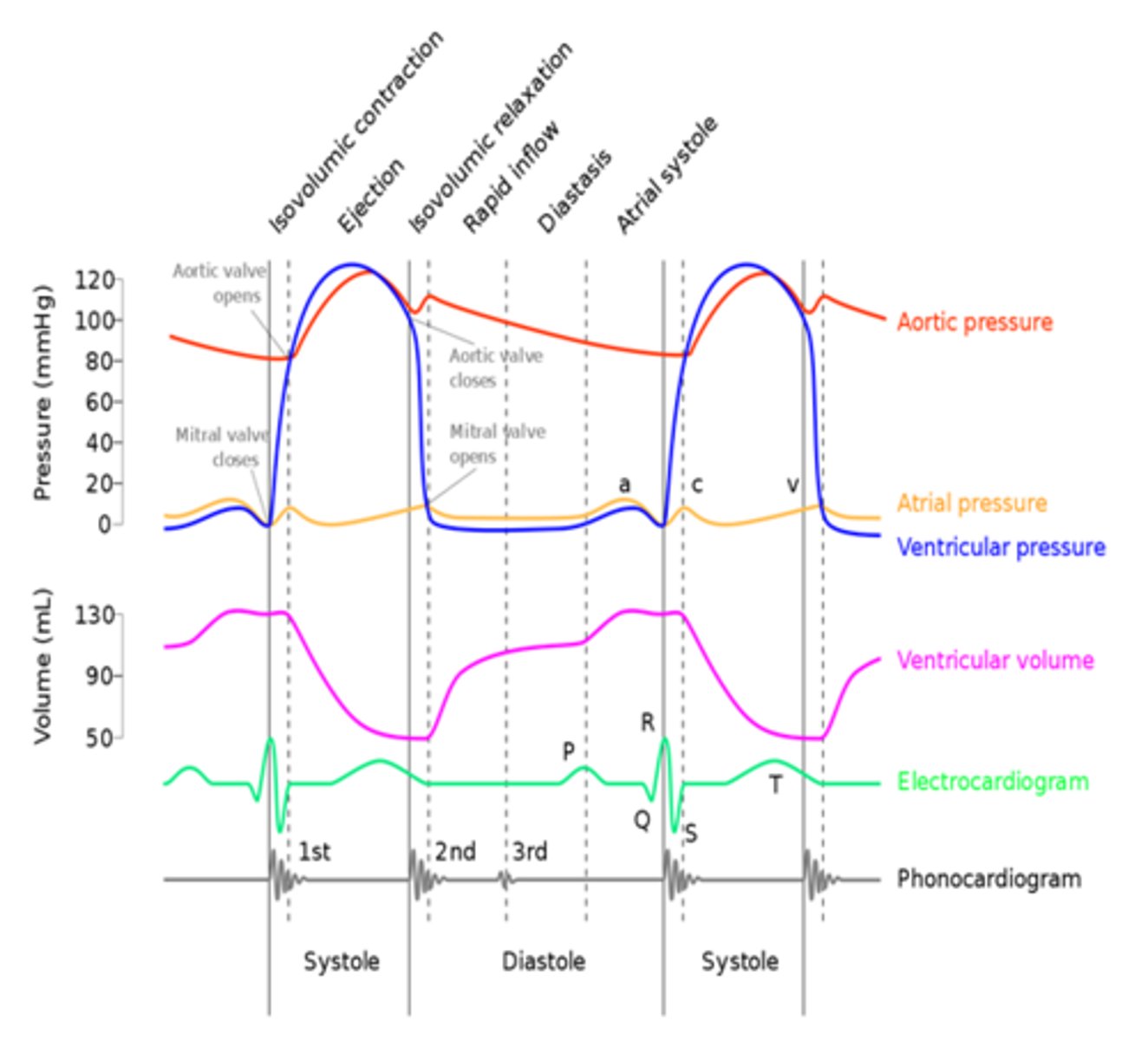
one cardiac cycle
P Wave
QRS complex
ST segment
T wave
PR interval
QT interval
systole
contraction
diastole
relaxation
70% passive,
30% atrial contraction
tachycardia
above 100BPM
bradycardia
below 60 BPM
Atrial fibrillaiton
irregular and chaotic
atrial flutter
sawtooth rhythm
____ and ____ increase the risk of blood clots, with common symptoms
including palpitations, dizziness, and shortness of breath
Afib and atrial flutter
Atrial flutter/fibrillation are closely related, often co-occurring, characterized by rapid, inefficient, or chaotic atrial contraction
The most frequent cause of sudden cardiac death
ventricular fibrillation
not enough time for the heart to fill with blood.
not enough blood is pumped out of the body.
ventricular tachycardia
elite endurance athlete has a BPM of
35 BPM
vagus nerve ______ heart rate
vagal tone
(parasympathetic NS)
decreases
sympathetic NS _____ heart rate
(ex: catecholamines) norepinephrine and epinephrine
increases
Isovolumetric Contraction (after S1):
All valves are closed; pressure _______
sharply without a change in volume.
rises
Isovolumetric Relaxation (after S2):
All valves are closed; pressure ______
rapidly without a change in volume
drops
arteries....
carry blood away from heart
arterioles...
control blood flow, feed
capillaries.
capillaries...
provide a site for nutrient
and waste exchange.
venules
collect blood from capillaries
veins...
carry blood from venules to heart
Mean blood pressure=
1/3 SBP + 2/3 DBP
average cardiac output (rest) is ____ L/min
4-5L
functional syncytium
pumping of the heart as one unit
torsional contraction
increased contractility during intense
exercise to enhance left ventricular filling
systole contraction
Heart twists gradually, storing energy like a spring.
diastole contraction
Abrupt untwisting allows atrial filling (dynamic relaxation)
muscle blood flow at rest is _____ L/min
0.75L
cardiac output during heavy exercise is ____ L/min
25L
muscle blood flow during heavy exercise is about ___ L/min
20L
blood volume distribution
at rest, veins contain ____ of blood volume
2/3
-elastic balloon-like vessel walls
-blood reservoir
blood volume distribution
venous reservoir can be sent back to heart and into arteries
-sympathetic stimulation
-venoconstriction
venous blood return
what kind of posture makes venous return to the heart more difficult?
upright
venous blood return
assisted by 3 mechanisms:
-one way venous vales
-muscle pump
-respiratory pump
vascular resistance
force that opposes flow
nL/r^4
*radius is the most important
_____ control 70-80% of the pressure fall from left ventricle to right atrium
arterioles
metabolic vasoldialtion
-build up of local metabolic by-products
-decrease O2
-increase CO2, K+, H+, lactic acid
intrinsic blood flow regulation is...
1. metabolic vasodilation
2. endothelial cells (mostly vasodilation)
3. Myogenic Vasodilation/Vasoconstriction
Nitric oxide (NO), prostaglandins, Endothelium-derived hyperpolarizing
factor (EDHF) are secreted by what?
vascular endothelial cells
myogenic vasodilation/vasoconstriction
pressure goes up with constriction
pressure goes down with dilation
more sympathetic activity causes __more or less____ vasoconstriction?
more
functional sympatholysis
-offsets sympathetic vasoconstriction to increase blood flow
-lowers alpha-adrenergic receptor activation
local metabolic signaling helps tissue meet ___ demand (_______)
O2, vasodilate
Integrative control of blood pressure
Autonomic
Baroreceptors sense pressure, send afferent signals
to brain, brain sends efferent signals to heart/blood vessels
Integrative control of blood pressure
Mechanoreceptors and metaboreceptors
Mechanoreceptors
and metaboreceptors
in muscle send afferent
signals to the brain
Extrinsic Neural Control of Blood Flow
-Redistributes blood at the organ/system level
-Innervates artery/arteriole smooth muscle
Main functions of blood
- Transportation (O2, waste)
- Temperature regulation
- Acid-base balance
average total blood volume
5-6L in males
4-5L in females
55% plasma
45% formed elements
blood
plasma contains....
90% H2O
7% plasma proteins
3% other
blood
formed elements contain....
99% red blood cells
1% white blood cells and platelets
hematocrit=
-total % volume composed of formed elements
45% formed elements (rbc)/100% total blood volume =45%
plasma increase/decrease
Increase by 10% with training or heat acclimation
- Decrease by 10% with dehydration in the heat
as red blood cell count (hematocrit) increases...
viscosity increases
Blood~2x viscous as water
Red Blood Cells
- No nucleus, unable to reproduce
- Replaced regularly via hematopoiesis
- New replace old every ~4 months
hemoglobin
-Heme (pigment, iron, O2) + globin (protein)
- O2-carrying protein in RBCs
- 20 mL O2 per 100 mL blood
250 million Hemoglobin per RBC x 4 O2 per hemoglobin = 1 billion O2 per RBC
Plasma volume must ______ as RBCs _______
increase, increase
Occurs in athletes after training/acclimation
- Hematocrit and viscosity remain stable
- Otherwise, blood flow or O2 transport may
suffer (recall: Resistance = nL/r4)
In the Wiggers diagram, _______________________ occurs when all heart valves are ______, causing ventricular pressure to rise sharply without changes in blood volume.
isovolumetric contraction, closed
Known as the primary resistance vessels, the _______ are the vessels responsible for approximately 70-80% of the total __________ across the systemic circulation.
arterioles, pressure drop
Because the venous system is a low-pressure environment, returning blood to the heart (especially from the lower body) requires _____ valves, the ________________________, and the respiratory pump
one-way, skeletal muscle pump
Hematocrit refers to the total percentage of blood volume composed of formed elements; if this value increases without a corresponding increase in plasma volume, ______ will rise, potentially hindering _______.
blood viscosity, blood flow
During exercise, the body uses _______________ to locally offset _____________________, ensuring that blood flow is redistributed to active skeletal muscles
functional sympatholysis, sympathetic vasoconstriction
Tidal Volume (L/breath) x Breathing Rate (breaths/min) =?
minute ventilation (L/min)
FEV1/FVC ratio is used for what?
Forced expired volume in 1 second/
Forced vital capacity
used to asses and diagnose airway disorders
tidal volume
normal breath
500mL
inspiratory reserve volume
extra amount of air you can breath in after a normal breath
usually about 3000mL
expiratory reserve volume
extra amount of air you can forcefully exhale after a normal exhale
approx 1000mL-1200mL
residual volume
air left in your lungs after you exhale as hard as you possibly can
approx 1200mL
respiratory gases at sea level
class 12 slide 10
O2 line
whats the role of the respiratory system?
O2 in air -> blood & CO2 in blood -> air
- Pulmonary ventilation (external respiration)
- Pulmonary diffusion (external respiration)
- Transport of gases via blood
- Capillary diffusion (internal respiration)
oxygen cascade
159 mmHg in air
Dilutes as it mixes in lungs
Leaves heart ~100 mmHg
Falls to 40 mmHg post-muscle
Returns to heart at 40 mmHg
Alveoli and pulmonary capillaries inside each alveolus
exchange zone
(everything else is a transport zone)
respiratory membrane (ie alveolar-capillary membrane)
pleura
lung lining
transport of oxygen in the blood
>98% bound to hemoglobin (Hb) in red blood cells
- O2 + Hb: oxyhemoglobin
- Hb alone: deoxyhemoglobin
<2% dissolved in plasma
max amount of oxygen blood can carry
- Based on Hb content (12-18 g Hb/100 mL blood)
- Anemia -> decrease Hb content -> decrease O2 capacity
Typical arterial oxygen saturation
- Hb 98% to 99% saturated at rest (0.75 s transit time)
- Lower saturation (usually still >95%) with exercise (shorter
transit time)
there's about ___ L oxygen in 5L of blood
1
artery has ____ ml of O2 per 100 ml of blood
vein has ____ ml of O2 per 100 ml of blood
20, 15-16
O2 is transported in muscle by _______
myoglobin
__________ has a higher affinity for O2
myoglobin
partial pressure of oxygen in our arterial blood is _____
100 mmHg
total pressure of our blood at sea level is _____
760mmHg
During the ______ process of inspiration, the ____________________ move the rib cage up and out while the diaphragm flattens, causing lung volume to ____________ and intrapulmonary pressure to decrease
active, external intercostals, increase
In the oxygen cascade, the partial pressure of oxygen (PO2) starts at ____ mmHg in the air, but it drops to approximately ____ mmHg as it leaves the heart and further decreases to ___ mmHg upon its return to the heart from the muscles
159, 100, 40
Most oxygen in the blood is transported by ________; oxygen within the muscle cells is transported by __________, which maintains a much higher affinity for O2.
hemoglobin, myoglobin
CO2
mostly central chemoreceptors
O2
mostly peripheral chemoreceptors
Neuromuscular communication
brain to respiratory muscles