Week 7 - PAT-3.10 Headaches and Schizophrenia
 Call Kai
 Learn
 Practice Test
 Spaced Repetition
 Match
 Flashcards
 Knowt Play
1/63

There's no tags or description
Looks like no tags are added yet.
64 Terms
what different pathologies can altered neural signalling cause? what can cause altered neural signalling?

what can cause a headache?
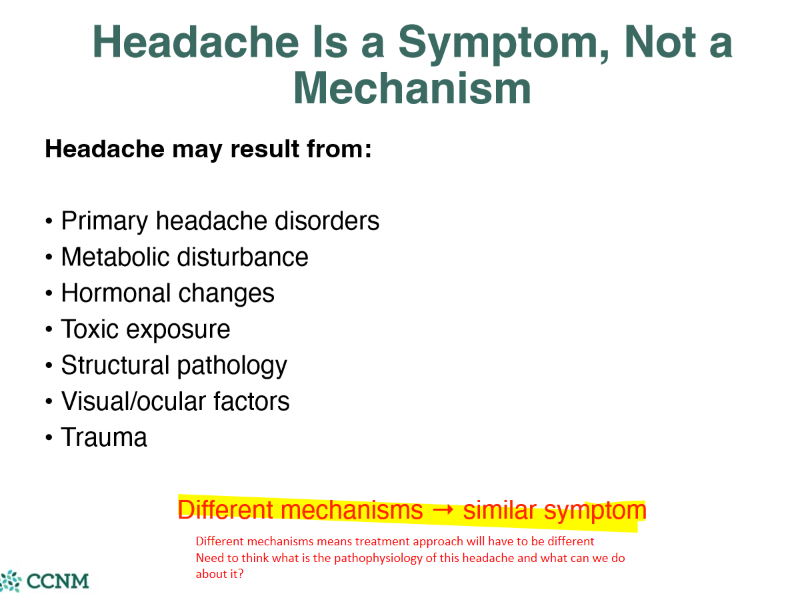
how is the trigeminovascular pathway involved in migraines?

describe the pathway from the meninges to the brainstem and how this correlates to headaches/migraines

what is the pathway from the TCC to pain perception?

what cellular effects are involved in migraines?

how is CGRP and neurogenic inflammation involved in migraines?

how can hypoglycemia cause a headache?

how is the menstural cycle involved in migraines?

how can carbon monoxide cause a headache?

how can a pituitary adenoma cause a headache

how can vision problems be related to headaches?

what happens in a trumatic brain injury that can cause a headache?

what is the neurometabolic cascade of TBIs

why does TBI cause headaches?

what is a post-traumatic headache look like?

why can post-traumatic headache persist?
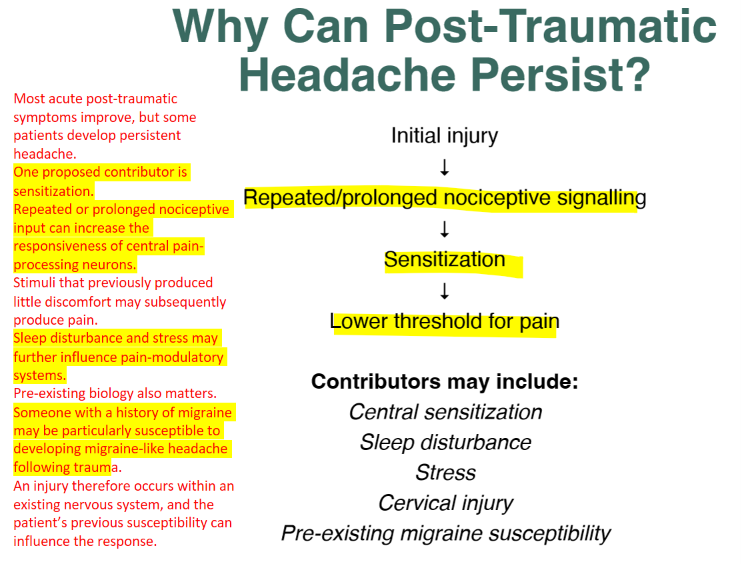

read picture and answer question
The answer is no.
Routine CT imaging is primarily intended to identify important structural abnormalities such as acute bleeding or fractures.
It does not directly measure neuronal metabolism, neurotransmitter function, inflammatory signalling or nociceptive sensitization.
The patient’s symptoms could therefore reflect altered neuronal metabolism, inflammatory signalling and altered pain processing despite normal structural imaging.
This illustrates the important distinction between structure and function.
how can inflammation sensitize pain?
Inflammation can alter how nociceptive pathways behave. The important concept is that inflammation does not simply produce swelling.
Inflammatory mediators can change the sensitivity of the nervous system itself.
Painful stimuli may therefore become disproportionately painful, producing hyperalgesia, while normally non-painful stimuli may become painful, producing allodynia.

how do the gut and brain communicate? how can this affect migraines?

what is the proposed microbiome-migraine pathway?
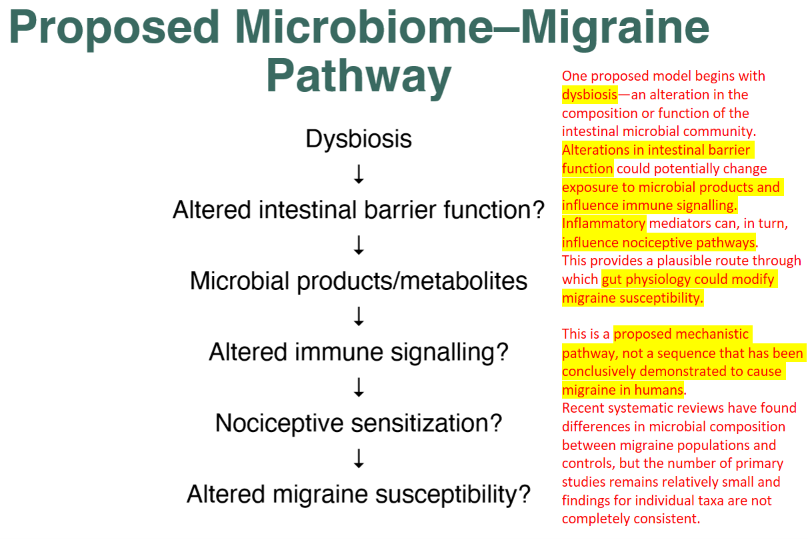
what is the evidence pertaining to the cut causing migraines?

what evidence supports the microbiome hypothyesis? what evidence limits it?

what is the definition for delusion?

what is the definition of hallucination

what are the clinical features of schizophrenia?

what is the DSM-5TR diagnosis for schizophrenia?

when does schizophrenia udually develop? what are the symptoms implicated?

what is the dopmaine hypothesis of schizophrenia?

describe the dopaminergic system

what are the supporting observations for the classical dopamine hypothesis?

how is the hippocampus/GABA related to dopamine/schizophrenia?

what is Aberrant salience?

what is the evidence supporting dopamine involvement and against it?

what is the inflammation hypothesis?

what is the evidence for the inflammation hypothesis?

what are the different factors that cause schizophrenia?

what are the roles of dopamine?

what is the mesolimbic dopamine pathway?
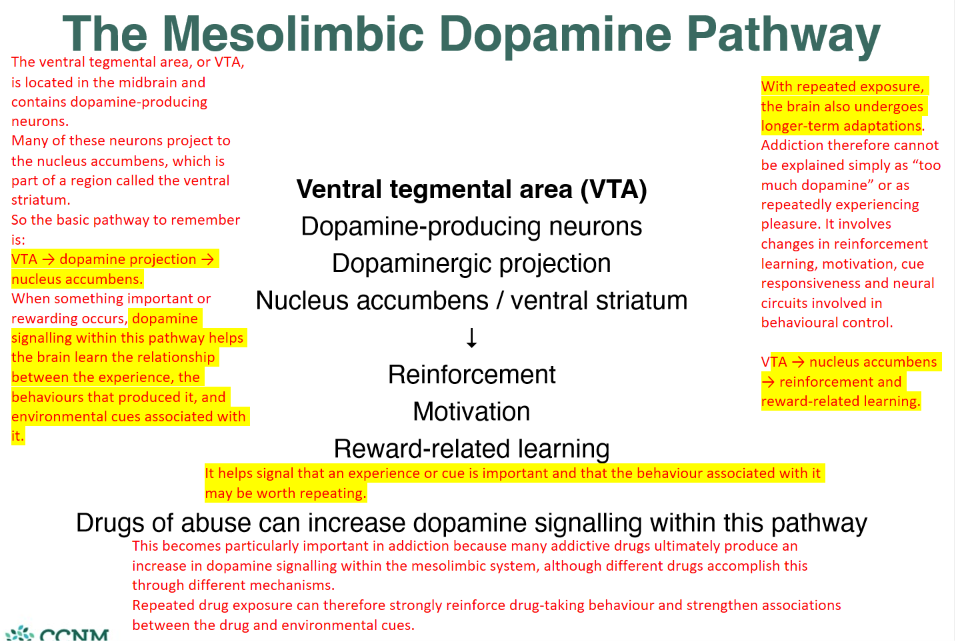
why can different drugs cause similar effects?

compare positive and negative reinforcement in drug use?

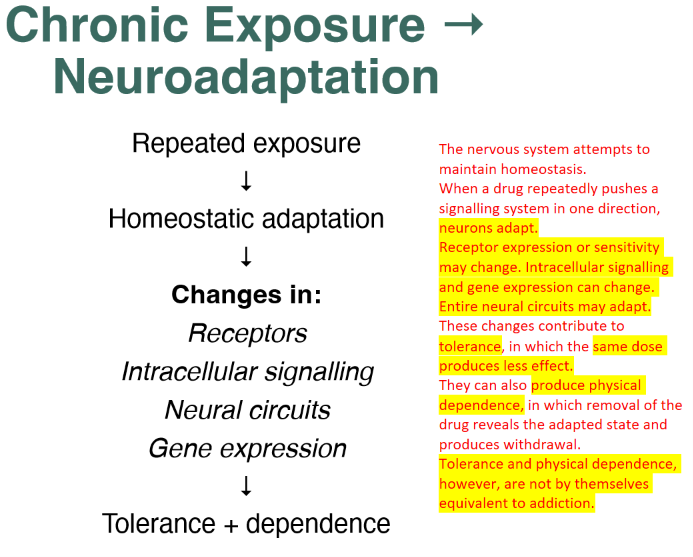
how does chronic exposure lead to neuroadaption?
how are cues, cravings and associations created?

what is the neurological pathway from drug use to addiction?


read and answer the question
The reduced effect is consistent with tolerance resulting from neuroadaptation.
The location has become a conditioned cue through repeated association with drug use.
Exposure to the cue can therefore activate learned motivational responses even in the absence of the drug.
This example demonstrates why addiction cannot simply be understood in terms of how pleasurable a drug currently feels.
what is peripheral neuropathy?

compare and contract axonal injury and demyelination?

why do symptoms often start in the feet?

how does diabetes cause peripheral neuropathy?

what happens when the vasa nervorum is injured?

what is nutritional neuropathy?

why can damaged nerves hurt?

what are the different roads to peripheral neuropathy? what do symptoms depend on?

review the different mechanisms in this lecture

review: formulate the mechanism for headache and photophobia around menstruation
For A, hormonal fluctuation may lower the threshold for activation of a susceptible migraine system.
review: formulate the mechanism for headache and cognitive difficulty after concussion
For B, consider post-traumatic headache involving neurometabolic disturbance and altered nociceptive processing.
review: formulate the mechanism for headache and dizziness; several family members affected
For C, multiple people affected in one environment raises concern for carbon monoxide exposure and impaired oxygen delivery.
review: formulate the mechanism for progressive headache and visual-field changes
For D, progressive headache with visual-field abnormalities raises concern for structural pathology, including a sellar or parasellar lesion.
review: formulate the mechanism for headache after skipping meals and tremor/diaphoresis
For E, consider hypoglycemia with neuroglycopenia and counter-regulatory sympathetic activation.
review: explain the mechanism of bruning feet in longstanding diabetes
For burning feet in longstanding diabetes, consider metabolic and vascular peripheral nerve injury combined with abnormal nociceptive firing.
review: explain the mechanism of hallucinations improving with D3 blockade
Improvement of hallucinations with D2 blockade supports an important role for dopamine in positive psychotic symptoms—but does not prove dopamine alone explains schizophrenia.
review: explain the mechanism of a drug producing less effect after repeated use
A smaller drug effect after repeated exposure suggests tolerance due to neuroadaptation.
review: explain the mechanism of a familiar location triggering intense drug craving
Craving triggered by a familiar location demonstrates conditioned learning and cue-associated salience.
Again, identifying the mechanism tells us considerably more than simply naming the disorder

take hoem concepts
The goal of pathophysiology is not simply to associate diseases with lists of symptoms.
It is to explain why those symptoms occur.
When reviewing this lecture, challenge yourself to explain each disorder as a sequence:
What initiates the disturbance?
Which cells, tissues or signalling pathways are affected?
How does the nervous system respond?
And how do those changes ultimately produce the clinical manifestations experienced by the patient?
If you can explain that sequence rather than simply recall the diagnosis, you are applying pathophysiologic reasoning.