Glutamate Receptor Roles
 Call Kai
 Learn
Learn Practice Test
 Spaced Repetition
 Match
Match Flashcards
 Knowt Play
1/19

There's no tags or description
Looks like no tags are added yet.
Name | Mastery | Learn | Test | Matching | Spaced | Call with Kai | Chat |
|---|
No analytics yet
Send a link to your students to track their progress
20 Terms
What are EPSPs?
- Excitatory postsynaptic potentials (EPSPs)
- Caused by glutamate binding to AMPA and kainate receptors (ionotropic glutamate receptors)
- Result in small depolarisation of the postsynaptic neurone
What is required for an action potential to be generated in the CNS?
- Generation of many EPSPs via glutamate binding.
- This leads to an action potential in the neurone.
What is the end plate potential (EPPs)?
A local depolarisation of the muscle fiber membrane at the neuromuscular junction caused by acetylcholine binding to nicotinic receptors, leading to Na⁺ influx and potentially triggering a muscle action potential.
What is the function of EPPs (Not relevant to Glutamate receptors)?
End plate potentials (EPPs) are very large (often around 50-70 mV) and are usually strong enough to trigger an action potential on their own, unlike EPSPs in neurons, which are smaller and require summation to reach threshold.
What are the two types of synapse?
Type 1 and Type 2
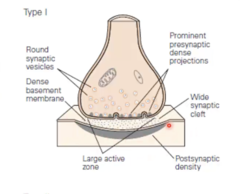
Describe type 1 synapses.
- Glutamatergic
- Excitatory
- Round synaptic vesicles
- Large postsynaptic density
Describe type 2 synapses.
- GABA
- Inhibitory
- Flattened synaptic vesicles
- Less postsynaptic density.

What is postsynaptic density?
- A dense protein structure located beneath the postsynaptic membrane at excitatory synapses.
- It anchors glutamate receptors (e.g. AMPA, NMDA) and organises key scaffold and signalling proteins.
What is the role of regulatory proteins in the postsynaptic density (PSD)?
- Proteins within the PSD which stabilise glutamate receptors and link them to intracellular signalling pathways.
- This allows synaptic plasticity like LTP which is crucial for learning.
- E.g., PSD-95
Describe PSD-95
- A regulatory protein which is important for clustering ion channels like NMDA and AMPA receptors.
- Contains a PDZ domain which can bind to subunits or TARP proteins on glutamate receptors.
- This allows them to anchor glutamate receptors down to the PSD.
What is EPSC?
- Excitatory post-synaptic current.
- The measurement of the flow of positive ions (e.g., Na⁺ and Ca2+) into a postsynaptic neurone after glutamate binding to ionotropic receptors (AMPA, Kainate, NMDA).
What are the roles of AMPA and NMDA receptors during an EPSC?
- AMPA receptors cause the fast (early) part of the EPSC by letting in Na⁺, leading to quick depolarisation.
- NMDA receptors work more slowly (late) and allow Ca²⁺ to enter instead of Na+.

What does APV (D-AP5) do to EPSCs and what effects does this have?
APV blocks NMDA receptors, reducing the late part of the EPSC.
- This prevents the Ca²⁺-dependent signalling (via NMDA) required for long-term functions like LTP and memory formation.

What is synaptic strength?
- Synaptic strength is how strongly one neurone can influence another through a synapse.
- For example, large depolarisation after glutamate binding to AMPA or NMDA means high synaptic strength and vice versa.
Describe synaptic plasticity.
- The ability of synapses to strengthen or weaken over time, allowing learning and memory.
- AMPA and NMDA receptors play an important role in this when glutamate binds to them.
- For example, LTP which increases synaptic strength.
What are the roles of NMDA and AMPA in synaptic plasticity?
- NMDA receptors respond to both glutamate binding and depolarisation, caused by AMPA, by allowing Ca²⁺ to enter the neurone during strong synaptic activity.
- This triggers signalling pathways that lead to the addition of more AMPA receptors onto the postsynaptic membrane, strengthening the synapse
— This allows synaptic plasticity.
What is long-term potentiation (LTP)?
- A long-lasting increase in synaptic strength that occurs when two neurones are repeatedly activated together.
- It's a key mechanism for learning and memory.
Describe long-term potentiation (LTP).
- The NMDA channel is blocked by Mg²⁺ at resting neuronal membrane potentials., so only AMPA receptors are active.
- After high-frequency stimulation, strong depolarisation removes the Mg²⁺ block, allowing NMDA receptors to open.
- Glutamate binds to NMDA receptors, and Ca²⁺ enters the postsynaptic neurone.
- Ca²⁺ activates CaMKII, PKC, and nitric oxide synthase (NOS).
- This leads to phosphorylation and insertion of more AMPA receptors into the postsynaptic membrane.
- Also triggers gene expression changes and structural growth, such as an enlarged postsynaptic density (PSD).
- These changes result in increased synaptic strength.

What is excitotoxicity?
- Process where excessive glutamate causes overactivation of NMDA receptors, leading to high calcium influx and neuronal cell death.
- Can lead to Alzheimer's disease.
How does excitotoxicity lead to Alzheimer's disease?
- Excess glutamate leads to overactivation of NMDA receptors, causing excess Ca²⁺ influx into neurons.
- This triggers cell damage and death, especially in memory-related areas like the hippocampus, contributing to cognitive decline.