307 exam 3
 Call Kai
 Learn
 Practice Test
 Spaced Repetition
 Match
 Flashcards
 Knowt Play
1/114

There's no tags or description
Looks like no tags are added yet.
115 Terms
Which of the following is not a granulocyte?
Monocyte
Which of the following is not a mononuclear cell?
Mast cell
Which of the following describes correct myelopoiesis?
Hematopoietic stem cell > CMP > GMP > Myeloblast > Promyelocyte > Myelocyte > Metamyelocyte > Band > Neutrophil
Which portion of myelopoiesis is part of the proliferation (mitotic) pool?
Myeloblast, promyelocyte, myelocyte
Which portion of myelopoiesis is part of the maturation (storage) pool?
Metamyelocyte, band, neutrophil
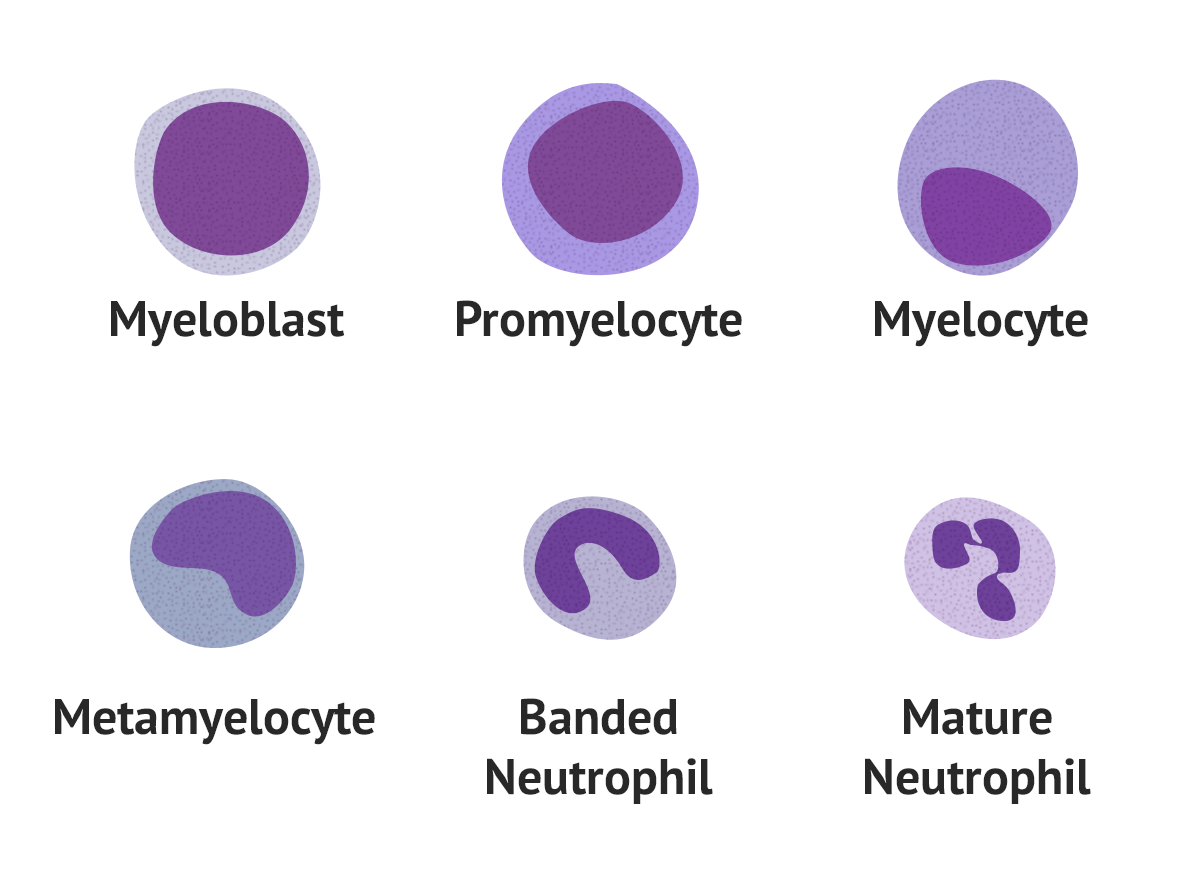
Which stage of myelopoiesis is the last stage of cell division?
Myelocyte
Which cells reach maturity with a nucleoli still present?
Lymphocytes
chromatin condensation is more apparent in ?
mature cells
Immature cells tend to be _____ in color
darker
N/C ratio is generally higher in ?
immature cells
As cells mature, they generally _______ in size
decrease

myeloblast

What type of granules are in this cell?
primary

promyelocyte

myelocyte

metamyelocyte

band

segmented polymorphonuclear neutrophils

What is the stimulating factor for eosinophils?
IL-5
Allergic reactions / parasitic infections are associated with ?
Eosinophilia
Which cell becomes mast cells in tissues?
Basophils

monoblasts

promonocyte

monocyte

large granular lymphocyte
Children younger than 1 year of age can have lymphocytes ________ of total leukocytes
up to 60%
Children 1 to 4 years of age can have lymphocytes __________ of total leukocytes
up to 50%
Adults have lymphocytes __________ of total leukocytes
18 - 42%
viral infections are commonly associated with ?
lymphocytosis

reactive lymphocyte
infectious mononucleosis is usually associated with?
reactive lymphocytosis
Which of the following is covered in primary granules?
promyelocyte
Which of the following is covered in secondary granules?
myelocyte
Which of the following as the biggest N/C ratio?
myeloblast
Which of the following correctly describes the granulocyte pools in the blood and bone marrow?
Bone marrow storage pool – mature granulocytes held in reserve for release when needed
Bacterial infections are associated with which WBC morphology?
toxic granulation & cytoplasmic vacuoles
Which form is seen naturally 9–32% in the bone marrow?
Band
Which form is seen naturally 0-3% in the bone marrow?
Myeloblast
Which 3 have the same myeloid maturation process?
neutrophils, basophils, eosinophils
Which is the following is the correct maturation process?
Monoblast > promonocyte > monocyte > macrophage
Which is the following is the correct maturation process?
Lymphoblast > prolymphocyte > lymphocyte > plasma cell
X–linked disease common in males
abnormal function in T cells, B cells, NK cells, neutrophils, and monocytes
thrombocytopenia, eczema, recurrent infections
Wiskott-Aldrich syndrome

Giant lysosomal granules in ALL WBC
neutrophils are deficient in chemotactic and bactericidal activities
Chediak-Higashi syndrome
What is the treatment for LADs?
BM transplantation
During leukocyte adhesion, what do selectins do?
Tethering & Rolling
During leukocyte adhesion, what do chemokines do?
Activation
During leukocyte adhesion, what do integrins do?
Adhesion & Extravasation
LAD I is caused by?
mutation in ITGB2 gene which encodes CD18 subunit of β-2 integrins
LAD II is caused by?
selectin deficiency (mutation in SLC35C1) gene
LAD III is caused by?
mutation in Kindlin-3
LAD patients may experience what?
severe bacterial and fungal infections
This disorder is caused by the inability of neutrophils to kill phagocytized pathogens intracellularly (defective respiratory burst)
Chronic granulomatous disease
How is the respiratory burst defective in CGD?
mutations in NADPH oxidase complex (NOC)
A patient experiencing severe and life-threatening infections by catalase-pos bacteria and fungi is suffering from?
CGD
mutations in the lamin B receptor gene affecting nuclear shape segmentation during maturation
unilobed or bilobed “pince nez” shaped nucleus in all WBC
Pelger-Huet anomaly
< 35% hyposegmented neutrophils, toxic granulation, fever, and cytoplasmic vacuoles may indicate what?
All of the above
Hypersegmented neutrophils without pancytopenia, and oval macrocytes may indicate what?
Hereditary hypersegmentation
Accumulation of mucopolysaccharide protein–carbohydrate complexes appearing as large and darkly–staining metachromatic granules in ALL WBC
Alder-Reilly anomaly
Mutation in MYH9 gene that causes thrombocytopenia, giant platelets, and large Dohle body–like inclusions in granulocytes and monocytes
May-Hegglin anomaly
What does MYH9 gene encode?
Myosin heavy chains that facilitate megakaryocyte maturation and PLT fragmentation
Dohle body–like inclusions are remnants of rough endoplasmic reticulum (ribosomal RNA).
False
Dohle body inclusions are remnants of precipitated myosin heavy chains.
False
Which mature WBC can still divide?
Lymphocytes
Plasmacytoid, Turk cells, and Downey cells are all names for what?
Lymphocytes
Which virus is known to cause infectious mononucleosis?
Epstein-Barr virus
What is the mechanism of infectious mononucleosis?
EBV binds to CD21 on B cells
Most of the circulating reactive lymphocytes in infectious mononucleosis represent?
Activated T cells
WBC count: 27 × 109/L
Reactive lymphocytes in PBS
Positive heterophile antibody test
Positive EBV-specific antigen & antibody tests
What do these results suggest?
Infectious mononucleosis

Niemann–Pick disease is caused by what deficiency?
Acid sphingomyelinase
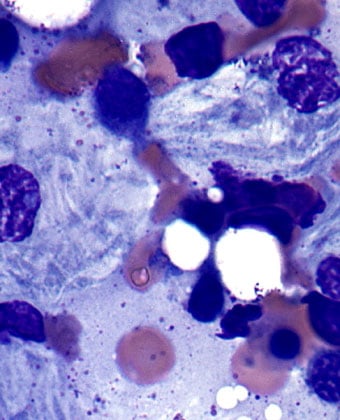
Gaucher disease is caused by what deficiency?
Beta-glucocerebrosidase
Examples of monocyte/macrophage lipid storage diseases include?
Gaucher and Niemann-pick diseases
A normal gene that is important for cell physiology (signaling pathways, proliferation, differentiation, and apoptosis)
Proto-oncogene
This mutated gene enables leukemogenic activity and gain–of–function activation
Oncogene
A gene that inhibits cell division (proliferation) and induces apoptosis; mutation may promote malignant transformation (loss–of–function)
Tumor suppressor gene
Examples of targeted therapies for hematologic malignancies include?
Cellular and immunotherapy
Hematologic malignancies are mostly what type of mutation?
Acquired somatic mutations
Specimens most commonly analyzed for flowcytometry in hematology DON’T INCLUDE:
Micro-clots, aggregates, and cell clumps in sodium citrate
During sample preparation for processing, samples must be _________ and at least _____ of the cells should be alive!
Single cell suspensions; 85%
Which of the following is false?
For flowcytometry: cells are lysed and suspended for characterization
Which tests require live cells?
flow cytometry & supravital staining
What does CD stand for?
Cluster of differentiation
Which of the following is true regarding sample QC?
Keeping cells on ice can improve the viability as this slows down necrosis and the cell metabolism

Detects an enzyme in primary granules of granulocytes; Auer rods are strongly positive
Myeloperoxidase (MPO)

Stains cellular lipids; positivity increases as granulocytes mature
Sudan Black B (SBB)

Positive in granulocytic cells and negative/weak in monocytic cells
Naphthol AS-D chloroacetate esterase (NASDA)

Strongly positive in monocytic cells; reaction inhibited by NaF
NSE: α-naphthyl acetate esterase

Diffusely positive in monocytes; less sensitive but more specific
NSE: α-naphthyl butyrate esterase
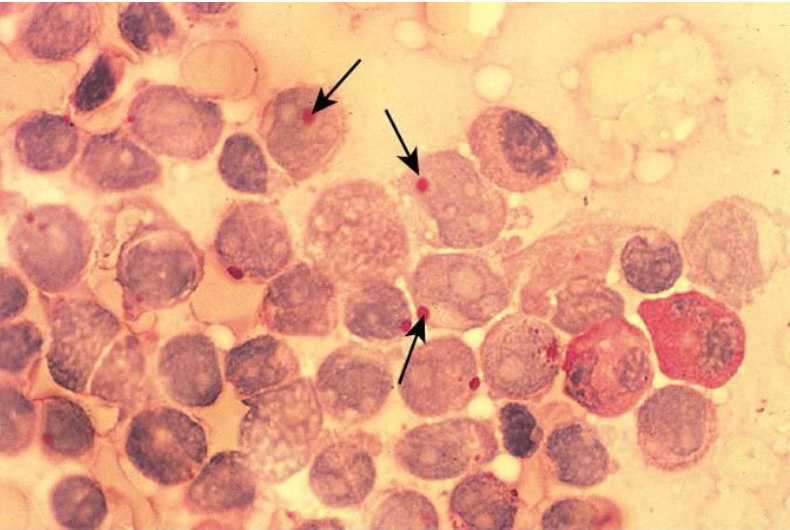
Stains carbohydrates and may produce coarse blocks of positivity in lymphoblasts; also positive in megakaryocytes, platelets, and leukemic erythroblasts
Periodic acid schiff (PAS)
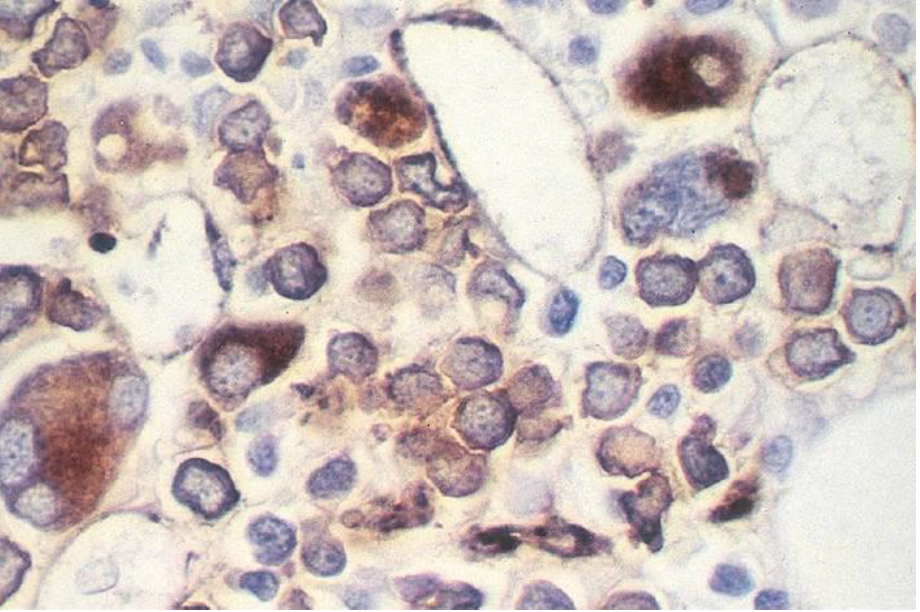
Positive in acute megakaryocytic leukemia through detection of platelet-associated proteins (α-granules)
Factor VIII / vWF Immunostaining

Positive in all hematopoietic cells, but T-cell ALL and hairy cell leukemia are +
Tartrate-resistant acid phosphatase (TRAP)
In acute myelomonocytic leukemia (M4), which tests are positive?
All of the above
MPO-
SBB-
NASDA-
ANBE -/+ (focal)
ANAE -/+ (focal)
PAS: “blocks of positivity” present
These results may indicate what?
ALL
MPO+
SBB+
NASDA+
ANBE -
ANAE -
These results may indicate what?
AML
MPO+
SBB+
NASDA+
ANBE + (diffuse)
ANAE + (diffuse)
These results may indicate what?
AMML
MPO-
SBB -/+
NASDA-
ANBE + (diffuse)
ANAE + (diffuse)
These results may indicate what?
AMoL
MPO-
SBB-
NASDA-
ANBE-
ANAE + (localized)
FVIII ab +
These results may indicate what?
Megakaryocytic leukemia
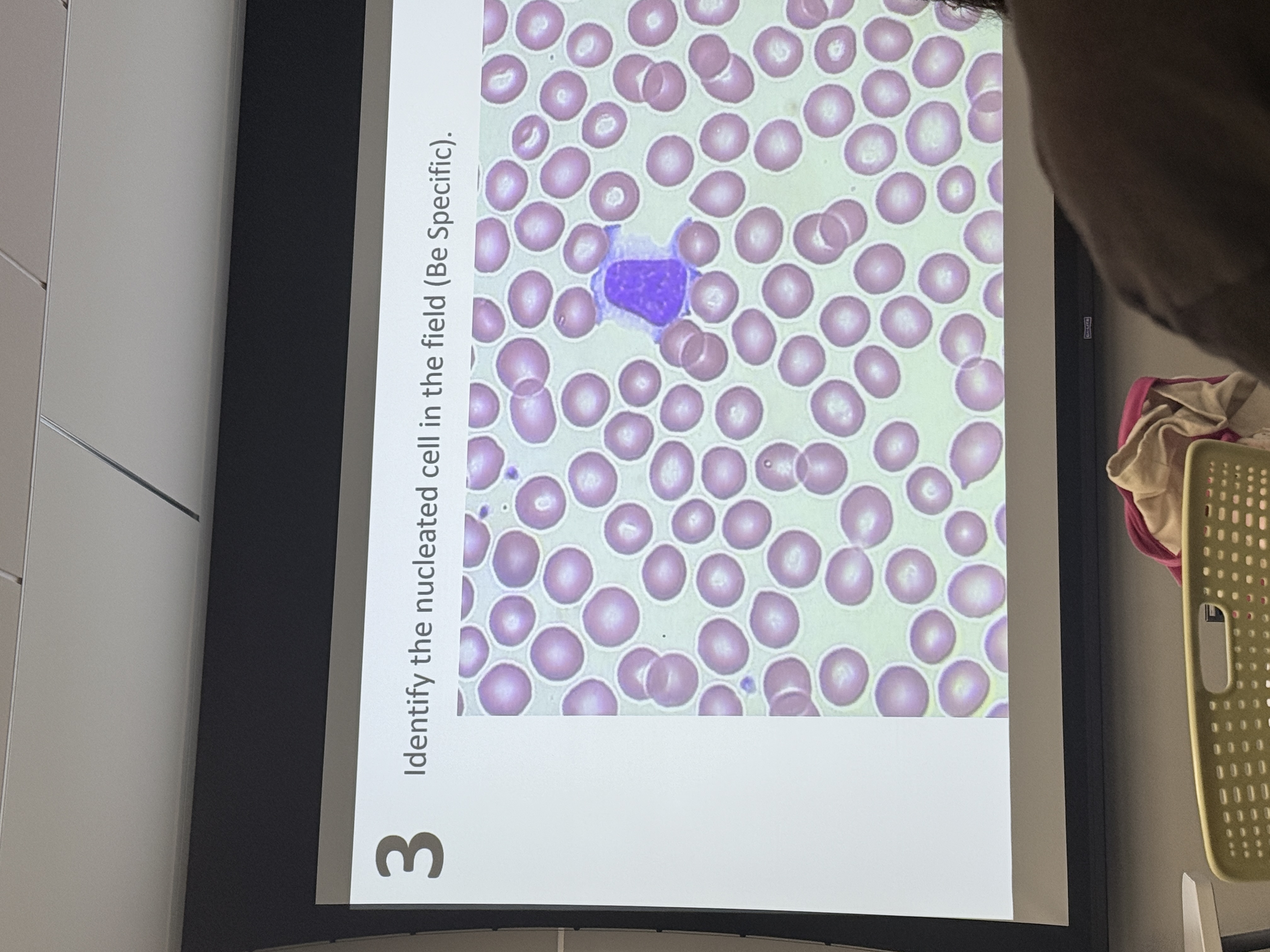
Reactive lymphocyte

band neutrophil with toxic granulation

leukocytosis with left shift neutrophilia

reactive lymphocyte