Med-Term Ch.4 Flash Cards
 Call Kai
 Learn
 Practice Test
 Spaced Repetition
 Match
 Flashcards
 Knowt Play
1/133

There's no tags or description
Looks like no tags are added yet.
134 Terms
acr/o
extremities
ankyl/o
crooked; bent; stiff; fused together
arthr/o, articul/o
joint
cervic/o
neck; cervix (neck of uterus)
cost/o
rib
crani/o
skull
kyph/o
humpback
myel/o
bone marrow'; spinal cord
oste/o
bone
peri
around; surrounding
phalang/o
phalanges; fingers or toes
-rrhaphy
suture
-rrhea
flow; excessive discharge
-rrhexis
rupture
sacro
sacrum
scoli/o
crooked; bent
-scope
instrument used to view
-scopy
visual examination using a scope
spin/o
spine
spondyl/o
vertebra; backbone
vertebr/o
verterbre; spinal column bones
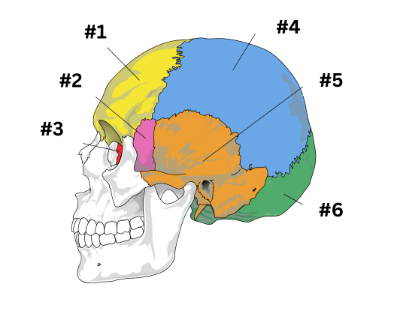
What is #1 in the image above?
Frontal

What is #2 in the image above?
Sphenoid
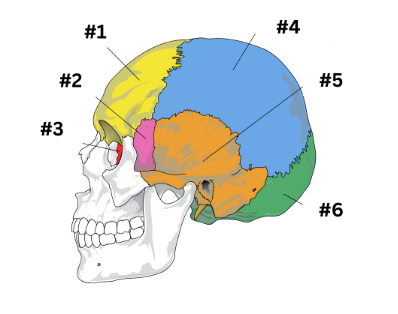
What is #3 in the image above?
Ethmoid

What is #4 in the image above?
Parietal

What is #5 in the image above?
Temporal

What is #6 in the image above?
Occipital
____________________ join all facial bones except one, making them immovable
Sutures
What lies between most vertebrae and are composed of cartilage and act as shock absorbers allowing for movement of the spinal column?
intervertebral disks
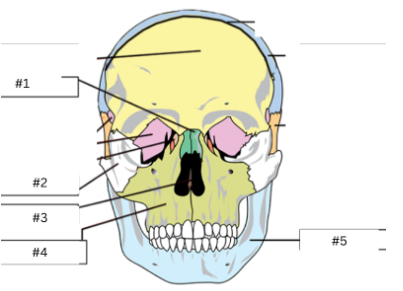
What is #1 in the image above?
nasal

What is #2 in the image above?
zygomatic

What is #3 in the image above?
vomer

What is #4 in the image above?
maxilla

What is #5 in the image above?
mandible

What is #1 in the image above?
cervical

What is #2 in the image above?
thoracic

What is #3 in the image above?
lumbar

What is #4 in the image above?
sacrum

What is #5 in the image above?
coccyx

What is #1 in the image above?
true ribs

What is #2 in the image above?
false ribs

What is #3 in the image above?
floating ribs
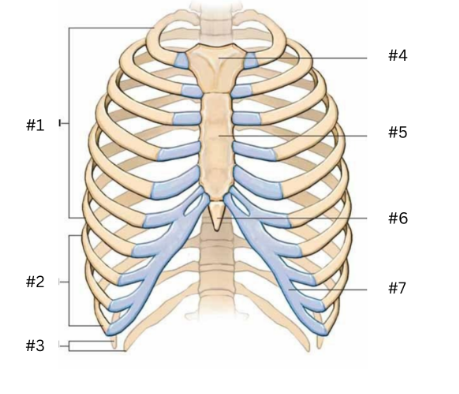
What is #4 in the image above?
manubrium

What is #5 in the image above?
body of sternum

What is #6 in the image above?
xiphoid process

What is #7 in the image above?
costal cartilage

What is #1 in the image above?
nasal

What is #2 in the image above?
maxilla

What is #3 in the image above?
mandible

What is #4 in the image above?
zygomatic
lumbar vertebrae
curve the lower back and are the strongest and largest vertebrae
cervical vertebrae
make up the neck region
coccyx
make up of four small bones fused together
thoracic vertebrae
connect the ribs
sacrum
triangular bone composed of five segments that gradually fuse together to become one
How many vertebrae are contained in the Cervical
7
How many vertebrae are contained in the Thoracic
12
How many vertebrae are contained in the Lumbar
5
last 2 pairs of costals (ribs 11 & 12)
called floating ribs
first 7 pairs of costals (ribs)
called true ribs or fixed ribs
the remaining 3 pairs of ribs
called false ribs
What are the 3 parts of the sternum
The manubrium
The body (of sternum)
The xiphoid
What bones make up the thorax or rib cage?
The sternum
The ribs
The thoracic vertebrae
What are the 7 bones that make up the face?
The nasal
the vomer
the zygomatic
the maxillary
the mandible
the palatine
the lacrimal
the skeletal system provides structure and shape for the body
support
the skeletal system surrounds and protects the internal organs
protection
the bones store calcium and phosphorus, two minerals that the body needs for important regulatory functions
mineral storage
red blood cells are manufactured in the bone marrow
red blood cell formation
the bones of the skeletal system act as levers for muscular action
anchoring and movement of muscles
very dense, hard and strong
cotical bone
the outer membrane of bone
periosteum
trabecular bone, much more porous and much less dense
cancellous bone
8 carpal bones
make up the wrist
ulna
larger/longer bone on the forearm (medial pinky side)
scapula
shoulder blade
5 metacarpals
make the hand
radius
smaller bones of the forearm on the lateral thumb side
sternum
breastbone
clavicle
collarbone
humerus
upper arm bone
14 phalanges
make up the finger bones
pubis
The anterior part of the pelvic bone
7 tarsal bones
make up the ankle
fibula
the smaller of the two lower leg bones on the lateral side
patella
kneecap, the bone that forms the anterior part of the knee
5 metatarsals
comprise the bone of the foot
ischium
the posterior part of the pelvic bone
femur
thighbone, the upper leg bone, the longest bone in the human body
14 phalanges
toes of the foot
tibia
shinbone, the larger more medially located lower leg bone
ilium
broad, blade-shaped bone that forms the upper part of each side of the pelvic

What is J
clavicle
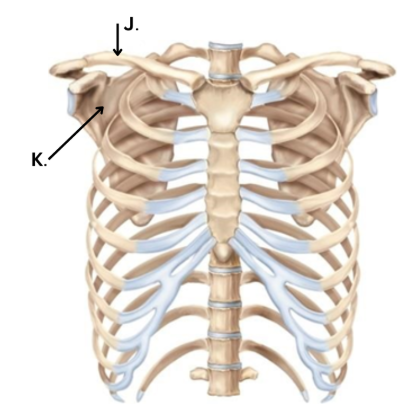
What is K
scapula

What is the letter A
clavicle
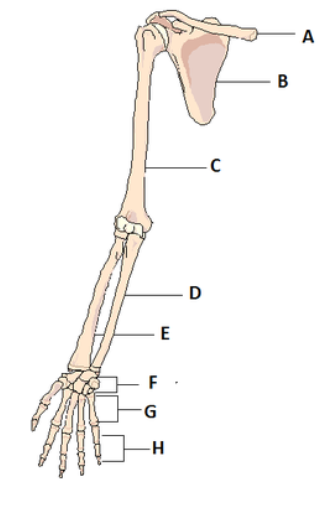
What is the letter B
scapula

What is the letter C
humerus

What is the letter D
ulna

What is the letter E
radius
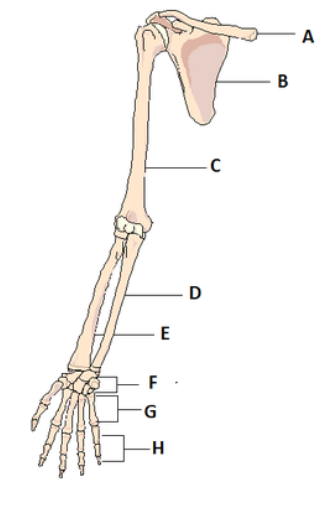
What is the letter F
carpals

What is the letter G
metacarpals