Science : Wave (year 9)
 Call Kai
 Learn
 Practice Test
 Spaced Repetition
 Match
 Flashcards
 Knowt Play
1/43

There's no tags or description
Looks like no tags are added yet.
44 Terms
Wave
A disturbance that transfers energy from one place to another .
Medium
The material through which a wave travels through
Mechanical wave
A wave which requires a medium to travel through.
Electromagnetic wave
A wave that can transfer energy through empty space without a medium .
what happens to particles when a mechanical wave passes through
The particles oscillate around a fixed position
Transverse Wave
A wave in which particles oscillate perpendicular to the direction of energy transfer.
A wave transfers ___ from one place to another
Energy
Oscillation / vibration
A repeated movement backs and forth around a fixed point
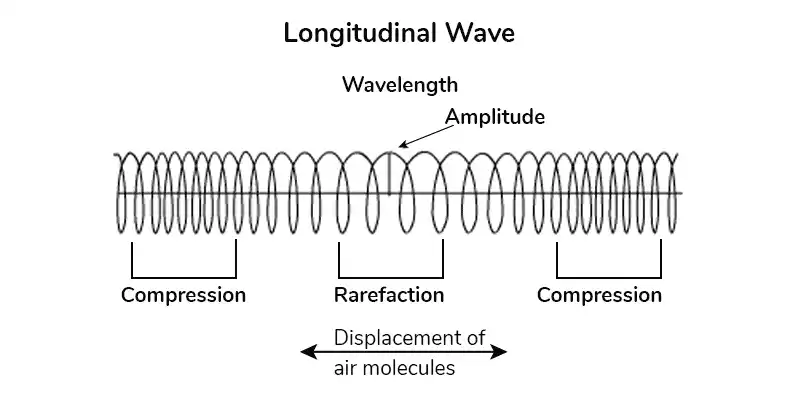
Longitudinal wave
A wave in which particles oscillate parallel to the direction of energy transfer .
Wave length
The distance between corresponding points on consecutive waves
Amplitude
The maximum distance a point moves from the equilibrium position (equilibrium to trough / equilibrium to crest )
Compression
A regional of a longitudinal wave where particles are close together
Type : Sound wave
Longitudinal
Type: Waves in water
Transverse
Type:Waves on a string
Transverse
Type: Light wave.
Transverse
Labelled image of longitudinal wave
Labelled image of transverse wave

Frequency
Number of complete oscillations/waves per second
Period
The time taken for One complete oscillation/wave
Equilibrium position
The position a particle occupies when it is not displaced by the wave
Unit of frequency
Hertz
Symbol for period
T
Symbol for wave length
lambda (λ)
Symbol for wave speed
v
T=
1/F
f =
1/T
f =
1/T
= v
fλ
Wave speed =
Frequency X wave length
In a sound wave , increased amplitude =
In a sound wave , increased volume =
In a sound wave ,increased frequency =
In a sound wave ,increased pitch =
Sound
A disturbance that transfers energy as particles oscillate around fixed positions
Pitch
How high or low a sound appears to us
Speed of sound through air =
343 m/s
Loudness
The intensity of the sound
Ultrasound
A sound with a frequency greater than 20,000 Hz
Range of humans hearing
20Hz to 20,000Hz
Echo
A sound that is heard again after it has reflected off a surface
How do we hear ?
Sound is produced by vibrations .
Vibrations travel through air as sound waves and hit the ear drum
The ear drum vibrates the tiny bones
The cochlea vibrates and transmits sound to the auditory nerve
The signals are sent to the brain which then interprets the sound
Formula for echo
V= 2d/t
Speed of an EM wave
300,000,000 m/s
Electromagnetic spectrum
Radio
Microwaves
Infrared
Visible light
Ultraviolet
X-ray
Gamma rays