3.4 Recovery Testing
 Call Kai
 Learn
 Practice Test
 Spaced Repetition
 Match
 Flashcards
 Knowt Play
1/5

There's no tags or description
Looks like no tags are added yet.
6 Terms
Recovery Testing
Ensures an organization can successfully carry out its disaster recovery plan.
It’s performed so that everyone is familiar with the process during an actual event.
Follow strict rules of engagement and avoid impacting production systems.
Are conducted within a set time frame
After the test, results are reviewed to assess performance, and any needed updates to the recovery plan are made before the next test.
Tabletop Exercises
Simulate a disaster recovery without actually deploying resources
Less costly and time-consuming than full recovery tests.
Walk through the recovery steps based on existing plans
Helps teams verify their procedures, coordinate with others, and identify gaps or inconsistencies
Fail Over
Failures are expected in IT, so systems must be designed to continue running when something goes wrong.
The process of automatically switching to a redundant system when a failure occurs
Ideally, this happens without the user even noticing—everything continues to function, just on backup systems.
Many systems come preconfigured to support it automatically
Redundant infrastructure must already be in place, including switches, firewalls, routers, and other critical components.
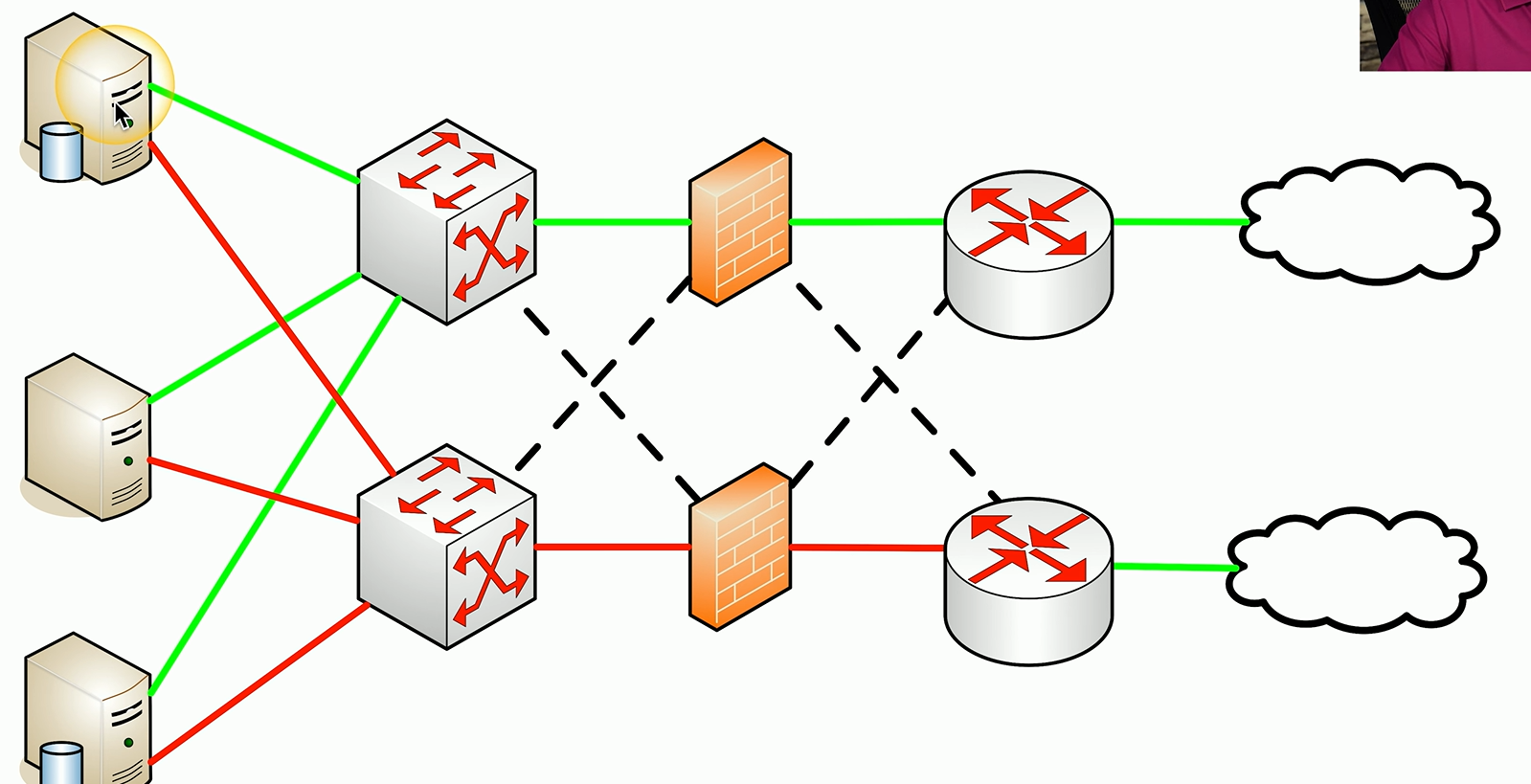
Fail Over Example
Here’s a diagram that describes how failover could be designed in an infrastructure.
We might have multiple internet connections from different providers.
Those are connected to different routers inside of our organization, which of course connects to redundant firewalls.
We would also have multiple switches, and on the back end we might have multiple links from the individual servers.
If we do have a break in the link for our primary connection because a switch, a firewall, or a router was to fail, we’ve always got a secondary link that we could use to gain access out to the internet
Simulation
Test how well security systems and users respond to potential threats.
These might include phishing simulations, testing password reset processes, or attempting data exfiltration to see if it’s detected.
A common example is a phishing simulation, where users receive fake phishing emails to test their awareness:
First goal is to see if automated defenses block the email. If not, we can track which users click the link and provide targeted training to improve future responses.
Parallel Processing
Involves using multiple CPUs or processor cores—either within a single computer or across multiple computers—to handle tasks simultaneously.
Improves performance by dividing complex transactions across several processors rather than relying on just one.
Also enhances resiliency: if one processor fails, the workload can continue on the remaining processors, maintaining availability and efficiency.