Section 2:3 - Cell adhesion
 Call Kai
 Learn
 Practice Test
 Spaced Repetition
 Match
 Flashcards
 Knowt Play
1/20

Earn XP
Description and Tags
Thinking about how cells and tissues are organized spatially
21 Terms
What is a landmark in cell polarity
A specific structure, protein, signal, or process that acts as an initial cue to direct subsequent polarity and organization.

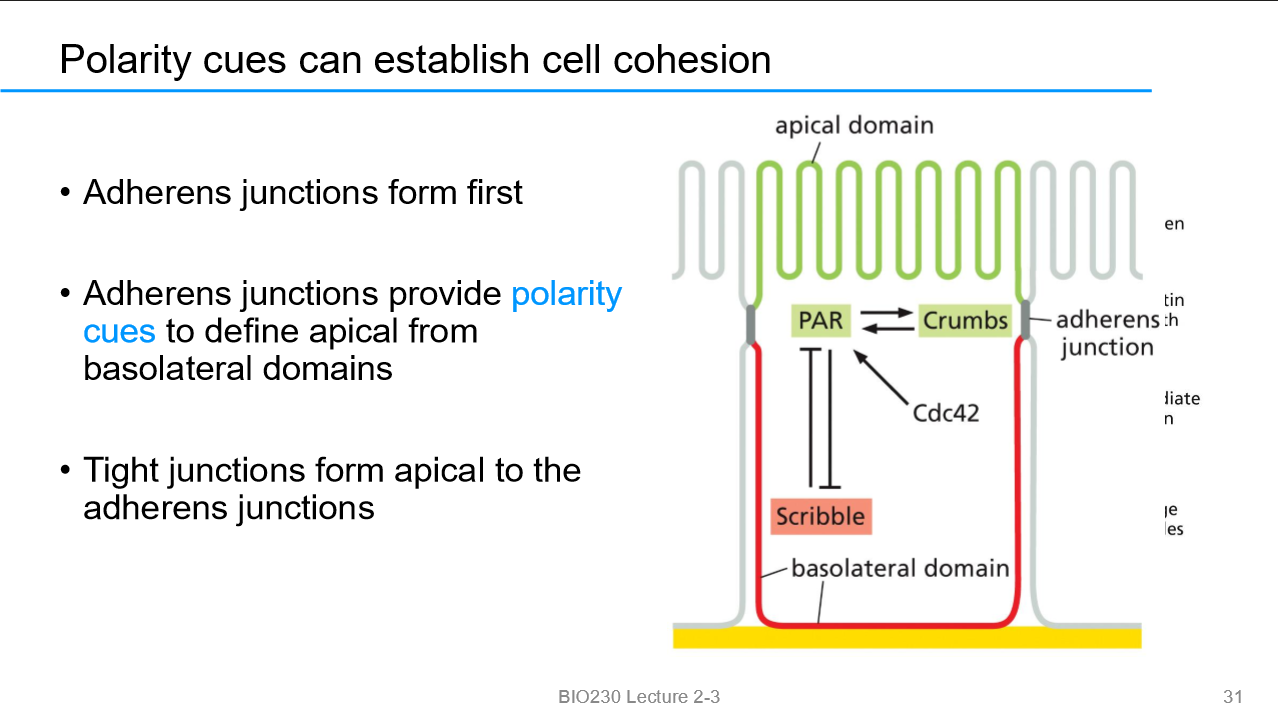
True or False: In establishing epithelial cell polarity, tight junctions assemble first and subsequently provide polarity cues to position adherens junctions.
False. Adherens junctions form first and provide polarity cues to define apical and basolateral domains; tight junctions then assemble apical to adherens junctions.
Fill in the blank: Extracellular cadherin domains require _____ to become rigid and engage in homophilic binding across an intercellular gap.
Ca2+
Explain how: How does coordinated contraction of apical adhesion belts drive epithelial morphogenesis?
Organized tightening of actin filament bundles within apical adhesion belts causes an epithelial sheet to invaginate and pinch off into a tube (forming structures such as the neural tube, gut, and blood vessels).

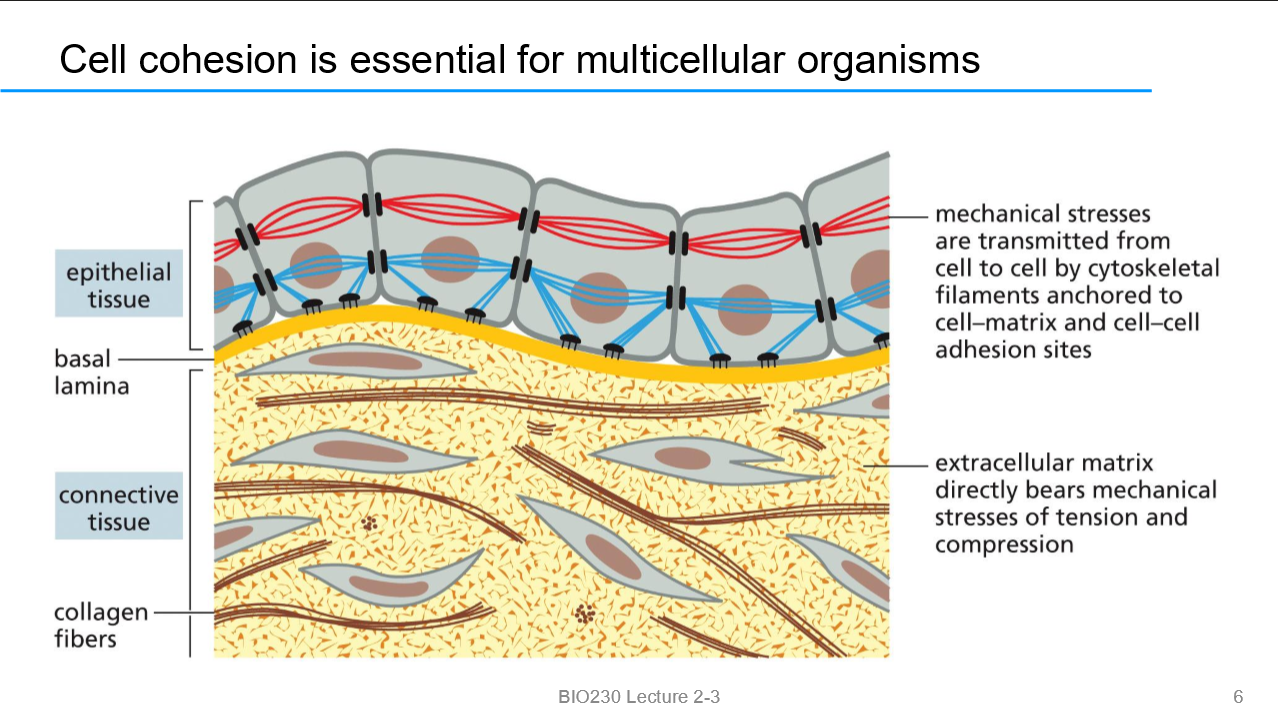
True or False: Connective tissue contains significantly more extracellular matrix than epithelial tissue, allowing the matrix itself to directly bear tension and compression stresses.
True. Connective tissue cells are dispersed within an abundant extracellular matrix that directly bears mechanical load, unlike epithelial cells which bear stress through cytoskeletal filaments anchored cell-to-cell.
Definition: Apical-to-basal order of junctional complexes in mature epithelial cells
From apical to basal:
Tight junctions: seals gap, prevents passage
Adherens junctions :actin adhesion belts
Desmosomes: intermediate filament anchors
Gap junctions: intercellular channels for small molecules

Multiple Choice: Which experimental condition most closely resembles adherens junction mutations in the outer epithelium of Drosophila embryos? A) Depolymerization of intermediate filaments B) Calcium removal at the outer epithelium C) Occludin mutation in the outer epithelium D) Inactivation of hemidesmosomes
B) Calcium removal at the outer epithelium. Cadherins require Ca2+ to maintain rigidity; without calcium, adherens junctions cannot form and cells fail to stick together.
Explain how: How do tight junctions enable directional glucose transport across the intestinal epithelium? Explain its importance
They function as a fence to confine active Na+-driven glucose transporters to the apical domain and passive glucose carriers to the basolateral domain,
while sealing intercellular spaces against back-leakage.
Importnace: This polarization ensures that glucose is absorbed efficiently into the cells and prevents its leakage back into the intestinal lumen.

Fill in the blank: Cadherins bind neighboring cadherins via _____ interactions, while their intracellular domains connect indirectly to actin filaments through adaptor proteins known as _____ and vinculin.
homophilic; catenins

Multiple Choice: An occludin mutation in intestinal epithelial cells will directly affect: A) Glucose transport B) Outer epithelium segmentation C) Cell sorting via N-cadherins D) Hemidesmosome assembly
A) Glucose transport. Occludin is an essential transmembrane component of tight junctions, which preserve cell polarity and prevent paracellular leakage of transported solutes.
True or False: Cells expressing E-cadherin will readily adhere to and mix with cells expressing N-cadherin via heterophilic cadherin interactions.
False. Cadherin interactions are homophilic; cells expressing E-cadherin sort out from cells expressing N-cadherin into distinct, non-mixing populations.
How does Rac help the front of a neutrophil move?
Rac promotes actin polymerization, which pushes the front of the cell forward.

How does Rho help the rear of a neutrophil move?
Rho promotes actin–myosin contraction, which pulls the rear of the cell in.

Definition: Three key components that define a functional epithelium
Overview of this lecture: (1) Intracellular trafficking, (2) cytoskeleton organization, and (3) cell cohesion.
Fill in the blank: Cell-matrix junctions mainly use transmembrane _____ heterodimers, which bind extracellular matrix proteins who link internally to actin filaments via adaptors like _____ and kindlin.
integrin; talin
Or: Cells attach to the extracellular matrix using ______. Inside the cell, these proteins connect to actin through adaptor proteins such as ______.

Fill in the blank: How can changes in cadherin expression help cells separate during neural tube development?
Changing which cadherins cells make changes which neighbors they stick to. This helps the surface tissue and neural tube separate and allows neural crest cells to detach and migrate.

Explain how: How do cell interactions and tissue boundaries change during the transition from a benign tumor to a malignant tumor?
In a benign tumor: proliferating cells remain contained within the basal lamina
Malignant tumor: cells lose cell-cell adhesion and break through the basal lamina to invade surrounding tissue.

True or False: Desmosomes anchor intermediate filaments to the basal lamina, whereas hemidesmosomes connect intermediate filaments between adjacent cells.
False. Desmosomes connect intermediate filaments between adjacent cells (cell-to-cell), whereas hemidesmosomes anchor intermediate filaments to the extracellular matrix/basal lamina (cell-to-matrix).

Explain how: How is anterior-posterior polarity initially established in a C. elegans zygote?
An external signal (the site of sperm entry) breaks symmetry
True or False: Sealing strands in tight junctions are formed by heterophilic interactions between claudin and occludin.
False. Claudins and occludins link cells via homophilic interactions (claudin binds claudin and occludin binds occludin) across the intercellular space.
Definition: Three essential functions of cell polarization
(1) Defining inside vs. outside, (2) performing different functions at different cell regions, and (3) transmitting directional signals.