BIO001 Midterm Review
 Call Kai
 Learn
 Practice Test
 Spaced Repetition
 Match
 Flashcards
 Knowt Play
1/85

There's no tags or description
Looks like no tags are added yet.
86 Terms
What aspect of the Earth’s physical shape and orientation to the sun drives global seasonality?
The tilt of the Earth’s axis; not because the earth is moving closer to the sun
How is science distinct from other ways of knowing? Two attributes stand out:
1) It focuses on questions about the natural and physical world; and
2) It is grounded in evidence-based decision-making, and specifically in evidence that is measurable and verifiable.
Scientists discover a previously unknown species of fish while researching the Mariana Trench and collect the following life history data: Adult specimens are 1-3 meters in length; their lifespan ranges from 120-130 years; after mating, each female produces several hundred eggs for which she provides no ongoing care or food; the majority of the hatchlings do not survive to sexual maturity, which generally occurs around 40 years of age.
How would you describe this species in terms of r- and K-selection?
This species has some r-selected traits and some K-selected traits.

What type of survivorship curve is A?
Type I: Most individuals survive to old age
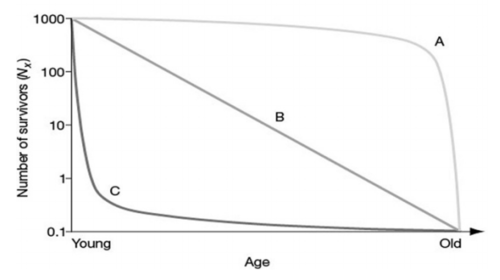
What type of survivorship curve is B?
Type II: individuals face a constant mortality risk at all ages
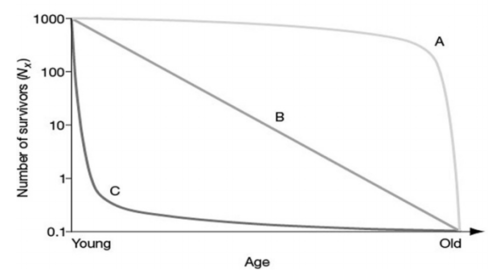
What type of survivorship curve is C?
Type III: Most individuals die young
The ability of an animal to sweat is an ____________, while the act of sweating in a hot environment is an ___________.
adaptation; acclimation
Humans and mammals are an example of endotherm or ectotherms?
Endotherms
Insects, fish, amphibians, and non-avian reptiles (such as snakes and lizards) are an example of endotherms or ectotherms?
Ectotherms
Between endothermy and ectothermy, which is superior?
Neither strategy is strictly superior; both offer tradeoffs which allow organisms to adapt in different ways to survive and reproduce in their environment.
Should Ectothermy and endothermy be viewed as clear and distinct categories.
No because some animals, such as sharks, are primarily ectothermic, but do generate some metabolic heat when their body temperature drops below a certain threshold. Similarly, some endothermic animals do not maintain body heat while hibernating.
Animals that switch between ectothermy and endothermy are called what?
Heterotherms
Animals that rely somewhat equally on both external and internal sources of heat are called what?
Mesotherms
A population evolves when
individuals with different genetic makeup survive or reproduce at different rates
Name the taxonomic groups
Domain, kingdom, phylum, class, order, family, genus, species
Which of these classes contains the most living species?
A. Ray-finned fishes (Actonopterygii)
B. Insects (Insecta)
C. Mammals (Mammalia)
D. Ferns (Polypodiosida)
E. Agaric fungi (Agaricomycetes
Insects (Insecta)
What kind of biome will show the least seasonality in temperature or precipitation?
Tropical rainforest
When is it beneficial to invest all your resources in reproduction and save none for survival?
When the chances of successfully reproducing again are low.
Resources allocated to one function _________ (can/cannot) be applied to another function.
cannot
All allocation decision results in _________.
trade offs
As the number of days since watering increases, unwatered plants will invest more recourses in _________, which will __________ the root:shoot ratio.
root; increase
True or false: An ectotherm’s body temperature always matches the ecosystem temperature.
True
Based on these characteristics: Change in phenotype, happens within an individual, short term, is this acclimation or adaptation?
Acclimation
Based on these characteristics: change in genotype, happens across generations, long term, is this acclimation or adaptation?
Adaptation
What are the tradeoffs of sweating?
Dehydration
According to Bergmann’s rule, having a big body size equals what average temperature?
Cold (Bergmann’s)
According to Bergmann’s rule, having a small body size equals what average annual temperature?
Hot (Bergmann’s)
According to Allen’s rule, having short limbs equals what average annual temperature?
Cold (Allen’s)
According to Allen’s rule, having long limbs equals what average annual temperature?
Hot (Allen’s)
From an energetic perspective, which of the following properly describes the best example of optimal foraging behavior:
a. A carnivore expending 4 units of energy to ingest 11 units of prey
b. A carnivore expending 10 units of energy to ingest 18 units of prey
c. A carnivore expending 5 units of energy to ingest 15 units of prey
c. A carnivore expending 5 units of energy to ingest 15 units of prey
Since freshwater contains significantly fewer ions than marine conditions, a freshwater fish would generally be __________ compared to its environment.
hypertonic
Since marine conditions contains significantly higher ions than freshwater conditions, a marine fish would generally be __________ compared to its environment.
hypotonic
Why do freshwater fish need to remove excess water, and how do they do it?
They absorb water from their surroundings and excrete very dilute urine to remove the excess.
How to freshwater fish obtain the ions they need?
Through food and ion uptake at their gills.
Why do marine fish lose water and how do they replace it?
Their environment has a higher solute concentration than their cells, so they lose water and drink more.
How do marine fish regulate excess ions?
They excrete concentrated urine to remove excess ions and maintain balance.
What is the main difference in osmoregulation between freshwater and marine fish?
Freshwater fish do not drink water, actively pump salts in through their gills, and excrete large amounts of very dilute urine; marine fish must constantly drink seawater, actively pump excess salt out through their gills, and produce small amounts of concentrated urine to save water.
Amphibians live in freshwater aquatic systems. This means that their aquatic environments will be ______ (hypotonic/hypertonic/isotonic) compared to their body.
Based on the above, water will move_____ their body.
hypotonic; into
Why might birth rate decrease with density?
Limited resources (fewer)
Why might mortality increase with density?
Competition for more resources (fewer resources)
Greater pathogen transmission
Increased predation
R-selected life histories
Environmental conditions keep populations at low density
Habitat is
unpredictable, variable
harsh, disturbed
Mortality is independent of other organisms and often catastrophic
K-selected life histories
Environmental conditions allow populations to reach high density
Habitat is
predictable
favorable for growth & survival
Mortality is often caused by interactions with other organisms
If the population size is unchanging throught time, then, on average, how many offspring does each individual produce throughout their lifetime?
One
What does a positive or negative S in (R=h2S) indicate?
Positive: Selection favors larger traits
Negative: Selection favors smaller traits.
How can certain alleles lead to higher or lower reproductive success? (This is the same as asking: Why does natural selection occur?)
The RNAs and proteins produced by some alleles work better than others in a particular environment, allowing an individual to thrive and produce more offspring.
Evolution by natural selection can be described as the inevitable outcome of heritable variation being associated with differential reproductive success. Why is this description accurate?
If some alleles get passed on to more offspring than others, it is inevitable that allele frequencies in the offspring population change.
What causes tusklessness in African elephants?
Specific alleles at two genes together cause the tuskless trait.
How did intense poaching affect tusklessness
Poaching killed many tusked elephants, increasing the proportion of tuskless elephants.
Why did tusklessness in elephants become more ocmmon during intense poaching?
Tuskless elephants were less likely to be killed for their ivory, so more surived to reproduce
Why are tusks usually advantageous to elephants?
They help them obtain food, dig for water and minerals, and compete for mates.
What might happen to tusklessness after poaching is reduced?
If tusks provide a fitness advantage again, tusklessness may decrease over generations through natural selection.

What type of selection is this graph?
Directional selection
What are two key impacts directional selection has on traits?
The average changes, because individuals with one extreme have higher fitness while individuals with another extreme have lower fitness.
The amount of overall variation decreases, because alleles associated with one extreme are being eliminated.
Directional selection can cause the average trait value to ____________, depending on which extreme phenotype has higher fitness and which has lower fitness.
increase or decrease

What type of selection is this graph?
Stabilizing selection
What are two key impacts stabilizing selection has on traits?
The average does not change, because individuals with intermediate values of the trait have the highest fitness.
The amount of overall variation decreases, because alleles associated with both extremes are being eliminated.
In stabilizing selection, does the average trait value vary over time?
No
Why is it important to use the term fitness correctly in a scientific context?
In humans and other organisms, fitness may have nothing to do with aerobic conditioning or physical size and strength.
Is it appropriate to make statements like "it's just a theory" in a scientific context?
No, because scientific theories aren't dismissed just because they are proposals or ideas. They are accepted or rejected based on rigorous testing with experiments and data.
What is the difference between ‘evolution’ and ‘natural’ selection?
Evolution is any kind of genetic change; natural selection is a particular ‘type’ of change (adaptation).
What are the three requirements for natural selection to occur?
Phenotypic variation
Heritability
Differential success — some individuals are more likely to survive & reproduce than others
What causes differential success?
Predation
Competition
Ability to find mate (mating success)
Abiotic conditions
R in Breeder’s equation represents
Response to selection — how much does the phenotype change
S in Breeder’s equation represents
Selection differential — how strong selection is
How do you calculate S in Breeder’s equation?
S = breeder average — population average (the sign matters)
How do you calculate R in Breeder’s equation?
R = Offspring average — Population Average (Previous generation)
R is always ____ S
less than
In directional selection, what happens to the mean and variance?
Mean = shift (+ or -)
Variance = reduce or stay the same
In stabilizing selection, what happens to the mean and variance?
Mean = stays the same
Variance = reduce (get smaller)
In disruptive (diversifying) selection, what happens to the mean and variance?
Mean = stays the same
Variance = gets bigger

What type of selection is this?
Disruptive selection
How is negative frequency dependence selection different than directional selection?
It maintains variation
What is the effect of Positive Frequency Dependence on variation?
It removes it
How is variation maintained in populations?
Balancing selection
Diversifying selection
Negative frequency dependent selection
Spatial + temporal variation in selection patterns
Heterozygote advantage
Lingering deleterious phenotypes
Recessive
Dalayed onset of phenotypic effects

The below graphics illustrate resource availability in the habitat of two different species of salmon. Assume these patterns of resource availability have been approximately as illustrated throughout the evolution of these different species. Based on these patterns, which species would you expect to exhibit semelparous reproduction (produces only once)?
Species A, because resource availability is unpredictable in its habitat
What is the relationship between body size and surface area to volume ratio?
Larger bodies have a lower surface area to volume ratio; smaller bodies have a higher ratio.
How does Bergmann’s law help mammals conserve heat?
Cold climate mammals tend to be larger, losing less heat relative to their body volume.
According to Allen’s law, how do limb length differ in cold vs. warm climates?
Cold climates: shorter limbs reduce surface area and heat loss
Warm climates: longer limbs help release heat.
Why does a lower surface area to volume ration help mammals in cold climates?
Less surface area relatie to volume means less heat escapes compared with the body’s heat-producing volume.
How do longer limbs help mammals climates
Longer limbs increase surface area relative to body volume, helping heat escape into the environment
Larger body (low SA:V) helps
conserve heat
Longer limbs (high SA:V) help
give off heat
N in (M/N) = (R/C)
estimated population size
M in (M/N) = (R/C)
# marked in 1st sample
C in (M/N) = (R/C)
total # caught in 2nd sample
R in (M/N) = (R/C)
# marked in 2nd sample