Unit 4 Part 2 (Proteins and Enzymes) Vocabulary
 Call Kai
 Learn
 Practice Test
 Spaced Repetition
 Match
 Flashcards
 Knowt Play
1/25

There's no tags or description
Looks like no tags are added yet.
26 Terms
Amino Acid
Monomer (building block) of proteins

R Group / Side Chain
The part of amino acid structure that distinguishes the 20 amino acids from each other
Condensation (Anabolic)
The kind of reaction that will create a peptide bond between two amino acids to form a dipeptide or polypeptide
Peptide Bond
A covalent bond between amino acids
Water
One of the products of a condensation reaction that creates a peptide bond to link two amino acids
Hydrophilic
A property of charged or polar amino acids
Hydrophobic
A property of nonpolar amino acids
Primary Protein Structure
The amino acid sequence in a polypeptide
Secondary Protein Structure
Twists and folds caused by Hydrogen Bonding between the backbones (amino groups and carboxylic acid groups) of a polypeptide chain; can form alpha helices or beta pleated sheets
Tertiary Protein Structure
Further twists and folds caused by interactions between the R groups of amino acids in a polypeptide chain

Quaternary Protein Structure
A protein formed by more than one polypeptide chain
Conjugated Protein
A protein with a structural component that is not an amino acid (an example is heme group containing Iron (Fe) in hemoglobin)
Fibrous Protein
A structural protein with only secondary structure; keratin and collagen are examples
Globular Protein
A protein with tertiary or quaternary structure; hemoglobin, insulin, salivary amylase, and histones are all examples

Hemoglobin
An example of a quaternary conjugated globular protein. This means the structure is made of more than one polypeptide chain with a non-amino acid structural component
Substrate
The molecule worked on by an enzyme
Active Site
Where a substrate will bind to the enzyme
Induced-Fit Model
The idea that the active site is flexible and will slightly change shape when in contact with the substrate to better allow for catalytic activity
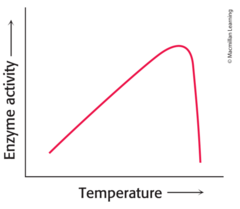
Enzymatic Activity
Increases from low temperatures increase kinetic energy and collisions will occur between enzymes and substrates more successfully; after the optimum temperature, further increases will denature the enzyme

pH Activity
Extreme pH outside of the optimum range will denature the enzyme
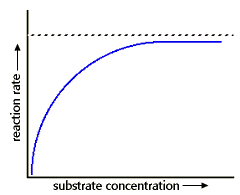
Substrate Concentration Activity
At the saturation point, further increases in substrate will not increase the rate of reaction (all active sites are already occupied)
Denature
When the 3-D structure of a protein is altered; typically high temperatures or extreme pHs interfere with the intermolecular forces causing the tertiary or quaternary structure to be disrupted
Competitive Inhibition
An inhibitor molecule is similar in structure to the substrate of an enzyme and blocks the active site

Non-competitive Inhibition
An inhibitor bonds to an allosteric site, causing a conformational change to the enzyme. This means the substrate is no longer able to fit with the active site.

End-Product Inhibition
The end product of a metabolic pathway is a non-competitive inhibitor of the first enzyme in the pathway; this means production of the product will stop the conversion of the original reactant to intermediates, saving time, resources, and energy.
Statins
A medication used to treat individuals with high cholesterol by competitively inhibiting an enzyme that helps synthesize cholesterol