WEEK 6 TESTBANK CH 14: Postpartum Complications & Nursing Care
 Call Kai
 Learn
Learn Practice Test
 Spaced Repetition
 Match
Match Flashcards
 Knowt Play
1/18

There's no tags or description
Looks like no tags are added yet.
Name | Mastery | Learn | Test | Matching | Spaced | Call with Kai | Chat |
|---|
No analytics yet
Send a link to your students to track their progress
19 Terms
The nurse works in a labor and delivery facility with new protocols for estimating postpartum blood loss. Which method for estimating blood loss is implemented in the delivery room?
Ask the patient how many peripads she considered to be “soaked”
Collect blood in calibrated, under-buttocks drapes for vaginal birth
Place a basin at the foot of the delivery table to catch any blood
Rely on the primary health care provider’s estimate of blood loss
ANS: 2
A calibrated under-buttocks drapes is used to collect blood during a vaginal birth. These drapes are weight to assist and estimate blood loss in the delivery room

* The nurse is aware the greatest source of bleeding during childbirth occurs following detachment of the placenta. Which physiological change takes place immediately after the expulsion of the placenta to decrease the amount of blood loss?
Contractions of the uterine myometrium
Factor VIII complex increases during gestation
Platelet activity increases before labor and deliver
Fibrin formation increases before labor occurs
ANS: 1
Once the placenta is detached from the uterus, the uterus contracts. This compresses the blood vessels at the placental site, thus decreasing the amount of blood loss
the nurse in a labor and delivery department carefully assesses postpartum patients for signs of complications related to hemorrhage. Which factor makes it most difficult to identify the risk of hemorrhage through vital sign evaluation?
Blood pressure may be elevate from prenatal conditions
Respirations are increased due to activity of labor
Changes in blood pressure may not be an immediate sign
Heart rate may increase with intensity of labor
ANS: 3
Changes in Blood pressure may NOT be an IMMDEIATE SIGN of hemorrhage in a postpartum patient.
Postpartum patients have increased blood volume ehich delays vital sign indications. The one that is most delayed are HR and BP

* The nurse continue to monitor a patient after a vaginal delivery with an estimated blood loss of 1,000 mL. Which assessment finding does the nurse recognize as requiring Stage 3 hemorrhage protocol?
Increased patient restlessness
Manifestations of severe pain
Development of abnormal vital signs
Patient requests water for extreme thirst
Abnormal vital signs is an indicator of Stage 3 hemorrhage.
Other indicators are bleeding, more than 2 units of RBCs, risk of bleeding, abnormal lab values, or oliguria
The nurse is assisting the primary care provider with the third stage of a vaginal delivery. The patient is multiparous, experienced a precipitous birth, and has a history of hypertension. Which medical prescription does the nurse anticipate for this patient?
Methylergonovine
Fresh frozen plasma
Hemabate (Carboprost-tromethamine)
Magnesium sulfate
ANS: 3
Hemabate is a prostaglandin administered IM that maintains contraction of the uterine muscles.
the nurse is closely monitoring a patient who is postpartum and at risk for PPH, which assessment finding will cause the nurse to contact the primary care provider immediately?
The uterus is displaced
The uterine fundus is boggy
Small clots are expressed with massage
Peripad weighs 100 g within 15 minutes
ANS: 4
A peripad weighing 100g in 15 mins is a sign of excessive bleeding.
(1g = 1 mL of blood) the patient has bled 100 mL in a span of 15 minutes

the nurse is providing care for a patient who is 8 hours postpartum after a vaginal delivery. The patient reports severe perineal pain unaffected by pain medication. Then nurse notices a 4 cm area of discoloration on the labia that is tender to the touh. Which action does the nurse take?
Continue to apply ice to the area for 24 hours
Monitor vital signs and report any abnormal findings
Contact the primary care provider for further evaluation
Relieve pressure by placing patient in a side-lying position
ANS: 3
A discoloration on the labia is a hematoma. When this is found, it is important to contact the primary care provider since the hematoma needs further evaluation.
* the nurse is providing postpartum care for a patient after a vaginal delivery. Which assessment finding causes the nurse to suspect endometritis from beta-hemolytic streptococcus?
Scant amount of odorless lochia
Presence of headache, malaise, and chills
Pain or discomfort in the midline lower abdomen
Elevated temperature greater than 100.4F (38C)
ANS: 1
Abeta-hemolytic endometritis has a specific different signs compared to a normal endometritis. The beta-hemolytic has a scant and odorless lochia.
In contrast, a general strand of endometritis will have the ff. s/s:

the lactation nurse takes a phone call from a mother who is breastfeeding her 2-month old infant. The mother reports an area of redness and warmth on the breast and a painful burning sensation when breastfeeding. Which statement by the nurse is correct if mastitis is suspected?
“If you nipplees are cracked, you will need to stop breastfeeding.”
“Pump your milk and throw it away until the infection is gone.”
“The baby gave you an infection and needs to be on antibiotics.”
“Continuing to breastfeed will help clear up the condition.”
ANS: 4
Mastitis is an inflammation on side of the breast. Continuing breastfeeding can help clear up the infection and condition.
the nurse is preparing discharge teaching for a postpartum patient who exhibits signs and symptoms of an episiotomy infection and is an oral antibiotic therapy. Which discharge teaching will the nurse provide regarding pain management?
Application of hot packs to the perineal area
Information applicable to medication therapy
Instructions to improve circulation by ambulating
Medicating for pain above level 4 on a 0 to 10 scale
ANS: 2
If a patient is being treated for an episiotomy infection, it is important that they get both antibiotic and analgesic therapy. With this, the nurse needs to teach medication therapy,
since the antibiotics need to complete the entire ordered dose until infection is gone.
* the nurse on a postpartum unit observes a patient who delivered 2 days ago. The nurse notices extreme agitation and depressed mood. The patient states, “I think that my baby is deformed inside and we have to fix him.” which risk factor is most strongly related to possible postpartum psychosis (PPP)?
Separation from the baby’s father
Personal history of bipolar disorder
Prolonged labor reseulting in cesarean
Loss of first child from a heart defect
ANS: 2
A risk factor that most likely have caused Postpartum psychosis (PPP) is history of bipolar disorder. The presence of a mental disorder prior to having a baby can highly result to PPP.
the nurse is providing care for a patient who is 1 day postpartum and exhibiting symptoms of postpartum psychosis. Which medical management does the nurse expect for his patient?
Prescriptions for antidepressant/antipsychotic drugs
Discharge to home with 24-hour observation in place
Immediate hospitalization in a psychiatric unit
Prescribed neonate visits during in-patient treatment
ANS: 3
If the patient has postpartum psychosis, the immediate medical response is immediate hospitalization. This is because there are HIGH RISKS of infanticide/suicide

* the nurse is aware of concern about the increasing numbers of severe maternal morbidity (SMM). it is believed to be related to changes in the overall health of the population of women giving birth. Which reasons does the nurse identify as causes of SMM? Select all that apply
Increases in maternal age
Prepregnancy obesity
Cesarean deliveries
Inability to pay for helth care
Preexisting chronic medical conditions
ANS: 1,2,3,5
Increased maternal age - older women have increased risk of death during pregnancy
Prepregnancy obesity
Cesarean deliveries - always a risk w/ surgical procedures
5. Preexisting medical conditions - decrease of overall health increases complication risk
he nurse is preparing a postpartum patient for discharge, for which reasons does the nurse instruct the patient to call the primary care provider? Select all that apply
Foul-smelling lochia
Hot, red, painful breasts
Mild headache
Not sleeping well
Frequent, painful urination
ANS: 1,2,5
Call the doctor if the postpartum patient has the following:
1. Foul-smelling lochia
2. Hot, red, painful breasts
5. Frequent, painful urination

a postparrtum patient informs the nurse of a frequent urge and burning when attempting to urinate, the nurse reviews the patient’s medical record and associates which risk factors related to a posible urinary tract infection (UTI)? Select all that apply
Neonatal macrosomia
Use of a vacuum extractor
Poor oral fluid intake
Urinary catheter during labor
Low-grade fever (101.3F [38.5C]
ANS: 1,2,3,4
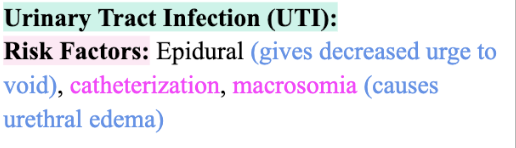
1. Neonatal macrosomia – causes urethral edema in the urethra
2. Vacuum extractor use - causes urethral edema
3. Poor oral fluid intake - dehydration; postpartum patient needs to drink 3,000 mL/day
4. Urinary catheter - a connection to the uterus during labor is an infection risk
WRONG: 5
low grade fever - is a symptom of UTI, NOT a risk factor
the nurse is assessing a patient who is 36 hours postpartum following a cesarean delivery. Which findings cause the nurse to conclude that a wound infection is developing? Select all that apply
Temperature increase from 99.8F to 100.5F
Incisional tenderness with palpation
Increased margins of incisional redness
Notably warm skin around the incision
Serosanguinous drainage from the suture line
ANS: 3,4
Signs that wound infection is developing:
3. Increased margin of incisional redness
4. Warm skin around incision
WRONG:
1. Temp from 99.8F to 100.5F - a sign of low-grade fever, which is a sign of surgical trauma
2. Incision tenderness w/palpation - surgical trauma
4. Serosanguinous drainage - expected post-op finding
* the labor and delivery unit nurses are adopting methods to reduce the number of women who develop postpartum depression. Research from Dennis and Dowswell (2013) procvides evidence-based suggestions regarding beneficial interventions. Which suggestions do the nurses consider? Select all that apply.
Telephone-based peer support
Partner report of symptoms
Interpersonal psychotherapy
Teaching for self-recognition of problems
Professionally based postpartum home visits
ANS: 1,3,5
Interventions to consider for pt. w/postpartum depression:
1. phone-based peer support - this is a psychosocial and psychological intervention, that is shown to decrease postpartum depression occurences
3. Interpersonal psychotherapy - psychosocia decreases postpartum depression.
5. Professional home visits - is a type of effective psychological intervention.

WRONG:
2. Partner report of symptoms - does not address any symptoms
4. Self-recognition of problems - no relation; does not benefit the pt.
* the nurse is collecting information during a follow-up OB appointment with a patient who delivered 3 months ago. The patient reports her partner has become cynical, irritable, and verbally abusive. The nurse will screen for which risks related to paternal postnatal depression (PPND)?
The father exhibited depression during the pregnancy
The birth of this fourth child was unexpected and unplanned
The father expresses feeling bored and underappreciated in his job
The father is recently estranged from his parents and siblings
The mother experienced a prolonged labor and a cesarean birth
ANS: 1,2,4
Risks for paternal postnatal depression:
1. Father has depression during pregnancy - history of depression can carry on be developed to PPND
2. Unexpected child - responsibility of another child was not prepared decently
4. Estranged from parents and siblings - lack of social support
a patient who is 8 months postpartum arrives for an OB appointment. The nurse notices that both the patient and the infant appear unkempt. The nurse anticipates a diagnosis of _______
ANS: postpartum depression
