Intro and perspectives / Evolution
 Call Kai
 Learn
Learn Practice Test
 Spaced Repetition
 Match
Match Flashcards
 Knowt Play
1/21

There's no tags or description
Looks like no tags are added yet.
Name | Mastery | Learn | Test | Matching | Spaced | Call with Kai | Chat |
|---|
No analytics yet
Send a link to your students to track their progress
22 Terms
What is the brain?
A tissue/organ inside the skull that produces consciousness and behaviour
What are examples of learned behaviours?
Plastic (can change with experience
Involve the forebrain
More in Organisms with complex nervous systems
Math, art language
What are examples of Inherited Behaviours?
Fixed (not learned)
Involve the hindbrain/ midbrain
Most common in organisms with simple nervous systems
Examples: smiling and other emotions
What is mentalism?
A non-material mind (“psyche”) produces/controls behaviour
The psyche is separate from the physical body
Mental abilities include reason, memory, attention, emotion, perception, consciousness, and language
Associated with Aristotle
What is dualism?
Behaviour is controlled by two things: a non-material mind and a material (physical) body
The mind controls/influences the physical body to produce behaviour
Descartes believed the mind and body interacted through the pineal gland
What is materialism
The brain and nervous system alone can explain the mind and behaviour
The mind is material/physical
The brain produces both inherited and learned behaviours
Associated with Charles Darwin
What is evolution by natural selection?
Charles Darwin proposed that helpful traits increase survival and reproduction.
These traits are passed to offspring over generations.
All animals share a common ancestor.
How does materialism explain inherited and learned behaviours?
Inherited behaviours → brain macrostructure determined by genes.
Learned behaviours → brain microstructure changed by experience (neuroplasticity).
What was Donald Hebb’s idea about learning?
Learning strengthens connections between neurons.
“Neurons that fire together, wire together.”
These connected groups of neurons are called cell assemblies.
What is the Encephalization Quotient (EQ)
EQ = actual brain size ÷ expected brain size relative to body size.
It controls for differences in body size, allowing fair comparisons between animals (e.g., cat vs. lion).
A relatively larger brain (higher EQ) is associated with more complex behaviour.
What is the lineage order that led to Homo sapiens?
Australopithecus → Homo habilis → Homo erectus → Homo sapiens
Australopithecus → walked upright, used stone tools
Homo habilis → larger brain, made stone tools
Homo erectus → human-like body/brain, complex tools, fire, socialized, migrated out of Africa
Homo sapiens → large brain, complex culture, migrated worldwide
What three factors are used to relate brain and behaviour across different animals?
1.Relative brain size
2.Number of brain cells
3.Brain cell connections
Where do humans fit in the tree of life?
Class: Mammals → large brains & social behaviour
Order: Primates → visual control of hands
Family: Great apes → tool use
Genus: Human → language
How did nervous systems become more complex through evolution?
Nerve net → simple network, no brain
Segmented nerve trunk → bilateral symmetry
Ganglia → clusters of neurons, somewhat brain-like
Brain + spinal cord → more centralized/complex nervous system
What nervous-system features did humans retain through evolution?
Neurons & muscles
Nerve net/PNS
Bilateral symmetry → two hemispheres
Segmentation → spinal cord segments
Ganglia → dorsal root ganglia
Brain + spinal cord
What trend occurred in nervous-system evolution?
Nervous systems became increasingly centralized and complex
This supported more complex movement and behaviour
What is Australopithecus and why is it important in human evolution?
“Southern ape” — lived about 3–4 million years ago
Proposed distant common ancestor of hominins
Walked upright and likely used stone tools
Had features of both modern chimps and humans
Lucy is a famous Australopithecus fossi

What is Homo habilis and why is it important in human evolution?
Lived ~1.4–2.4 million years ago and was known as the “Handy Human.”
Walked upright and likely made stone tools.
Was taller and had a larger brain with smaller jaws and teeth than earlier hominins.

What is Homo erectus and why is it important in human evolution?
Lived from about 2–3 million to 110,000 years ago and walked fully upright.
Had a larger brain and body size closer to modern humans.
Made more complex tools and used fire for cooking, warmth, protection, and socializing.
Migrated out of Africa, which is a major evolutionary milestone.
Thought to be an ancestor of later humans.

What is Homo neanderthalensis and why is it important in human evolution?
Lived mainly in Europe and had larger, stronger bodies and large brains.
Co-existed and interbred with Homo sapiens.
Made and used sophisticated tools.
Showed complex culture through jewelry, makeup, and music.
Buried their dead and marked graves, suggesting complex social/cultural behaviour.

What is Homo floresiensis and why is it important in human evolution?
Nicknamed “the Hobbit” because of its very small stature (about 3'6" tall).
Had a small brain and large teeth, but still made and used stone tools.
Lived on the Indonesian island of Flores and hunted animals such as small elephants and large rodents.
May have used fire and survived until relatively recently in human evolutionary history.
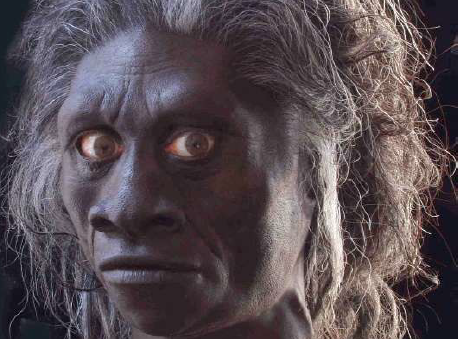
What are Homo sapiens and why are they important in human evolution?
Means “Wise Human” and evolved in Africa ~300,000 years ago.
Have large brains and developed complex culture.
Made specialized tools, such as fish hooks, harpoons, bows, and arrows.
Migrated throughout the world and are the only living human species today.
