Measurements Quiz 3

0.0(0)
Studied by 0 people
call kaiCall Kai
learnLearn
examPractice Test
spaced repetitionSpaced Repetition
heart puzzleMatch
flashcardsFlashcards
GameKnowt Play
Card Sorting

1/66

encourage image

There's no tags or description

Looks like no tags are added yet.

67 Terms

1
New cards

What is the difference between Instrument Characteristics and Instrument Specifications?

Characteristics describe the general inherent behavior or performance features of an instrument

Specifications are specific, quantitative details provided by the manufacturer that define expected or guaranteed performance

2
New cards
What are the four primary pairs of instrument types classified in measurement?

1) Active/Passive

2) Null Type/Deflection Type

3) Analog/Digital

4) Indicator/Signal Output

3
New cards

What is the difference between a Passive and an Active instrument?

  • Passive Instrument: The output is created entirely by the measured quantity itself.

  • Active Instrument: The measured quantity simply controls or adjusts the strength (magnitude) of an external power source


4
New cards
What is the difference between Analog and Digital instruments?

Analog instruments provide measurements using a continuously moving pointer or continuous signal (more durable/cost-effective in harsh environments).

Digital instruments convert physical quantities into discrete numerical values on a screen (higher accuracy, features like data logging/auto-ranging)

5
New cards
What is a Smart Instrument?

An instrument that includes a microprocessor or digital controller capable of signal processing, decision-making, self-calibration, or digital communication

6
New cards
What is Accuracy?

The closeness of a measured value to the true value

7
New cards
What is Inaccuracy (Measurement Uncertainty)?

The difference or bound on measurement error

8
New cards
What is Tolerance?

The permissible limit of error, often set by standards or specifications

9
New cards
What is Precision?

How tightly clustered repeated measurements are to one another

10
New cards
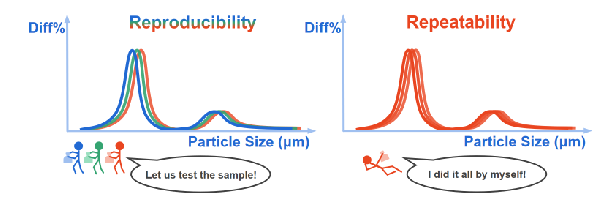
What is the difference between Repeatability and Reproducibility?

Repeatability is measurement closeness under the same conditions (same operator, setup, short time).

Reproducibility is measurement closeness under different conditions (different operators, instruments, times)
<p>Repeatability is measurement closeness under the same conditions (same operator, setup, short time). </p><p>Reproducibility is measurement closeness under different conditions (different operators, instruments, times)</p>
11
New cards
What is Linearity?

How close an instrument's actual response is to an ideal straight line

12
New cards
What is Hysteresis?

The difference in output readings at the same input value depending on whether the input is increasing or decreasing

<p>The difference in output readings at the same input value depending on whether the input is increasing or decreasing</p>
13
New cards
What is Dead Space (or Dead Band)?

The range of input values where no change in output occurs

<p>The range of input values where no change in output occurs</p>
14
New cards
What is Sensitivity?

The ratio of output change to input change, represented by the slope of the calibration curve

<p>The ratio of output change to input change, represented by the slope of the calibration curve</p>
15
New cards
What is Resolution?

The smallest detectable change in input that an instrument can register

<p>The smallest detectable change in input that an instrument can register</p>
16
New cards
What is Threshold?

The minimum input value that produces a detectable output

17
New cards
What is Sensitivity Drift?

A gradual, undesirable change in an instrument's sensitivity over time or due to environmental shifts

<p>A gradual, undesirable change in an instrument's sensitivity over time or due to environmental shifts</p>
18
New cards
What is Sensitivity to Disturbance?

How external variables (such as temperature or vibration) affect the output slope or sensitivity of an instrument

19
New cards
What do the Dynamic Characteristics of a measuring instrument describe?

An instrument's time-dependent behavior between the moment a measured quantity changes and the time the output reaches a steady value (transient state vs. steady state)

20
New cards

zero point calibration

Adjusts the instrument to read zero when there is
no input signal, ensuring an accurate baseline

21
New cards

span calibration

Adjusts the instrument to correctly read a known value at the end of its measurement range, ensuring accuracy across the full scale

22
New cards

linearity calibration

Verifies and corrects any non-linearities in the
instrument's response at various points within its operating range

23
New cards

zero order system

Follows input instantly (e.g., digital caliper)

Approximate, barely exists in the real world

<p>Follows input instantly (e.g., digital caliper)</p><p>Approximate, barely exists in the real world</p>
24
New cards

first order system

Includes a time constant (e.g., thermocouple)

Most common type in basic instrument

<p>Includes a time constant (e.g., thermocouple)</p><p>Most common type in basic instrument</p>
25
New cards

Second order system

Behaves like a mass-spring-damper system involving natural frequency and damping factor (e.g., accelerometer)

<p>Behaves like a mass-spring-damper system involving natural frequency and damping factor (e.g., accelerometer)</p>
26
New cards
What is vibration?
A mechanical phenomenon whereby oscillations occur about an equilibrium point, which can be deterministic (characterized precisely) or random (analyzed statistically).
27
New cards
What are the main types of vibration?

Free vibration (natural vibration), forced vibration, and damped vibration.

28
New cards
What is a Chladni plate and how does it work?
A flat sheet of metal mounted on a central stalk where sand vibrates away from antinodes and gathers at nodes to form symmetrical patterns when oscillating.
29
New cards
What are Faraday waves?
Nonlinear standing waves that appear on liquids enclosed by a vibrating receptacle, oscillating at half the driving frequency.
30
New cards

Passive vibration isolation

uses materials and mechanical linkages (like springs and dampers) to absorb and damp waves

31
New cards

active vibration isolation

uses sensors and actuators to produce disruptive interference that cancels incoming vibration.

32
New cards
What are mechanical metamaterials?
Rationally designed artificial materials with precision geometrical arrangements whose unusual physical and mechanical properties are derived from their internal structures.
33
New cards
What are some examples of useful vibrations?
Musical instruments, compressors, ultrasonic cleaners, cell phone alerts, and clock pendulums.
34
New cards
What are the primary methods utilizing vibration?

Vibration analysis (machinery health/fault detection)

medical and health monitoring (ultrasound, bone density)

non-destructive testing (NDT, commonly used in construction and manufacturing).

35
New cards
How do piezoelectric-based vibration instruments work?
Mechanical deformation produces an electric charge via the piezoelectric effect (e.g., ICP accelerometers).
36
New cards
How do capacitive and MEMS-based vibration instruments work?
Vibration changes the capacitance between microfabricated plates.
37
New cards
How do laser/optical-based vibration instruments work?
They use optical interference or the Doppler shift to detect motion or velocity (e.g., Laser Doppler Vibrometer).
38
New cards
How do strain gauge-based vibration instruments work?
Vibration causes strain on a surface, leading to a change in electrical resistance.
39
New cards
How do electromagnetic velocity transducers work?
Relative motion between a coil and a magnet induces a voltage proportional to velocity.
40
New cards

What is Time-Domain Analysis in vibration?

An analysis method that examines vibration amplitude and RMS values as they happen second-by-second to see how strong the shake is and spot unusual spikes.

41
New cards
What is Frequency-Domain Analysis using FFT?
A method that uses the Fast Fourier Transform to convert time-domain vibration data into frequency-domain data to identify specific component frequencies.
42
New cards
What is Modal Analysis?
An analysis method that identifies a structure's natural frequencies, mode shapes, and damping characteristics.
43
New cards
What is the Short-Time Fourier Transform (STFT)?
A transform that divides a longer time signal into shorter segments of equal length and computes the Fourier transform separately on each segment to analyze frequency content as it changes over time.
44
New cards
What is the equation of motion for a single-degree-of-freedom Spring Mass Damper (SMD) system?

second order ODE

<p>second order ODE</p>
45
New cards

solution to the SMD system second order ODE

knowt flashcard image
46
New cards

What is the formula for undamped natural frequency

where k is the spring constant, and m is mass

<p>where k is the spring constant, and m is mass</p>
47
New cards

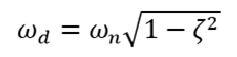
What is the formula for damped natural frequency

where zeta is the damping ratio
<p>where zeta is the damping ratio</p>
48
New cards

What is the formula for the damping coefficient

where zeta is the damping ratio

<p>where zeta is the damping ratio</p>
49
New cards

What is the formula for the critical damping coefficient

where k is the spring constant, and m is mass

<p>where k is the spring constant, and m is mass</p>
50
New cards

What is the damping ratio formula in terms of c and cc


<p></p>
51
New cards

What is Logarithmic Decrement used for, and what is its formula?

It characterizes the rate of decay in a damped system,

<p>It characterizes the rate of decay in a damped system, </p>
52
New cards
What is number-based data?
Data represented by numerical values involving discrete or continuous measurements (like temperatures, pressures, forces, or voltages) used to quantify measurements directly.
53
New cards
What is figure-based data?
Data represented visually through images, graphs, or plots (such as scatter plots, bar charts, or thermal camera images) used for qualitative interpretation and visualization.
54
New cards
What is signal-based data?
Data represented as a continuous or discrete signal varying over time (such as machine vibration signals or sound waves), shown in either the time domain or frequency domain.
55
New cards
What are the main methods of data cleaning?

Removing outliers from engineering datasets

Handling missing data using techniques like interpolation or removing incomplete records.

56
New cards
What are low-pass, high-pass, and band-pass filters used for?
Data filtering methods used to eliminate noise from sensor signals (such as vibration monitoring data).
57
New cards
What is smoothing in data processing?
Techniques such as moving averages used to reduce signal noise.
58
New cards
What basic statistics are commonly used in statistical processing?
Mean, variance, standard deviation, and Root Mean Square (RMS).
59
New cards

What correlation methods are commonly used in statistical processing?

Autocorrelation is used to detect periodicity within a signal

Cross-correlation measures the similarity between two different signals.

<p>Autocorrelation is used to detect periodicity within a signal</p><p>Cross-correlation measures the similarity between two different signals.</p>
60
New cards
What are normalization and standardization used for in data transformation?
Adjusting data to comparable scales.
61
New cards
What is the purpose of a Fourier Transform in data processing?
Converting time-domain data into the frequency-domain to analyze signal frequency content.
62
New cards
What is the purpose of a 2D Fast Fourier Transform (FFT)?
It can determine the spatial frequency of an image.
63
New cards
What does the fftshift function do in MATLAB?
It performs a zero-centered, circular shift on a discrete Fourier transform to better visualize its periodic nature across positive and negative frequencies.
64
New cards
What are the three damping regimes in a spring-mass-damper system based on the damping ratio?

Underdamped (oscillatory decay)

Critically Damped (fastest return to equilibrium without oscillation)

Overdamped (slow, non-oscillatory return to equilibrium).

65
New cards
What is Logarithmic Decrement used for?
It is used to characterize the rate of decay in a damped vibration system.
66
New cards

deflection type instruments

  • measure a quantity by creating a mechanical deflection, usually of a pointer against a scale

  • Accuracy depends on the linearity and calibration of spring

  • Usually more convenient and has faster response.


<ul><li><p><span>measure a quantity by creating a mechanical deflection, usually of a pointer against a scale</span></p></li><li><p><span style="color: rgb(0, 0, 0);">Accuracy depends on the linearity and calibration of spring</span></p></li><li><p><span style="color: rgb(0, 0, 0);">Usually more convenient and has faster response.</span></p></li></ul><p></p>
67
New cards

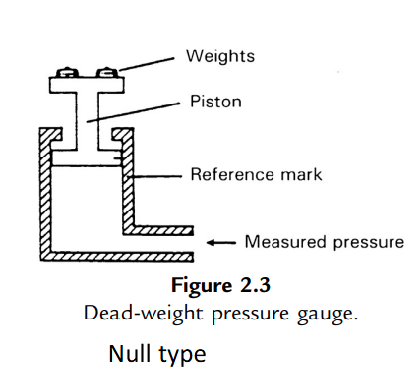
null-type instruments

  • measuring by balancing the measured quantity against a calibrated standard until a null or zero deflection is achieved

  • Accuracy depends on the calibration of weights (easier)

  • Usually more accurate


<ul><li><p><span>measuring by balancing the measured quantity against a calibrated standard until a null </span><span style="color: rgb(0, 0, 0);">or zero deflection is achieved</span></p></li><li><p><span style="color: rgb(0, 0, 0);">Accuracy depends on the calibration of weights (easier)</span></p></li><li><p><span style="color: rgb(0, 0, 0);">Usually more accurate</span></p></li></ul><p></p>