Ch 8: Nucleotides and Nucleic Acids
 Call Kai
 Learn
 Practice Test
 Spaced Repetition
 Match
 Flashcards
 Knowt Play
1/58

There's no tags or description
Looks like no tags are added yet.
59 Terms
Nucleic acids are both repositories and functional expressions of biological information (T/F)
T
The transmission of biological information relies on molecular complementarity (T/F)
T
Biological information is not subject to natural damage and change (T/F)
F
Biological information can be accessed, interpreted, and altered in the laboratory (T/F)
T
Nucleoside triphosphates (ATP) occupy the central role in cellular metabolism, serving as an energy currency and as important regulatory signals (T/F)
T
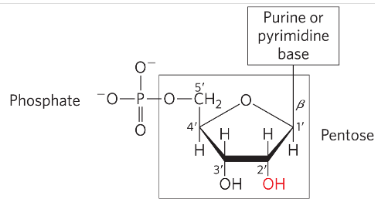
Deoxyribonucleic acid, also known as this, is a nucleic acid that is a molecular repository of genetic information. The storage of biological information and the transmission of that information from one generation to the next are the only known functions of this nucleic acid. Has no Red OH but instead an H
DNA
A segment of a DNA molecule that contains the information required for the synthesis of a functional biological product, whether protein or RNA, is referred to as this
Gene

Ribonucleic acid, also known as this, is a nucleic acid that is a molecular repository of genetic information. Has a broad range of functions, including as complexes that carry out the synthesis of proteins, as intermediates that carry information for the synthesis of a protein from a gene to a ribosome, and as adaptor molecules that translate the intermediate messenger into a specific sequence of amino acids
RNA
Ribosomal RNA, also known as this, is a complex that carries out the synthesis of proteins
rRNA
Messenger RNA, also known as this, is an intermediate that carries information for the synthesis of a protein from one or a few genes to a ribosome
mRNA
Transfer RNA, also known as this, is an adaptor molecule that faithfully translates the information of mRNA into a specific sequence of amino acids
tRNA
This molecule has three characteristic components: (1) a nitrogenous (nitrogen-containing) base, (2) a pentose, and (3) one or more phosphates
Nucleotide
A nucleotide without a phosphate group
Nucleoside

A type of nitrogenous base consisting of two rings. Includes cytosine, thymine (in DNA), and uracil (in RNA)
Purine
A type of nitrogenous base consisting of a ring. Includes Adenine and Guanine
Pyrimidine
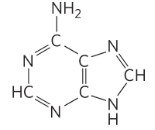
Identify this nucleotide base and whether it is a purine or a pyrimidine
Adenine; purine

Identify this nucleotide base and whether it is a purine or a pyrimidine
Guanine; purine

Identify this nucleotide base and whether it is a purine or a pyrimidine
Cytosine; pyrimidine

Identify this nucleotide base and whether it is a purine or a pyrimidine
Thymine; pyrimidine

Identify this nucleotide base and whether it is a purine or a pyrimidine
Uracil; Pyrimidine

The successive nucleotides of both DNA and RNA are covalently linked through phosphate-group “bridges,” in which the 5’-phosphate group of one nucleotide unit is joined to the 3’-hydroxyl group of the next nucleotide, creating this type of linkage
Phosphodiester linkage
The definition of “short” is somewhat arbitrary, but polymers containing 50 or fewer nucleotides are generally called this. A longer nucleic acid is called a this
oligonucleotide; polynucleotide

Free pyrimidine and purine bases may exist in two or more of these forms depending on the pH. Uracil, for example, occurs in several readily interconverted forms.
Tautomer
[8.1 Some Basic Definitions and Conventions] These consists of a nitrogenous base (purine or pyrimidine), a pentose sugar, and one or more phosphate groups. If no phosphate is present, the combination of the pentose sugar and the nitrogenous base is a nucleoside.
Nucleotide
[8.1 Some Basic Definitions and Conventions] These are polymers of nucleotides, joined together by phosphodiester linkages between the -hydroxyl group of one pentose and the -hydroxyl group of the next. There are two types RNA and DNA.
Nucleic acids
[8.1 Some Basic Definitions and Conventions] The nucleotides in (RNA/DNA) contain ribose, and the common pyrimidine bases are uracil and cytosine. In (RNA/DNA), the nucleotides contain -deoxyribose.
RNA/DNA
[8.1 Some Basic Definitions and Conventions] The common pyrimidine bases are what?
Thymine, Uracil and Cytosine
[8.1 Some Basic Definitions and Conventions] The primary purines are these in both RNA and DNA.
Adenine and Guanine
[8.1 Some Basic Definitions and Conventions] The nitrogenous bases have a hydrophobic character and interact via base-stacking interactions. (T/F)
T
A+G = T+C is whose rule?
Chargaff
Because nucleotides in each new strand are joined in a sequence specified by the base-pairing rules stated above, each preexisting strand functions as a template to guide the synthesis of one complementary strand (T/F)
T

Identify the form of DNA. Right handed anti bond configuration
A Form DNA

Identify the form of DNA. Right handed anti bond configuration
B Form DNA

Identify the form of DNA. Left handed anti bond configuration
Z Form DNA
A common type of DNA sequence that is identical when read forwards or backwards. It is a region with an inverted repeat with a self-complementary sequence in one strand that is repeated in the opposite orientation in the paired strand
Palindrome

Is this a palindrome or a mirror repeat? Note that it is double stranded with two fold symmetry
Palindrome
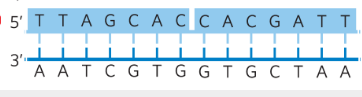
Is this a palindrome or a mirror repeat? Note that it is a symmetric sequence within each strand
Mirror repeat
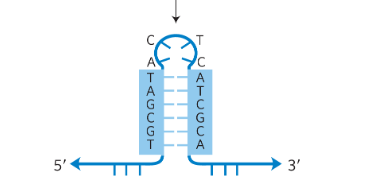
What kind of structure is this, formed from palindromic DNA?
Hairpin
mRNA is formed from a DNA template by what process?
Transcription
If an mRNA that codes for only one polypeptide, it is (mono/poly)cistronic. Most eukaryotes are this
monocistronic
An mRNA that codes for multiple polypeptides is (mono/poly)cistronic
polycistronic
The (primary/secondary/tertiary) structure of RNA includes hairpins, bulges , and internal loops
secondary
[8.2 Nucleic Acid Structure] Putting together the available data, Watson and Crick postulated that native DNA consists of two antiparallel chains in a right-handed double-helical arrangement. Complementary base pairs, A═T and , G=C are formed by hydrogen bonding between chains in the helix. The base pairs are stacked perpendicular to the long axis of the double helix, 3.4 Å apart, with 10.5 bp per turn. (T/F)
T
[8.2 Nucleic Acid Structure] Messenger RNA transfers genetic information from DNA to ribosomes for protein synthesis. (T/F)
T
[8.2 Nucleic Acid Structure] Transfer RNA and ribosomal RNA are also involved in protein synthesis. RNA can be structurally complex; single RNA strands can fold into hairpins, double-stranded regions, or complex loops. Additional noncoding RNAs have a variety of special functions. (T/F)
T
Alterations in DNA structure that produce permanent changes in the genetic information encoded therein are called this. Linked with aging and carcinogenesis.
Mutations
Under typical cellular conditions, deamination of cytosine (in DNA) to uracil occurs in about one of every cytidine residues in 24 hours. This rate of deamination corresponds to about 100 spontaneous events per day, on average, in a mammalian cell. (T/F)
T
In this process, researchers can greatly amplify any DNA segment they might be interested in if the sequences of the ends of the targeted DNA segment are known.
PCR
Enzymes that synthesize DNA strands from deoxyribonucleotides (dNTPs), using a DNA template by adding nucleotides called primers to the 3’ end of pre-existing strands
DNA Polymerase
The steps of PCR are Denaturation —> Primer annealing —> Elongation (T/F)
T
[8.3 Nucleic Acid Chemistry] Native DNA undergoes reversible unwinding and separation of strands (melting) upon heating or at extremes of pH. DNAs rich in G=C pairs have higher melting points than DNAs rich in A═T pairs (T/F)
T
[8.3 Nucleic Acid Chemistry] DNA is a relatively stable polymer. Spontaneous reactions such as deamination of certain bases, hydrolysis of base-sugar N-glycosyl bonds, radiation-induced formation of pyrimidine dimers, and oxidative damage occur at very low rates, yet are important because of a cell’s very low tolerance for changes in its genetic material. (T/F)
T
[8.3 Nucleic Acid Chemistry] DNA is NOT subject to enzymatic modification of nucleotide bases at particular locations. Methylated bases are NOT common. (T/F)
F
[8.3 Nucleic Acid Chemistry] Routine DNA sequencing of genes or short DNA segments is carried out using an automated variation of Sanger dideoxy sequencing. (T/F)
T
[8.3 Nucleic Acid Chemistry] DNA sequences, including entire genomes, can be efficiently determined in hours or days using commercial next-gen sequencing technologies. (T/F)
T
Hydrolysis of nucleoside triphosphates provides the chemical energy to drive many cellular reactions. Adenosine -triphosphate, ATP, is by far the most widely used nucleoside triphosphate for this purpose, but UTP, GTP, and CTP are also used in some reactions. (T/F)
T
[8.4 Other Functions of Nucleotides] The presence of an adenosine moiety in a variety of enzyme cofactors may be related to binding-energy requirements. (T/F)
T
[8.4 Other Functions of Nucleotides] Cyclic this, formed from ATP in a reaction catalyzed by adenylyl cyclase, is a common second messenger produced in response to hormones and other chemical signals.
AMP
[8.4 Other Functions of Nucleotides] ATP and ADP serve as neurotransmitters in a variety of signaling pathways. (T/F)
T