Inorganic 1
 Call Kai
 Learn
 Practice Test
 Spaced Repetition
 Match
 Flashcards
 Knowt Play
1/46

Earn XP
Description and Tags
Periodicity, Group 2, Group 7
47 Terms
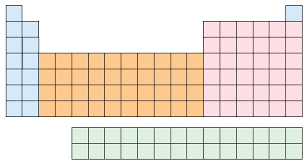
Which block is the blue block
The s block
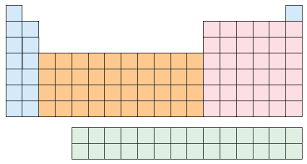
Which block is the orange block
The d block
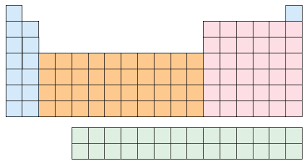
Which block is the pink block
The p block
Trend for atomic radius going down group 2
Going down the group, atomic radius increases
Trend for ionisation energy going down group 2
Going down the group ionisation energy decreases
Trend for melting point doing down group 2
what do group 2 metals produce when reacted with water
metal hydroxides
Reaction between magnesium and water
Mg + 2H2O → Mg(OH)2 + H2
Trend for reactivity going down group 2 (+Explanation)
going down the group reactivity increases
Explanation: The lower elements have lower ionisation energies and therefore lose their outermost electrons more easily
Trend for solubility of hydroxides going down group two
Solubility of hydroxides increases going down group 2
Trend for solubility of sulphates going down group two
Solubility of sulphates decreases as you go down group 2
Which sulphate is insoluble
Barium sulphate is completely insoluble
Which group 2 metal does not react with water (+Explanation)
Beryllium
If it were to lose its two outermost electrons the resulting ion would be very small and have a very high charge density, causing it to become unstable
What are the steps for Titanium extraction
Extraction: Converting titanium ore (TiO2) into titanium chloride (TiCl4) using chlorine gas and carbon
Heating: Heating the TiCl4 with magnesium metal at 1000oC
Equation for step 2:
TiCl4(g) + 2Mg(l) → Ti(s) + 2MgCl2(l)
What is the solubility of Magnesium hydroxide
Sparingly soluble
What are Calcium Hydroxides and Magnesium Hydroxides used for
To neutralise acids
Calcium Hydroxide - Neutralises acidic soils in agriculture
Magnesium Hydroxide - Used in indigestion tablets as an antacid, neutralising excess stomach acid
What is another name for Calcium Hydroxide
Slaked Lime
Use for Barium Sulphates
Barium meals in healthcare
Barium Sulphates are insoluble and reflect in X-Rays
The Barium meal can coat soft tissues which would otherwise not show up on an X-ray such as the oesophagus, stomach and intestines
What are the uses for the group 2 metals
Acid neutralisation
Barium meals
Wet Scrubbing
Titanium Extraction
What are CaO and CaO3 used for (+ Process)
to remove SO2 from flue gases through the process wet scrubbing
Process:
CaO is mixed with water and sprayed onto the gases
The byproduct is calcium sulphite (CaSO3)
Where is wet scrubbing used
To remove chimneys and industrial waste
Why does wet scrubbing work
SO2 is acidic and the calcium compounds are bases
which group are the halogens
Group 7
What are the states of matter for the halogens
Fluorine - Gas
Chlorine - Gas
Bromine - Liquid
Iodine - Solid
what is the trend of electronegativity going down group 7 (+ explanation)
Going down the group electronegativity decreases
Explanation: Going down the group atomic radius increases, therefore there is less attraction between the nucleus and the electrons
Electrons further away from the nucleus experience less attraction
What is the trend of boiling points going down group 7
Going down the group boiling points increase, this is reflected in the states of matter of the halogens going down the group
gas to solid
Explain the trend for boiling point going down group 7
going down the group the elements have more electrons
this increases the strength of the VDW forces
Greater intermolecular forces
This causes a higher boiling point
what is the trend of solubility for Silver halides in NH3
going down the group solubility decreases
How can each silver halide be redissolved
Chlorine (White ppt) - Dilute Ammonia
Bromine (Cream ppt) - Concentrated Ammonia
Iodine (Yellow ppt) - ppt is insoluble in Ammonia solution of any concentration
What is the trend of oxidising ability going down group 7
Going down the group oxidising ability decreases (Follows the trend of electronegativity)
What is the trend of reduction ability going down group 7
going down the group reducing ability increases (Opposite of oxidising ability and electronegativity)
Iodide ions are the most reducing, fluoride ions are not reducing at all
How do the halides react with sulphuric acid
The Halides react differently depending on their reducing ability
Fluoride and Chloride: producing HCl and HF
Bromide: produces Br2 and some SO2
Iodide: produces I2 immediately and reduces Sulphur to H2S
How to test for Halides (+ Results)
Test: Silver Nitrate
Results:
AgCl → White ppt
AgBr → Cream ppt
AgI → Yellow ppt
Further testing:
AgCl ppt → Redissolved in Dilute Ammonia
AgBr ppt → Redissolved in Concentrated Ammonia
AgI ppt → Cannot be redissolved in ammonia
Reaction between Silver nitrate and halides
Ag+(aq) + X-(aq) → AgX(s)
How do Halogens react with metal halide reactions (Use The reaction between Cl2 and NaBr)
They will be displaced by a more reactive halogen (not by a less reactive one)
This is a displacement reaction =
Cl2(aq) + 2NaBr(aq) → Br2(aq) + 2NaCl(aq)
Reaction between Sodium Chloride (Solid) and Sulphuric Acid
NaCl(s) + H2SO4(l) → NaHSO4(s) + HCl(g)
This is not a redox reaction as there is no change in oxidation state
This is because the chlorine ion is too weak a reducing agent. to reduce the sulphur
Reaction between Sodium Bromide (Solid) and Sulphuric Acid
Two reactions occur
NaBr(s) + H2SO4(l) → NaHSO4(s) + HBr(g)
2H+ + 2Br- + H2SO4(l) → SO2(g) + 2H2O(l) + Br2(l)
This is a redox reaction as bromide ions are strong enough reducing agents to reduce the sulphuric acid to sulphur dioxide
Both of these reactions are exothermic and some of the bromine vaporises
Reaction between Sodium Iodide (Solid) and Sulphuric Acid
NaI(s) + H2SO4(l) → NaHSO4(s) + HI
There are several reactions
What can be observed when reacting sodium iodide with sulphuric acid
Steamy fumes of hydrogen iodide
Black solid of iodine
Bad egg smell of hydrogen sulphide
Yellow sulphur may also be seen
What may be observed in the reaction between Sodium bromide and Sulphuric acid
Steamy fumes of hydrogen bromide
Brown fumes of bromine
Colourless Sulphur dioxide is formed
What is observed in the reaction between sodium chloride and sulphuric acid
Steamy fumes of hydrogen chloride are seen
The solid product of Sodium Hydrogen sulphate
Reaction with Chlorine and water
Cl2(g) + H2O(l) ⇌ HClO(aq) + HCl(aq)
This is a disproportionation reaction Chlorine goes from having an oxidation state of 0 to both +1 and -1
Reaction of Chlorine with water in sunlight
2Cl2(g) + 2H2O(l) → 4HCl(aq) + O2(g)
Uses of Chlorine
To purify water for drinking
Purify water in swimming baths
Kills bacteria by oxidation
A bleach
Alternate method for the chlorination of pools and the reason it’s necessary
NaClO(s) + H2O(l) ⇌ Na+(aq) + OH-(aq) + HClO(aq)
In sunlight Chlorine is rapidly lost so shallow pools need frequent addition of chlorine
Reaction of Chlorine with cold, dilute sodium hydroxide
It forms sodium Chlorate, an oxidising agent, it is the active ingredient in chlorine household bleach
It is a disproportionation reaction
Cl2(g) + 2NaOH(aq) → NaClO(aq) + NaCl(aq) + H2O(l)
How do the other halogens behave when reacting with dilute sodium hydroxide
They behave similarly to chlorine