EXAM 1
 Call Kai
 Learn
Learn Practice Test
 Spaced Repetition
 Match
Match Flashcards
 Knowt Play
1/67

Earn XP
Description and Tags
Important terms
Name | Mastery | Learn | Test | Matching | Spaced | Call with Kai | Chat |
|---|
No analytics yet
Send a link to your students to track their progress
68 Terms
What is the Lifespan Perspective?
Emphasizes development change from adulthood to childhood.
What’s the Life Expectancy?
78.6 Years old
What is the oldest age documented?
122 years old
What are the dimensions of the Life Span Perspective?
Development is lifelong, Multidimensional, multidirectional, Plastic, Multidisciplinary, and contextual
What are the different Conexts for aging?
Normative age-graded influences, and Normative history grade influences
Normative age graded influences
Individuals in an age groups biological process such as puberty and menopause
Normative History graded influences
Historical events in the time period (COVID, the Great Depression etc.)
Normative life events
Life events that impact the person’s life ex: home burning down.
What are behavioral and social cognitive theories?
Development can be described in terms of behaviors learned through interactions with our surrondings.
What’s Skinner’s Operant Conditioning theory?
The consequences of a behavior produce changes in the probability of the behavior's recurrence.
What is Bandura’s Social Cognitive Theory?
Behavior, environment, and person/cognitive factors are the key factors in development.
What is observational learning?
This is the idea that people learn through observing others’ actions.
What is forethought?
When people create goals and they see positive outcomes.
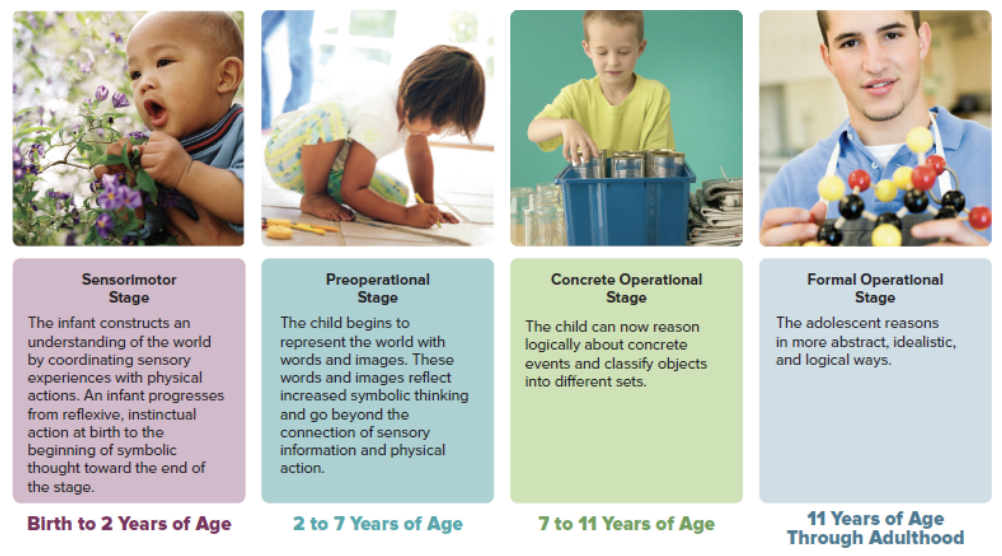
What is Piaget’s theory?
Children go through 4 stages of cognitive development as they build their understanding of the world.
What is Piagets’s 4 Stages?
Sensorimotor Stage: infants build an understanding of the world through their senses
Preoperational (2 to 7): build the world with words and images,
Concrete ( 7 to 11): children perform operations with objects and think logically about events
Operational stage: abstract, idealistic and logical
What is Vygotsky’s Sociocultural Cognitive Theory?
Children’s development is inseparable from social and cultural activities, as cognitive development is shaped by learning language, math, and memory strategies.
What is Erikson’s Psychosocial Theory?
We develop in 8 psychosocial stages, that reflects our desire to be social with others, and confronts a crisis that the individual must face and resolve.

What are the three developmental stages of Aging?
Normal Aging: psychological functioning peaks in early middle age and remains stable
Pathological Aging: Individuals who show greater-than-average decline as they age ( chronic disease)
Successful Aging: Positive physical, cognitive, and socioemotional development is maintained longer.
What are the 3 DEVELOPMETAL PROCESSES of Aging?
Biological Processes: physical change
Cognitive Processes: thinking, intelligence, and language
Socioemotional Processes: an individual’s relationship with other people
What is DNA?
double helix with a genetic information
What are Genes?
Units of information in DNA and they tell give us our genotype or phenotype and what traits we get.
What are the three prenatal Stages?
Germinal (266 days)
Embryonic (2 wk to 8 wk) Organogenesis formation in 2 m
Fetal ( 8wk to 7m)
What is post-partum depression
It can happen to mothers after childbirth. The mother drops estrogen, and uterus returns to its size. It can cause emotional mood swings for 1 to 2 weeks, depression after delivery, and trouble coping with tasks 4 wks after delivery.
What is Evolutionary Psychology?
Focus on adaptation, reproduction, and “survival of the fittest in shaping behavior. Natural selection behaviors that increase reproductive sucess.
What is accommodation in development?
Children adjust their schemes based on their newly gained knowledge. ex:not all animals with 4 legs are dogs.
What are schemes?
How a child constructs their understanding of the world by organizing knowledge.
What is assimilation?
Assimilation occurs when children use their existing schemes to deal with new information or experiences.
What is explicit memory?
Conscious memory of facts and experiences
What is Implicit Memory?
Skills, routines and procedures that are performed automatically.
What are some examples of fine motor skills?
Grasping a toy, using a spoon or pencil, buttoning a shirt.
What are some examples of Gross Motor skills?
Skills that involve large-muscle activity, like moving your arm and walking. Standing, holding their head up (6 or 7 m ), sitting down ind.
Do children understand language?
Yes
What is the Sensorimotor stage?
This is from 0 to 2 years old, when children learn through their senses and physical action
What is child-directed speech?
Language spoken in a higher-than-usual pitch, slower tempo and exaggerated intonation in simple words and sentences
What is telegraphic speech?
These are short, precise words without grammatical markers such as articles, auxiliary verbs, and other connectives. Mommy ice cream, go please
What are emotions?
Feelings or affect that occur when a person is in a state or an interaction that is important to their well-being, reflecting responses to experiences
Types of Baby Cries
There are three types of baby cries:
angry (excess air forced),
basic (Rhythmic pattern usually consisting of a cry and a briefer silence)
pain (sudden outburst of loud crying)
What are the types of baby smiles?
There are two types of baby smiles, reflexive(1m, no stimulus), social ( external)
What is stranger anxiety?
wariness of strangers
emerges 6m and by 9 its more intense to 1 yr
Depends on social context and characteristics of strangers
What is social referencing?
Reading emotional cues to determine how to act in a setting
When does fear appear for infants?
appears at 6 m of age, but at 3 m for abused children
peaks at 10 m
What is Temperamant?
differences in behavioral styles, emotions, and characteristics of responding
What are the different types of temperament?
avoidant, anxious, secure, and disorganized
Give an example of an Avoidant type?
A child that does not cry or care when the caregiver leaves.
What is an example of a disorganized type of child?
Appearing scared when the caregiver appears.
What is the Ethological Theory?
Behavior is heavily influenced by biology and evolution in certain life periods.
What are Psychoanalytic Theories?
These are theories that focus on the unconscious mind that is filled with emotion.
What is Freud’s Theory in lifespan?
We go through the five stages of psychosexual development: oral, anal, phallic, latency, and genital. How we resolve conflicts and sources of pleasure in each stage determines our adult personality.

List the theorists under the psychanalytic theory?
Freud and Erikson
What are Cognitive theories?
Piaget, Vygotsky, and Information Processing Theory
What is the informational Processing Theory?
Emphasis on the gradual increase for capacity of information, and the manipulation, monitoring and strategizing.
What is the Ecological theory?
This theory stresses the environmental factors. Bronfenbrenner’s theory applies here.
What is Bronfenbrenner’s ecological theory?
Development reflects the influence of several environmental systems.
Micro- lived setting
Meso- micro relationship to exo system
Exo- Social setting the client has no role in
Macro- culture
Chrono
How many pairs of chromosomes do humans have?
Humans have 23 pairs of chromosomes
What are the different modes of inheritance?
Dominant-Recessive, and Polygenetics (multi-gene influence)
Why is it important for counselors to understand the role of biology?
To understand the role of heredity in mental disorders
Collaborate with a genetic counselor working with families
Psychoeducation on how genetic predispositions interact the environment
What are teratogens?
Anything that harms the pregnant wormen or fetus during the pregnancy.
List some teratogens
Alcohol, nicotine, mari, maternal stress, malnutrition, hard drugs
What is Fetal alcohol Syndrome?
When the mother drinks heavily during their pregnancy
What are the effects of fetal alcohol system?
facial deformities, defective limbs, face and heart abnormalities, learning problem/ intellectual issues, memory issues, lower executive functioning
mental health and emotional problems
What are the heredity-environment interactions?
What is epigenetics?
Environmental experiences that can turn genes on or off. It can impact trauma stress, and nutrition, and caregiving can impact this expression.
Why do they conduct twin and adoption studies?
These studies determine the strength of hereditary influences on development.
What is the key take away for brain development during prenatal development?
Rapid neural growth and pruning
Babies have 100 billion neurons
What is Neurogenesis?
The production of new neurons during prenatal development.
What is the difference between adoption and twin studies?
Adoption focuses on whether children are more like their adoptive parents or biological parents.
Twin studies look at the similarities between genetically identical twins.
What are some ways heredity and environment are correlated?
Passive genotype-environment correlations- rearing environment: I like reading so I get my kids books (biological parents set up framework)
evocative: child’s characteristics elicit environment- smiling gets more pleasant responses
Active children seek out environments that they find compatible and suitable, joining a soccer club cause they love soccer