Depression
 Call Kai
 Learn
Learn Practice Test
 Spaced Repetition
 Match
Match Flashcards
 Knowt Play
1/33

There's no tags or description
Looks like no tags are added yet.
Name | Mastery | Learn | Test | Matching | Spaced | Call with Kai | Chat |
|---|
No analytics yet
Send a link to your students to track their progress
34 Terms



Describe MDD:
Dx stats
Mortality
Reason for under diagnosis?
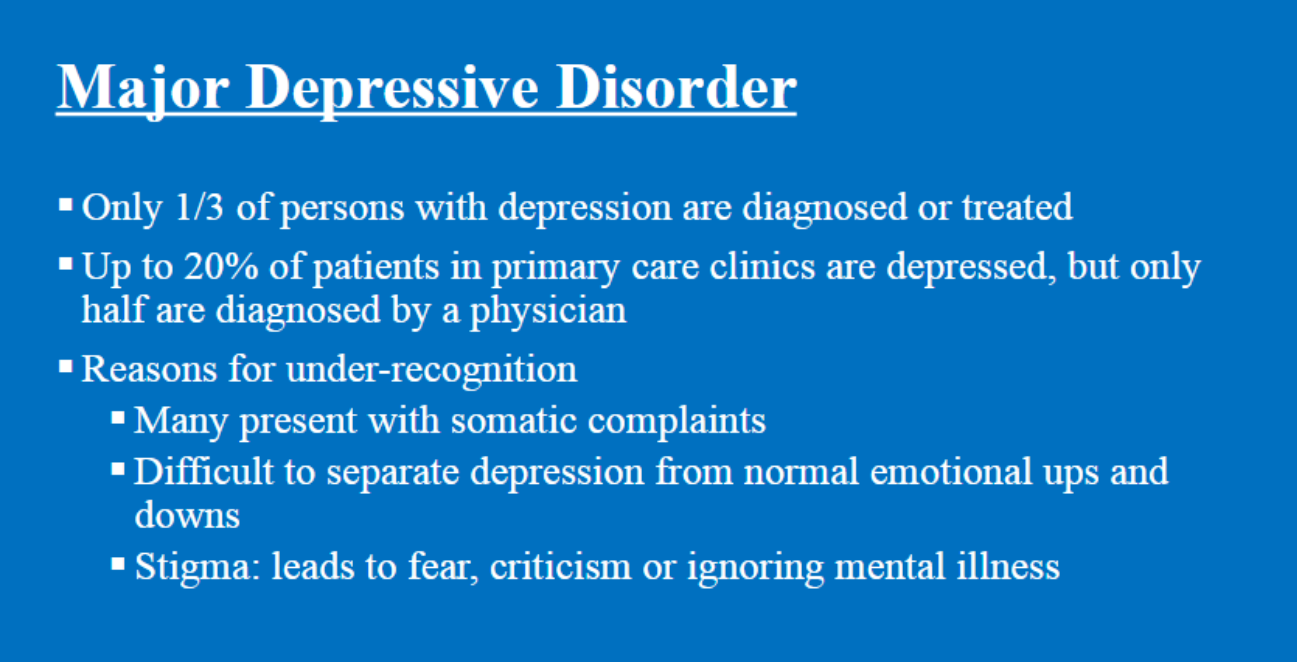
Major Depressive Disorder
Diagnosis Stats:
Only 33% of depressive pts = diagnosed/treated
Up to 20% of pts in primary care clinics are depressed;
Only half are diagnosed
Mortality:
Up to 15% if individuals die by suicide
Pts > 55 = 4x Mortality
Reasons for Under Diagnosis:
Many present w/ somatic complaints
Difficult differentiate depression from normal emotional ups/downs
Stigma: Reasons for under-recognition
List the Dx criteria for MDD and Associated Symptoms (8,10)
When does an episode end?
Dx Criteria
One or more Major Depressive Episodes
Must have:
Depressed mood* OR Loss of interest or pleasure*
>5 of Sig:ecaps during 2 Week Period:
Increased or decreased Sleep
Loss of Interest in activities
Inappropriate Guilt
Decreased Energy
Trouble Concentrating
Increased or decreased Appetite
Psychomotor agitation or retardation
Suicidal ideation
Associated Symptoms of MDD:
Tearfulness
Irritability
Brooding or Obsessive Rumination
Anxiety or Phobias
Excessive Worry over Physical Health
Complaints of Pain
Difficulties in Sexual Functioning
Menstrual Problems
Dizziness
GI Complaints
When does an episode end?
considered to have ended when the full criteria for a Major Depressive episode have not been met for at least two months
Describe the mental status findings in depression
Mental Status Findings
Alertness and Orientation
Usually unremarkable
Speech
normal or slowed or soft
Mood
depressed or irritable
Affect
normal range in mild cases,
blunted or labile in severe cases
Thought Process
thought blocking in severe cases
tangential in bipolar depression
Thought Content
query for suicide ideation
delusions or hallucinations in severe cases
Memory
impaired in severe cases (“Pseudodementia”)
Intellect
not impacted
Judgment for self-preservation
impaired in moderate to severe cases (“Nothing matters”)
passive wish for death
Insight
intact in mild cases; impaired in severe
Describe the relationship between cognitive problems and depression
Cognitive problems in depression
Depression filter distorts normal perceptions and memories
-> dramatically affect mood and feelings of self-worth
Describe Self Esteem
What is it?
Purpose
High vs Low
History
Reality
Effect of low
Self Esteem
What is self-esteem?
How positively person feels about themselves
Eval. of the self
Purpose of Self Esteem:
helps us monitor our social worlds for indications that we might be rejected and motivates us to make ourselves acceptable to other people
High vs Low Self Esteem:
History:
High: history of primarily acceptance
Low: history of neglect, disinterest, or rejection
Reality:
Most people who are considered to have “low self-esteem” actually have a midline view of themselves
Effect of Low Self Esteem:
Low -> negative emotions -> rejection
People function best w/ realistic view of strengths/weaknesses
Therapy: improves social live quality -> have adequate supportive relationships

List the Psychosocial Effects of Depression (3)
Psychosocial Effects
Difficulty in intimate relationships and marital problems
Less satisfying social interactions
Difficulties in sexual functioning
Occupational problems
Loss of job
Absenteeism/Presenteeism
Academic problems
Truancy
School failure
Underachievement


Describe the Course of MDD:
Course
Effect of Remission and future recurrence:
Prognosis
Describe the Effects of Depression on:
Glucocorticoids
Sleep (5)
Other Hormones? (3)
Course and Duration
Course:
Dev. over days/weeks -> (untreated) lasts up to >6 months
Effect of Remission and future recurrence:
First episode: 50-60% likelihood of recurrence
5-10% = manic episode later
Second: 70%
Third: 90%
NOTE:
Periods of remission longer early in course
Psychosocial factors play a greater role in precipitating first/second episode
Prognosis (1 yr after diagnosis)
40% no mood disorder
20% do not meet criteria for MDD
40% still meet criteria for MDD
Associated Laboratory Findings
Elevated glucocorticoid levels + EEG Sleep disturbances (MDD or w/ psychotic features)
Elevated Glucocorticoids:
Elevated urinary free cortisol levels
Dexamethasone nonsuppression of plama cortisol
Sleep Findings:
Prolonged sleep latency
Increased wakefulness
Early morning awakening
Reduced stage 3/4 (slow wave) sleep
Decreased REM latency and increased early REM sleep
Blunted growth hormone, TSH and prolactin responses
Describe Sick Behavior:
What does Depression cause activation of? Consequence of this?
What are normal ways of activating this?
What are other conditions w/ high rates of depression (7)
“Sick behavior” (SB)
Depressive symptoms -> Microglia activation
inflammatory cytokines -> impaired synaptic plasticity -> neuronal dysfunction and mental disorders
Other Activation of Microglial
Cytokines crossing leaky BBB
Afferent vagal nerve
Increased levels of glutamate associated with exposure to acute stress
Conditions with High Rates of Depression
Thyroid disease
Cancer
CV disease
Stroke
Autoimmune and inflammatory disorders
Huntington’s, Parkinson’s, MS
COPD


Describe the link of depression and painful physical symptoms


Describe the relationship of Depression on:
Diabetes
Why does this happen? (5)
Hypertension
Arthritis
Symptomatic Effects? (4)
Give examples of Depression Hindering Self-Management of Medical Illness
Depression and Diabetes
Depression = increased risk of diabetes
(~15-20%)
Greater risk if on antidepressants
(~25%)
Diabetes = increased risk of Depression:
(~25-30%)
Greater risk if on insulin
(~>50%)
Reasoning why
Daily diabetes management is stressful
Depression -> interfere w/ Diabetes Management (BS monitoring +good diet)
Poorly controlled diabetes -> symptoms that mimics MDD
PTs feel conflicts w/ physician b/c of complications + difficulty controlling BS
Thus, Common denominator = stress hormone levels (cortisol)
Depression and Hypertension
Depression -> increased risk of hypertension
1.4-1.8 x
Anxiety -> increased risk of hypertension
1.8 x
Depression and Arthritis
Depression -> decreased remission
41% vs 57% for rheumatoid arthritis
18% vs 38% for psoriatic arthritis
Symptomatic Effects (depression/anxiety)
higher tender joint count,
worse general health,
more pain,
slightly elevated inflammation markers
NOTE: The presence of anxiety without depression did not have a statistically significant effect, though those with anxiety did numerically worse.
Depression Hinders Self-Management of Medical Illness
Depressed smokers 40% less likely to quit smoking
Depressed coronary artery disease patients less likely to adhere to low-dose aspirin therapy
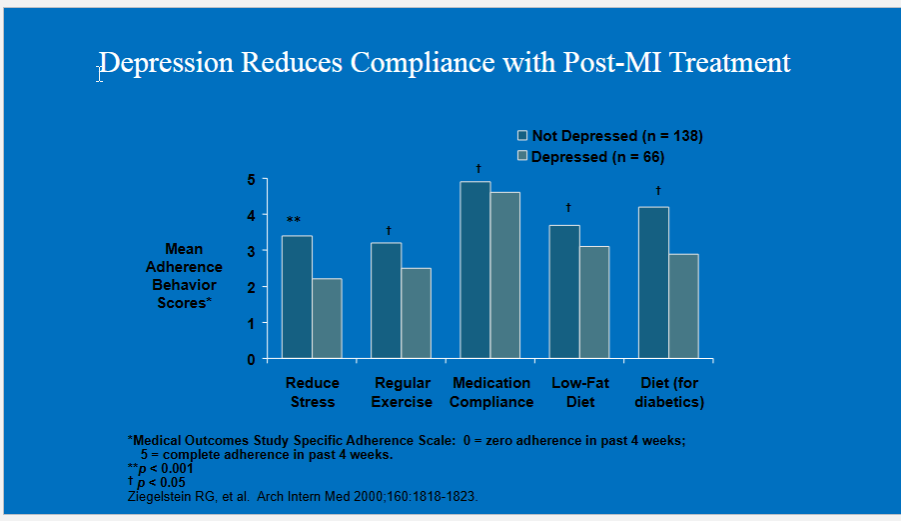
Depressed post-MI patients more likely to drop out of exercise programs
Describe the Adverse Effects of Depressive Symptoms on Health for:
Post CABG (3)
HIV (3)
Hep C (1)
Overall Health (3)
Adverse Effects of Depressive Symptoms on Health
In Women after CABG:
Reduced NK Activity
more all-cause infections
more self-reported illnesses
HIV:
Negatively affects progression
Decreased CD4 T lymphocytes,
increases in viral load,
greater risk for clinical decline and mortality
hepatitis C virus
More depressive symptoms during IF N-alpha treatment -> less likely to clear
Overall health:
Decrements in adaptive immune measures
Increased mortality in nursing facility
Worsens mortality post-stroke
Describe the Gender Differences in Co-morbidities with Depression
DDx
Gender Differences in Co-morbidities with Depression
More Common in Men
Alcohol Use disorders
Other substance use disorders
Stimulant
Cannibas
Hallucinongen
More Common in Women
Panic disorder
GAD
Social phobia
Bulimia
Thyroid disease
Migraine
Fibromyalgia
Chronic fatigue syndrome
DDx of Depression
Bipolar disorder, depressive phase
Anxiety disorders
Effects of substance use
Medical conditions
Dementia (elderly)
Schizophrenia (negative symptoms)
Bereavement
Describe the relationship between Depression and Long-term Brain Injury:
Depression and Long-term Brain Injury:
Prolonged depression ->
Progressive/cumulative damage to brain
Predisposition to chronicity or recurrence
Challenges traditional view that depression = fully reversible
Describe SAD
What is it?
Course
Symptoms (4)
Geology
Tx
Seasonal Affective Disorder [SAD]
What is it?
MDD + “With Seasonal Pattern”
Course:
Symptoms emerges in fall and winter
Also summer
Symptoms:
Lethargy, fatigue, hypersomnia, overeating
Others may present
Geology:
More common in northern latitudes (light deprivation)
Tx:
Standard therapy + light therapy
Describe Persistent Depressive Disorder (Dysthymia)
What is it? (6)
MEMTIP?
What is it NOT?
AKA?
Lifetime Prevalence?
Course
Persistent Depressive Disorder (Dysthymia)
What is it?
Depressed mood most of the time for >2 yrs; W/ two of following: MEMTIP: lets play A game of CHESS
Increased/decreased appetite
poor concentration or difficulty making decisions,
feelings of hopelessness
low energy
in/hypersomnia
low self-esteem,
Not w/o symptoms for more than 2 months w/in this period
What is it NOT?
NO MDD during two years
Could have MDD only if it ended in remission
AKA:
Called in past: “Depressive Neurosis”
Lifetime Prevalence:
Women: 4.1%
Men: 2.2%
Course: Two groups:
Those who have depressive symptoms since childhood or late adolescence
Healthy pts -> major losses -> demoralization
10% each year will develop MDD
Describe Disruptive Mood Dysregulation Disorder
What is it?
Dx Criteria
Disruptive Mood Dysregulation Disorder
What is it?
Severe recurrent temper outbursts (verbal/behaviorally)
Out or proportion/duration
Inconsistent with developmental level
On average, 3 or more times per week
Mood between outburst = persistently irritable or angry
Dx Criteria:
Symptoms present 12 or more months, without a period of 3 months or more w/o symptoms
Diagnosis should not be made the first time before the age of 6 or after the age of 18.
Age of onset of symptoms should be before 10.
Describe Premenstrual Dysphoric Disorder
Course
Symptoms (4)
Associated symptoms
Course:
Symptoms present:
final week before onset
improve within a few days after onset
minimal/absent post menses
Symptoms occur in most menstrual cycles over prev. year
Symptoms (one or more):
affective lability
irritability or anger or increased interpersonal conflicts
depressed mood, feelings of hopelessness, or self- deprecating thoughts
anxiety, tension, and/or feelings of being keyed up or on edge
Associated Symptoms (one or more present w/ symptoms above):
Decreased interest in usual activities
Difficulty concentrating
Lethargy or fatigue
Change in appetite
Hypersomnia or insomnia
Feeling overwhelmed
Physical symptoms such as breast tenderness or swelling, joint or muscle pain,
bloating or weight gain
Describe Other Specified Depressive Disorder
Dx criteria
Describe these NOS:
Minor depressive disorder
recurrent brief depressive disorder
Postpsychotic depressive disorder of schizophrenia
Dx Criteria:
Symptoms do not meet criteria for other mood disorders
Recurrent Brief + short duration
(2-13 days per month for at least 12 months)
(episode of 4-13 days duration)
Insufficient symptoms
(episode of 14 or more days with depressed mood and at least one other symptom)
NOS:
Minor depressive disorder
Episodes of at least two weeks of symptoms but < 5 symptoms of MDD
Recurrent brief depressive disorder
Depressive episodes lasting from 2 to 14 days at least once a month for twelve months
Postpsychotic depressive disorder of schizophrenia
major depressive episode that occurs during residual phase of schizophrenia
How do you manage depression
Management of Depression
Establish optimistic tone in initial interview
Assess severity of symptoms
Avoid extensive psychological “probing” when the patient is deeply depressed
Assess and reassess risk of suicide
Mild depression:
psychotherapy or somatic therapy (Antidepressant medication, ECT, TMS)
Moderate to severe depression:
somatic therapy +/- psychotherapy
Draw out the clinical stages in treatment of MDD

Describe APA Treatment Guidelines
Acute Phase
Cont. Phase
Maintenance Phase
Describe Treatment Outcomes for Depression
What does Response mean
Describe Remission?
What is it?
STATS
What are the Risks of Not Achieving Remission
APA Treatment Guidelines
Acute phase (Months 1–2)
Goal:
achieve remission
Restore baseline level of symptomatology and functioning
Continuation phase (Months 2–6+)
Goal:
prevent relapse of episode
Medication dose that achieved remission should generally be used in this phase
Maintenance phase (Months 6+)
Goal:
prevent recurrence of new episode
Tx depends on clinical condition of patient
Treatment Outcomes for Depression
Response:
Clinically significant reduction in baseline symptom severity
50% or greater reduction in HAMD-17
Remission:
What is it:
Absence or near absence of symptoms
Return to “functional normality”
(not just feeling better)
Pts can’t be distinguished from those w/o depression
STATs:
<50% of pts achieve this
Risks of Not Achieving Remission
Greater risk of relapse/recurrence
More chronic depressive episodes
Shorter durations between episodes
Continued impairment in work and relationships
Increases Mortality of Everything


Describe Depressed patient’s response to physician and the consequence of that
Depressed patient’s response to physician
Guilt: expectation of being criticized or punished
May underreporting symptoms -> not be complainer
Anger: feel rejected
struggle against perceived mistreatment
verbalized disappointment at prior clinicians inability to treat symptoms
elicit helpless feeling in physician
Dependent
Hoping for rescue, but believing physician powerless
May elicit “rescue” fantasy in physician