Ch11 Adaptive Quiz: Biological Membranes and Transport
 Call Kai
 Learn
 Practice Test
 Spaced Repetition
 Match
 Flashcards
 Knowt Play
1/16

There's no tags or description
Looks like no tags are added yet.
17 Terms
Consider the structure shown.
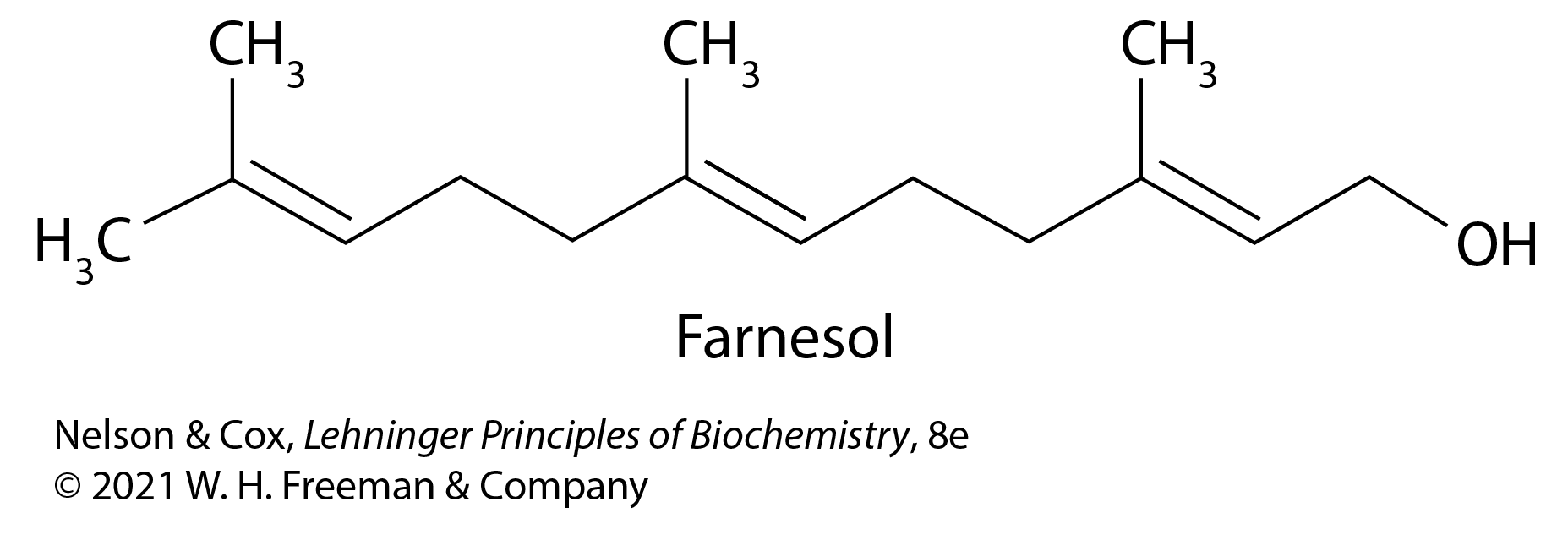
The farnesyl group can be reversibly attached to certain cytosolic proteins, targeting them to the plasma membrane. What are these proteins called?
A) temporary membrane proteins
B) lipid-linked proteins
C) integral membrane proteins
D) porins
E) transmembrane proteins
B) lipid-linked proteins
Which statement is false regarding the liquid-ordered (Lo) state of the lipids in a bilayer?
A) This state occurs below normal physiological temperatures.
B) Lateral diffusion of individual lipid molecules is strongly constrained.
C) Polar head groups are uniformly arrayed at the surface.
D) Individual hydrocarbon chains of fatty acids constantly rotate about the carbon–carbon bonds of long acyl side chains.
D) Individual hydrocarbon chains of fatty acids constantly rotate about the carbon–carbon bonds of long acyl side chains.
Which statement is true about simple diffusion of ions across a membrane?
A) Removal of the hydration shell is exergonic, whereas rehydration of the ion is endergonic.
B) Removal of the hydration shell and rehydration of the ion are both endergonic.
C) Removal of the hydration shell and rehydration of the ion are both exergonic.
D) Removal of the hydration shell is endergonic, whereas rehydration of the ion is exergonic.
D) Removal of the hydration shell is endergonic, whereas rehydration of the ion is exergonic.
A lipid bilayer has a width of 3 nm. What is the approximate length of the fatty acyl chains of the lipid molecules in the bilayer?
A) 1.5 nm
B) 6 nm
C) 0.75 nm
D) 3 nm
A) 1.5 nm
Which statement is false about BAR domains?
A) They consist of coiled coils.
B) Some proteins with these domains have a helical region that inserts into one leaflet of the bilayer.
C) Proteins with these domains can facilitate membrane curvature.
D) Proteins with these domains form dimers that have a negative charge that interacts with the positive charge of membrane phospholipids.
D) Proteins with these domains form dimers that have a negative charge that interacts with the positive charge of membrane phospholipids.
Which statement is false about the glucose transporter of erythrocytes (GLUT1)?
A) In a living cell, it operates at close to ½Vmax.
B) It allows erythrocytes to accumulate glucose at concentrations above that of blood plasma.
C) It is specific for D-glucose.
D) It has two conformations, one that faces outward and one that faces inward.
B) It allows erythrocytes to accumulate glucose at concentrations above that of blood plasma.
Which amino acid in a glycoprotein would LEAST likely be found attached to a carbohydrate?
A) Asn
B) Ser
C) Gly
D) Thr
C) Gly
The protein NSF (N-ethylmaleimide sensitive factor) regulates the interactions among:
A) BAR domains.
B) caveolins.
C) septins.
D) SNAREs.
D) SNAREs.
Which statement is true about secondary active transport systems?
A) A secondary transporter can be either a uniporter or a cotransporter.
B) A secondary transporter must have ATPase activity.
C) Secondary active transport systems can be disrupted by an ionophore.
D) Secondary active transport systems do not depend on primary active transport systems.
C) Secondary active transport systems can be disrupted by an ionophore.
Consider the structure shown.
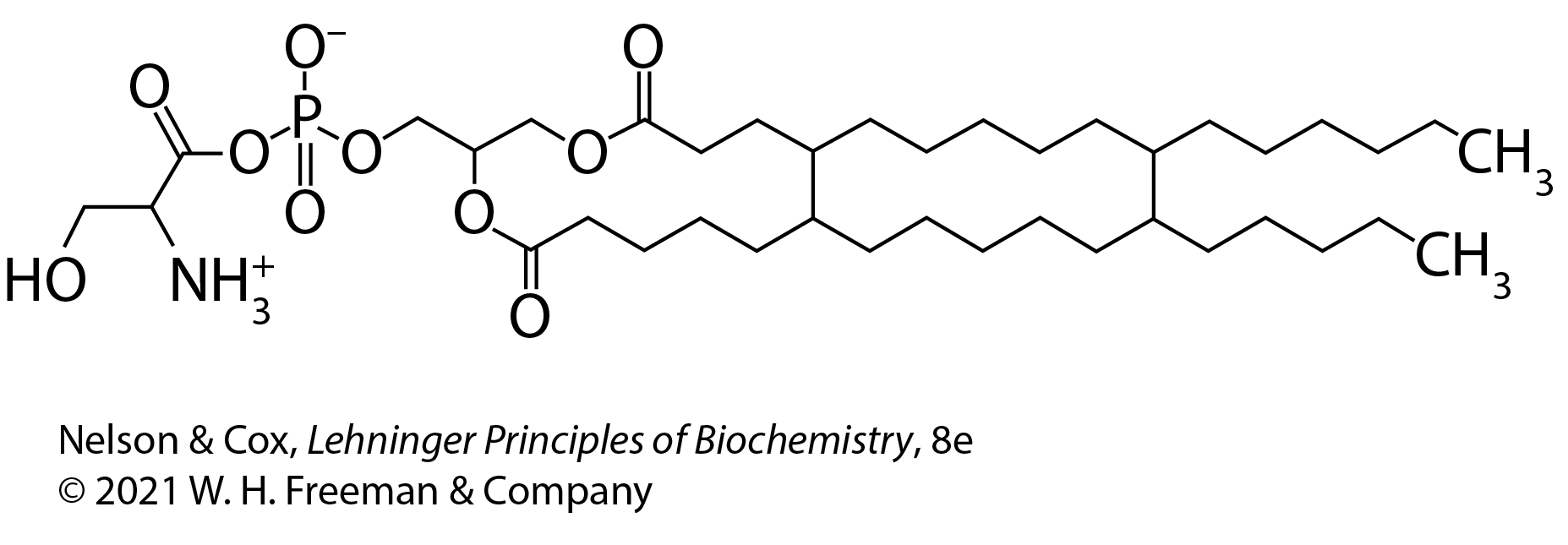
This novel lipid was isolated from a new mammalian species discovered in the Antarctic. What can you say about this lipid?
A) It probably aids in digestion by forming micelles.
B) It is most likely a stored form of fat such as a triacylglycerol.
C) It a sterol derivative that probably travels through the bloodstream.
D) It is a glycerophospholipid and is probably a membrane lipid.
D) It is a glycerophospholipid and is probably a membrane lipid.
Which statement about secondary active transport is false?
A) One substrate is transported against its electrochemical gradient.
B) It relies on an electrochemical gradient generated by primary active transport.
C) One substrate is transported down its electrochemical gradient.
D) It is driven by ATP hydrolysis.
E) Two substrates are transported.
D) It is driven by ATP hydrolysis.
All of these are almost exclusively found in the inner (cytoplasmic) leaflet of the plasma membrane EXCEPT for:
A) phosphatidylinositol.
B) phosphatidylethanolamine.
C) phosphatidylcholine.
D) phosphatidylserine.
C) phosphatidylcholine.
Which cellular process does NOT involve membrane fusion?
A) viral infection
B) cell division
C) targeting of lipid-linked proteins to the plasma membrane
D) transport of proteins through the Golgi and ER
C) targeting of lipid-linked proteins to the plasma membrane
A glucose transporter has Kt of 5.5 mM and a Vmax of 0.75 nmol/min. Calculate the initial rate of glucose transport (V0) when the blood glucose concentration is 4.5 mM.
A) 0.75 nmol/min
B) 0.61 nmol/min
C) 1.4 nmol/min
D) 0.34 nmol/min
D) 0.34 nmol/min
Calculate the energy cost (free-energy change) of moving lactose against a two-fold concentration gradient at 37 °C.
A) −210 kJ/mol
B) −1.8 kJ/mol
C) 1.8 kJ/mol
D) 210 kJ/mol
C) 1.8 kJ/mol
Consider the image.
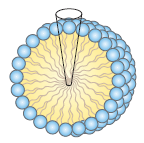
Which statement is true regarding the structure shown?
A) It is a hollow structure enclosing an aqueous cavity.
B) Its formation is favored when the cross-sectional areas of the head group and acyl side chain(s) are similar.
C) Its formation is favored when the cross-sectional area of the head group is greater than that of the acyl side chain(s).
D) This structure forms when a two-dimensional lipid bilayer folds on itself.
C) Its formation is favored when the cross-sectional area of the head group is greater than that of the acyl side chain(s).
Consider the table showing the fatty acid composition of E. coli cells cultured at different temperatures.
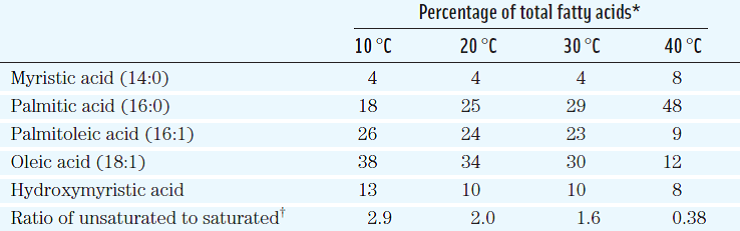
How might a bacterium adjust its lipid composition to maintain fluidity when moved from low temperature to high temperature?
A) increase the number of lipids with palmitic acid tails and decrease the number of lipids with palmitoleic acid tails
B) increase the number of lipids with palmitoleic acid and oleic acid tails
C) increase the number of lipids with hydroxymyristic acid tails and decrease the number of lipids with myristic acid tails
D) increase the number of unsaturated fatty acids and decrease the number of saturated fatty acids
A) increase the number of lipids with palmitic acid tails and decrease the number of lipids with palmitoleic acid tails