PCC EXAM 3(minus pain and skin):
 Call Kai
 Learn
 Practice Test
 Spaced Repetition
 Match
 Flashcards
 Knowt Play
1/85

There's no tags or description
Looks like no tags are added yet.
86 Terms
Legal Record
A chart connected to the patient that records all aspects of patient care
confidential, permanent, and legal document that is admissible in court
specific guideline
Purposes of Documentation
Communication - helps the interprofessional team communicate about the client’s status and care; e.g., you can't speak directly to the respiratory therapist, so you review the progress notes. Now you are able to better plan and evaluate their treatment
communication promotes…
Continuity of care - you are able to communicate your concerns on the EHR or written plan of care with other nurses so they can implement actions, observe for, and know what to pay attention to during their shift
Reimbursement - insurance companies, government and third party payers, and budget managers use client health records to determine the cost of care
Utilization: refers to whether medical treatments and interventions were necessary and appropriate
Quality Improvement - improve quality of care
Accreditation
Research and Educational Tool - the health record provides a snapshot of what is going on with the client so you can research unfamiliar diagnoses, prescriptions, and treatments before beginning direct client care
How should you do a Chart Review?
ESSENTIAL COMPONENT TO NURSING CARE
gather critical history, baseline information, data, treatment plan, and orders
verify accuracy
identify trends
develop conclusions
ELEMENTS OF DOCUMENTATION (what are some characteristics of correct documentation)
Factual (Subjective & Objective Data)
Accurate and Concise
Complete and Current (Timely)
Organized
LEGAL GUIDELINES
Begin each entry with the date and time.
Record entries legibly, in non-erasable black ink, and do not leave blank spaces in the nurses’ notes.
Do not use correction fluid, erase, scratch out, or blacken out errors in the medical record.
Make corrections promptly, following the facility’s procedure for error correction.
Sign all documentation as the facility requires, generally with name and title, Judy Long, RN
Documentation should reflect assessments, interventions, and evaluations, not personal opinions or criticism about client or other health care professionals’ care.
Flow Charts
Narrative Documentation
Chronological, sequential order of client encounters
Paragraph format tells the story of the client’s experience in the order that it happens
Advantages: changing health status can be tracked, progress towards goals can be tracked can help construct timelines like cardiac arrest or other emergencies
Disadvantages: lengthy notes which make it difficult to retrieve relevant data in a timely manner
Problem-Oriented Record Systems
PIE
SOAP
DAR
PIE
organizes information according to the client’s problems
need to keep daily assessment record and progress notes
Problem: Use data from your original assessment to identify appropriate nursing diagnoses.
Intervention: Document the nursing actions you take for each nursing diagnosis.
Evaluation: Document the client’s response to interventions and treatments.
Ongoing care plan, nursing-focused rather than medical-focused
focuses only on listed problems not client as a whole, does not document the planning part of the nursing process
SOAP
Subjective: what client tells you ; quotes
Objectice: factual, measurable findings like vital signs, test results, breath sounds
Assessment: conclusions drawn from the subjective and objective data; use nursing diagnosis
Plan: short-term and long-term goals and strategies that will be used to relieve the client’s problems
DAR
review client status from a positive, rather than a problem-oriented perspective
first column contains the time and date
second column identifies the focus or problem addressed in the note
third column is the DAR
Data: subjective and objective
action: Describe interventions performed, such as medications administration or nurse-provider communications
response: The client’s response to your interventions

Charting By Exception(CBE)
only identify significant findings or exception to standards and norms of care
Nursing Admission Data forms
provides baseline data so you can monitor change
discharge planning begins at admission; what would the client need if they went home tomorrow
Admission Database
Chief Complaint/Reason for Admission
Physical assessment
Vital signs
Allergies
Current medications
ADL status
Client support system and contact information
CARE SUMMARY
Demographic data
Medical diagnoses
Allergies
Diet/activity orders
Safety precautions
Intravenous therapy orders
Ordered treatments (wound care, physical therapy),
surgery, laboratory, and tests
A summary of medications ordered
Isolation orders
DNR-Do Not Resuscitate orders
MARs
comprehensive list
Inpatient: list of prescribed meds
Outpatient: addition to the drug name, dose, route of administration, and amount of medication, the MAR contains information about how the patient is to use the medications prescribed and the number of refills.
Patient Allergies & Reaction
Documents:
Scheduled/Routine Medications - given on a regular scheduled basis
PRN Medications - as needed; usually for pain, fever, nausea, constipation
STAT Medications - med given immediately, only once
Omitted Medications - withholding a med, need to document the omission and reason in the MAR
Additional explanation may be required for non-routine or omitted medications
Safe Medication Administration
Nursing Responsibilities
Prevalence of Medication Errors(PREVENTABLE events that may lead to harm of patients; each year med. errors account for 7,000-9,000 patient deaths in the United States)
Usually due to confusion caused by similar drug names, lack of knowledge about the drug(incorrect dosing or mixing), and lack of information about the patient(allergies, medical condition)
The Institute for Safe Medication Practices (ISMP)- report errors, close calls, or hazardous conditions. ISMP guarantees the confidentiality and security of the information received.
they also identify several unsafe practices associated with IV push such as; using prefilled syringes or cartridges as vials, unnecessary dilution of medications, and failing to properly label medication not prepared at the patients bedside.
Six Rights of Medication Administration
3 CHECKS!
1.Right PATIENT
2.Right DRUG
3.Right DOSE
4.Right ROUTE
5.Right TIME
6.Right DOCUMENTATION
Medication Information
Drug Name (Generic vs. Trade/Brand)
Chemical name: chemical composition and molecular structure(2-(p-isobutylphenyl) propionic acid)
Generic name: similar to the chemical name but in a simpler form(ibuprofen)
Trade/Brand: what the drug is sold as in stores: easily recognized and begins with a capital letter(advil, nuprin, and motrin are all brand names for ibuprofen)
Mechanism of Action
Absorption - route of administration(local effects-topical application, little absorption or ststemic effects-absorbed into bloodstream through injection into vein), form of the drug, solubility(the more soluble, the more rapid the absorption), effects of pH(drug may need an acidic or alkaline environemnt to be absorbed effectively; aspirin needs acidic and sodium bicarb needs alkaline), blood flow to area(more blood flow to an area, the faster the absorption)
Onset
onset of action: amount of time for med to reach a high enough concentration in the blood to feel its effects(minimum effective concentration)
peak action: when the concentration of medication is highest in the blood
duration of action: the period of time in which a medication has an effect
Side Effects vs. Adverse Effects
side effects: unintended, predictable physiological effects of the medication, occur at the normal dose, may be immediate or delayed
teach patients what side effects to anticipate and how to manage them
Adverse Reactions: harmful, unintended, unpredictable reaction to a drug administered at the normal dose
can be dose related or patient sensitivity related
severe: life-threatening, require intervention to prevent permanent impairment or death, lead to disability, death, etc.
Indication
Contraindications
Nursing Intervention/Education
Patient Assessment
Complete Assessment - vitals, appropriate med for the condition, do you know anything about the drug(research it), biological factors that affect drug metabolism(kidney dysfunction), allergies, history of illness, medications, attitudes toward medications, learning needs, pregnant or breastfeding
If administering PO medications, check for dysphagia.
Are liquid formulations available?
Can the pill be cut/crushed? Scored?
What can the pill be administered with (applesauce, thickened liquids)?
Skin Integrity (topicals, dermals, injections)
Mental Status & Cognitive Impairment
Oral Medication (PO)
Pills: tablets (scored), capsules, enteric coated, meltaway(sublingual, buccal, troche).
sublingual- under tongue; absorbed within seconds
buccal- held in cheek
both of these are rapidly absorbed in the mucous membranes rather than in the GI
Enteral (NGT/G-Tube) Medications
do not administer hydrophilic medications(psyllium(Metamucil)) through tubes because they attract water and could solidify in the tube
do not crush enteric coated or extended release medications into the tube
continuous tube feeding: disconnect and flush the tubing before giving medications
enteral tube suction: discontinue suction for 30 minutes after administration and clamp the tube so the drug has time to be absorbed
Syrups, liquids, elixirs, suspensions.
Consider measurements and accuracy.
hold the bottle so the liquid does not run over the label(difficult to read), place label inside the palm
Read the dosage where the lowest part of the concave surface(meniscus) of the fluid is on the line
Considerations for Pediatrics - do not understand that taking meds will help them feel better
sweetened and flavored liquids or chewable tablets if they can not swallow
Topical Medications
Lotions, creams, ointments, sprays, powder, patches.
asses for skin irritation and open lesions
use a cotton swab, tongue blade, or gloved finger to apply
Transdermal Patch - allow constant and controlled amounts of medication to be released over 24-72 hours
Skin assessment (open area, area of irritation)
Hairless area
Rotate sites
Remove previous patches before applying a new one
GLOVES ARE REQUIRED FOR ALL TOPICAL MEDICATIONS(avoid absorption into own skin)
Ophthalmic & Otic Drops
Eye Administration
Drops are patient specific.
Dropper must remain sterile.
patient to high fowler position and tilt head slightly back, unless neck injury or contraindication(supine if so)
hold dropper 1.5-2cm(.5-3/4inch) above patients eye and ask patient to look up
Instill drops or ointment in conjunctival sac.
Drops must be administered before ointment.
Punctal Occlusion (60 Seconds) - prevents eye drops from draining into systemic absorption
Ear Administration
Clean procedure unless eardrum is not intact (sterile).
Drops should be room temperature. —→too hot or too cold can cause nausea, vertigo, and pain
Pinna positioning (Adults; up and back. Children; down and back)
Suppositories
(Vaginal[PV] & Rectal[PR])
Vaginal medications include irrigations (douches), foams, gels, creams, tablets and suppositories
Rectal medications include irrigations (enemas) and suppositories–patient to hold it in at least 5 minutes
Suppositories – usually kept refrigerated to prevent melting – place in a medicine cup to transport but make sure it is inserted in the correct area
dorsal recumbent position or sims(left side with right hip and knee flexed)
Be generous with lubricant and insert at about 4 inches – for all suppositories
If patient can administer on their own – let them!
Respiratory Medications
Dry-Powder Inhaler vs. Metered Dose Inhaler
MDI: can use an extender(spacer) which helps deliver med straight into respiratory tract, high dose medication can be rapidly instilled into the lungs, avoids systemic affects. Need to have the manual dexterity and skill to coordinate the inhalation while pushing the canister which may be difficult for older adults and younger children
DPI: should not use spacer, releases medication when the patient inhales(breath activated), the small powdered particles can reach tiny airways however it requires quick forceful inspirations which may be difficult during an asthma attack
Requires assessment before and after administration-stay with the patient.
These medications are patient specific.
Education
Have patient exhale.
Seal lips around mouthpiece of the inhaler.
Press down on inhaler while inhaling. Hold breath for 10 seconds.
May need to wait in-between doses. Certain meds require patients to rinse their mouth.
Use a spacer if necessary.
Syringes
parts of a syringe and different syringes on ipad
can not touch the inside of the barrel, plunger shaft, tip or hub, or needle.

Needle Gauge & Length
the smaller the gauge, the larger the needle
smaller needles for patients with frequent and long-term injections like insulin and heparin
larger needles are used for blood and more viscous medications, mix IV meds, rapid infusion IV
long bevels are sharper—→subcutaneous and IM injections
skinny patients- smaller needle and shorter angle
obsese patients- larger needle and larger angle(90)
Standard syringe
2ml, 5ml, 10 ml sizes
Insulin Syringe
.3, .5, 1ml
for insulin use only
marked in 100units/mL
Tuberculin Syringe
1 mL capacity
for TB testing, small precise doses of medications, allergy testing, or administering dangerous medications
Leur Lock
nonleur lock
twist on
slip on
Prefilled Syringe
Single dose, preloaded medication
You must check each cartridge and dose carefully because many of the cartridges look alike. You simply insert the cartridge into the holder and lock it in place. After administering the medication, dispose of the cartridge; clean and keep the holder for reuse.
Safety syringe
retractable or shielded needle
Injectable Medications
Consider route: Subcutaneous (SQ) or Intramuscular (IM)
Possible injection sites.
Solution type and volume.
Age of patient, and developmental considerations.
Needle safety: NEVER recap a dirty needle.
ALL INJECTABLES MUST BE LABELED: Date, Time, Initials, Contents
Intradermal Injections
Injection into the dermis layer just beneath the skin’s surface
Only very small amounts of medication usually 0.1 mL
Uses small 1 mL syringe, fine 26-28 Gauge Needle
Insert at 5-15º angle (ex. tuberculin syringe or allergy testing)
Sites: forearms – upper chest and upper back
Subcutaneous Injections
25-30 Gauge Needle
3/8-1 Inch Length
Maximum injection amount – 1 mL
45º- 90º angle
Injection Sites: back of the upper arm, upper back, lower back, abdomen, and top of the thighs.
Avoid areas with burns, birthmarks, scars, or inflamed tissue; (2) sites with lesions; (3) sites over bony prominences; and (4) sites with large underlying vessels or nerves.
■ When using the abdominal site, do not inject any closer than 5 cm (2 in. horizontally and vertically) from the umbilicus.
■ For repeated injections, each injection should be at least an inch apart.
minimize scarring and hardening of fatty tissue that will interfere with absorption
Mixing Insulin
Order:
1.Insert air into NPH (cloudy)
2.Insert air into Regular insulin (clear)
3.Draw up regular insulin (clear)
4.Draw up NPH insulin (cloudy)
Intramuscular Injections
21-23 Gauge Needle
1-1.5” Inch Length
Use appropriate syringe for amount.
Maximum amount depends on the site.
90-Degree Angle
Z-track Method
Sites: Deltoid, Vastus Lateralis, Ventral Gluteal.
Deltoid
Maximum injection amount is 1mL for the deltoid.
Locating the site: Place hand 2 fingerbreadths below the acromion process, make a “V”, and inject in the center of the muscle
Vastus Lateralis
Maximum injection amount is 3mL for the vastus lateralis site.
Locating the site: Place one hand on the greater trochanter, and one hand on the lateral femoral condyle. The injection site is the middle third of the muscle.
best spot for infants
Ventrogluteal
Maximum injection amount is 3mL for the ventrogluteal site.
Locating the site: Place your palm on the greater trochanter, with your thumb facing anteriorly, index finger towards the anterior superior iliac spine, and middle finger pointing towards the iliac crest. Make a “V” and inject in the center of that “V”.
preferred for adults
IV Medications
Check for medication compatibility (y-site
compatibility)
You must keep IV tubing sterile at all times.
Assess patient before, during and after IV Medication Administration.
Oxygenation refers to:
how well the cells, tissues, and organs of the body are supplied with oxygen.
depends on…
Ventilation (Mechanical):
Inhalation(expansion of the chest cavity and lungs -negative pressure) vs. Exhalation(diaphragm and intercostal muscles relax-pressure inside the chest and lungs rise above atmospheric pressure) - diaphragm is the major muscle of breathing
Respiration (Chemical) - process of gas exchange; the oxygenation of blood and elimination of CO2 in the lungs
Internal(capillary-tissue; occurs in body organs and tissues)vs. External(alveoli-capillary; occurs in the alveoli of the lungs)
Exchange of oxygen and carbon dioxide in the alveoli and capillary membrane.
Factors Impacting Oxygenation
Low hemoglobin—→low oxygen
Age(Babies(premature-lungs are immature and they do not have sufficient surfactant) Infants(choking/obstruction of airway, apnea is common(20sec periods is normal)), Preschooler: exchange of germs, upper resp. infections, small airways and inflammation of airways—→lots of issues, also prone to tonsilitis due large adenoids). School aged: asthma, allergies. Adolescents: smoking, vaping. Young/middle ages adults: occupation(exposure to chemicals, sedentary job. Older adults: lose muscle strength and ability to breathe; thorax is not able to expand fully, GERD and reflux, alveoli do not inflate as well, immune system function decrease
Lifestyle
obesity—→sleep apnea
pregnancy: fetus pushes up on diaphragm so they are unable to take deep breaths—>tachypnea; increased oxygen demand
Environment; stress inc risk for PE and weakens immune system
air pollution
high altitude - same percent of O2 but breathe in less with each breath; over long term you adapt
Medications: opioids(morphine), sedatives, benzos - decrease resp. rate, anti-anxiety drugs(diazepam), magnesium sulfate, neuromuscular blocking agents —→ depress CNS, depress respirations
albuterol - bronchodilator, corticosteroids, cough suppressants, expectorants, decongestants improve resp. function
steroids and antibiotics
Comorbidities: pneumonia, PE, pneumothorax, fibrosis
Trauma: thoracic region
Assessment of Oxygenation Status
Physical Exam:
Inspect: resp patterns, signs of resp. distress, skin and mm, color, edema, sputum characteristics
Palpate: pulses, skin temperature, heart pulsations through chest wall, tenderness?
Percuss: lungs; any consolidation
Auscultate: breath sounds, heart sounds, vascular sounds
Medical History: demographic data, health history(current problems person is being treated for, hospitalizations or surgeries, allergies, asthma, meds, OTC meds, resp. conditions and symptoms, env. history, lifestyle)
Breathing Pattern: coughing, congestion, chest tightness, wheezing, dyspnea
Respiratory Effort: SOB, nasal flaring, retractions, grunting, tripod positioning, use of accessory muscles
Pulse Oximetry - reflects the percentage of hemoglobin molecules carrying oxygen
Diagnostic Testing
Arterial Blood Gas (ABG’s) - monitor pH *go over - the effectiveness of gas exchange
Peak Flow Monitoring - for asthma patients to monitor acute changes; measures the amount of air that can be exhaled with forcible effort; personal best-take sreies of three readings and record the highest
Imaging
Breathing Patterns
Eupnea - regular breathing; 12-20
Bradypnea - slow breathing; fewer than 10; due to overdose, opioids, sedatives, athletes naturally have slower breaths
Tachypnea - rapid, shallowing breathing; more than 24; due to hypoxemia and increased O2 demand can result in hyperventilation. anxiety, stress, compensatory mechanism
Kussmauls Respirations - increased rate and abnormally deep respirations; compensatory for loe blood pH
Biots Respirations - irregular with variable depth and periods of apnea, associated with damage to brain(medulla) and increased ICP
Cheyne-Stokes Respirations - gradual increase in depth, then gradual decrease in depth, then period of apnea
Apnea - no breathing
agonal breathing: gasping for air
Indications for Oxygen Therapy
normal 95-100
Hypoxemia: low levels of oxygen (<90%) in arterial blood. start to get worried
Hypoxia: low levels of oxygen in the tissues
Pulse ox: affected by cold hands, moving, nail polish/acrylics, decreased blood flow
Early signs in adults: trying to compensate—→tachypnea, tachycardia, restlessness, anxiety, confusion, pale skin and mucous membranes, elevated blood pressure, use of accessory muscles, nasal flaring, adventitious(abnormal) lung sounds
Late Signs in Adults: no longer able to compensate—→stupor(look dead), cyanotic skin and mucous membranes, bradypnea, bradycardia, hypotension, cardiac dysrhythmias
Nursing interventions: hypoxia
Confirm probe placement.
Confirm that the oxygen delivery system is working and the patient is receiving the prescribed amount (check all tubing and equipment).
Raise the head of the bed and encourage pursed lip breathing(kiss shaped lips).
Stay with the patient, provide support, and decrease anxiety.
Nasal Cannula
(1-6 L/min, 24-44%) (room air is 21%; increase 1L —→25%)
ADVANTAGES
Safe and easy-to-apply.
Comfortable and well-tolerated.
Patient can eat, talk, and ambulate.
DISADVANTAGES
FiO2 varies with the flow rate, and rate/depth of breathing.
Skin breakdown and dry mucous membranes long term(within the nares).
NURSING ACTIONS
Assess patency & tubing.
Ensure proper fit.
Use water-soluble gel to prevent dry nares.
Humidification for flow rates of 4 L/min and greater.
no smoking, acetone, alcohol; flammable
know where the closest fire extinguisher is

Simple Face Mask
(5-10 L/min, 35-60%)
Advantages
Good for patients who breathe through their mouth.
Humidified oxygen.
Disadvantages
Flow rates less than 5 L/min can result in rebreathing of CO2.
Anxiety or claustrophobia.
Eating, drinking, and talking are impaired.
Risk of skin breakdown.
Risk of aspiration.
Nursing Actions
Assess proper fit.
Make sure the client wears a nasal cannula during meals.
Monitor for skin breakdown.
Use with caution for clients who have a high risk of aspiration or airway obstruction

Venturi Mask
(5-10 L/min, 24-60%)
Advantages
Delivers the most precise oxygen concentration with humidity added.
Disadvantages
Can be noisy.
Eating, drinking, and talking are impaired.
Risk of skin breakdown.
Nursing Actions
Assess equipment & patient frequently to ensure an accurate flow rate.
Assess proper fit.
Assess for skin breakdown.
Ensure that the client wears a nasal cannula during meals.

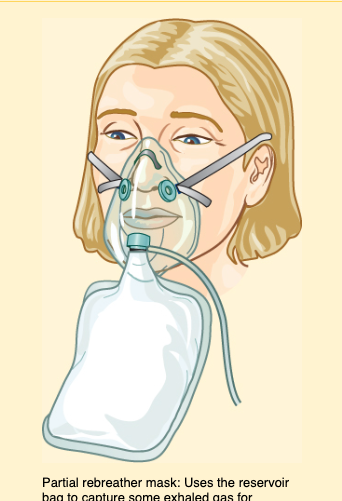
Partial Rebreather
(10-15 L/min, 60-90%)
Advantages
Patient can rebreathe up to ⅓ of exhaled air together with room air with partial rebreather.
Humidified Oxygen
Disadvantages
Complete deflation of the bag during inspiration causes CO2 buildup.
FiO2 varies with the client’s breathing pattern.
Anxiety or Claustrophobia
Eating, drinking, and talking are impaired.
Risk of aspiration and skin breakdown
Nursing Actions
Keep the reservoir bag ⅓ to ½ full on inspiration by adjusting flow rate.
Assess proper fit.
Monitor for skin breakdown.
Ensure that the client uses a nasal cannula during meals.
Use with caution for clients who have a high risk of aspiration or airway obstruction.
Non-Rebreather
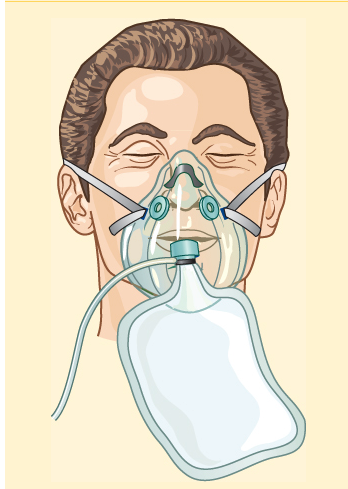
(10-15 L/min, 80-95%)
Advantages
It delivers the highest O2 concentration possible (except for intubation).
A one-way valve situated between the mask and reservoir allows the client to inhale maximum O2 from the reservoir bag. The two exhalation ports have flaps covering them that prevent room air from entering the mask.
Disadvantages
A good seal Is required around the face to ensure effectiveness.
Nursing Actions
Assess proper fit.
Assess for skin breakdown.
Make sure the client uses a nasal cannula during meals.
Airway Clearance
Positioning & Postural Drainage:
Incentive Spirometer: exhale before and then breathe in
Mobilizing Secretions:
Chest Physiotherapy- help loosen up everything inside so it can be suctioned out~percussion, vibration, vests that shake you(CF)
Turn, Cough, and Deep Breathing (TCDB)
Hydration
Humidification of Oxygen
Medications: expectorants(helps you get stuff out), decongestants, bronchodilators, and steroids
Artificial airways
Oropharyngeal - C-shaped, inserted into mouth, provides open airway by holding the tongue away from back of pharynx
Nasopharyngeal - inserted into nostril into pharynx - do not stimulate gag reflex
both keep the upper air way open
Endotracheal Tube (ET): patients who can not breathe effectively on their own because of airway obstruction
Orotracheal; tube inserted through mouth into trachea
Nasotracheal; through nose and into trachea
Tracheostomy; directly into trachea(need an obturator at bed side: one smaller and one same size).
Cuffed(used when patients are being ventilated or have difficulty swallowing) vs. Uncuffed.
Monitor for complications; requires suctioning to clear secretions.
signs indicating need for suctioning: agitation, gurgling sounds during respiration, restlessness, labored respirations, decreased o2 sat, increased HR and RR, adventitious breath sounds
Chest Tubes
Inserted into the pleural space.
Purpose
To evacuate air or fluid from the pleural space to make room for the lungs to expand
3 Major Types
Water-Seal, Dry-Seal, or Portable
Nursing Assessment Required
Vitals
SpO2
Pulmonary Assessment
Color, Consistency, Amount of Drainage
Pain
Bowel Elimination:
Anatomy Review(know where the structures are and the quadrants: review)
Upper GI: mouth, pharynx, esophagus, and stomach.
Lower GI: small intestine, large intestine, rectum, anus.
Small Intestine: digestion and absorption of food and nutrients (fats, bile salts, and some vitamins). 1inch wide, 20 feet long~mostly absorbed in duodenum and jejunum
Large Intestine: facilitates passage of stool and absorbs water, electrolytes. 6ft long, 2.5 inches wide
e.coli in the colon: vitamin K and B complex
2 sphincters: internal-dont have control over, external-have control over when your potty trained
Patient Education: Elimination
Adequate fluid intake
2,000 to 2,400 mL per day(2000ml for females, 3700ml for males)
High Fiber Diet
Activity Level
Establish Bowel Routine
Seek Treatment:
Changes in Bowel Patterns
Hematochezia/Melena
Factors Impacting Bowel Elimination
Developmental Stage: meconium(when babies are born, they have black stool)
Personal Factors
Sociocultural Factors
Nutrition/Hydration
Medications(iron-stool will be black, laxatives)
Procedures(anesthesia stops peristalsis)
Pregnancy(smushes bowels, hemorrhoids)
Allergies/Intolerances
Medical Conditions
Physical Assessment
Abdominal Assessment- Inspect: bulging, masses, visible peristalsis; assess the rectum for hemorrhoids, fissures. Auscultate: 1 minute first; 5-30/min, 5 mins if no sounds—→tell provider.
History
Medical/Surgical History
Bowel Pattern
COCA-color, odor, consistency, amount
Elimination Assistance
Food, fluid, laxatives, enemas
Change in bowel patterns
OLDCARTS
Diagnostic Testing
Laboratory Studies
Occult blood - hidden blood, vitamin c can cause false negative for occult
O & P - ova and parasites
Stool culture
Direct Visualization
Colonoscopy - bowel prep; liquid diets, laxatives, enemas
Sigmoidoscopy
Radiographic Views
Flat plate of the abdomen
GI series
CT
Be aware of nursing responsibilities/patient preparation for all tests.
Fecal Occult Blood Test (Guiac)
Follow hospital policy for collection technique
Collect stool smear on card
Apply reagent
Blue = positive
High rate of false positive or false negative
Stool Specimen
Verify order
Use standard precautions
Select appropriate container
Have patient defecate into bedpan, BSC, or hat.
Collect stool and include visible blood or mucus (keep outside of container clean).
Follow proper storage instructions.
Colonoscopy
Informed Consent(required)
May be done either inpatient or outpatient.
Bowel Prep: clear liquid diet, then NPO(no red dye)
Conscious Sedation
Post-Procedure
Recover from anesthesia
Assess for bleeding or perforation
45-50
Complications: trauma, perforation, gas pain, hitting a polyp can make it bleed, thin walls in UC easy to puncture walls
Management of Diarrhea
replace electrolytes
BRAT diet
skin integrity
Management of Constipation
If obstruction suspected
X-ray or CT/Ultrasound
Lifestyle changes
Increase fiber and fluids
Do not delay defecation
Laxatives or Enemas
Bulk-forming (fiber makes stool formed and also pulls water into intestines), stool softeners, osmotics(brings water into the intestines), stimulants.
Digital Disimpaction
Bowel Retraining Program
Enemas(know the different types of enemas; chart in book look over-25.2?)
Types
Cleansing
Soap suds, Tap water (Hypotonic)
Hypertonic
Sodium/Phosphate - Fleet®
Retention
Mineral oil
Medicated
Neomycin, Kayexalate
Risks
Fluid/Electrolytes imbalances, Rectal trauma, Vasovagal reaction
Position them on the left side because of the descending colon; use room-temperature water, put it in 4 inches max, abdominal cramping—>lower bag and go slowly
Bowel Diversion
Stoma
Part of the intestine that is exposed
Ileostomy (placed in the ileum)
Colostomy (placed in the colon)
Purposes
colitis, cancer, diverticulitis, trauma
Temporary or Permanent
Placement planned with WOCN
more formed stool in bag the further down the ostomy is
biggest concern is infection due to skin break down and irritation

Ostomy Care
Fit to Stoma
Skin Barrier
Empty when 1/3 full
Patient Education
Involve patient in care
Consult with WOCN
Diet Education
Psychosocial Concerns
Body Image
Sexuality
Support Groups
Nasogastric Tube (NGT)
Purposes
Decompression of the GI tract, administration of feeding/medications, lavage of GI bleed, or poisoning.
Types
Salem sump, small bore, dobhoff tubes.
Nursing Interventions
Follow proper insertion assessment & technique, confirm placement [x-ray], check suction, evaluate and record output.
X-ray=gold standard for placement
Urinary Elimination
Anatomy Review
Purpose: waste elimination, maintain fluid balance, maintain electrolytes and acid/base balance, and regulate blood pressure.
Bladder: Can hold 500-1000mL of urine. Once 250-400mL collect, stretch receptors send a signal to the brain to indicate the need to urinate.
Output: Adults produce 1500-2000mL per day (and will urinate roughly 5-6 times). Minimum output is 30mL/hr
kidney-ureters-bladder-urethra-out
if the bladder is full you can feel it
you should not be able to feel the kidneys
urethra in females is 3-4inches, urethra in males is about 8inches
URINE CHARACTERISTICS
Color
Pale Straw (Expected)
Red Urine: bleeding or diet-related.
Bright orange or rust-colored: may be associated with certain medication; analgesics
Dark Amber: high level of bilirubin resulting from liver dysfunction, muscle breakdown
Odor
Stronger odor when concentrated
Ammonia smell – stagnant urine
Sweet, fruity odor – Ketones (Diabetes Mellitus)
Clarity
Should be clear – becomes cloudy after standing several minutes
Initially cloudy – protein or bacteria
Amount
Adults normally void 1500 - 2000 mL day
Minimum output is at least 30mL/hr
Creatinine and BUN labs to measure renal function and hydration? if tenderness with CVA palpation
FACTORS IMPACTING URINATION
Age
•Pregnancy
•Diet
•Immobility
•Pain
•Psychosocial Factors
•Surgical Procedures
•Medications
URINARY RETENTION
Retention is the inability to empty the bladder completely.
Etiologies include:
Obstruction- prostate or fecal impaction
Inflammation and swelling
Neurological conditions (SCI)
Medications- antihistamines, decongestants, SSRIs
Anxiety
MANAGEMENT OF RETENTION
Medications
Credé maneuver - push down on bladder to help expel urine
Urinary Catheterization
Introduction of a sterile tube into the bladder
Straight catheter
Indwelling catheter: Foley
Suprapubic catheter
Nursing considerations
Prevent UTIs
Prevent backflow of urine
Encourage fluids
Perineal hygiene
Urinary Incontinence
Loss or lack of voluntary control over urination
Risk factors include advanced age, history of UTI’s, neurological disease, obesity, smoking/drinking, immobility, perimenopause, childbirth, benign prostatic hyperplasia (BPH), and diabetes.
Complications: infection (UTI and/or bacteremia) and inflammation (prostatitis, epididymitis, cystitis, pyelonephritis).
Openly assess for and discuss urinary incontinence with sensitivity and a caring demeanor.
STRESS INCONTINENCE
Involuntary loss of urine with increased intra-abdominal pressure in the absence of an overactive bladder.
Causes: Pregnancy, childbirth, obesity, chronic constipation and straining, physical activity, laughing, sneezing, coughing, lifting.
Treatment
Kegel Exercises
Sling/Pessary Procedure
Injection of Synthetic Materials
URGE INCONTINENCE
Inability to stop urine flow long enough to reach the bathroom due to increased bladder pressure.
Causes: Overactive detrusor muscle, or UTI
Treatment
Bladder Retraining (Goal of 4hrs)
Medications
Neuromodulation (Nerve Stimulation)
Botox Injection
OVERFLOW INCONTINENCE
Frequent loss of small amounts of urine due to overdistention or retention.
Causes: Spinal cord injury, multiple sclerosis, impaired detrusor muscle, obstruction (enlarged prostate) or fecal impaction.
Treatment
Intermittent Catheterization
Bladder Training
Medications
Surgery
Neuromodulation
REFLEX INCONTINENCE
Also known as “Unconscious” incontinence. Loss of urine when the person does not realize the bladder is full and has no urge to void.
Causes: Central nervous system (CNS) disease; spinal cord injury; tissue damage from radiation, cystitis, bladder inflammation, or radical pelvic surgery.
Treatment
Intermittent Catheterization
Neuromodulation
Botox Injections
Surgery
FUNCTIONAL INCONTINENCE
Loss of urine that occurs when a physical or cognitive disability prevents the person from reaching the toilet.
Causes: Immobility, pain, external obstacles, or problems in thinking or communicating.
Treatment depends on the underlying cause.
Ensure access to bathroom.
Timed voiding (with reminders).
Catheterization
Incontinence pads/underwear
URINARY
CATHETERIZATION
Straight (I+O)
Obtain specimen
Relieve urinary retention
Indwelling (Foley)
Accurate I+O
Post-operatively
Not for Incontinence
3-Way
CBI (Murphy Drip)
URINARY TRACT INFECTION
(UTI)
Commonly caused by Escherichia coli (E. Coli) bacteria.
Signs and Symptoms:
Dysuria
Hematuria
Polyuria, frequency & urgency
Fever, chills, nausea/vomiting, malaise,
Cloudy, concentrated, foul smelling urine.
Confusion/Altered LOC in elderly
Flank pain & tenderness*
Urosepsis
Organisms spread into bloodstream
UTI TREATMENT & PREVENTION
Treatment
Most bladder infections can be treated with oral antibiotics
More severe infections (e.g. pyelonephritis) may require IV antibiotics
Health Promotion & Prevention
Increased Fluid Intake
Proper Voiding
Avoid/Remove Catheters
Proper Perineal Hygiene
Avoid baths
URINARY DIVERSIONS
Diverts urine from kidney to abdomen or back – may be temporary or permanent.
Diversions are either continent (with controlled elimination ofurine from the body) or incontinent (with urine draining continuously without control).
Examples
Ureterostomy (Ileal Conduit)
Nephrostomy
Kock Pouch
Neobladder
DIAGNOSTIC
TESTING
Blood Studies
Blood Urea Nitrogen [BUN] 8-21mg/dL
Creatinine 0.5-1.2 mg/dL
Direct Visualization
Cystoscopy & Cystometry
Kidneys, Ureters, Bladder [KUB] X-ray.
Indirect Visualization
Intravenous Pyelography [IVP]
Ultrasound/CT
Urinalysis
URINE SPECIMEN
COLLECTION
Urinalysis (UA)
Clean container
Urine Culture & Sensitivity (C&S)
Sterile container
Clean catch
Straight cath
Collecting sample from Foley
24-hour Urine Collection
Discard 1st void
Save all urine
Have patient void at 24 hour mark
Follow lab policy for use of preservative, refrigeration, labeling