16. Endocrine System
 Call Kai
 Learn
 Practice Test
 Spaced Repetition
 Match
 Flashcards
 Knowt Play
1/11

There's no tags or description
Looks like no tags are added yet.
12 Terms
endocrine system
composed of glands + organs → release signalling molecules = hormones
hormones released into interstitial space
enter nearby capillaries → carried in blood to target cells
2 types
lipid soluble
water soluble
functions
hormones collectively act on all body cells to
maintain body homeostasis
regulate tissue activities + processes in response to internal/external body stresses
regulate tissue growth + development
contribute to reproductive processes
lipid soluble hormones
synthesized only when needed → not stored
EXCEPTION: thyroid hormones, T3 + T4 → amino acid tyrosine w/ attached iodine
steroid hormones = derived from cholesterol
eg. cortisol, aldosterone, estrogen
water soluble hormones
synthesized + stored in granules until needed
eg. insulin storage in pancreatic beta cells
amines
eg. epinephrine, norepinephrine
derived from amino acids phenylalanine or tyrosine
peptides
short amino acid chains
eg. ADH, oxytocin
proteins
larger amino acid chains
eg. growth hormone, insulin, prolactin
hormone release regulation
hormone secretion generally regulated by negative feedback mechanisms
signals from nervous system
eg. sympathetic preganglionic fibers → ⬆ norepinephrine + epinephrine release from adrenal medulla
chemical changes in blood
eg. ⬇ blood calcium = ⬆ parathyroid hormone release from parathyroid glands
other hormones
eg. adrenocorticotropic hormone (ACTH) released from anterior pituitary gland = ⬆ cortisol release from adrenal gland
hormone transport
lipid-soluble
hydrophobic = do not like water environment of blood
hormones circulate in bloodstream bound to carrier/transport protein
water-soluble
hydrophilic = like water environment of blood
circulate freely in blood → no carrier/transport protein needed

hormone mechanism of action
cells express variety of receptors each binding specific hormone
eg. hepatocytes
insulin receptors = binding → ⬆ glucose storage
glucagon receptors =binding → ⬆ gluconeogenesis
hormone circulates in bloodstream → encounters cells w/ hormone-specific receptor = target cell
hormone-receptor binding = cellular activity changed
different cells may express receptors for same hormone BUT have different effect
eg. insulin → ⬆ glycogen synthesis in liver cells + ⬆ triglyceride synthesis in adipose cells
intracellular receptors
bind lipid-soluble hormones
hydrophobic hormones → diffuse across PM
bind to receptors in nucleus or cytoplasm

plasma membrane receptors
bind water-soluble hormones
hydrophilic hormones → cannot diffuse across PM
bind to receptors on PM
hormone binding effects
hormone binding modifies cellular activities - alters
membrane permeability
open/close ion channels
⬆ # of channels/pumps
intracellular enzymatic activity
gene expression
lipid-soluble MOA
main effect: gene expression changes
hormone diffuses across PM via carrier protein
hormone binds w/ receptor in cytoplasm = receptor-hormone complex
receptor-hormone complex enters nucleus → gene transcription triggered
transcribed mRNA → protein translation = cell activity altered
eg. estrogen acts on mammary gland cells → synthesis of
DNA polymerase synthesis = cell proliferation
RNA polymerase = protein synthesis

water-soluble MOA
main effect: ion channel activity, enzymatic activity
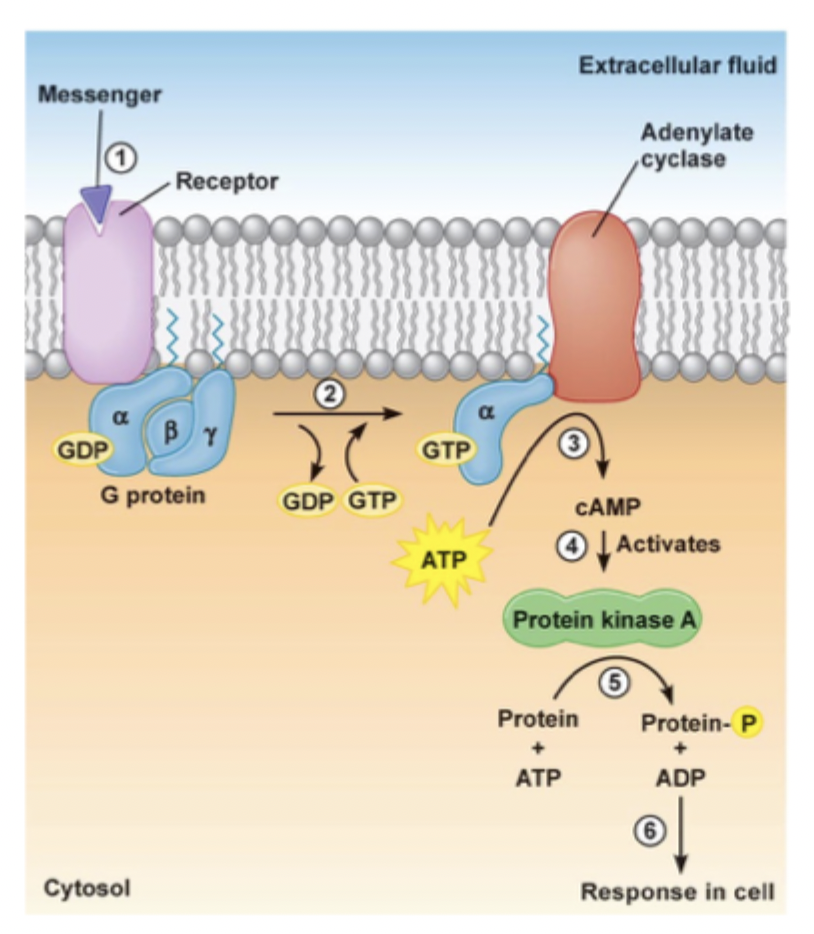
hormone binds to receptor on PM = receptor-hormone complex
receptor associated w/ G protein
G protein activated → activates adenylate cyclase
secondary messenger system → G protein-mediated signalling
GDP exchanged for GTP
adenylate cyclase converts ATP → cAMP (cyclic adenosine monophosphate)
cAMP activates protein kinase A in cytosol
kinase phosphorylates proteins → phosphorylation cascade
proteins activate OR deactivate = different effects
hormone can be excitatory or inhibitory
eg. catecholamines (EP NEP) bind to B1- receptors on SA node pacemaker cells of heart
intracellular cascade → ion channel activity altered
speed up spontaneous depolarization of heart = ⬆ HR
target cell responsiveness
depends on
[hormone]
# of target cell receptors
binding affinity b/w hormone + receptor
influence exerted by other hormones