Phototropism, photoreceptors, plant movement
 Call Kai
 Learn
 Practice Test
 Spaced Repetition
 Match
 Flashcards
 Knowt Play
1/58

There's no tags or description
Looks like no tags are added yet.
59 Terms
External factors for plant growth
Plants can’t move, they must adapt
Tropism are mechanisms by which plants adapt to environmental changes
Tropism
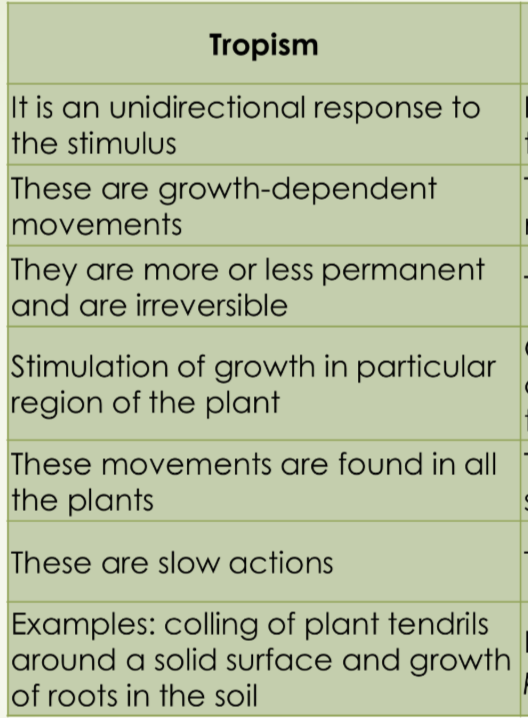
Growth response toward (positive) or away (negative) from an external stimulus.
Common stimuli:
light
gravity
water
touch
Phototropism
curving or growing toward light
Role that light plays in the phototrophic response:
light decreases the auxin sensitivity of the cells on the lighted side.
Light destroys auxin
light drives auxin to the side of the growing tip
Response to light mediated by a photoreceptor
Auxin migrates from the light side to the dark side (redistribution)
Photoreceptor
a pigment-containing protein that absorbs light and converts the signal into a biochemical response
Phototrophic responses re triggered by what wavelengths?
blue wavelengths of light (400-500 nm)
Phototropins
Main blue light receptors
Phototropins control and regulate:
Phototropins control the opening of the stomata
Regulate the movement of chloroplasts in response to different light intensities (with light they align).

What is signal transduction?
Changing cellular activity in response to external signals.
Components of signal transduction (in response to the plant’s hormones)
Environmental or physiological signal → Receptor → Second messenger/activators/regulators → Response
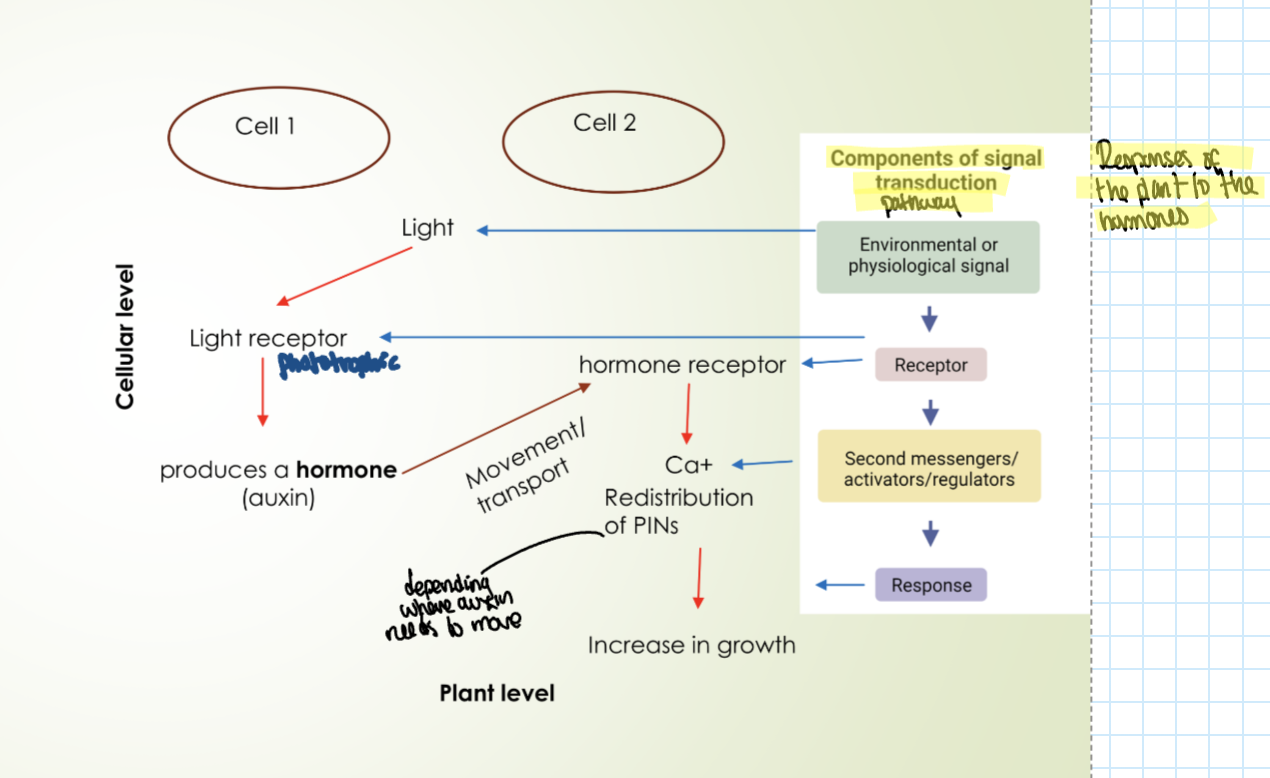
What are examples of external signals?
Light, temperature, mechanical stimuli, hormones and nutrients.
Where are many receptors for external signals located?
In the plasma membrane, where they detect external stimuli.
What do second messengers/ activators/ regulators do?
Amplify signals inside the cell.
Example: Ca²⁺ in ABA signaling.
Gravitropism
Response to gravity by plants
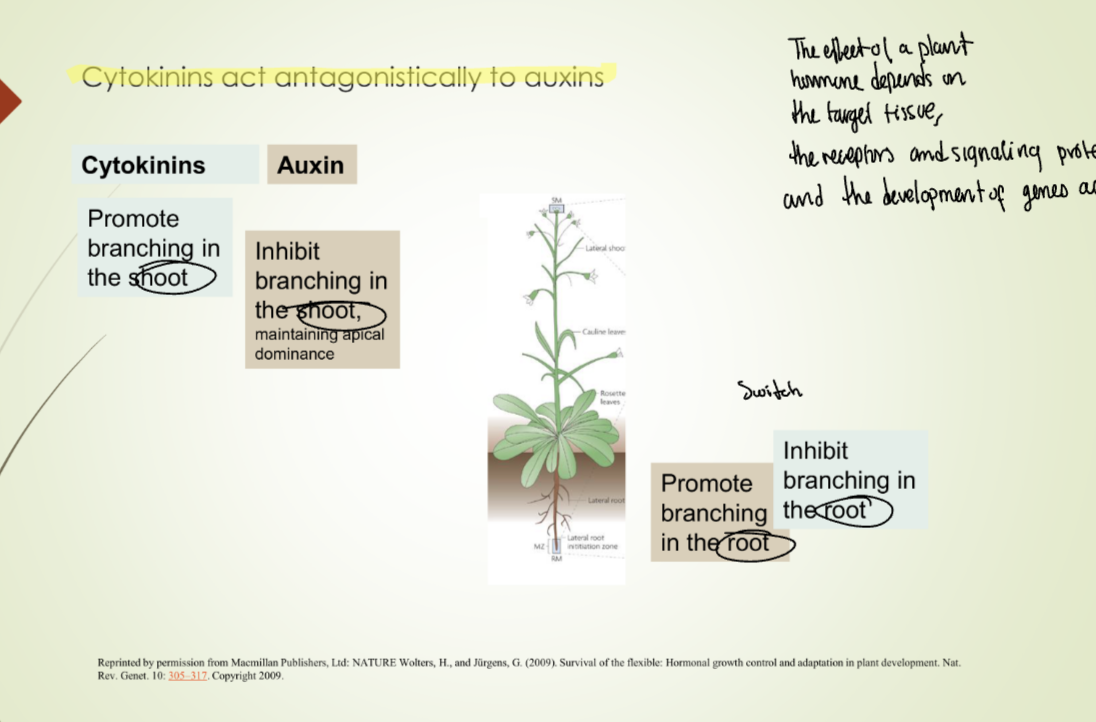
Shoot: More auxin → more growth.
Root: More auxin → less growth.
Gravitropism
What happens when a seedling is placed on its side?
The root grows downward (positive Gravitropism)
The shoot grows upward (negative gravitropism)

Gravitropism
How does auxin redistribute when a seedling is placed horizontally?
Auxin accumulates on the lower side of both the shoot and the root.
Gravitropism
How does auxin cause a shoot to bend upward?
Auxin promotes cell elongation on the lower side, causing faster growth and upward bending.
Gravitropism
How does auxin cause a root to bend downward?
Roots are more sensitive to auxin.
High auxin on the lower side inhibits cell elongation, so the upper side grows faster and the root bends downward.
Starch
Transitory Starch in leaves, where in the leaves is located?
in chloroplasts

Starch
Transitory Starch in leaves,
What happens to excess CO₂ assimilated during photosynthesis?
A high proportion is converted directly into starch.
Starch
Transitory Starch in leaves,
What are the two functions of transitory starch in photosynthetic cells?
Provides a carbohydrate reserve for energy during the night.
Acts as an overflow storage when sucrose synthesis capacity is limited.
Starch
Storage Starch in non-photosynthetic cells ,
Where is storage starch found in non-photosynthetic plant cells? What are amyloplasts?
In amyloplasts, non-pigmented plastids specialized in synthesizing and storing starch. They do not perform photosynthesis.

Gravity perception in plants
Statocytes
Specialized gravity-sensing cells in plant shoots and roots.

Gravity perception in plants
Statocytes, In the roots, they are located where?
Statocytes in in the roots are located in the columella of the root cap.
Gravity perception in plants
Statoliths
Amyloplasts that act as gravity sensors by sedimenting inside statocytes.

Gravity perception in plants
How do plants perceive gravity according to the starch-statolith hypothesis?
Amyloplasts settle toward the lower side of gravity-sensing cells, helping the plant detect gravity's direction.
gravity is sensed through amyloplast sedimentation.
Gravity perception in plants
Where is gravity perceived in shoots?
In the starch sheath, whose innermost layer is the endodermis.
What happens when Arabidopsis or any plants’ shoots lack amyloplasts in the starch sheath?
Their gravitropic response is altered because gravity perception is disrupted.
Where are amyloplasts located in vertically oriented root columella cells?
Near the bottom of each cell, where they settle due to gravity.

What happens to amyloplasts when a root is placed on its side
They move toward the newly lower, normally vertical walls of the columella cells.
How does amyloplast movement help roots perceive gravity?
The movement of amyloplasts helps root cells detect the direction of gravity.
auxin causes a root to bend downward in response to gravity
Where is the gravity response initiated, and where does root curvature occur?
Initiated at the root tip; curvature occurs in the zone of elongation.

auxin causes a root to bend downward in response to gravity
How is auxin transported during the root gravitropic response?
It moves down through the vascular cylinder, is redistributed to the cortex and epidermis at the root tip, and then moves upward toward the elongation zone.

How does auxin cause a root to bend downward?
Auxin inhibits cell elongation on the lower side and allows greater elongation on the upper side, causing the root to curve downward.
Root = more auxin → less elongation.
Upper side grows faster, so the root bends down.

Gravitropism is a sequential process

Thigmotropism
Directional plant growth in response to physical contact with a solid object.
examples of thigmotropism
Roots growing around rocks and tendrils wrapping around objects for support.
What causes tendrils to twist around objects?
Different growth rates between the inside and outside of the tendril.
How do plants detect physical contact?
Mechanoreceptors detect touch and can activate calcium channels, triggering signal transduction.
What role does auxin play in thigmotropism?
Auxin redistributes toward the side opposite contact, promoting cell elongation there and contributing to bending.
What cellular changes contribute to bending during thigmotropism?
Localized cell wall loosening and changes in turgor pressure.
nastic movements
Plant movements in response to a stimulus that are independent of the stimulus direction.
nyctinasty
Up-and-down leaf movements in response to daily cycles of light and darkness.
Ions move → water follows → motor cells change volume → leaves move.
nyctinasty
What is a pulvinus
A flexible, cylinder-shaped structure containing vascular tissue surrounded by parenchyma cells, responsible for leaf movement.
nyctinasty
What causes nyctinastic movement?
Unequal volume changes in motor cells on opposite sides of the pulvinus due to ion and water movement.
nyctinasty
How do ions and water contribute to nyctinastic movement?
Ion movement across the plasma membrane causes water to move by osmosis, changing cell volume and turgor pressure.
nyctinasty
What regulates nyctinastic movements?
The circadian clock and phytochrome
(photoresponsive chromoprotein photoreceptors found in plants, certain fungi, and bacteria that detect red and far-red ligh).
Thigmonatic Movements
Rapid plant movements caused by changes in turgor pressure in the motor cells of the pulvinus.
Thigmonatic Movements
What triggers thigmonastic movements?
Thigmonatic Movements
What triggers thigmonastic movements?
Touch or vibration detected by mechanoreceptors.
Thigmonatic Movements
What happens to ions during thigmonastic movement?
Ca²⁺ enters the cells, while K⁺ and Cl⁻ move out, generating an electrical signal.
Thigmonatic Movements
How is the electrical signal transmitted to the pulvinus?
Through cell-to-cell connections, including plasmodesmata, and vascular tissues such as the phloem.
Thigmonatic Movements
What causes the leaflets to fold?
Motor cells lose K⁺ and water, decreasing turgor pressure. Unequal changes on opposite sides of the pulvinus cause leaf movement.
Thigmonatic Movements
How do leaflets reopen after thigmonastic movement?
H⁺-ATPase pumps help restore ion gradients, allowing ions and water to re-enter motor cells and restore turgor pressure.
Thigmonatic Movements
What is the proposed defensive function of thigmonastic movements?
Rapid leaf folding may startle potential herbivores and discourage feeding.
Tropism
Nastic Movements
