Communication Theory Midterm
 Call Kai
 Learn
 Practice Test
 Spaced Repetition
 Match
 Flashcards
 Knowt Play
1/99

There's no tags or description
Looks like no tags are added yet.
Name | Mastery | Learn | Test | Matching | Spaced | Call with Kai | Chat |
|---|
No analytics yet
Send a link to your students to track their progress
100 Terms
epistemology
the way in which we come to know what truth is
objective
the ___ approach assumes that truth is singular and is accessible through unbiased sensory observation; committed to uncovering cause-and-effect relationships
interpretive
the ___ approach refers to the linguistic work of assigning meaning or value to communicative texts; assumes that multiple meanings or truths are possible
objective
an ___ view of epistemology holds that we come to truth through:
empirical observation
“T”ruth
being free of bias
interpretive
an ___ view of epistemology holds that we come to truth through:
socially constructed meaning
“t”ruth
intersubjectivity
inevitable bias
objective
___ scholars subscribe to determinism, or the assumption that behavior is caused by heredity and environment
interpretive
___ scholars subscribe to the idea of free will, ie. people are free agents who could decide to respond differently under an identical set of circumstances
objective
___ theories rely on research methods like experiments and surveys
experiment
an objective research method involving:
a controlled environment
manipulation of independent variable to establish relationship with dependent variable
survey
an objective research method involving:
self-reported data that tells researchers what people think/feel
compilation into statistical reports
interpretive
___ theories rely on research methods like textual analysis and ethnography
textual analysis
an interpretive research method involving:
describing and interpreting messages
finding categories and explaining what is going on
ethnography
an interpretive research method involving:
researcher who learns through immersion in a culture or participant observation
“Thick description” (culturally/contextually conscious)
“Getting it right means seeing it from their point of view”
objective
the goal of ___ theories is to understand and predict
interpretive
the goal of ___ theories is to describe and/or to create positive social change (critical)
objective
___ scholars rely on deductive reasoning
inductive
___ scholars rely on inductive reasoning
objective
___ scholars view truth as like looking into a mirror
interpretive
___ scholars view truth as like looking at an object from different angles/in different light
objective
good ___ theories offer the following:
Explanation of the Data
Prediction of Future Events
Parsimonious
Testable Hypothesis
Practical Utility
explanation of the data
a characteristic of good objective theories that brings clarity and understanding to the communication phenomenon; explains communication processes and results
prediction of future events
a characteristic of good objective theories that enables accurate forecast of human behavior
parsimonious
a characteristic of good objective theories that refers to simplicity; uncertainty reduction lacks it
testable hypotheses
a characteristic of good objective theories that offers researchers the ability to collect evidence against or in support of its claims
practical utility
a characteristic of good objective theories that offers pragmatic insight for life; refers to a theory’s usefulness
interpretive
good ___ theories offer the following:
New Understanding of People/Salience
Clarification of Values
Aesthetic Appeal
Community of Agreement
Reform of Society
new understanding of people/salience
a characteristic of good interpretive theories that offers an important insight into human communication and provides an effective explanatory mechanism
clarification of values
a characteristic of good interpretive theories that unmasks ideologies within communication
aesthetic appeal
a characteristic of good interpretive theories that sparks appreciation; the ideas creatively captures some aspect of human communication
community of agreement
a characteristic of good interpretive theories referring to scholars’ support and use of the theory
reform of society
a characteristic of good interpretive theories that challenges the guilding assumptions of a culture and furthers social change
socio-psychological
objective tradition seeking universal laws of how communication influences thoughts, attitudes, & behaviors; focuses on empirical, cause-and-effect relationships and scientific observation
3 causes of persuasive variation:
Who (source)
What (content)
Whom (audience characteristics)
cybernetic
studies communication as the processing and exchange of information within systems

rhetorical
studies the art and practice of persuasive communication, especially public speaking
semiotic
this tradition studies how signs and symbols create and communicate meaning
socio-cultural
this tradition examines how communication creates, maintains, and changes shared social realities and cultural norms
critical
examines how communication and language reinforce or challenge power, privilege, and oppression
phenomenological
studies communication through people’s lived experiences and their subjective understanding of others
symbolic interactionism
this communication theory posits that identity is created through communication with others
symbolic interactionism
this communication theory posits that if we define a situation as real, it will be real in its consequences, regardless of objective reality
symbolic interactionism
this communication theory posits that meaning is created through language
looking-glass self
in symbolic interactionism, the mental self-image that results from taking the role of the other; the objective self; me

symbolic interactionism
this communication theory holds that “individuals’ self-conceptions result from assimilating the judgments of significant others”
generalized other
in symbolic interactionism, the composite social comparison group a person refers to in assessing their sense of self
self-fulfilling prophecy
in symbolic interactionism, the tendency for our expectations to evoke responses that confirm what we originally anticipated
I
in symbolic interactionism, the subjective self; the spontaneous force that fosters all that is novel, unpredictable, and unorganized in the self
me
in symbolic interactionism, the objective self; the image of self seen when one takes the role of the other
symbolic interactionism
this communication theory holds that symbolic naming is the basis for human society
coordinated management of meaning
this communication theory holds that persons-in-conversation co-construct their own social realities and are simultaneously shaped by the worlds they create
coordinated management of meaning
this communication theory holds that the way people communicate is often more important than the content of what they say
lived
in coordinated management of meaning, ___ stories refers to real life
telling
in coordinated management of meaning, story ___ refers to the way we choose to communicate
told
in coordinated management of meaning, ___ stories refers to our subjective account of reality
unknown
in coordinated management of meaning, ___ stories refers to missing information
untold
in coordinated management of meaning, ___ stories refers to what we choose not to say
unheard
in coordinated management of meaning, ___ stories refers to what is spoken but not acknowledged
untellable
in coordinated management of meaning, ___ stories refers to stories that are forbidden/painful
coherence
in coordinated management of meaning, ___ is learning to tell another’s story with integrity, to accept them on their own terms; does not mean finding or agreeing on the “true” story lived
bifurcation
in coordinated management of meaning, the ___ point is the critical point in a conversation where what one says next will affect the unfolding pattern of interaction and potentially take it in a different direction
coordination
in coordinated management of meaning, ___ entails the meshing of stories lived; collaborating in an attempt to bring into being their vision of what is good
cosmopolitan
in coordinated management of meaning, a ___ communicator seeks out conversation with differing perspectives
dialogic
in coordinated management of meaning, ___ communication refers to conversation in which parties remain in the tension between holding their own perspective while being profoundly open to the other
constructivism
this communication theory seeks to explain how some people communicate more skillfully than others to achieve communication goals
constructivism
this communication theory holds that cognitive complexity determines communication aptitude
constructivism
this communication theory uses the Role Category Questionnaire (RCQ) to assess cognitive complexity
cognitive complexity
in constructivism, ___ ___ can benefit a person in the following ways:
organizational effectiveness
better at reading others
better at delivering comforting communication and showing empathy
effective problem-solving skills
better at listening comprehension
more fluid family communication patterns
less romantic jealousy
improved interpersonal outcomes (with qualifiers for romantic relationships)
personal constructs
in constructivism, ___ ___ refer to contrasting features we use to perceive differences in people; necessary but not sufficient for person-centered messages
person-centered
in constructivism, ___-___ messages reflect an ability to predict and adapt to the receiver; attends to objective, identity, and relationship
social penetration theory
an objective theory of relational development
onion
social penetration uses the model of the ___ to illustrate layers of intimacy
self-disclosure
social penetration assumes we become more intimate through ___-___ that slows with increased depth; includes a depth and breadth of information
depenetration
in social penetration theory, ___ refers to layer-by-layer withdrawal of intimacy
outcome (O)
in social penetration theory, ___ refers to the value we assign to our relationships; if benefits > costs, social penetration proceeds
comparison level (CL)
in social penetration theory, ___ refers to the value one needs to be satisfied in a relationship; determined by relational history
comparison level of alternatives (CLalt)
in social penetration theory, ___ refers to the value you think you could get from a different relationship
relational dialectics
this communication theory holds that tensions are inherent in relationships
connectedness-separateness
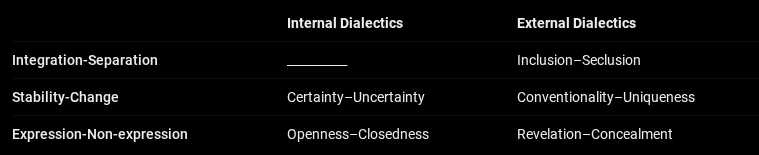
inclusion-seclusion

certainty-uncertainty

conventionality-uniqueness

openness/closedness

revelation-concealment

interactional view
this communication theory holds that interpersonal interaction occurs within a system; understanding the system is central to navigating and changing our relationships
one-up
in the interactional view, a conversational move to gain control of the exchange; attempted domination
own-down
in the interactional view, a conversational move to yield control of the exchange; attempted submission
one-across
in the interactional view, a conversational move to neutralize or level control within the exchange
reframing
in the interactional view, the process of instituting change by stepping outside of a situation and reinterpreting what it means; can change the punctuation of the interaction
coordinated management of meaning
Name that Theory! We can’t access another person’s understanding of reality…but we can still find ways to tell his/her story with integrity, and we can still work together to pursue our mutual values.
relational dialectics
Name that Theory! If you experience tension, you must be in a relationship.
expectancy violations theory
Name that Theory! When someone does something we don’t expect, we react on the basis of our evaluation of the unexpected action and the likeability and power of the person.
symbolic interactionism
Name that Theory! Communication from others shapes our identities.
constructivism
Name that Theory! Cognitive complexity determines our ability to accomplish our communication goals.
social penetration theory
Name that Theory! Relationships form through self-disclosure. We weigh the costs and benefits and decide how to proceed (i.e. how much to disclose).
interpretive
the interactional view is more objective/interpretive
objective
social penetration theory is more objective/interpretive
objective
expectancy violations theory is more objective/interpretive
objective
constructivism is more objective/interpretive
interpretive
relational dialectics is more objective/interpretive
interpretive
coordinated management of meaning is more objective/interpretive
interpretive
symbolic interactionism is more objective/interpretive