AP European History Review
 Call Kai
 Learn
 Practice Test
 Spaced Repetition
 Match
 Flashcards
 Knowt Play
1/402

There's no tags or description
Looks like no tags are added yet.
403 Terms
*Jacob Burkhardt*
a Swiss writer that wrote Civilization of the Renaissance in Italy in 1860. He was the first to coin the Renaissance as a period of rebirth.
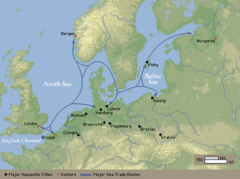
Hanseatic League
a commercial and defensive league of many merchant guilds and their market towns that were made up of many German States against trade that prevented a lot of commerce for a time
The Medici
a banking family of Florence that controlled much power in the city state; they helped patron much of the arts and made Florence the center of the Renaissance
Baldassare Castilglione
wrote Book of The Courtier; a standard for the Renaissance man that aimed to make a man achieve a well-rounded life through the arts. It also gave some advice on women, asking them to be chaste.

Francisco Sforza
the founder of the Sforza dynasty in Milan, he was able to hold his country. He was a moderate patron of the arts.
Florence
the center of the Renaissance. It was a cultural breeding ground and patroned many people of the arts. It was also a flourishing city in trade.
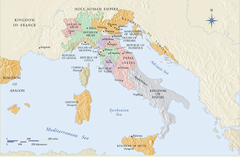
Venice
a city that was centered around trade and dominated in power

Papal States
the religious states that helped patron the arts. It was centered around the Pope's power

Naples
a kingdom that did not have much power; they were not a real patron of the Renaissance

Isabella d'Este
was one of the leading women in the Renaissance as a political and cultural figure that was a patron of the arts; regent of Mantua and prolific writer. She patroned the arts.
Peace of Lodi
treaty between Milan and Venice that ended the war of succession to Milan in favor of Sforza that balanced the power between Venice, Milan, Naples, Florence and the Papal States

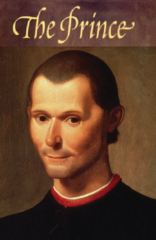
Niccolo Maciavelli
wrote The Prince that described that the acquisition and expansion of political power as the means to restore and mantain order. It was secular and said the ends justified the means.
Cesare Borgia
son of Pope Alexander VI that used ruthless measures to achieve his goal of carving a new state in Italy. He abandoned morality for political activity.

Humanism
an intellectual movement based on the study of the classical literary works of Greee and Rome. They studied the liberal arts and antiquity. They were largely secular.
Petrarch
the father of humanism. He was the first to say that the Middle Ages were a period of darkness. It set him searching for Latin books that put an emphasis on classical Latin such as that of Cicero.

Civic Humanism
Florence's humanist movement that was tied to civic spirit and pride in that country.
Lorenzo Valla
educated in bothLatin and Greek that made him write The Elegances of the Latin Language to purify medieval Latin and restore Latin to its proper position over the vernacular. He accepted only the Latin Language of the last century of the Roman Republic and first of their empire

Neoplatoism
the rebirth in interest in Plato that was advocated by the translator Ficino
Giovanni Pico della Mirandola
one of the most famous pieces of writing of the Renaissance called The Oration on the Dignity of Man. He combined the works of many philosophers that were all part of God's revelation to humanity. He believed in unlimited human potential.

Laura Cereta
educated in Latin by her father. She defended women to be scholars. She wrote a series of letters defending this.

Johannes Gutenburg
made the Gutenburg Bible, which was the first truebook of the West to be produced by the movable type.

Sandro Boticelli
had an interest in Greek and Roman mythology as seen with Primavera. It has well-defined figures with an otherworldly quality that is not quite realism.

Donato di Donatello
spent his time in Rome copying Greek and Roman statues. His statue David shows the triumph and strength of Florence over Milan. It had simplicity and strength that reflected the dignity of man.

Filippo Brunelleschi
a friend of Donatello that drew inspiration from architecture of Ancient Rome that built Church of San Lorenzo. He created church environments that did not overwhelm the worshipper but comforted them in human, not divine measurements.

Leonard da Vinci
transitional figure to the High Renaissance that carried on experimenting and even disecting human bodies. He advanced the idealization of nature from natural to ideal form. It uses space and perspective to show people as three dimensional.

Raphael
he was acclaimed for madonnas that achieved an ideal beauty beyond human standards. He painted frescos in the Vatican and displayed balance, harmony and order.

Michelangelo
an accomplished painter, sculptor and architect that was influenced by Neoplatonism. His muscular figures shows an ideal being that shows divine nature.
Jan van Eyeck
the first to use oil paint that allowed a range of colors and fine details. He did not have a true grasp of perspective though. He used empirical observation of reality.

Albrechet Durer
understood laws of perspective and proportion. Adoration of the Magi brough details to the art as well as ideal form.

Guillaume Dufay
changed the music of the Mass. Used secular tunes to replace Gregorian chants as the fixed melody. He composed a number of secular songs.
Charles VII
established a royal army composed of cavalry and archers. He recieved from the Estates General the right to levy the taille without any further approval of them. It meant less power for the Estates General.
Taille
an annual direct tax on land or property
Louis XI
the Spider King that retained the taille as a permanent tax imposed by royal authority. Louis secured a sound source of income. He could not repress the French nobility though.

Charles the Bold
Duke of Burgundy that attempted to create a middle kingdom between France and Germany. Louis opposed his action and Charles was killed in battle. Louis took his lands and started to develop a strong French Monarchy.

Henry VII
the first Tudor king that worked to reduce internal dissension and establish a strong monarchy. He ended private wars of the nobility by abolishing the practice that aristocrats mantained privatearmies of followers dedicated to the service of their lord.
Isabella of Castile and Ferdinand of Aragon
the dynastic union of two rulers not a political union. Both kingdoms maintained their own parliaments, courts, laws, coins, speech, customs and political organs.The two rulers worked to strengthen the government. They reorganized the military forces of Spain. They secured from the pope the right to select the most important church officials in Spain. They made people convert to Catholicism or they were forced to leave.
Maximilian I
attempted the centralize the administration by creating new instutions common to the entire empire. Opposition grom German princes doomed this. However, he arranged his son to Mary of Isabella and Redinand. Charles created heir to all three lines.
John Wyclif
disgust with clerical corruption led him to far-ranging attack on papal authority and medieval Christian beliefs and practices. Alleged that there was no basis in Scripture for papal claims and advocated popes to be stripped of their power. He attracted followers called Lollards

John Hus
urged the elemination of the worldliness and corruption of the clergy and attacked the excessive power of the papacy within the Catholic church. Hus was condemned as a heretic that led to revolutionary upheaval.
Pope Julius II
most involved in war and politics. Called the 'warrior-pope' personally led armies against his enemies,much to the disgust of pious Christians.

Pope Alexander VI
a member of the Borgia family that was known for his sensuality. He encouraged his son Cesare to carve out a central Italian territory out of the Papal States, creaing a scandal.

Pope Leo X
patron of Renaissance culture. Accelerated the construction of St. Peter's.

Northern Humanism
focused on sources of early Christianity, the Holy Scriptures and the writings of church fathers. They discovered a simple relgion. They believed that the teaching of this could bring inner piety that would reform the church and society. This brought support of education.

Desiderius Erasmus
formulated and popularized the reform program of Christian humanism. Wrote The Handbook of the Christian Knight that reflected his preoccupation with religion. He called his conception of religion the philosophy of Christ. Believed Christianity should be a guiding hilosophy for the direction of daily life. He emphasized inner piety and deemphasized the external forms of religion.
Thomas More
wrote Utopia that gave an account of idealistic life and institutions. A new social system in which cooperation and reason replaced power and fame as the proper motivating agents for human society. All people work together. They are carefully controlled for the moral welfare of society and its members.
Martin Luther
he believed that salvation through faith alone in promises of God. This became from the primary Protestant Reformatio. Luther arived from this as the sole authority of the Bible.
95 Theses
a statement that criticized that the sale of indulgences was not just. It was originally just to spark debate and not a break with the church.
Peasants' War
peasant dissatisfaction in Germany stemmed from several sources. Many peasants had not been been touched by economic improvement. Social discontent became tangled with religion, seeking for Luther's support but he did not.
Charles V
Holy Roman Emperor that ruled over an empire consisting of Spain and its overseas possessions, Austrian-Habsburg lands, Bohemia, Hungary, the Low Countries and the kingdom of Naples. He could not control his empire.
Habsburg-Valois Wars
rivalry between Charles V and Valois king of France, Francis I that became in conflict after disputed territory in southern France, the Netherlands, the Rhineland, northern Spain and Italy.

Suleiman the Magnificient
defeated and killed King Louis of Hungary, Charles V's brother in law. They overran most of Hungary and into Austria.

Schmalkaldic League
eight Lutheran princes and eleven imperial cities firned a defensive alliance against Charles V's threat of turning them back to the Catholic church. They vowed to help oneanother.

Peace of Augsburg
the division between Christianity was formally established. Lutheranism granted equal legal standing with Catholicism. Each German ruler could choose the religion for their subjects.

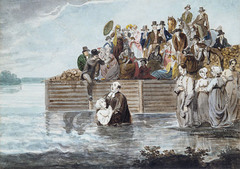
Anabaptists
went to simple living. Believed that The Lord's Supper was interpreted as a remembrance, a meal of fellowship celebrated in the evening in private houses. They believed in adult baptism and complete seperation of church and state.
Ulrich Zwingil
Swiss reformer that spread rthe reformation. Relics and images were abolushed, paintings and decorations were removed from the churches and repaced by whitewashed walls. The Mass was replaced by reading of the Bible.
Henry VIII
wanted to divorce his wife Catherine of Aragone. he cut off all appeals from English church courts to Rome. He abolished pope authority in England.

Thomas Cranmer
archbishop of Canterbury

Thomas Cromwell
King's principle secretary that advised annulment of marriage.

Act of Supremacy, 1534
The King was the only supreme head of the Church of England. They could control doctrine, appointments, and discipline.
Treason Act
Punishable by death to deny that the King was the supreme head of the church
Edward VI
Underage and sickly king that passed power to the council of the refency. They moved England to be more Protestand and insituted rights of clergy to marry, elimation of images and the creation of a revised Protestant lituary in the Book of Common Prayer

Mary I
Catholic who intended to restore Englan back. She burned more than 300 heretics that actually made England more Protestant.
John Calvin
The founder of Calvinism that wrote The Institutes of Christian Religion that adhered to justification of faith alone.

Predestination
God had predestined some people to be saved (the elect) and some to be damned (the reprobate). One had to openly profess faith, participate in baptism and communion and live a godly life. One couldn't be absolutely certain about this though.

Geneva
John Calvin set up a ministry that brought a church constitution that used clergy and layman for te church as well as a code enforcing discipline.

John Knox
Scottish reformer that helped spread the Calvinist thought throughout Europe

Catholic Reformation
mixture of old and new elements. Medieval Catholicism revived with mysticism through tied experiences as well as monasticism was brough in.
Society of Jesus
Jesuits became the chief instrument for the Catholic reformation that submitted to will of the church. They emphasized that human will can be strengthened by the church. The believed in strong heirarchy as well as education of the masses.

Ignatius of Loyola
experiences spiritual torment similar to Luther but turned to Catholic church. He wrote The Spiritual Exercieses as a training manual for spiritual development by exercises that helped follow the will of God

Pope Paul III
included himself in politics and patronized the arts. He appointed a reform commission and helped create papal reform.

Paul IV
he increased Inquisition so even liberals were silent. Hecreated the Index of Forbidden Books that was ungodly for Catholics to read.

Council of Trent
upheld traditional Catholic teachings in opposition to Protestant beliefs.

Huguenots
French Calvinists that made up to 50 percent of the nobility icluding the house of Bourbon which was a threat to monarchial power.
St. Bartholomew's Day Massacre
when reconciliation was believed between Valois king and Bourbon ruler, the French family were persuaded that Huguenots were a threat and sent a wave of violence that gripped the city.

Catherine de Medici
a powerful womanwho used her young sons as puppets to control the throne

Henry IV
a Protestant that changed to Catholicism for France to assend the throne

Edict of Nantes
acknowledged Catholicism as the official religion of France but guaranteed Huguenots could worship in select areas and recieve fortified towns as well as political privileges.
Phillip II
King of Spain that ushed it into greatness by use if the Soanish Inquisition. He made trade important as well as the importance of Catholicism.

William of Orange
wished to unify all seventeen provinces of Netherlands after a revolt but later was split to the North and south. He led the South Protestant Union as the Dutch Republic.

Elizabeth I
Settled religion that used Act of Uniformity that restored service to Book of Common Prayer as well as Act of Supremacy. She also used caution in her foreign policy.

Mary, Queen of Scots
next in line to the English throne who was Catholic. She was placed on house arrest and later executed.

Puritans
those who were in the Anglican church who wanted to remove any trace of Catholicism from their church

Spanish Armada
an attempt to get rid of a Protestant monarch in England in place of a Catholic one. Miserably failed by being caught in a storm and brought Europe to Naval power.

*Prince Henry the Navigator*
founded a school for navigation in Portugal. This caused Portuguese fleets to probe around the coast of west Africa for Gold. It brought back slaves from the Senegal river and gold on the southern coast of the hump of West Africa.

Bartholomeu Dias
took advantage of westerly winds in South Atlantic to tried to round the Cape of Good Hope but feared mutiny and went back.

Vasco de Gama
rounded the cape with his crew and stopped at several ports controlled by Muslim merchants along the coast of East Africa. Crossed the Arabian Sea and reached the port of Calicut and brought back ginger and cinnamon.

Christopher Columbus
an Italian explorer that worked with the queen of Spain. He believed Asia was larger than previously thought and thought he could reach it by sailing west. He send 3 ships and landed on the Bahamas, believing he had reached Asia. He converted natives to Christianity.

John Cabot
made a British claim of Canada that was the first British explorer

Treaty of Tordesillas
split the land claims between the Spanish and the Portuguese. Spain got most of Latin American and the Portuguese got the Cape of Good Hope

Hernan Cortez
arrived to the capital of the Aztecs and was greeted by Moctezuma. He believedthat he was a God and gave him gold. But eventually he tookhimgostage and pillaged the city. The disease they brought killed many of the Aztecs and led for the Spanish to take over.

Francisco Pizzaro
had steel weapons, gunpowder and horses that were unfamiliar to the Incan empire. They already were ravaged by smallpox. The emporer died because of it and his two sons claimed the throne which caused a civil war. He captured the capital and took it for the Spanish.

Encomienda
a system that permitted the conquering Spaniards to collect tribute from the natives and use them as laborers. In turn, the holders were supposed to protect them, pay them and suprivise their spiritual needs. Many took advantage of this and treated them poorly.

Bartolome de Las Casas
participated in the conquest of Cuba and recieved land and natuves, He underwent radical transformation and came to believe that the natives were treated porly. He became a Dominican friar and fought for their rights. He wrote The Tears of the Indians.

Boers
Dutch farmers that began to settle in areas outside the city of Cape Town.
King Alfonso from the Congo
became concerned about the impact of slave trade in his society
Robert Clive
an aggressive British empire-builder who eventually became the chief representative of the Easy India Company. He consolidated British control in Bengal. Would later lead to colonies being made there.

East India Company
expanded their authority for an economic decision that made regular revenue to pay for military operations in India.

Dutch East India Company
Dutch trade of spices near the East India

Jacob Fugger
head of one of the wealthiest banking firms inin Amsterdam that eventually went bankrupt

Antwerp
the older commercial and banking center replaced by Amsterdam