🧈 Lecture 3: Part 1 - Fat-Soluble Vitamins
 Call Kai
 Learn
Learn Practice Test
 Spaced Repetition
 Match
Match Flashcards
 Knowt Play
1/13

There's no tags or description
Looks like no tags are added yet.
Name | Mastery | Learn | Test | Matching | Spaced | Call with Kai | Chat |
|---|
No analytics yet
Send a link to your students to track their progress
14 Terms
Vitamins
Definition
• Organic compounds with a carbon skeleton
Solubility
• Can be lipid-soluble or water-soluble
• Solubility is important
Functions
• Perform a variety of functions
• Metabolic regulation
• Coenzymes
• Antioxidants
Essential Vitamins
• May or may not be considered essential
• Depends on the species
Fat-Soluble Vitamins
Vitamin A
• Retinol
• Retinal (retinaldehyde)
• Retinoic acid (retinol metabolite)
• Retinyl esters (esterified retinol)
• Beta-carotene (provitamin A carotenoid)
Vitamin E
• Tocopherols: alpha, beta, gamma, delta
• Tocotrienols: alpha, beta, gamma, delta
Vitamin K
• K₁ (phylloquinone)
• K₂ (menaquinone)
• K₃ (menadione)
Vitamin D
• D₂ (ergocalciferol)
• D₃ (cholecalciferol)
Why is it important to know which vitamins are fat-soluble?
• They can be stored in body fat, so they can accumulate to toxic levels

Vitamin A
Functions
• Vision
• Growth
• Tissue maintenance
• Immune function
• Embryonic development
Biologically Active Forms
• Retinol
• Retinal (retinaldehyde)
• Retinoic acid
Storage Forms — Inactive
• Retinyl ester
• From animal products
• Stored in the liver
• Beta-carotene (mostly)
• From plant products
• Associated with red/orange pigmentation
Vitamin A Forms
• Retinyl esters → Retinol → Retinaldehyde → Retinoic acid

Vitamin A – Vision
Photoreceptors
• Retinal + opsin (light-sensitive protein) = rhodopsin and iodopsin
Rhodopsin
• Photoreceptor found in rod cells of the retina
• Responsible for black and white vision
• Works in dim light → “night vision”
Iodopsin
• Photoreceptor found in cone cells of the retina
• Responsible for colour vision
• Works in bright light

Vitamin A – Toxicity and Deficiency
Toxicity
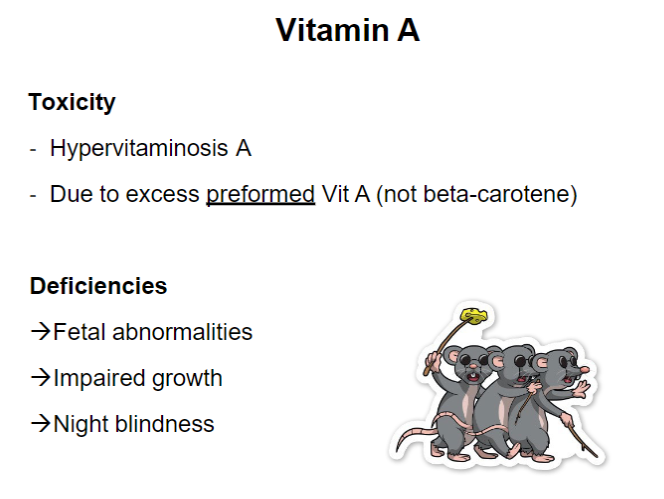
• Hypervitaminosis A → too much vitamin A in the body
• Caused by excess preformed vitamin A, not beta-carotene
Deficiency
• Fetal abnormalities
• Impaired growth
• Night blindness
Vitamin A – Essentiality
Preformed Vitamin A is Essential For
• Felids
• Marine birds
• Most carnivorous mammals
• These animals lack sufficient amounts of 15,15′-dioxygenase, an enzyme needed to convert beta-carotene into vitamin A
Not Essential For
• Canids → foxes, coyotes, wolves
• Most herbivores
• Most omnivores
• These animals can readily convert beta-carotene into vitamin A

Vitamin D
Functions
• Homeostatic regulation of calcium and phosphorus → keeps calcium and phosphorus levels balanced
• Growth
• Bone remodeling → changes and maintains bone tissue
• Eggshell formation
Sources
Vitamin D₂ – Ergocalciferol
• Very few natural sources
• Foods are often fortified with D₂
Vitamin D₃ – Cholecalciferol
• Sunlight → UV-B exposure
• Phytoplankton
• Zooplankton
• Marine fish

Vitamin D – Activation
Inactive Forms
• D₂ → obtained from the diet
• D₃ → obtained from sunlight and diet
• D₂ and D₃ are biologically inactive
Active Form
• Calcitriol → 1,25-dihydroxycholecalciferol
• Also called 1,25-dihydroxyvitamin D₃ or 1,25(OH)₂D
• Calcitriol is the biologically active form
Vitamin D Activation
1. UV-B radiation reaches the skin
2. UV-B initiates conversion of 7-dehydrocholesterol → vitamin D₃ (cholecalciferol)
3. In the liver, vitamin D₃ → 25-hydroxyvitamin D₃ (calcidiol or 25(OH)D3)
4. In the kidney, 25-hydroxyvitamin D₃ → 1,25-hydroxyvitamin D₃ (calcitriol or 1,25(OH)₂D3)
Main Function of Calcitriol
• Calcitriol regulates calcium and phosphorus (Ca/P)

Vitamin D – Dietary Requirement
Mammals
• Vitamin D is only required in the diet for mammals with insufficient sun exposure
• Polar regions
• Fossorial/subterranean → live or spend most time underground
• Nocturnal → active at night
Vitamin D₃
• Essential for amphibians, birds, and reptiles
• These animals cannot use vitamin D₂
Mammals
• Can use vitamin D₂ or D₃

Vitamin D – Toxicity and Deficiency
Toxicity
• Hypervitaminosis D → too much vitamin D, causing hypercalcemia
• Calcium builds up in soft tissues and organs
Deficiency
• Rickets → soft bones in young animals
• Osteomalacia → brittle bones in adults

Vitamin E
Function
• Antioxidant
• Inhibits or prevents oxidative damage
• Scavenges free radicals → unstable or reactive atoms
Forms
Tocopherols
• Alpha, beta, gamma, delta
• Organic compounds with various methylated phenols
• Alpha-tocopherol = most active form of vitamin E
Tocotrienols
• Alpha, beta, gamma, delta

Vitamin E – Toxicity and Deficiency
Toxicity
• Hypervitaminosis E → too much vitamin E
• Can counteract vitamin K actions → affects blood coagulation
Deficiency
• Muscular dystrophy → muscle weakness and paralysis
• Nerve damage
• Infertility in rats and birds

Vitamin K
Function
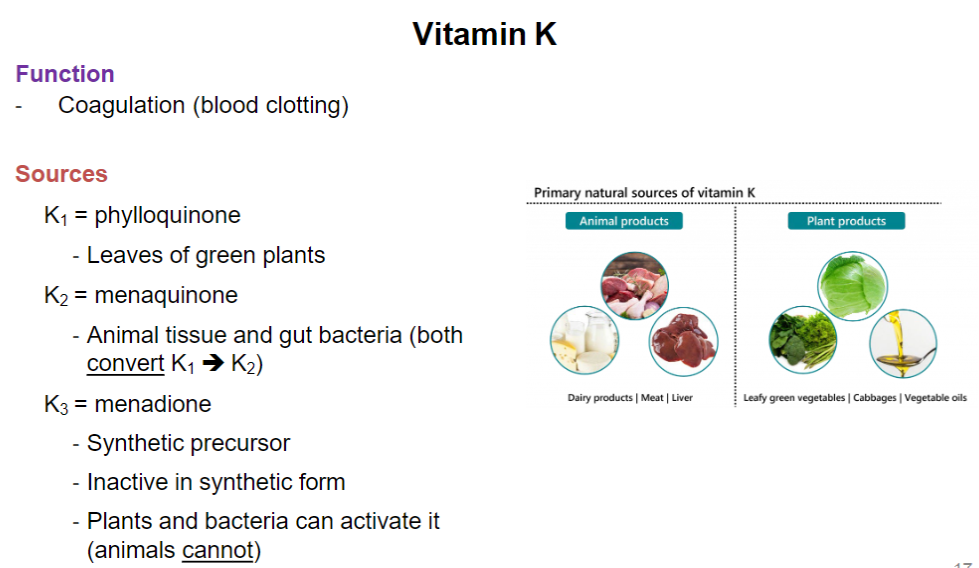
• Coagulation → blood clotting
Sources
Vitamin K₁ – Phylloquinone
• Found in leaves of green plants
Vitamin K₂ – Menaquinone
• Found in animal tissue and gut bacteria
• Animal tissue and gut bacteria can convert K₁ → K₂
Vitamin K₃ – Menadione
• Synthetic precursor
• Inactive in its synthetic form
• Plants and bacteria can activate it
• Animals cannot activate it
Vitamin K – Toxicity and Deficiency
Toxicity
• K₁ and K₂ are innocuous → not harmful, even in very large amounts
• K₃ can be toxic
• K₃ is no longer used as a supplement
Deficiency
• Increased risk of hemorrhage or excessive bleeding
