Lesson 18: Ω-Verbs- First Aorist Active and Middle Indicative; First Aorist Active and Middle Infinitives; First Aorist Active and Middle Imperative
 Call Kai
 Learn
Learn Practice Test
 Spaced Repetition
 Match
Match Flashcards
 Knowt Play
1/7

There's no tags or description
Looks like no tags are added yet.
Name | Mastery | Learn | Test | Matching | Spaced | Call with Kai | Chat |
|---|
No analytics yet
Send a link to your students to track their progress
8 Terms
what does the 3rd principal part of GK verbs give you?
the stem to form the aorist tense in the active and middle voices
3rd pp is 1st person sing aorist active indicative
how do you form the aorist passive?
different stem supplied by the 6th principal part
what is an aorist action?
one that the speaker perceives not as an activity continuing over time, but as a mere occurrence or event.
it may happen in th epresent, past, or future.
it does not specify whether the action is/was/will be prolonged (not progressive-that’s a diff aspect; so means “undefined”)
what is the First Aorist?
aka sigmatic or weak aorist
majority of GK verbs have it
what is the Second Aorist?
aka asigmatic or strong aorist
*few GK verbs have both 1st + 2nd aorist
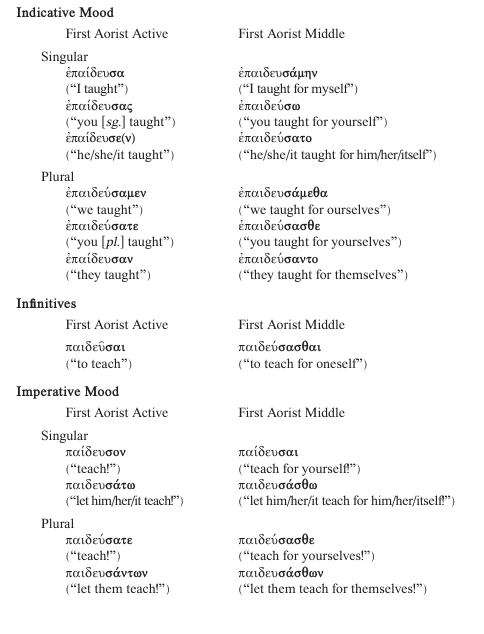
First Aorist, Active + Middle Paradigms:
most of the endings are combinations of letters σα and secondary personal endings → no intervening thematic vowel (ο/ε)
to show past tense = epsilon augment added to aorist indicative forms, but not infs or imperatives (bc those only show aspect—here, aoristic—not time)
aorist active infinitive = always accented on the penult, while mid imperative has recessive accent (like all other finite forms of the aorist); aorist md inf has persistent accent on antepenult

First Aorist, Active + Middle Paradigms (with example παιδεύω)
what is genitive of value?
also called gen of price (in context of buying/selling)
common construction in GK (e.g., whenever you combine a genitive with ἄξιος, -ᾱ, -ον, you are using the genitive of value to indicate what someone or something is worth)