Biology Unit 1 Exam
 Call Kai
 Learn
 Practice Test
 Spaced Repetition
 Match
 Flashcards
 Knowt Play
1/76

There's no tags or description
Looks like no tags are added yet.
77 Terms
What is the most important rule in the lab?
Follow all instructions given by the lab manager
Be prepared for an experiment by...
Reading protocols prior to coming to the lab
If necessary, what clothes does one have to wear in the lab?
Protective clothing such as closed-toe shoes, goggles, lab coats, etc. *Anything that covers bare skin*
Before doing any lab task...
Read all labels carefully
What happens when working with hazardous chemicals?
You work under the chemical fume hood by lab personnel
What is a chemical fume hood
A protective area meant to protect against *harmful fumes, gases, dirt and splashes*
If one has long hair...
They must tie it back
How tight do clothes have to be in the lab and why?
Clothes must not be loose or baggy to prevent getting caught on lab equipment
What to do with hot plates in the lab
Never leave them unattended; never touch the heating surface
When glassware is hot, do *not*
handle them with bare hands
Are people allowed to work alone in the laboratory and why
People (especially students) cannot work alone in the lab. This is because if one works alone in the lab and they get hurt by a chemical or glassware, no one is there to help them.
If any part of an experiment is unclear, what to do and why
Ask the teacher. If you try to do something you don't understand, you might do something wrong.
In the event of a fire:
Get out of the room immediately
In the event of broken glass or a spill:
tell the teacher. do not touch it yourself
In the event of a power failure:
sit quietly or ask the teacher for flashlights if necessary
In the event of a lockdown:
Hide in the research room
In the event of bodily harm:
Report it to the teacher and get medical assistance
Assume that all chemicals in the lab are...
Dangerous
How to carry bottles or beakers that contain chemicals/reagent
Hold them with two hands to avoid spilling or use a cart
When containers or bottles are unattended...
Close the lids tightly when not in use. Don't leave them open
When finished working with chemicals
Return them to where you found them
In case a chemical hits your eyes:
wash them in the water fountain immediately
In case of skin/clothing contact with a dangerous substance:
put the contaminated clothing away and wash the contaminated skin (usually in the shower)
In case of ingesting a chemical (consuming it):
Tell teacher for medical help.
In case of inhaling a chemical (smelling it too much):
Move to fresh air immediately and tell the teacher
What color is a health hazard on the safety symbol square, and what are each of the terms?
Blue;
4: deadly
3: extreme danger
2: hazardous
1: slightly hazardous
0: normal
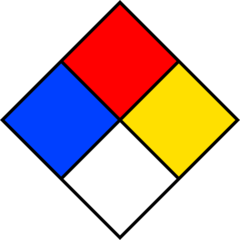
What color is a specific hazard on the safety symbol square, and what are each of the terms?
White;
ACID: Acid
ALK: Alkali
COR: Corrosive
OXY: Oxidizer
☢️: Radioactive
W: Use no water
What color is a Fire hazard on the safety symbol square, and what are each of the terms?
Red;
4: burns below 73F
3: burns below 100F
2: burns above 100F, below 200F
1: burns above 200F
0: does not burn at all
What color is an instability on the safety symbol square, and what are each of the terms?
Yellow;
4: May detonate
3: Shock and heat
2: Violent
1: Unstable if heated
0: stable
What is the symbol for a flammable substance
Flame
What is the symbol for a harmful substance or irritant
X mark
What is the symbol for a corrosive
A liquid melting a hand
What is the symbol for a poisonous or toxic substance
A skull like a pirate
What is the symbol for an explosion
...an explosion (wow)
What is the symbol for a biohazard
3 circles with one circle overlapping all of them
What is the symbol for an oxidizer
A circle with a flame on it
What is the symbol for an environmental hazard
A dying fish
What is the symbol for radioactive substances?
a circle with 3 cones surrounding it
What is the symbol for laser radiation?
a circle with lines coming out of it
What is science
The state of knowing distinguished from ignorance and misunderstanding
What is Biology
Scientific study of life/the state of understanding life
list 12 units of organization in organisms
atom - molecule - cell - tissue - organ - organ system - organism - population - community - ecosystem - biosphere
Taxonomy
discipline of identifying and grouping organisms; involves *naming* and *classifying* species
Systematics
Study of evolution and evolutionary relationships
How is diversity organized? what are the organization categoeries
They are organized by the fields that they are in. The categories of the fields from most to least inclusive are:
Domain
Kingdom
Phylum
Class
Order
Family
Genus
Species
Domain bacteria
Most diverse + widespread prokaryotes (organisms without a nucleus)
Domain archaea
prokaryotes that live in extreme environments like volcanoes and deep sea
Domain Eukarya
Most diverse + widespread eukaryotes
(organisms with a membrane bound nucleus)
characteristics, cell wall, and representative organisms of the eubacteria kingdom
CHARACTERISTICS:
- simple orgarisms lacking nuclei
(prokaryotic)
- either heterotrophs of autotrophs
- all can reproduce asexaully
- live nearly everywhere
CELL WALL:
-often present (contains peptidoglycan)
REP. ORGANISMS:
-bacteria,
-cyanobacteria
characteristics, cell wall, and representative organisms of the archebacteria kingdom
CHARACTERISTICS:
- prokaryotic
- heterotrophs
- live in salt lakes, hot springs, animal guts
CELL WALL:
-absent
REP. ORGANISMS:
-methanogens
-extreme thermophiles
-extreme halophiles
characteristics, cell wall, and representative organisms of the protista kingdom
CHARACTERISTICS:
- *most* single celled and/or prokaryotes
- some autotrophs, heterotrophs, both
- reproduce sexually + asexually
- live in aquatic + moist habitats
CELL WALL:
-absent
REP. ORGANISMS:
-algae
-protozoa
characteristics, cell wall, and representative organisms of the fungi kingdom
CHARACTERISTICS:
-most are multicellular
-all are heterotrophs
-reproduce sexually and
asexually
-most are terrestrial
CELL WALL:
-present
REP. ORGANISMS:
-mushrooms
-yeast
-bread molds
characteristics, cell wall, and representative organisms of the plantae kingdom
CHARACTERISTICS:
-all are multicellular
-all are autotrophs
-reproduce both ways
-most are terrestrial
CELL WALL:
-present
REP. ORGANISMS:
-mosses, ferns, conifers,
flowering plants
characteristics, cell wall, and representative organisms of the animalia kingdom
CHARACTERISTICS:
-all are multicellular
-all are heterotrophs
-mostly reproduces sexually
-terrestrial and aquatic
CELL WALL:
-absent
REP. ORGANISMS:
-sponges, worms, lobsters, starfish, humans
Steps of the scientific method
1. make an observation
2. ask a question
3. make a hypothesis
4. perform an experiment(s)
5. collect and analyze data
6. make conclusions
phenomena
natural event
what is a hypothesis
a possible explanation for a natural event. Informed based on other information
experiment
series of procedures
theory
broader than a hypothesis and supported by large amounts of evidence
Illumination source definition and types
Type of electromagnetic radiation used to illuminate a sample in microscopy.
1. Light microscope
2. Electron microscope
Lens
Symmetrical, optical device that can focus and bend electromagnetic radiation
What are the different types of lenses
1. Condenser - gathers electromagnetic radiation from source to specimen
2. objective(s) - gathers er from sample and focuses to detector
3. intermediate and projector - sometimes used to increase magnification
ocular lens magnification
10x
resolution
ability to distinguish two points touching each other that otherwise look like one figure.
the higher the resolution, the less the distance between points
Magnification
degree of enlargement in an image compared to the original
examples of small elements:
sand - 1 mm
pollen - 100 micrometers
red blood cell - 10 micrometers
bacteria - 1 micrometer
virus - 100 nanometers
protein - 10 nanometers
dna - 2 nanometers
c60 - 1 nanometer
atom - 0.1 nanometer
minimum distinguishable point distance to human eye
0.2 mm
magnification formula:
point on image distance
---------------------------
point on object distance
SEM
Scanning electron microscope
how do SEMs work
They scan the surface of an object of image to create a detailed black and white image. The wavelength is much smaller than visible length and the resolution is much higher than light microscopy.
biologist
expert or student in science of living organisms
scientist
expert or student in one or more of the physical scientist
difference between biologist and biological scientist
research and doing it
artificial selection
humans selectively breeding animals for their own benefit
biotechnology
exploiting biology for industrial and other purposes
goal of science vs technology
understand natural phenomena; apply scientific knowledge for a purpose
What are the 7 characteristics of life?
1. All living things maintain homeostasis
2. All living things reproduce
3. All living things respond to their environment
4. All living things can develop
5. All living things adapt
6. All living things need energy
7. All living things are organized