SPPA 220: phonatory anatomy quiz
 Call Kai
 Learn
 Practice Test
 Spaced Repetition
 Match
 Flashcards
 Knowt Play
1/56

There's no tags or description
Looks like no tags are added yet.
57 Terms
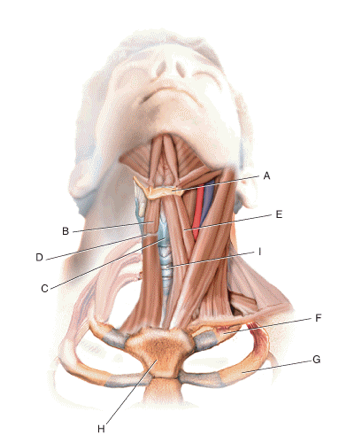
A: corpus of hyoid
B: thyrohyoid
C: angle of thyroid
D: oblique line
E: omohyoid
F: first rib
G: second rib
H: manubrium
I: cricotracheal membrane
Label this
A: mandible
B: mylohyoid
C: geniohyoid
D: hyoid corpus
E: digastricus anterior
F: stylohyoid
G: digastricus posterior
Label this(not H)

A: epiglottis
B: greater cornu of hyoid
D: oblique arytenoid
E: posterior cricoarytenoid
F: cricoid
G: transverse
H: thyroid
Label this(not c)
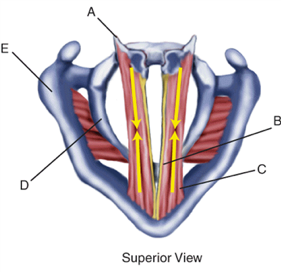
A: arytenoid
B: thyrovocalis
C: thyromuscularis
D: cricoid
E: thyroid cartilage
Label this
B: posterior
C: valleculae
D: epiglottis
F: prominence of arytenoid
G: true vocal folds
H: conus elasticus
label this(not e)
Posterior
The __________ belly of the digastric muscle courses from the mastoid process of the temporal bone to the hyoid bone.
Posterior
The __________ belly of the digastric muscle pulls the hyoid back.
epiglottis
The __________ cartilage is a large, leaf-like structure that covers the aditus of the larynx during swallowing.
cuneiform
The __________ cartilage is embedded within the aryepiglottic folds.
greater
The __________ horn of the hyoid bone is connected to the thyroid cartilage via the lateral thyrohyoid ligament.
stylohyoid
The __________ muscle arises from the styloid process of the temporal bone and inserts into the hyoid.
thyrohyoid
The __________ muscle courses from the oblique line of the thyroid cartilage to the hyoid bone.
sternohyoid
The __________ muscle courses from the sternum to the hyoid bone.
sternothyroid
The __________ muscle courses from the sternum to the thyroid cartilage.
mylohyoid
The __________ muscle forms the floor of the mouth.
omohyoid
The __________ muscle has two bellies that insert into an intermediate tendon that attaches to the hyoid.
Sternohyoid
The __________ muscle has two bellies that insert into an intermediate tendon that attaches to the hyoid.
Omohyoid
The __________ muscle is the only laryngeal depressor with two bellies.
Vocalis
The __________ muscle lies medial to the thyromuscularis muscle.
Transverse interarytenoid
The __________ muscle originates on the posterior-lateral surface of one arytenoid cartilage and courses laterally to the other posterior-lateral surface.
stylohyoid
The __________ muscle originates on the styloid process of the temporal bone and courses to the hyoid bone.
mylohyoid
The __________ muscle originates on the underside of the mandible, coursing fan-like to the median fibrous raphe and the hyoid bone.
Cricothyroid
The __________ muscle runs between two unpaired laryngeal cartilages; it tenses the vocal folds.
Superior surface
The arytenoid cartilage articulates with this portion the cricoid cartilage.
cricoid
The cartilage that articulates with the inferior aspect of the arytenoid cartilage is the __________.
corniculate
The cartilage that articulates with the superior aspect of the arytenoid cartilage is the __________.
cricoid
The cartilage that articulates with the thyroid cartilage is the __________.
vestibule
The cavity of the larynx immediately superior to the ventricular folds is the __________.
Inferior cornu
The cricoid cartilage articulates with this portion of the thyroid cartilage.
aditus
The entryway to the larynx is the __________.
cricoid
The inferior-most cartilage of the larynx is the __________.
cricoarytenoid
The joint between the arytenoid and cricoid cartilages is termed the __________ joint.
adductor
The lateral cricoarytenoid muscle is a(n) ___________.
thyrohyoid
The membrane that stretches across the space between the greater cornu of the hyoid and the lateral thyroid is the __________.
thyroid
The most massive of the laryngeal cartilages is the __________.
adductor
The oblique arytenoid muscles are a(n) __________.
cricothyroid joint
The point of articulation between the cricoid and thyroid cartilages is the __________.
abductor
The posterior cricoarytenoid is a(n) __________.
true
T or F: The false vocal folds are superior to the laryngeal ventricle.
cricoid
The ring-like cartilage that is higher in the posterior aspect than the anterior is the __________.
valleculae
The space between the epiglottis and the tongue is the __________.
glottis
The space between the left and right vocal folds is the __________.
medial compression
The term __________ refers to the degree of force that may be applied by the vocal folds at their point of contact.
relaxer
The thyromuscularis is a(an) __________.
muscular
The thyromuscularis muscle attaches to this process of the arytenoid cartilage.
tensor
The thyrovocalis is a(n) __________.
vocal
The thyrovocalis muscle attaches to this process of the arytenoid cartilage.
corniculate
This cartilage articulates with the apex of the arytenoid cartilage.
True
T or F: When the PCA muscle is contracted, the muscular process of the arytenoid cartilage is pulled posteriorly.
epiglottis
Which of the following is a leaf-like cartilage?
laryngeal ventricle
Which of the following is the cavity between the true and false vocal folds?
anterior belly of digastric
Originates from mental spines of inner mandible.
posterior belly of digastric
Which of the following muscles does not originate on the inner surface of the mandible?
mylohyoid
Which muscles is considered to 'form the floor of the mouth'?
styloid process; mastoid process
The stylohoyid originates on the _____________; whereas the posterior belly of the digastric originates on the _______________.
all of them
Which of the following muscle(s) attaches to/near the mental spines?
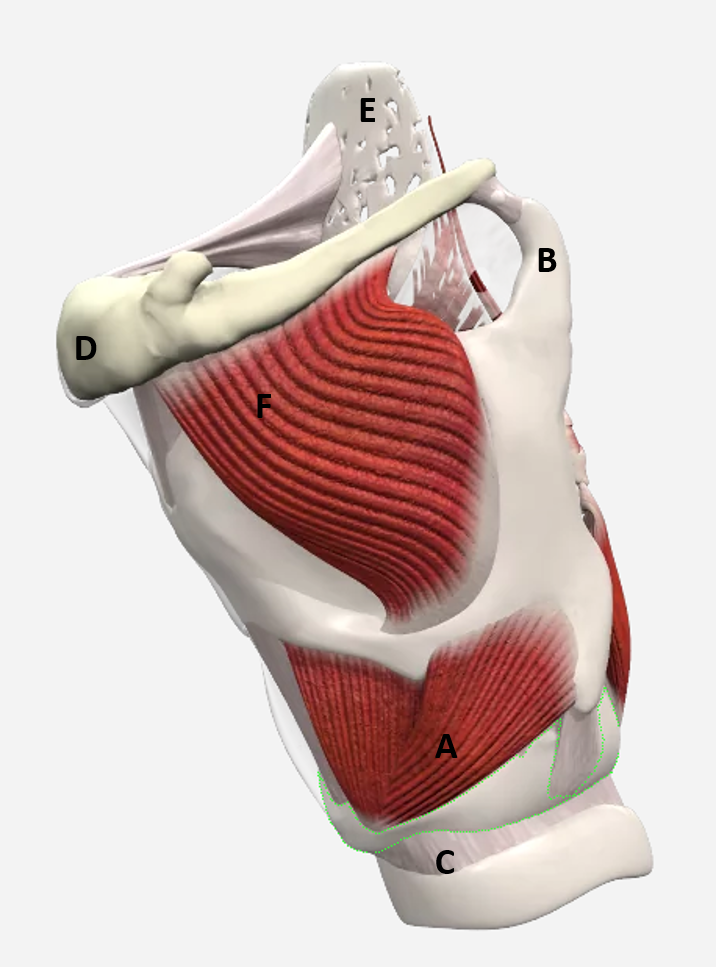
A: cricothyroid muscle
B: superior cornu of thyroid cartilage
C: cricotracheal membrane
D: body
E: epiglottis
F: thyrohyoid muscle
Label this