MAB Unit 2 DNA and Gene Expression 26-27
 Call Kai
 Learn
 Practice Test
 Spaced Repetition
 Match
 Flashcards
 Knowt Play
1/75

There's no tags or description
Looks like no tags are added yet.
76 Terms
Lac Operon
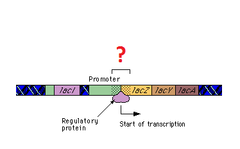
a gene system whose operator gene and three structural genes control lactose metabolism in E. coli

operon
A unit of genetic function common in bacteria , consisting of coordinately regulated clusters of genes with related functions.
Promoter
specific segment of DNA that binds with RNA Polymerase to begin transcription of mRNA from the operon genes

RNA Polymerase
Attaches to the promoter. Transcribes DNA, creates a complimentary RNA strand.
Operator
sequence of nucleotides located between the promoter and structural genes where the repressor protein can bind
A chain of amino acids produced at the end of translation that is then folded to form a protein.
Polypeptide

Large molecule made up of one or more polypeptide chains with a specific function.
Protein

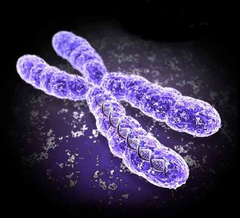
A structure in the nucleus made up of DNA and histones which holds the genetic information of an organism
Chromosome
DNA replication
DNA unzips into two parts and splits with the cell. In it's new home each side of the DNA strand attack to matching nucleotides to create 2 exact copies.
DNA helicase
An enzyme that unwinds the DNA double helix during DNA replication
DNA polymerase III
Enzyme involved in DNA replication that joins individual nucleotides to produce a DNA molecule
DNA polymerase 1
enzyme that replaces RNA primers with DNA nucleotides
DNA ligase
A linking enzyme essential for DNA replication; catalyzes the covalent bonding of the 3' end of a new DNA fragment to the 5' end of a growing chain.
RNA primase
An enzyme that creates an RNA primer for initiation of DNA replication.
Hydrogen bonds in DNA
Bonds that form between the nitrogenous bases that form the "rungs" of the DNA ladder
phosphodiester bonds
Bonds between phosphate group and pentose sugar in nucleic acids.
semi-conservative replication
in each new DNA double helix, one strand is from the original molecule, and one strand is new
base pairing rules
the rules stating that cytosine pairs with guanine and adenine pairs with thymine in DNA, and that adenine pairs with uracil in RNA
The DNA strand that is used to manufacture a RNA strand using the complementary base pairing rule.
Template strand

DNA backbone
sugar and phosphate
The process by which mRNA is made from the template strand of the DNA in the nucleus
Transcription

The process where the mRNA is read by the ribosome in the cytoplasm and an amino acid chain is created based on the codons on the mRNA.
Translation

Three consecutive bases on mRNA that code for a specific amino acid and are complementary to the anticodon portion of tRNA.
Codon

The three bases on the tRNA molecule that ensure that the correct amino acid is added to the growing polypeptide chain.
Anti codon
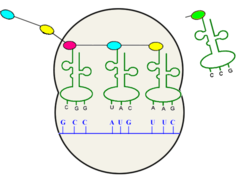
A short single strand of RNA that is made off the template strand of DNA. Its function is to carry a copy of a gene to the ribosome for protein synthesis.
mRNA

Alternative Splicing of mRNA
-One gene can code for more than one protein
-Exons can be spliced together into a variety of different mRNAs (exons can be treated as introns)
A small RNA molecules that transfers an amino acid to a growing polypeptide chain during translation.
tRNA

The site of translation during protein synthesis. It is found in the cytoplasm.
Ribosome

A permanent change in the DNA sequence
Mutation.

Nucleotides
Basic units of DNA molecule, composed of a sugar, a phosphate, and one of 4 DNA bases.

Gene
A segment of DNA on a chromosome that codes for a specific trait

Insertion Mutation
a mutation in which one or more nucleotides are added to a gene, leads to frameshift

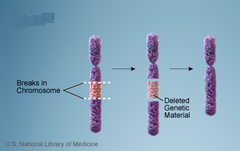
Deletion Mutation
a mutation in which one or more pairs of nucleotides are removed from a gene, leads to frameshift
Substitution Mutation
Mutation in which a single base is replaced, potentially altering the gene product., point mutation

Amino Acid
Building blocks of protein

Exons
Coding segments of eukaryotic DNA.
Introns
Noncoding segments of nucleic acid that lie between coding sequences.
RNA processing in eukaryotes
Occurs in nucleus.
After transcription:
1.) methyl Capping on 5' end
2.) PolyA on 3' end (~200 A's)
3.) Splicing out of introns
Only processed RNA is transported out of the nucleus.
transcription factors
Regulatory proteins that binds to the promoter region in DNA and affects transcription of specific genes.
frameshift mutation
mutation that shifts the "reading" frame of the genetic message by inserting or deleting a nucleotide
point mutation
a mutation affecting only one or very few nucleotides in a gene sequence.
Epigenetics
the study of environmental influences on gene expression that occur without a DNA change, but through chemical modifications to DNA or histones
acetylation of histones
opens chromatin, allowing transcription
Methylation of DNA
inactivates genes or altered gene activity (prevents binding of transcription factors and deacetylation of histones)
Phosphorylation
Attaches to histone proteins and causes interactions with other histone modifications. Can have various effects.
Epigenome
The genome-wide distribution of epigenetic marks.
gene regulation
the process of turning genes on and off
epigenetic tags
Markers that show which genes have been turned on or off
Enhancers
A DNA sequence that recognizes certain transcription factors (activators ) that can stimulate transcription of nearby genes.
repressors and activators
Transcription is prevented by ___, and stimulated by ____.
activators bind to
enhancer regions
catabolite activator protein (CAP)
Protein that functions in catabolite repression. When bound with cAMP, it binds to the promoter of certain operons and stimulates transcription.
Direction of DNA replication and transcription
5' to 3' direction
Lac Z gene
encodes beta- galactosidase; turns lactose into glucose and galactose
Lac Y gene
permease - transport lactose into cell
Lac A gene
encodes transacetylase
Lac I gene
encodes the lac repressor protein
leading strand
The new continuous complementary DNA strand synthesized along the template strand in the mandatory 5' to 3' direction.
lagging strand
A discontinuously synthesized DNA strand that elongates by means of Okazaki fragments, each synthesized in a 5' to 3' direction away from the replication fork.
missense mutation
A base-pair substitution that results in a codon that codes for a different amino acid.
nonsense mutation
changes a normal codon into a stop codon
spliceosome
A large complex made up of proteins and RNA molecules that splices RNA by interacting with the ends of an RNA intron, releasing the intron and joining the two adjacent exons.
silent mutation
A mutation that changes a single nucleotide, but does not change the amino acid created.
Sickle cell disease is caused by
Point mutation (substitution) -resulting in abnormally shaped Hgb molecule.
Sickle Cell disease is an advantage for
Homozygous genotype coding for Malaria resistance, Heterozygous are codominant and resistant to malaria and express both normal and sickle cells
Lactose
glucose + galactose
Low glucose in cell
CAP bound to cAMP, binds to promotor- Lac operon will have high levels of transcription
High glucose in cell
low cAMP, CAP not bound to promotor, Lac operon low or off
tryp operon
a repressible gene system whose operator gene controls the production of Trytophan
inducible operon
usually off, but can be stimulated (induced) when a specific small molecule interacts with a regulatory protein (example lac operon)
repressible operon
transcription is usually on, but can be inhibited (repressed) when a specific small molecule binds allosterically to a regulatory protein (example tryptophan)
prodigiosin
The red pigment produced by S. marcescens.
prodigiosin is produced when
when Serratia marcescens is grown at 27 degrees C
prodigiosin function
acts as an antimicrobial substance
agouti gene
gene in mice that affects coat color. pregnant mice fed diet that increases DNA methylation results in offspring with darker coat color
epigenetics and nutrition
-nutrition and diet significantly affect epigenome
-methyl rich foods - provide more methyl groups - possible effect on epigenome
-Agouti Mice