The Solid State
 Call Kai
 Learn
 Practice Test
 Spaced Repetition
 Match
 Flashcards
 Knowt Play
1/65

There's no tags or description
Looks like no tags are added yet.
66 Terms
What does “solid state” mean in pharmacy? (2 meanings)
Drug substances (APIs) and excipients that exist as solid materials rather than liquids or gases.
The physical and chemical properties of a drug substance (Active Pharmaceutical Ingredient, API) or formulated product in its solid form, such as tablets, capsules or powders.
`
Which statement best describes a solid?
A solid has a fixed shape and a fixed volume.
Molecules do not move freely through the container (that's a gas/liquid)
It does not take the shape of its container
It is not highly compressible
Roughly what proportion of medicines are made and dispensed as solids?
About 80–90% of medicines are manufactured and dispensed in solid form.
The vast majority of dosage forms – tablets, capsules, powders, granules – depend on solid-state properties.
Why are so many medicines formulated as solids?
A solid is more stable than its liquid counterpart
Solids are easier to handle: APIs are usually manufactured, transported and stored as solids
Most drugs are marketed in solid dosage forms
The table shows the API is solid in tablets, capsules (solid or liquid), powders/granules, ointments/creams/gels, transdermals and suppositories; liquid in solutions; solid or liquid in dispersions.

Beyond the slidesMolecules in a solid have far less mobility than in a liquid, so chemical reactions such as hydrolysis and oxidation happen much more slowly. That's the underlying reason solids are more stable.
Which of these is a solid dosage form: syrup, injection, tablet, suspension?
Tablet.
Syrups and injections are liquids; a suspension is solid particles dispersed in a liquid.
Why does the solid state matter? Name the 4 properties it helps predict and the 3 stages it affects.
Understanding how molecules are arranged and behave in the solid state is essential for predicting:
Stability
Solubility
Manufacturability
Bioavailability
It influences how a drug is stored, how it is processed, and ultimately how it performs in the body.
Exam tip: Memory aid: S-S-M-B = Stability, Solubility, Manufacturability, Bioavailability.
Why is understanding the solid state “critical”?
Because the same chemical compound can exist in different solid forms – identical chemistry, different arrangement of molecules.
These different forms can have a major impact on the drug's performance, safety and stability.

Which solid-state properties must manufacturers control, and what do they influence?
Properties: particle size, morphology (particle shape), crystallinity, moisture content.
They influence:
Blend uniformity
Tablet compression
Flow properties
Stability during storage
Drug release in the body
Manufacturers must control them so the medicine is safe, effective and consistent.

Which solid-state properties directly influence a drug's dissolution rate?
All of them:
Crystal structure – crystalline vs amorphous, and which polymorph
Particle size
Surface area – smaller particles give a larger surface area in contact with fluid, so faster dissolution
What is bioavailability, and how does the solid state affect it?
Bioavailability = the amount of drug reaching the systemic circulation.
Chain: solid form → solubility & dissolution → absorption → bioavailability.
Solubility and dissolution depend on crystal packing, so different crystal forms can alter absorption rates.

What are excipients?
The inactive ingredients in a medicine, added alongside the active drug to create the final product – improving taste, texture, or how the drug is absorbed.
Examples: binders, fillers, preservatives, colourants.
Excipients have their own solid state (crystalline, amorphous, partly crystalline), which affects how they behave.
Give the state, key solid-state features and functions of lactose, starch and MCC.
Excipient | State / structure | Key features | Function |
|---|---|---|---|
Lactose | Crystalline (α-monohydrate, anhydrous) | Good flow, good compressibility, polymorphic, slightly hygroscopic | Diluent, carrier |
Starch | Amorphous / semi-crystalline | Swells, wicks water, aids disintegration, plastic deformation | Disintegrant, binder |
MCC (microcrystalline cellulose) | Partially crystalline polymer | Excellent compressibility, moderate flow, moisture sensitive | Binder, diluent |
Pattern: the crystalline excipient flows well; the amorphous one takes up water (useful for disintegration).

Compressibility, compactibility and tabletability: define each.
The triangle links solid fraction, compression pressure and tensile strength:
Compressibility (pressure ↔ solid fraction): how much the powder's volume reduces (it packs denser) under compression pressure
Compactibility (solid fraction ↔ tensile strength): how strong a tablet is at a given density
Tabletability (pressure ↔ tensile strength): how strong a tablet you get for a given compression pressure

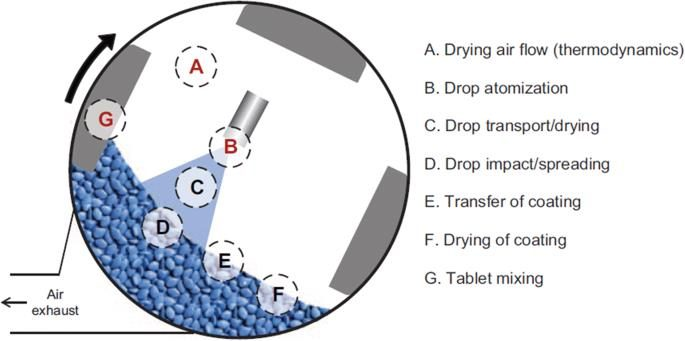
Name the stages of tablet coating in a coating pan.
Drying air flow (thermodynamics)
Drop atomisation
Drop transport/drying
Drop impact/spreading
Transfer of coating
Drying of coating
Tablet mixing
Coating is another process where the solid state of the tablet surface matters.
How is this seminar assessed?
Science exams: questions will include this content
OSCEs: apply the knowledge in scenarios
E-portfolio: conversations with service users and carers may need it
Presentation: apply it in the case study
Calculations: N/A · Report: unlikely in year 1
FAR progression: knowledge (understand) → enacted practice (analyse, compare, predict) → generative output (evaluate drug performance and support formulation decisions). GPhC LO 21.
Outline how solid forms of an API are classified.
Crystalline (long-range order)
Single component → polymorphs
Multiple components → ionic = salt; non-ionic = molecular adducts (solvates/hydrates, co-crystals)
Liquid crystalline (long-range order in some directions only; sits between crystalline and amorphous)
Amorphous (short-range order only)


Name the 4 key types of crystalline form used in pharma.
Polymorphs – same molecule, different packing
Hydrates & solvates – water or solvent in the lattice
Co-crystals – API + co-former
Salts – ionic form
The non-crystalline option is the amorphous form.
Polymorphs: what are they, and what effect do they have on performance?
Same molecule, different crystal packing. They can vary significantly in solubility and stability, and also in melting point and compressibility.
Effects: dissolution and bioavailability (via solubility), shelf-life (via stability) and tablet manufacture (via compressibility).
Hydrates & solvates: what are they
Crystal structures that contain water (hydrate) or an organic solvent (solvate) within the lattice.
They are multi-component, non-ionic molecular adducts. Example: α-lactose monohydrate.

Co-crystals: what are they, and why use them?
API + a co-former (a safe, approved excipient) in the same crystal lattice, held together without ionic bonds.
Benefits: tunable solubility and mechanical properties, while staying crystalline. Co-crystals can be patented.
Salts: what are they, and why use them?
An ionic, multi-component crystalline form of the API.
A common way to improve solubility, stability or manufacturability.

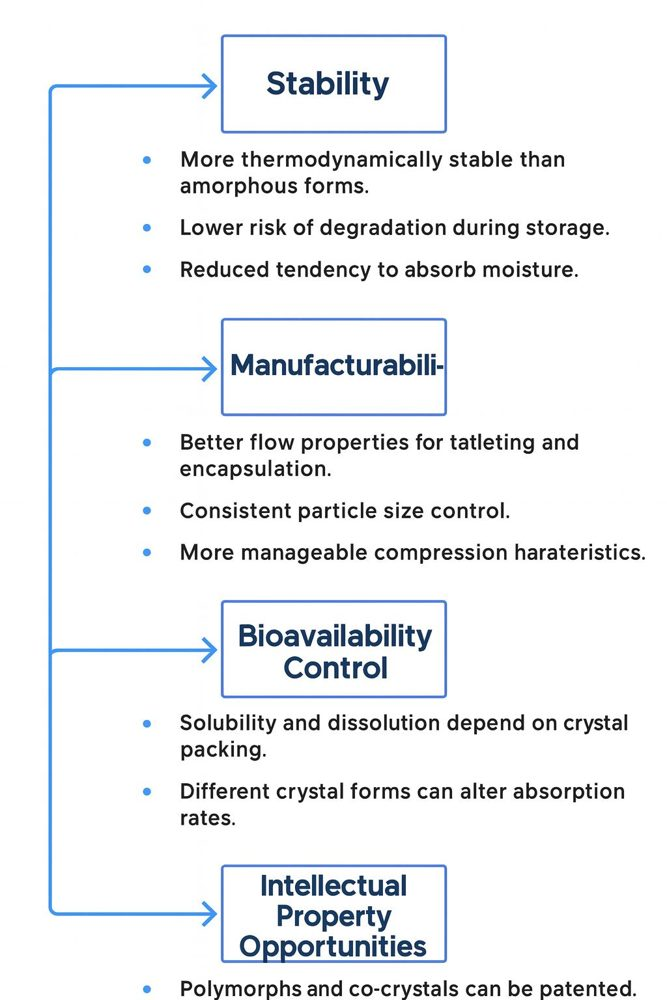
Why do crystalline forms matter in drug development? (4 headings, all bullets)
Stability: more thermodynamically stable than amorphous forms; lower risk of degradation during storage; reduced tendency to absorb moisture
Manufacturability: better flow properties for tableting and encapsulation; consistent particle size control; more manageable compression characteristics
Bioavailability control: solubility and dissolution depend on crystal packing; different crystal forms can alter absorption rates
Intellectual property opportunities: polymorphs and co-crystals can be patented
In what forms do amorphous drugs exist in pharmaceuticals?
Pure amorphous APIs
Amorphous solid dispersions (ASDs) – drug dispersed in a polymer
Spray-dried or freeze-dried amorphous powders

PREDICT: a drug is poorly soluble with low bioavailability. Which solid forms could help, and what's the trade-off?
Amorphous form or ASD: higher solubility, faster dissolution – but less stable
Salt: improves solubility (if the drug ionises)
Co-crystal: tunable solubility, stays crystalline
A more soluble polymorph – but it must not convert to a less soluble form
Smaller particle size: larger surface area

PREDICT: a less soluble polymorph forms in a product during storage. What happens?
Reduced drug availability: slower dissolution → less absorption → lower bioavailability → the product may become ineffective and fail QC.
This is exactly what happened with ritonavir (Form II).
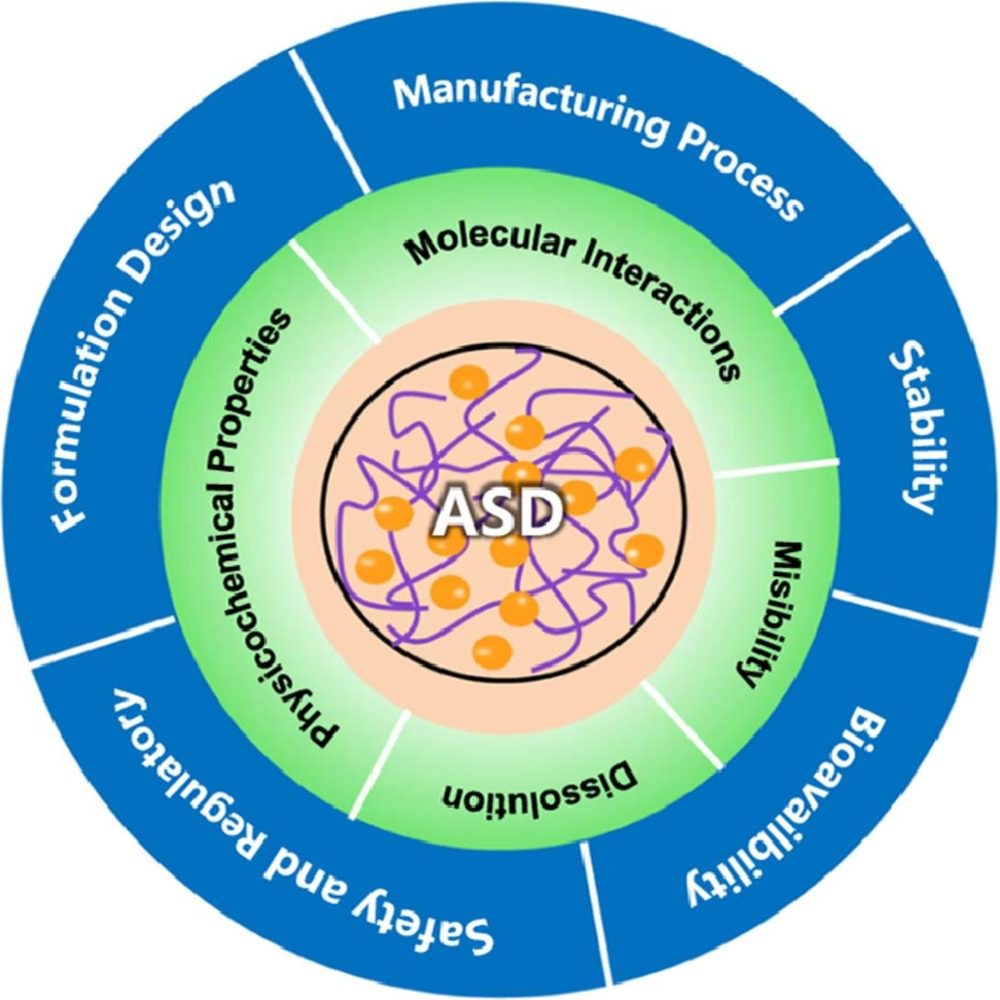
How do polymers like PVP stabilise amorphous drugs in ASDs? (nifedipine example)
Molecular interactions between polymer and drug suppress phase separation and subsequent recrystallisation.
In a nifedipine–PVP ASD, hydrogen bonds form between drug and polymer → slower molecular mobility and crystallisation.
PVP disrupts the drug's self-interactions (drug–drug) by forming drug–polymer interactions, so drug molecules can't come together to form crystals.
ASD design links molecular interactions and physicochemical properties to stability, dissolution, bioavailability, manufacturing, formulation design, and safety & regulation.
Give 6 examples of drugs used in amorphous forms and why.
Drug | Area | Note |
|---|---|---|
Indomethacin (amorphous) | NSAID | Classic model compound for amorphous research; higher solubility than crystalline |
Nifedipine | Antihypertensive | Often stabilised in ASDs |
Ritonavir (partly amorphous formulations) | Antiviral (HIV) | New polymorph caused crystallisation issues; amorphous used to recover solubility |
Atorvastatin | Cholesterol-lowering | Amorphous or partially amorphous to improve dissolution |
Curcumin (nutraceutical) | Anti-inflammatory | Formulated amorphous for significantly increased solubility |
Itraconazole (Sporanox®) | Antifungal | ASD in polymer (HPMC acetate succinate) |
Common thread: amorphous is used to enhance solubility and bioavailability, accepting lower stability.
What is lyophilisation used for? Give the examples and reasons.
Freeze-drying is used for thermally labile, biological or poorly soluble drugs to improve stability and storage.
Product | Class | Why freeze-dried |
|---|---|---|
Penicillin G | Antibiotic | Heat-sensitive, unstable in solution |
Vancomycin | Antibiotic | Poor stability in liquid form |
Acyclovir IV | Antiviral | Improves shelf stability |
Doxorubicin (incl. liposomal) | Chemotherapy | Prolongs stability; avoids degradation |
Erythropoietin (EPO) | Biologic protein | Long-term stability |
Insulin (some) | Biologic | Stability for storage/transport |
mRNA vaccines (early) | Vaccines | Temperature-sensitive nucleic acids |

Define a crystalline solid: structure, melting, stability, solubility, examples.
Molecules arranged in a highly ordered, repeating lattice (3D, long-range order)
Have a sharp melting point
Usually more stable but often less soluble
Examples: paracetamol (acetaminophen), aspirin, table salt (NaCl).
The ordered structure gives predictable physical and chemical properties, crucial for development, manufacturing, stability and performance.

Define an amorphous solid: structure, melting, energy, solubility, stability.
Molecules lack long-range order; disordered, like a “frozen liquid”
No sharp melting point – they soften gradually
Higher internal energy and molecular mobility than crystalline
Usually more soluble and may dissolve faster
Less stable; more prone to moisture uptake or recrystallisation

Crystalline vs amorphous: full side-by-side comparison.
| Amorphous | |
|---|---|---|
Order | Long-range, repeating 3D lattice | No long-range order (“frozen liquid”) |
Melting | Sharp melting point | Softens gradually |
Energy / mobility | Lower; molecules locked | Higher internal energy and mobility |
Solubility / dissolution | Lower / slower | Higher / faster |
Bioavailability | Can be limited for poorly soluble drugs | Often improved |
Stability | Thermodynamically stable; less degradation | Physically unstable; recrystallises |
Moisture | Less moisture-sensitive | Moisture-sensitive |
Shelf-life | Longer, predictable | Shorter shelf-life risks |
Manufacture | Better flow, consistent particle size, manageable compression | Specialised processing |
IP | Polymorphs, co-crystals patentable | Innovative formulations (ASDs) |
Examples | Paracetamol, aspirin, NaCl | Indomethacin, itraconazole ASD |
WHY is an amorphous solid more soluble than the crystalline form?
Slides: amorphous has higher internal energy and molecular mobility and no long-range order → higher solubility and faster dissolution.

WHY is a crystalline solid more stable, and why does an amorphous solid recrystallise?
Slides: crystalline solids are more thermodynamically stable, less likely to degrade, less moisture-sensitive. Amorphous solids can revert to crystalline forms over time, potentially altering drug performance.

WHY does a crystal have a sharp melting point but an amorphous solid softens gradually?
Crystalline: sharp melting point. Amorphous: no sharp melting point; softens gradually.

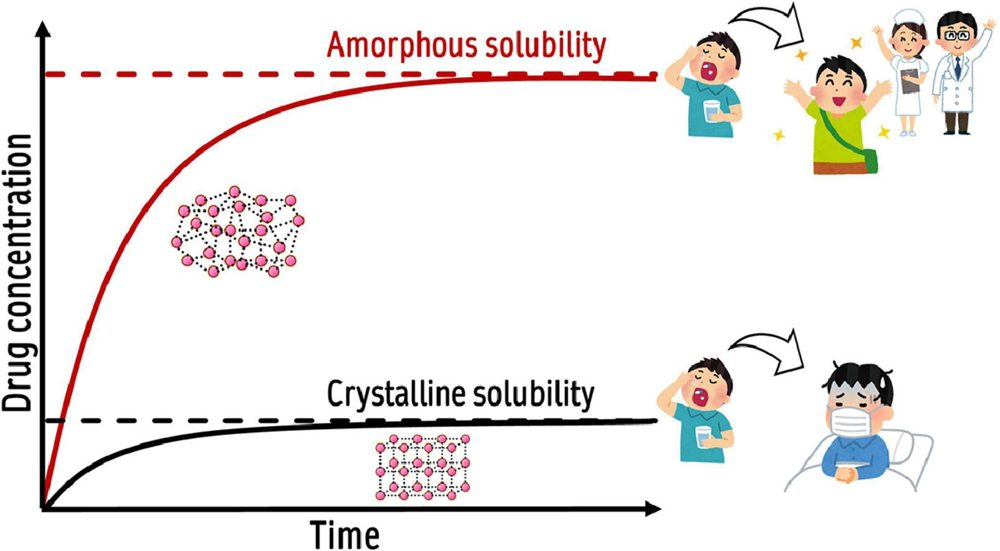
What does this graph show? Explain it.

Both curves rise as the solid dissolves, then level off at their solubility
The amorphous curve levels off at a much higher drug concentration than the crystalline one
More dissolved drug = more available for absorption = better bioavailability (the cartoon patient recovers)
The crystalline form stays low, so the patient doesn't get enough drug
Why does the crystalline vs amorphous distinction matter for a medicine?
The physical form of a drug can dramatically affect dissolution rate, absorption, shelf-life and therapeutic performance.
Crystalline: generally more thermodynamically stable, less likely to degrade, less moisture-sensitive
Amorphous: can revert to crystalline forms over time, potentially altering drug performance
Amorphous solids: list the 5 pros and 5 cons.
Pros | Cons |
|---|---|
Higher solubility | Physically unstable |
Faster dissolution | Risk of recrystallisation |
Improved bioavailability | Moisture-sensitive |
Useful for poorly soluble drugs | Requires specialised processing |
Enables innovative formulations (ASDs) | Shorter shelf-life risks |
Every pro comes from the high energy and disorder; every con comes from the same property. That's the central trade-off.
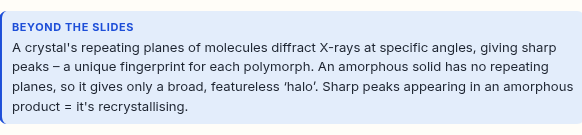
How can XRPD tell crystalline and amorphous apart?
X-ray powder diffraction is the standard technique for identifying solid forms.
What holds a crystal lattice together, and what does packing determine?
Ordered, repeating lattice held by intermolecular forces: hydrogen bonding, ionic, van der Waals, π–π stacking.
Packing determines: melting point, density, mechanical properties and dissolution.
Example: crystalline quartz (SiO₂) – atoms in a regular arrangement of linked tetrahedra.


What is a unit cell? Give the analogy.
Crystalline solids have repeating patterns of their components in three dimensions (a crystal lattice). The whole crystal is built from the smallest identical units that, stacked together, form the crystal. This basic repeating unit is the unit cell.
Analogy: if a house is a stack of bricks, the unit cell is a single brick.
The 7 unit cells: what makes them differ? Name them.
There are seven fundamentally different unit cells, differing in the relative lengths of the edges (a, b, c) and the angles between them (α, β, γ). Each has six sides, and each side is a parallelogram.
Cell | Edges | Angles |
|---|---|---|
Cubic | a = b = c | all 90° |
Tetragonal | a = b ≠ c | all 90° |
Orthorhombic | a ≠ b ≠ c | all 90° |
Monoclinic | a ≠ b ≠ c | α = γ = 90° ≠ β |
Hexagonal | a = b ≠ c | α = β = 90°, γ = 120° |
Rhombohedral | a = b = c | α = β = γ ≠ 90° |
Triclinic | a ≠ b ≠ c | α ≠ β ≠ γ ≠ 90° |
The seminar focuses on cubic cells (all sides equal, all angles 90°), but the concepts also apply to non-cubic cells.
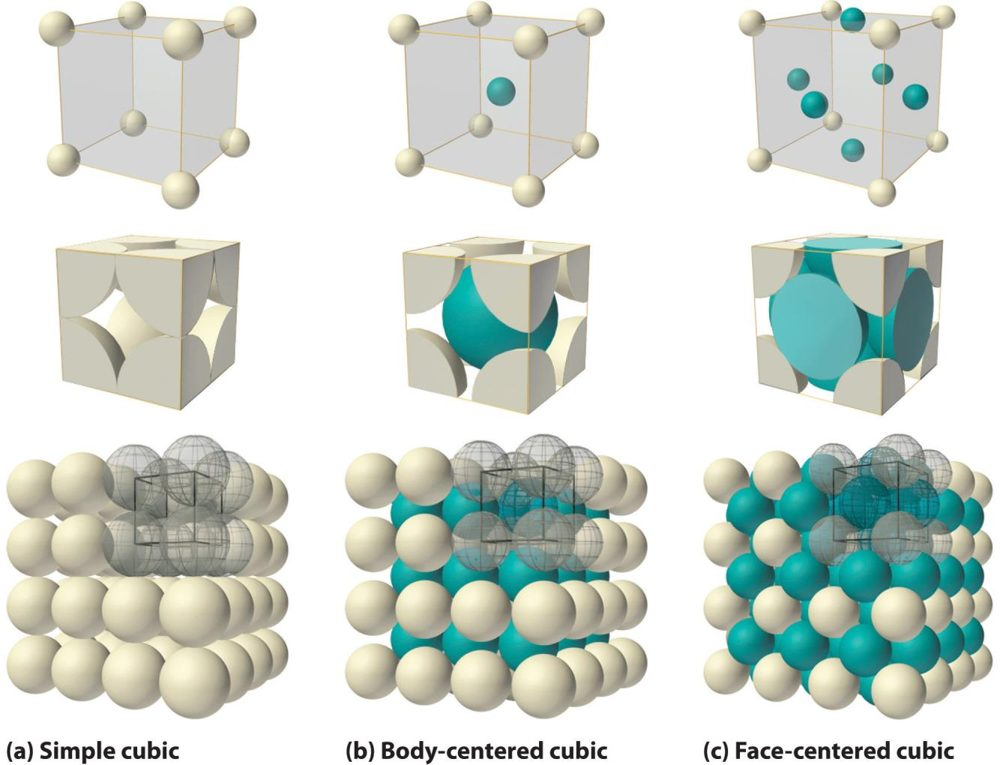
What are the 3 kinds of cubic unit cell?
Simple cubic: eight component atoms, molecules or ions at the corners of the cube
Body-centred cubic (bcc): corners + an identical component in the centre of the cube
Face-centred cubic (fcc): corners + a component in the centre of each face
The slide 26 debate: what's the task and the 5 criteria?
Task: choose a team (crystalline or amorphous) and persuade the class that your solid form is the best option for developing a new oral medicine.
Criteria:
Solubility
Stability
Bioavailability
Patenting potential
Manufacturing costs

Debate – SOLUBILITY: best argument for each side?
Amorphous (strong ground)
No long-range order, so no crystal lattice to break; higher internal energy and mobility → higher solubility, faster dissolution
Slide 10 graph: amorphous reaches a much higher concentration
Proven for poorly soluble drugs: indomethacin, curcumin, atorvastatin, itraconazole
Crystalline (counter)
Lower but predictable, reproducible solubility
Solubility can be raised while staying crystalline: salts, co-crystals (tunable solubility), a more soluble polymorph, smaller particle size
Amorphous advantage can be temporary – if it recrystallises, solubility drops back
Amorphous rebuttal
ASD polymers (PVP, HPMCAS) hydrogen-bond with the drug and suppress recrystallisation (slide 29)
Debate – STABILITY: best argument for each side
Crystalline (strong ground)
Lowest-energy, thermodynamically stable; molecules locked in a lattice
Lower risk of degradation during storage; reduced moisture uptake
Longer, more predictable shelf-life; simpler storage
Amorphous (counter)
Stability can be engineered: polymers in ASDs slow molecular mobility and block phase separation (nifedipine–PVP)
Moisture-protective packaging and controlled storage
Crystalline isn't immune: ritonavir's crystalline product failed when Form II appeared
Crystalline rebuttal
Ritonavir argues for polymorph screening, not against crystals – choose the most stable form first and there's nothing more stable to convert to. Abbott fixed it by reformulating in stable Form II.
Debate – BIOAVAILABILITY: best argument for each side?
Amorphous (strong ground for poorly soluble drugs)
Bioavailability = amount reaching systemic circulation; for a poorly soluble drug, dissolution is the bottleneck
Faster dissolution + higher concentration → more absorbed → improved bioavailability
Ritonavir: amorphous formulations used to recover solubility
Crystalline (counter)
If the drug is already soluble enough, crystalline gives adequate bioavailability without the stability risk
Bioavailability control: dissolution depends on crystal packing, so choosing the form controls absorption rate
Consistency: a stable form gives the same absorption throughout shelf-life; partial recrystallisation of amorphous gives unpredictable dosing
Debate – PATENTING POTENTIAL: best argument for each side?
Crystalline (strong ground)
Polymorphs and co-crystals can be patented (slide 15)
Each form (polymorph, salt, hydrate, co-crystal) is distinct and clearly identifiable – e.g. by its XRPD fingerprint
Screening finds forms early, so they can be protected
Amorphous (counter)
Amorphous enables innovative formulations (ASDs) (slide 23): polymer choice, drug:polymer ratio and process (spray-/freeze-drying)
Example: itraconazole (Sporanox®) ASD in HPMC acetate succinate
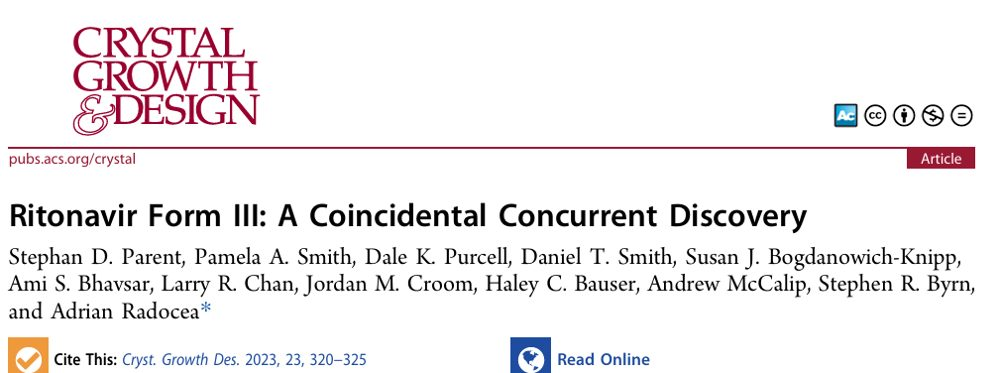
Crystal forms can surprise you: ritonavir Form II appeared in 1998 and Form III was reported in 2023

Debate – MANUFACTURING COSTS: best argument for each side?
Crystalline (strong ground)
Better flow for tableting and encapsulation; consistent particle size; manageable compression (slide 15)
No polymers, no specialised drying; less moisture protection; simpler packaging and stability testing
Amorphous (counter)
Concedes: requires specialised processing (spray-drying, freeze-drying, polymer carriers)
But a cheap product that isn't absorbed has no value – the cost is justified when amorphous is the only way to reach therapeutic levels
Crystalline failures are expensive: ritonavir meant a recall, manufacturing shutdown and reformulation (a headline on slide 21 puts it at $250 million)

Debate – OPENING STATEMENT for the crystalline team.
“Crystalline forms are the reliable foundation of oral medicines. Their ordered, repeating lattice makes them thermodynamically stable, less likely to degrade and less moisture-sensitive, giving a long, predictable shelf-life. They flow and compress well, so they are cheaper and simpler to manufacture. Their solubility is predictable, and when it's too low we can use salts, co-crystals or a different polymorph without giving up stability. And polymorphs and co-crystals can be patented.”
Debate – OPENING STATEMENT for the amorphous team.
“A medicine that doesn't dissolve doesn't work. With no long-range order and higher internal energy, amorphous drugs have higher solubility and faster dissolution, which means improved bioavailability – the key for poorly soluble drugs. Modern amorphous solid dispersions use polymers like PVP and HPMCAS that hydrogen-bond with the drug to suppress recrystallisation. Marketed products such as itraconazole (Sporanox®) show it works, and even ritonavir needed amorphous formulations to recover solubility.”
Debate – what are each side's WEAKEST points, and how do you defend them?
Crystalline weakness: solubility & bioavailability
Defend: salts, co-crystals, particle size reduction, polymorph selection; crystalline gives predictable “bioavailability control”
Concede: for very poorly soluble drugs, these may not be enough
Amorphous weakness: stability & cost
Defend: polymer stabilisation (ASDs), packaging, established spray-/freeze-drying; benefit outweighs cost
Concede: shorter shelf-life risk and specialised processing are real

Debate – balanced verdict: which form for a new oral medicine?
It depends on the drug – there's no universal winner:
If solubility is adequate → choose the most stable crystalline form (identified by polymorph screening): stability, easy manufacture, predictable performance, patentable
If poorly soluble and bioavailability-limited (and salts/co-crystals don't fix it) → amorphous, usually as a polymer-stabilised ASD, accepting extra processing and stability controls
Either way, solid-state characterisation and polymorph screening are essential – ritonavir shows what happens without them.
Debate – quick summary: who wins each criterion?
Criterion | Usually favours | Why |
|---|---|---|
Solubility | Amorphous | No lattice; higher energy |
Stability | Crystalline | Lowest energy; less moisture uptake |
Bioavailability | Amorphous* | Faster dissolution (*for poorly soluble drugs) |
Patenting | Crystalline | Polymorphs, co-crystals patentable; ASDs = formulation IP |
Manufacturing cost | Crystalline | Good flow/compression; no specialised processing |
What is a pharmaceutical polymorph?
Same molecule → different crystal arrangements. Same chemical composition, different crystal structure.
The molecular formula, atomic make-up and chemical identity do not change – only the crystal arrangement does.

Which properties can differ between polymorphs, and why does it matter?
Solubility
Stability
Melting point
Compressibility
So polymorphism has major regulatory and manufacturing relevance.

Why is polymorphism important in pharmaceuticals?
It can affect drug performance and bioavailability. It does not change the chemical identity, prevent manufacturing or eliminate dissolution – but a different polymorph can dissolve and be absorbed differently.
What does “Form I” mean?
A specific crystalline phase (polymorph) of an API.
A drug can exist in different crystalline structures (polymorphs), designated by Roman numerals: Form I, Form II, etc.
Which polymorph is generally the most stable, and what's the catch?
The form with the lowest energy.
Catch: the most stable form is usually the least soluble. Ritonavir Form II was more stable and much less soluble.

Ritonavir (part 1): what was the original product?
In 1996, Abbott Laboratories introduced ritonavir (Norvir®) as a life-saving HIV medication.
It was formulated as a semi-solid capsule containing an ethanolic solution of the drug.

Ritonavir (part 2): what went wrong in 1998?
Unexpected change: in 1998 the drug began to fail quality control tests
The capsule contents developed a white paste with sharp, needle-like crystals instead of the expected gel
Discovery of Form II: a new, more stable crystal form
Form II had much lower solubility and was ineffective when it appeared in the original formulation

Ritonavir (part 3): consequences and resolution.
1998 recall – the original formulation was unusable
Manufacturing shutdown and reformulation
Resolved when Abbott reformulated the drug to be stable in Form II and launched a new soft gelatin capsule
Partly amorphous formulations were also used to recover solubility
A further form, Form III, was reported in 2023

Ritonavir: what are the key lessons?
Discovery of a new stable polymorph (Form II)
Same drug, different crystal forms (polymorphism)
Form II: much lower solubility → capsules failed
Led to manufacturing shutdown and reformulation
Changed industry practice: extensive polymorph screening & solid-state control

What is the aim of polymorph screening?
Identify (discover) all relevant solid forms of an API
Investigate (characterise) their properties – solubility, stability, melting point, compressibility
Choose the optimal crystalline form for development
It does not change the drug's structure.
Why is polymorph screening so important in drug development?
Polymorphism control is exceptionally important
Screening can help prevent new drug forms appearing in the later stages of development (or after launch)
Protects bioavailability, stability and manufacturing; polymorphs have major regulatory relevance
Supports IP: polymorphs and co-crystals can be patented
The ritonavir crisis made extensive screening standard practice
What can happen if a stable polymorph is NOT found during development?
Unexpected changes in drug performance. A more stable, less soluble form may appear later → failed QC, recalls, shutdowns, costly reformulation and supply problems for patients. Ritonavir is the classic example.
Which analytical technique is commonly used to identify polymorphs?
X-ray powder diffraction (XRPD). Not UV-Vis, flame photometry or titration – those measure chemical identity/amount, which is the same for all polymorphs.
