1. Nutrition & Diet Quality
 Call Kai
 Learn
Learn Practice Test
 Spaced Repetition
 Match
Match Flashcards
 Knowt Play
1/53

There's no tags or description
Looks like no tags are added yet.
Name | Mastery | Learn | Test | Matching | Spaced | Call with Kai | Chat |
|---|
No analytics yet
Send a link to your students to track their progress
54 Terms
What is Nutrition?
Study of nutrients found in foods and the bodys handling of them: 1. ingestion 2.digestion 3. absorption 4. transportation 5. metabolism 6. storage 7. excretion
What are nutrients?
Substances found in food and used in the bodys to promote growth, maintenance, and repair of tissues
What are essential nutrients?
Nutrients the body cant make, or does not make in suffiucent quailities.
what is the criteria for essential nutrients?
have identified biological function 2. absence of the nutrients must lead to observable symptoms 3. if you give the body nutrients before any physical damage, then reverse to deficency symptoms happen
uncapitalized calorie energy ? 1 calorie =
energy to raise 1g (1 ml) at 1 degree celcius. = 20 drops of water
Capitalized calorie? 1 Calorie =
energy it takes to lift 1 kg water at 1 degree celcius. one water bottle
what is the amount of kcal in calories?
1000 calories = 1 Calorie = kcal
what are nutrient-dense foods
have high levels of vitamins & minerals
non-energy dense foods
lots of kcal & few micronutrients per unit weight. like potato chips
what are the 6 classes of nutrients?
carbohydrates 2. lipids 3. proteins 4. vitamins 5. minerals 6. water
Carbohydrates (acronymn, kcal/g, major or minor source energy?
cho, 4kcal/g, major source (except for fibre)
Lipids (acronymn, kcal/g, major or minor source energy?) also what type of fatty acids are there?
FAT, 9kcal/g, major source. fatty acids→ essnetial fatty acid AND non-essential fatty acid
proteins (acronymn, kcal/g, major or minor source energy?) also what type of amino acids are there?
pro, 4kcal/g, minor energy source. amino acids → essential amino acids (aa) AND non-essential amino acids. PROTEINS ARE GREAT FOR MAKING OWN PROTIEN (AMINO ACIDS)
what do carbohydrates, lipids, and proteins all have in common?
they are all ENERGY YIELDING NUTRIENTS
what are micronutrients?
vitamins & minerals
what do vitamins, water and minerals have in common
they are non energy yielding nutrients
vitamins (acronymn, kcal/g) are they organic or inorganic?
VIT, 0kcal/g. organic
minerals (acronymn, kcal/g) are they organic or inorganic?
MIN, 0kcal/g inorganic
what are the 4 FAT soluable vitamins? what are the 9 water soluable vitamins? what do B vitamins act as
FAT: A, D, E, K. WATER: 8 B-VITAMINS, 1 C-VITAMIN. B vitamins act as co-enzymes
what are the major and trace minerals? how much trace is needed a day (if u remember major, it can be easier on tests)
major: Na, K, Chloride, P, Mg, S. trace less than 100 mg/day: Fe, Zn, Selenium, Iodide, Cu, flouride, chroimum, manganese
what do minerals do, and what is the difference of them when they enter and leave the body
act as co-factors (activates enzymes) and the way they are consumed they will leave the body same as well. they dont break down.
is water a micronutrients and what are some function?
not a micronutrients. it brings nutrients to cells, permits reaction to occur.
what are the 6 nutrient reference values?
EAR (estimated average requirement) 2. RDA (Recommended Dietry Allowance) 3. AI (Adequate intake) 4. UL (Tolerable Upper Intake Level) 5. EER (Estimated Energy Requirements) 6. AMDR (Acceptable Macronutrient Distrubution Range)
What is the purpose EAR and what is it (Estimated Average Requirement)?
acts as middlepoint baseline to calculate RDA. its the ESTIMATED intake value to meet 50% of age/gender specific in HEALTHY population group.
what is the RDA and what is it determined EAR (Recommended Dietary Allowance)
It was average daily dietary intake level sufficient to meet nutrient requirement of 98% HEALTHY population. determined thru EAR.

what is the AI and what is it correlation to EAR & RDA? (Adequate Intake)
recommended average daily nutrient level that is assumed to ensure nutritional adequecy for health population. correlation: if scendific isnt enough to prove EAR, AI is used.since EAR is used for RDA, AI REPLACES RDA
what do RDA, EAR, AND AI STAND FOR
Reccomended Dietary Allowance, Estimated Average Requirement, Adequate Intake
What is UL, and some important info about it
maximum level of daily nutrients intake that is unlikely to pose risk of adverse health effects to ALMOST all healthy individuals. important: only set with SCENTIFIC evidence, items that can cause toxicity have ULS
Obersve.
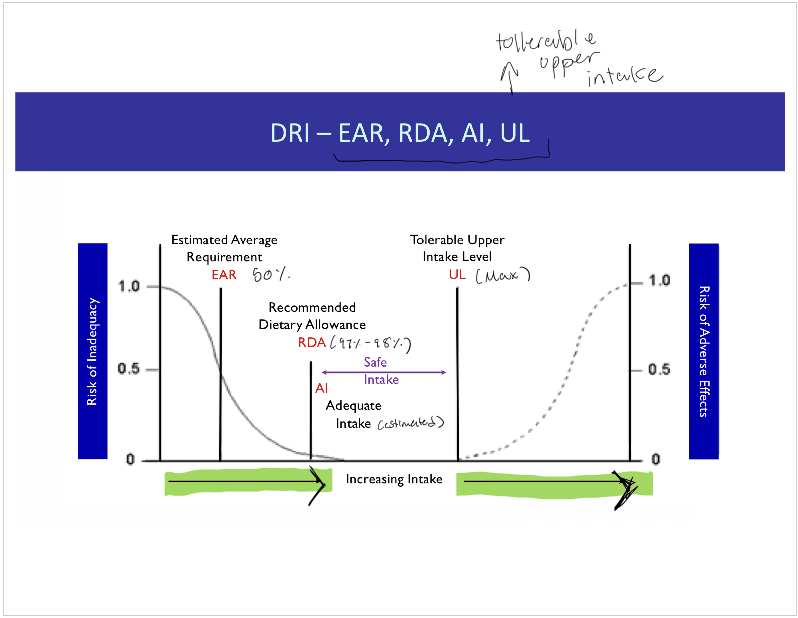
how are nutrient RDA values different from nutrient AI values?
RDA values are avergae daily goal values, but AI values are not
What is EER and its purpose
Estimated Energy Requirement. it is dietry energy intake that predicted to maintain enegery balance consistent with good health (+-20).

what is difference between EAR and EER?
EAR: nutrients EER: energy
What is AMDR and what is the purpose? also list percentages
Acceptable Macronutrients Distribution Range. It is the percentage of EACH macronutrients of total energy intake. carbs : 45%-65%. lipids: 20%-35%. protein 10%-35%.
What are the 6 principles for planning a Healthy Diet?
Adequacy 2. Balance 3. kCal Control 4. Nutrient Density 5. Moderation 6. Variety
Why is adequecy, Balance, and kCal control. in diet
provides essential nurtients in amounts to maintain health 2. eat foods respect to their ratio: veggies 50%, fruits 25%, whole grain 25%, protein food. 3. kCal controt: not too much or not too little eating. consume appropriate kcal.
What is Nutrient Density, Moderation, Variety. for food choices
choose high density foods (high in macronutirents like banana over potato chips). 2. moderation: regulate to not overconsume one food. 3. VARIETY!!! have diverse food choices. MOST IMPORTANT
canada’s food guide:
1. eat plenty of veggies, fruits, some whole grains & protein food. (plant based best) 2. eat variety food 3. mindful eating habits 4. enjoy 5. food labels 6. limit processed foods
what must be included in a nutrional facts table?
Specific amount of food 2. % daily value (DV). 3. 12 core nutrients + Calories 4. list of food alergions

what are the exceptions to nutrional facts tables?
not on every individual package 2. fruits, veggies, etc. 3. foods that contain few nutrients (=0) 4. packaged at store
what are NFT serving sizes
regulated amount within a specific range for each type of food. cant have different, has to use reference amount
what are %dv and what kcal are they based on?
%dv are based on 2000kcal diet, are used to compare similair foods.
how are sugars added in NFT label
added and free (naturally present) together
how much is a little %DV and how much is a lot?
5% a little, 15% a lot.
What order is the ingredient list listed in, and what is needs to be listed
descending order by weight, 10 common food allergons, a source of nutients and non-nutrient info.
what are 10 common food allergons? are they seperate or together with ingredients
seperate. 1. eggs 2. milk 3. mustard 4. peanuts 5. seafood 6. fish, crustaceans, shellfish 7. sesame 8. soy 9. sulphites 10. tree nuts 11. wheat
what are fat regulations to claim? (fat free, low fat)
fat free: 0.5g fat/serving less. low fat: not more that 3g fat/serving
dietry fibre claims. (source, high source, very high source)
source: at least 2g (and less than 4g) dietary fibre serving. high source: at least 4g (and less than 6g) dietary fibre serving. very high source (at least 6g dietary fibre)
vitamins & minerals claims. (source, high source, very high source)
source: at least 5% DV per serving. high source: at least 15% DV per serving and less than 25% DV, EXCEPTION VITAMIN C has to be AT LEAST 25% AND LESS THAN 50%. very high source: 25% DV+, VITAMIN C 50%+
disease risk reduction claims are strictly monitored
must be low/free in sodium, and have high potassium