Child Lang Dev (Week 4)
 Call Kai
 Learn
 Practice Test
 Spaced Repetition
 Match
 Flashcards
 Knowt Play
1/27

There's no tags or description
Looks like no tags are added yet.
28 Terms
Phonotactic knowledge:
which sound sequences ur language allows

Define phones, phonemes, & allophones:
Phones: different sounds a language uses [p], [b], [pʰ]
Phonemes: sounds that signal a difference in meaning (/p/ vs /b/ in pat & bat)
Allophones: phones that don’t change meaning ([pʰ]ill & s[p]ill in English)
Berko (1958)
(we follow ‘rules we can’t state’)
bug/z/ vs bike/s/
by age 4: one wug, two wug/z/; tdy I rick, yesterday I rick/t/
Christmas → Kalikimaka
map each consonant onto nearest Hawaiin consonant
insert vowels os every syllable is consonant + vowel
(borrowings reveal phonological knowledge)

Speech articulators:
Lungs: air supply, power source
Velum: down for nasals, up for orals
Lips: close, round, spread
Larynx: (glottis) voicing!! moves up & down
Tongue: (8 muscles)
Jaw
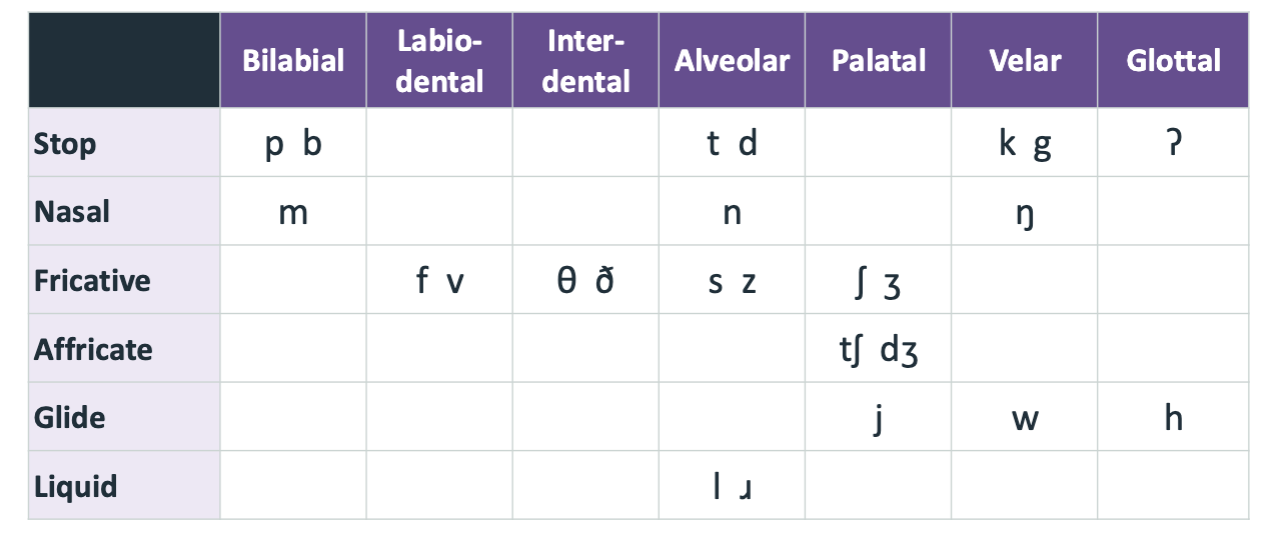
Consonant chart:
Vowel description:

Producing “mama:” the targets
/m/
voiced (glottis vibrate)
bilabial
nasal (velum down)
consonant (oral tract closed, jaw high)
/a/
low: jaw low, tract open
back: tongue body bunched & retracted
voiced
coordinating all this in time is hard

2 kinds of speech movement:
Oscillatory (rhythmic):
breathing, vocal fold vibration, jaw open & close
babies can control first!
Discrete (targeted)
lip closures, tongue placements, velum lower & raise
5 stages of prespeech vocal development:
Reflexive crying & vegetative sounds
Cooing & laughter
Vocal play
Reduplicated (canonical) babbling
Non-reduplicated (variegated) babbling
Crying, cooing & laughter
(birth to 4 months →)
cries & vegetative sounds use voicing & airflow
6-8 weeks: coos vowel-like, social
16 weeks: first laughter
Vocal play: (expansion stage)
(16 - 30 weeks →)
squeals, growls, raspberries
back consonants first ([g], [k]), then front
long series: marginal babbling
not “all sounds of all languages”
Canonical babling:
(6 - 9 mo)
true syllables
consonant + vowel syllables
reduplicated: [bababa]
not aimed at a listener
deaf infants rarely babble canonically
Variegated babbling & jargon:
(10-12 mo)
different syllables strung together [badu]
prosody becomes noticeable
jargon: melody without the words
Consonants make up ____% of what 12-month-olds produce; define protowords:
90%
/h w j p b m t d n k g/
Protowords: child-made words that refer to objects/ppl/actions before they learn the conventional adult way (yumyum for food)
What drives change in speech development?
Biology: (a elongating vocal tract, brain maturation, growing skull)
Experience: (hearing adults, yourself, & contingent social feedback)
Frame/content theory:
(MacNeilage)
Frame: rhythmic jaw oscillation (jaw closed → consonant; jaw open → vowel)
Deaf infants produce silent ‘jaw wags’
Content: discrete lip & tongue targets (layered on frame later)
Predicts about which consonants and vowels go together: ([ba], [di], [gu])

Babbling drift (& listening test vs sound counts): (does ambient language show?)
as early as 6 months, the sounds babies produce are somewhat influenced by the language they hear
Listening test:
Phoneticians: 6 mo
French listeners: 8 mo (~70%)
10 mo: harder (they’ve lost the melody of their language, although they can pronounce consonants better
Sound counts (babbling transcription data):
More nasals: Japanese, French
More alveolars: English
More labials: French
2 languages from birth (babbling):
infants tune to both
stress is harder
can tell the languages apart!
Babbling:
Fusion: one combined system
Autonomous: 2 separate systems
Interdependent: 2 linked systems

Can toddlers recognize familiar words?
Yes!
they notice when baby become vaby; infants catch the differences that matter (distinctiveness (sound change)) and ignore the ones that don’t (constancy (a new voice/accent))
The switch task:
Habituate, switch, test ~ 14 mo: struggled; 18 mo: succeeded
They can differentiate the sounds, but may not process that the sound change matters/is significant or may be overwhelmed with new info

Bilingual toddlers: 1 or 2 sound systems?
2 systems:
around 2, some kids use different sound features in each language
Mixing:
at 3, some words carry sounds from the other language
1 system:
listeners couldn’t tell the language for over 1/3 of 2 yr olds’ words
Hearing, word learning (bih/dih monolinguals @ 17 mo; bilinguals at 20 mo), producing (2 systems mostly separate, but interacting)
First words are full-word representations (not segmented sounds)? (evidence)
Inconsistency: /p/ in purse and pretty come out differently
Phonological idioms: one word sounds adultlike; others with same sounds don’t
Templates: panda → /pajan/
tiger → /tajak/
(Priestly, 1977)
~ 18 mo, errors become systematic
Common phonological processes:
systematic ways in which to alter sounds of target language so they fit repertoire of sounds they can produce
Whole word processes:
weak syllable deletion
final consonant deletion
reduplication
consonant harmony
Cluster word processes:
cluster reduction
Segment word processes:
velar fronting
stopping
gliding
Harmony: duck, doggie, tub, candy; one consonant copies another’s place

Early vs. late sounds (& why?):
2: /b n m p h w d/
3: /g k f t ŋ j/
4: /v dʒ s tʃ l ʃ z/
5: /ɹ ð ʒ/
6: /θ/
WHY:
articulatory complexity, frequency of input, functional load: frequency with which sound is used in target language
Perception ahead of production, with the caveat that some errors may be ______
perceptual
Phonology & vocabulary (which drives which?):
Phonology → words
first words use first sounds, kids pick words the they say, bigger sound inventory = bigger vocab
Words → phonology
more words, more look-alikes (force a phoneme system), 11 mo alr have detail
5 accounts of phonological development:
Behaviorist: imitation + reinforcement
Universalist: innate features, ranked constraints
Biological: motor capacity shapes sounds
Usage-based: categories built from input
Connectionist: weighted links, no rules