Wildlife Behavior: Exam 1
 Call Kai
 Learn
Learn Practice Test
 Spaced Repetition
 Match
Match Flashcards
 Knowt Play
1/56

There's no tags or description
Looks like no tags are added yet.
Name | Mastery | Learn | Test | Matching | Spaced | Call with Kai | Chat |
|---|
No analytics yet
Send a link to your students to track their progress
57 Terms
Lady Liuwa - example study
Lion recovery in Liuwa Plain
Male lion reintroduced in 2009
•Re-establish a self-sustaining
lion population in the park.
•Implemented primarily through
reintroductions. Two males
initially reintroduced.
•Successful reproduction is key
to increasing population.
•Community outreach and
conflict mitigation will be critical
to the success of lion
management.
Lion Behavior
Live in prides of typically 3-12 adult females, 1-6 adult males, and several cubs
All females in a pride are related; all born and reared in the pride and stay there to breed
Males leave their natal pride at 3 years (usually in small group. Nomadic, then take over a pride for 2-3 years, then driven out by new males
Females are synchronous in oestrus:
Different litters born at the same time have higher survival due to communal suckling
It also ensures that a young male will have a companion when it reaches the age it leaves the pride and greater likelihood of future pride take-overs
Lions exhibit high rate of copulation, but low birth rate
Females in ‘heat’ 2-4 days each month (when not pregnant) and copulate once every 15 minutes throughout the day and night.
Unsuccessful matings due to high probability of ovulation failure
Copulation is devalued: because of 1:3000 chance, male in-fighting reduced; and multiple matings increase paternal uncertainty
Young die when new males take over a pride (infanticide)
Advantage for a new male is that
killing the cubs fathered by a
previous male brings the female into
oestrus much quicker. Genetic ben.Contributes to reproductive
synchrony because all offspring are
killed.Heightened sexual activity after a
take-over leads to competition
among male coalitions for control of
the pride. This eventually leads to
larger coalitions becoming resident.
Larger coalitions stand a greater
chance of being in pride for >2
years (time needed to raise cubs).
Behavior - conservation interface: List
fragmented habitats
responses to exploitation and disturbance
spread of disease
effective population size
Behavior - conservation interface: Fragmented habitats
Principal cause of species’ extinctions is habitat loss and fragmentation
Behavioral info on ranging behavior, dispersal distances, influence of social and landscape factors on individual movements, for example needed to evaluate respones to fragmentation
Example: carnivores in coastal California
Behavior - conservation interface: Responses to exploitation and disturbance
population respones to exploitation are a focus of conservation and management
Behaviors such as mating systems can dramatically affect populatoin growth rates under certain forms of exploitation
Example: in infanticidal species, male off-take leads to increased rates of offspring mortaliry with new males move in to fill vacancies (not always lions)
Behavior - conservation interface: spread of disease
can quickly reduce a population to individuals
Examples: island foxes, black-
footed ferrets, lions, and
Ethiopian wolves (Haydon et
al. 2006).Rate of disease spread
depends on the proportion of
susceptible, infectious, and
recovered individuals, which
depends on the degree of
grouping and individual
movements
Behavior - conservation interface: effective population size
Ne approximates number of
breeding individuals and can
be defined in terms of
demographics or genetics.
•Number of breeders is
influenced by mating system,
population and age structure,
and maternal/paternal
certainty.
•Example: social organization
greatly affects Ne in wild dogs
(Creel 1998). What is Ne and
how can you estimate it?
Ne
the size of the ‘ideal’ population of an actual population (Hardy-Weinberg equilibrium); or stated another way, the number of individuals that will contribute genes equally to the next generation; characterizes the genetic state of a population
(even having many individuals, effective population size may be fewer)
Hardy-Weinberg principle
If you have a large population with random mating, and no agents of evolution acting on the population, then genotype frequencies will remain constant from one genertation to the next
Hardy-Weinberg equilibrium formula
P2 + 2 Pq + q2
P = A1
q = A2
(results in getting a baseline of whats normal to compare how its being effected with field data)
Ideal population has the problems of…
Imbreeding
Effects genotype frequencies (how common certain genotypes are)
Reduces heterozycesity
Genetic Drift
Effects allele frequencies
Agents of evolution
Natural selection
Mutations
Genetic Drift
Gene Flow
Behavior - conservation interface: captive breeding and reintroductions
Captive populations
provide useful tools
for species
conservation.
•Provide a source for
reintroductions and
information on
biology.
•Examples: whooping
cranes, California
condors, bald ibis.
Behavior - conservation interface: monitoring and predictive tools
Behavior data often guides
conservation monitoring
strategies.
• Ranging patterns, breeding
times and breeding
locations affect spatial and
temporal aspects of
population censuses.
Patterns of vocalizations
can be used to assess
population sizes.
• Example: swift fox
vocalizations (Darden et al.
2003).
Behavior and survival Ne formulas: 1. population fluctuations
Harmonic mean —> applied to cases with a rate of something over time
Formula = t / ( [1/N1] + [1/N2 ]+… [1/Nt] )
Behavior and survival Ne formulas: sex ratio
Ne = (4 Nf x Nm) / (Nf + Nm)
Nf = number of females
Nm = number of males
Behavior and survival Ne formulas: uneven reproductive output
Ne = (k [Nk - 1]) / (Vk + k [k - 1])
k = average # of offspring per parent
V = variance in that (k’s) average
SD involved? idk
Four main questions for behavioral researchers according to the Niko tinbergen (paraphrased)
How does the behavior promote an animal’s ability to survive and reproduce? (adaptation)
How does an animal use its sensory and motor abilities to activate and modify its behavior patterns? (causation)
How does an animal’s behavior change during its growth, especially in response to the experiences that it has while maturing? (development)
How does an animal’s behavior compare with that of other closely related species, and what does this tell us about the origins of its behavior and the changes that have occurred during the history of the species (evolutionary history)
Why may you want to imbreed? (ex. African Wild Dogs)
pattern = optimal imbreeding
tends to surface really harmful alleles
those animals will die/not reproduce, exspanging them from population
Tradeoff = low genetic diversity
Proximate cause
an immediate, underlying cause based on the operation of internal mechanisms possessed by an individual
Ex. when hand slaps table suddenly, you jump
Ultimate cause
the evolutionary, historical reason why something is the way it is
Ex. when hand slaps table suddenly, why jump, shake, haert drop?
Proximate versus ultimate cause in lion behaviors table:

Anti-predator behavior
A behavioral adaptation for survival
can result in substantial impacts on the landscape, and as such are central to managing species and ecosystems
the role of predators in shaping the behavior of prey in the Yellowstone system provides and excellent example
Specifically, the extirpation and reintroduction of wolves in Yellowstone National Park resulted in changes in elk numbers and behavior, which affected plant and animal communities at lower trophic levels.
Two types:
those that help prey avoid detection by predators
those that function once prey encounters a predator
trophic cascade
progression of indirect effects by predators across successively lower trophic levels
Wolves were extirpated from Yellowstone in the
1920s and remained absent for ~70 years. What
effects did the removal of wolves have
Increased elk numbers and movement into
lower, riparian areas.
• Decreased aspen, willow, and cottonwood
recruitment.
• Reduced beaver and bird populations
Wolves were reintroduced to Yellowstone in
1995/1996. What effects did this have?
Changes in elk behavior – ‘predation risk
effects’, foraging in different habitats, and
reduced elk numbers.
• Release of aspen, willow, and cottonwood
from browsing pressure.
• More beaver colonies and bird diversity.
Predation risk effects
Lost foraging opportunities and reduced growth and reproduction experienced by prey investing in anti-predator behavior
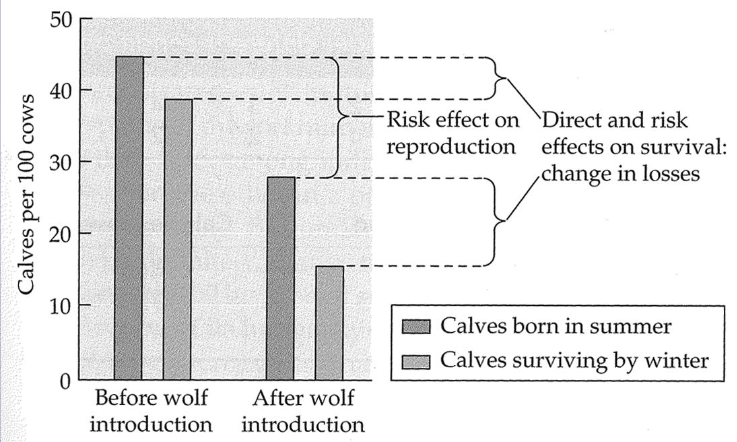
Anti-predator behavior: Avoiding predators
avoid predators can decrease not only the probability of being captured and eaten but also the costs associated with fleeing, fighting, back against a predator, and so on.
Three primary ways:
Blending into the environment
cryptic, changing color, blending into habitat
Ex: Common potoo (nightjar type bird)
Being quiet, Being vigilant
sound sppression
Ex: Gulf toadfish
Head up, eyes and ears open, try to detect predator
Choosing a safe habitat
Slow predation risk limits potential encounters, loss of better food, trade off of lower quality food = less predators
Ex: Baboons
Moose and human shields example
when moose give birth more proximate to roads, bears don’t like roads that much
In the Yellowstone Ecosystem, researchers
studied the 9-day synchronicity in which
90% of moose neonates are born (1995-
2004).
• Birth sites shifted away from traffic-averse
brown bears and toward paved roads.
Behavioral shift toward road associated
with carnivore recolonization.
• Mothers in bear free and non-parous
females did not alter habitat use.
• Moose use humans to shield against
carnivores. Result: redistribution of
species in community.
• Predation risk effect?
• Conservation implications?
• Control? Other factors?
Anti-predator behavior: What to do when prey encounter predators
There are six primary anti-predator actions:
Fleeing
most common response, flee to safety
top factor for fleeing is refuge distance
Feigning death
faking death
Ex: Virginia opossum
Signaling to the predator
Transmit signals to predator for probability of catch or consequences
Ex: warning coloration in monarch butterflies
slotting in Thomson’s gazelles —> most likely the largest benefit being predator detection
Approaching a predator to obtain information
allows prey to gather important info, intimidation effect
Ex. Thomson’s gazelle, as group size increases, prob of approaching cheetah increases and more prob of cheetah walking away increases
Attacking
Fight back, attack, direct means of reducing likelihood of mortality
Ex: Chemical defense in beetles, mobbing behavior in birds/meerkats
Alarm calling
Calling out, screaming, alert others, threaten predators
Ex: Meerkats —> pups learn what to alarm for
Deceptive alarm calls —> Ex: vervet monkey, use during intergroup encounters, entering new group
A priori
“beforehand”
customized set of hypothesiezes before going into the field, based on prior knowledge
Logit link function
= EXP (model) / (1 + EXP [model] )
model —> (Beta1 + Beta2 * variable)
This function is used to find probability
likelihood: excel
= IF (occupancy variable = 1, probability, 1 - probability)
Ex:
=IF(B6=1, D6, 1-D6)
AIC weight equation
exp(-0.5*delta AIC for a given model) / sum of all exp(-0.5*delta AIC) values across all models
AIC weight is telling you the weight of evidence that what model is the best in a group
All weights will sum up to 1, 99% of weights in data suggest that is your model, less than 1% of weight suggests that those models are not good
LnL: excel
= LN (likelihood)
Ex:
=LN(E6)
linear model:
y = m*x+b
b= intercept (parameter)
m= slope (effect size parameter)
x= any given variable value
A ‘beta’ is a parameter estimate
Rewriting the model:
Probability of sotting = βintercept + βgrass slope * x
AIC stands for… and the equation is…
Akaike’s information criterion
-2LnL + 2k
opportunity cost
The time lost that could otherwise have been devoted to other activites (e.g., foraging, mating, resting)
Model set development
a priori vs all subsets
Altruism
Acting to increase another individual’s lifetime number of offspring at a cost to one’s own survival and reproduction
Kin selection
a form of natural selection that favors altruistic behavior toward close relative resulting in an increase in the altruistic individual’s genetic contribution to the next generation
The three types of fitness and what they mean:
Direct fitness
the component of fitness gained through personal reproduction (i.e. production of offspring)
Indrect fitness
the component of fitness gained from aiding the survival of non-descendant kin, such as siblings
Inclusive fitness
the fitness gained through both direct and indirect fitness
Coefficient of relatedness: Use
A measure of relatedness ( r ) that is the probability that an allele in one individual is an identical copy (by descent) of an allele in another individual
at each generation, there is a meiosis and so 0.5 probability that copy of a particular allele will get passed on
Range of values = 0 to 1

Coefficient of relatedness: Equation
∑ (0.5)n
n = # of links between individuals
∑ = sum, number of pathways a gene could flow
Coefficient of relatedness: Collateral relationship
path: back against the arrows from one relative to the common acnestor, then follow the arrows forward to the other relative
An individual should only occur in the same path once

Hamilton’s Rule
More benefit relative to cost if there is relatedness
(B/C) > (1/r) OR rB - C > 0
Costs: C
Benefits: B
Costs and benefits are often measured in terms of offspring lost and gained
(B/C) > (r donor to own offspring / r donor to recipient’s offspring)
Essentially, example is helping sister to produce offspring would only help me if she produced MORE than 1 offspring (helping would evolve only if it resulted in greater than 2 extra offspring produced by the sister for every one offspring lost by the donor)
How do individuals recognize kin?
Hamilton’s theory of kin selection requires an individual to behave
differently towards individuals of different degrees of relatedness, and
this could involve assessing relatedness to other individuals.
There is a rapidly growing body of evidence that individuals can
recognize kin and even distinguish close kin from distant kin.
simple rules
imprinting
phenotype matching
Kin selction: simple rules
‘treat anyone in my
home as kin’. Parent birds, for
example, may ignore their own young
if they are placed just outside the rim
of their nests, yet will readily accept a
strange chick placed inside their next.
Example: reed warblers
(Acrocephalus scirpaceus) will mob
an adult cuckoo (Cuculus canorus),
which approaches its nest and then, a
minute later, return to feeding a baby
cuckoo inside its nest.
Usually, this simple rule will lead
individuals to care for their own
offspring
Kin selection: Imprinting
Learning that those you grow
up with are kin. Lorenz coined the term
to describe the phenomenon observed in
young geese, of following the first
conspicuous moving object they see after
hatching. Usually this will be their
mother and so result in them following
someone who will keep them warm and
protect them.
Example: ground squirrel experiments by
Holmes and Sherman (1982) indicated
that sibling recognition in ground
squirrels is in part based on association
in the natal nest.
• Sibs reared by one mother
• Sibs reared apart by different mothers
• Non-sibs reared as a single litter
• Non-sibs reared apart
Kin selection: Phenotype matching
A situation in
which an individual may be most altruistic
to those that are phenotypically similar
(e.g., matching odors).
Example: ground squirrel females mate
with up to 8 different males and have
mixed-paternity litters (78% of litters sired
by more than one male).
Littermates who where full sisters were
less aggressive to one another and more
cooperative than half-sisters in a litter –
e.g., when establishing nest burrows and
defending territories full sisters fought and
chased less often when they encountered
each other than did half-sisters. Sisters
identified one another through phenotype
characteristics.
Altruism among unrelated individuals evolution: Hypothesises
Mutualism
benefical for +2 individuals to cooperate bc each gains a net survivial or reproductive beneift from doing so
Ex: Pied wagtail —> improved territory defense outweigh the costs of having to share the food
Manipulation
A situation in which altriusim on the part of the donor is due to manipulation by the recipient
Ex: Cuckoos
Reciprocity
You help me, I help you. As long as help is reciprocated at some point, both gain
The ‘Prisoner’s Dilemma’ model used to evaulate human behavior often used to assess cooperative beahvior among animals
Ex: Vampire bats and blood!
Home range
The area traversed by the individual in normal activites of food gathering, mating, caring for young
Territory
Any area that an animal consistently defends against conspecifics (and sometimes animals of other species)
Nomad
Individuals who lack a home range or territory and who rarely frequent the same area over time.
Rarely happens
Ex: Secretary bird
How to define a home range? The two methods:
Minimum Convex Polygon estimator (MCP)
Kernel density estimator (KDE)
Minimum Convex Polygon estimator (MCP)
Easiest, angular shaped, rubberband around pins!
Pure geometry
Polygon that connects all outer most points (of an individuals range)
called 100% mcp
Cons:
sensitive to outlyers
can include a lot of non-habitat
does not take into account the intensity of use
can used 95% mcp (remove 5% of outer most points, then wrap)
In the point samples, find the geometric center, measured to all points, then 5% that are farthest away are removed
Polygons on outside called “hull” or “Isopleth” (or “contour”)
Edge effect issue, neglects elements just beyong polygon
Can have variations: min. concave polygon, ducking in from outer point to outer point
Kernel Density estimator (KDE)
Most common
Relies on probability
Builds home range based on if animal is wthin that polygon or not
Bivariate normal distribution on every point, center of point is highest chance of animal in habitat, as you go out, less likely
Ultization distrubution (UD) —> areas of high and low use