GENETICS FINAL EXAM!!! (Week 1)
 Call Kai
 Learn
 Practice Test
 Spaced Repetition
 Match
 Flashcards
 Knowt Play
1/50

There's no tags or description
Looks like no tags are added yet.
51 Terms
D. All organisms will have the same number of genes.
All organisms share a common coding system for their genomic information. The common features of heredity imply all of the following EXCEPT
A. All life forms on Earth share a common ancestor.
B. The study of one organism’s genes often reveals principles that
apply to other organisms.
C. Genes from one organism will often function in another organism.
D. All organisms will have the same number of genes.
E. None of the above are implications of a shared coding system.
B. False
Recent discoveries in genetic engineering allowed humans to alter the genome of plants
(crops) for the first time.
A. True
B. False
B. Discovered the principles of heredity by crossing different varieties of pea plants and analyzing their traits in subsequent generations.
Gregor Mendel is generally recognized as the father of genetics because he
A. Generated new varieties of pea plants by random crosses of natural varieties.
B. Discovered the principles of heredity by crossing different varieties of pea plants and analyzing their traits in subsequent generations.
C. Discovered which genes were responsible for the inheritance of specific traits.
D. Both B and C are correct.
E. All A, B and C are correct.
1, 2 and 4

Which of the following are features of heredity that would help explain these results?
Traits are passed from parents to offspring as distinct units of heredity that do not blend together.
The units are not lost, but their presence can be obscured or hidden.
Each offspring receives units from the fittest parent.
Each offspring receives one unit from each parent.
2 and 4
Only 4
1,2 and 3
1, 2 and 4
C. Plant height is the trait, and tall and short represent different phenotypes associated
with this trait.
Mendel observed both tall and short pea plants. Which statement correctly describes the genetic terminology we would use today?
A. Tall and short are two different genes, and plant height represents an allele of each of
these genes.
B. Plant height is an allele, while tall and short represent different genes inherited
from the two parents.
C. Plant height is the trait, and tall and short represent different phenotypes associated
with this trait.
D. Tall and short are two different traits, while the gene represents the phenotype observed in each plant.
B. Short generation time, many offspring, and easy maintenance in the laboratory.
A research laboratory is searching for a new organism to use in genetic studies. Which of the following characteristics would make an organism MOST useful as a model organism for genetics research?
A. Long life cycle, many offspring, and highly specialized environmental requirements.
B. Short generation time, many offspring, and easy maintenance in the laboratory.
C. Large body size and complex behavioral traits.
D. Slow development and limited genetic variation.
B. False
Bacteria and Archaea are interchangeable names to describe the same type of organisms.
A. True
B. False
B. Cell B
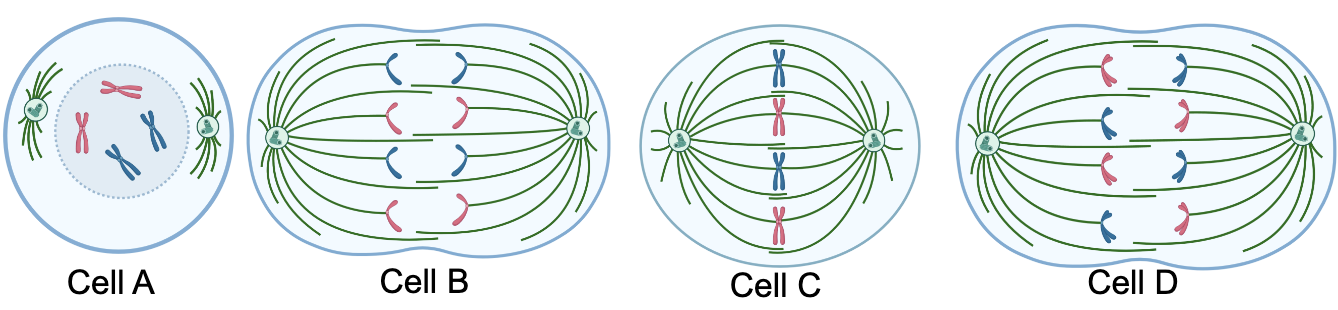
Which of these four cells is in anaphase of mitosis?
A. Cell A
B. Cell B
C. Cell C
D. Cell D
A. The cell contains two sets of each chromosome.
A scientist is studying a cell and determines that it is diploid. Which of the following conclusions can be made based on this information?
A. The cell contains two sets of each chromosome.
B. The cell contains two homologous chromosomes.
C. The cell contains two chromosomes.
D. Each chromosome in the cell contains two sister chromatids.
E. Each chromosome in the cell contains two copies of every gene.
E. Meiosis involves two divisions and produces genetically variable cells with half the chromosome number.
Which of the following statements BEST distinguishes meiosis from mitosis?
A. Meiosis produces genetically identical daughter cells through a single division.
B. Mitosis reduces chromosome number by half, whereas meiosis maintains chromosome number.
C. Mitosis and meiosis both produce haploid daughter cells.
D. Meiosis occurs without DNA replication prior to division.
E. Meiosis involves two divisions and produces genetically variable cells with half the chromosome number.
A. Bacteria have no histones associated with their chromosomes and the other two groups do.
Which statement is characteristic of the bacteria and makes them different from both the archaea and the eukaryotes?
A. Bacteria have no histones associated with their chromosomes and the other two groups do.
B. Bacteria do not have a nuclear envelope and the other two groups do.
C. Bacteria have multiple chromosomes and the other two groups have single chromosomes.
D. Bacteria require mitosis for cell division and the other two groups use binary fission.
E. Bacteria have linear chromosomes and the other two groups have circular chromosomes.
Which of the following statements best describes the cell below?
A. This cell has 2 chromosomes.
B. This cell has 2 sister chromatids.
C. This cell has 4 pairs of chromosomes.
D. This cell is in prophase.

E. Usually have the same genes in the same order as each other.
Which of the following is TRUE about homologous chromosomes?
A. Usually are identical.
B. Are present only after S-phase.
C. Are always composed of two sister chromatids.
D. Are attached to a single centromere in Metaphase I.
E. Usually have the same genes in the same order as each other.
D. The cell still contains 4 chromosomes, but each chromosome now consists of two sister chromatids, for a total of 8 DNA molecules.
The diploid cell below (same as your worksheet) contains 4 chromosomes during G1 of interphase. Which of the following statements correctly describes the cell after S phase but before mitosis begins?
A. The cell contains 8 homologous chromosomes arranged into 4 pairs.
B. The cell contains 4 DNA molecules because chromosome number and DNA amount remain unchanged during S phase.
C. The cell now contains 8 chromosomes because DNA replication doubles chromosome number.
D. The cell still contains 4 chromosomes, but each chromosome now consists of two sister chromatids, for a total of 8 DNA molecules.
B. Haploid gametes ; Half
Meiosis produces ________, which contain ________ the genetic material of the original diploid parent cell.
A. Diploid somatic cells ; Twice
B. Haploid gametes ; Half
C. Sister chromatids ; Identical
D. Haploid somatic cells ; Half
E. Diploid gametes ; Half
C. Homologous chromosomes; Sister chromatids
In summary, Meiosis I separates _____ while Meiosis II separates _____
A. Homologous chromosomes; Homologous chromosomes
B. Sister chromatids; Sister chromatids
C. Homologous chromosomes; Sister chromatids
D. Sister chromatids; Homologous chromosomes
C. 3.82 x 10^12 Daltons
The haploid amount of DNA in a human cell is 1.91 x 10^12 Daltons. How much DNA (in
Daltons) do you expect to find after telophase and cytokinesis of Meiosis I?
A. 3.82 x 10^13 Daltons
B. 7.64 x 10^12 Daltons
C. 3.82 x 10^12 Daltons
D. 1.91 x 10^24 Daltons
E. 3.82 x 10^24 Daltons
F. 0.95 x 10^12 Daltons
F. Only B and C are correct.
What are the overall consequences of meiosis?
A. Four daughter cells are identical to the parental cell.
B. The chromosome number is reduced.
C. The daughter cells are genetically different from each other.
D. Sister chromatids recombine.
E. All of the above are correct.
F. Only B and C are correct.
A. The tan seed phenotype is dominant.
A scientist crossed a stock melon plant that produced tan seeds with a plant that produced red seed. All 13 offspring produced tan seeds. What can you conclude from these data?
A. The tan seed phenotype is dominant.
B. The red seed phenotype is dominant.
C. Both parents were heterozygous for the seed color phenotype.
D. This is a typical example of a dihybrid cross.
D. A and B
If tan seed color (S) is dominant over cream (s), what is/are the possible genotype(s) that tan seeds could have?
A. SS
B. Ss
C. ss
D. A and B
E. A, B and C
D. 3/16
The probability that a plant is tall is ¾. The probability that a plant has purple flowers is ¼. What is the probability that a plant is tall AND has purple flowers?
A. ¾
B. 1
C. ½
D. 3/16
E. 9/16
B. To determine the genotype of an individual.
What is the purpose of a test cross?
A. To determine if an individual is homozygous recessive.
B. To determine the genotype of an individual.
C. To determine the phenotype of an individual.
D. To determine the genotype AND the phenotype of an individual.
B. Dihybrid
9:3:3:1 is the expected phenotype ratio for a __________ cross, assuming complete dominance.
A. Monohybrid
B. Dihybrid
C.Trihybrid
C. Any offspring for whom both parents are F1 individuals.
Which of the following is correctly referred to as an F2 individual?
A. Any offspring of a cross where the genotypes are Aa x Aa.
B. Any offspring who has at least one F1 parent.
C. Any offspring for whom both parents are F1 individuals.
D. Any individual who is heterozygous at the two loci under consideration.
C. 1/2
In guinea pigs, white coat color (w) is recessive to black (W). What is the probability that a heterozygous black guinea pig and a homozygous white guinea pig produce white offspring?
A. 0/4
B. ¼
C. 1/2
D. ¾
E. 4/4
B. Aa
Alkaptonuria results from an allele (a) that is recessive to the allele for normal metabolism (A). Sally is healthy and so is her mom. Her father has alkaptonuria. What is Sally’s genotype?
A. AA
B. Aa
C. aa
D. Homozygous recessive
C. WWhh or Wwhh
In guinea pigs, black coat color (W) is dominant to white coat color (w), and short hair (H) is dominant to long hair (h). You identify a black guinea pig with long hair. Which of the following could represent the genotype(s) of this animal?
A. Wh or Wh
B. WWHH or WwHh
C. WWhh or Wwhh
D. Ww, WW or hh
D. WH, Wh, wH, wh
A guinea pig has the genotype WwHh. Which of the following represent possible gametes produced by this animal?
A. WwHh
B. Ww, Hh
C. W, w, H, h
D. WH, Wh, wH, wh
B. 9/16
What is the probability of getting a round and yellow seed from the RrYy x RrYy cross?
A. 6/8
B. 9/16
C. 3/16
D. 1/16
E. 6/4
E. DdRrbb
Which of the following genotypes could represent a dull, orange and nonbitter plant?
• Dull: D
• Glossy: d
• Orange: R
• Cream: r
• Bitter: B
• Nonbitter: b
A. DDRRBB
B. DdRrBb
C. DDRrBb
D. DdRRBb
E. DdRrbb
B. 9/64
What is the probability of getting a dull, orange and nonbitter seed from the F1 cross?
• Dull: D
• Glossy: d
• Orange: R
• Cream: r
• Bitter: B
• Nonbitter: b
A. 27/64
B. 9/64
C. 6/64
D. 3/64
E. 1/64
E. In many different ways in different organisms.
Sex is determined _____
A. Always by sex chromosomes.
B. Always by a small number of genes on the Y chromosome.
C. Always by the number of X chromosomes.
D. Always by the presence/absence of a Y chromosome.
E. In many different ways in different organisms.
D. Genic sex determination
Some animals and plants do not have sex chromosomes but have genes that determine
sex. This type of sex determination system is known as
A. Heterogametic sex determination
B. Homogametic sex determination
C. Chromosomal sex determination
D. Genic sex determination
E. Environmental sex determination
A. 1
In mammals, how many X chromosomes are active in a single somatic (non-germline) cell?
A. 1
B. 2
C. 1 for males, 2 for females
D. Different somatic cell types will have different numbers of active X chromosomes.
D. Random X-inactivation
The patchy distribution of color on tortoiseshell cats results from…
A. Cats having a single X chromosome
B. Multiple X chromosomes (XXY)
C. A Y-linked color determining gene
D. Random X-inactivation
E. Cats having environmental sex determination
B. Dosage compensation
The modification of the amount of protein produced by a sex chromosome is called __
A. Barr bodies
B. Dosage compensation
C. X-inactivation
D. X-linked expression
E. None of the above
C. Environmental sex determination
Larvae of the green spoon worm Bonellia viridis develop as females when they settle alone, but exposure to a chemical released by an adult female causes larvae to develop as males. What type of sex-determination system is involved?
A. Chromosomal sex determination
B. Genic sex determination
C. Environmental sex determination
D. Both chromosomal and genic
E. Both genic and environmental
C. Female AB and male BB
You discover a new amphibian and name the sex chromosomes A and B. If the female is heterogametic and the male is homogametic, then what would be the chromosome arrangement of sex chromosomes in the adult?
A. Female AA and male BB
B. Female AB and male AB
C. Female AB and male BB
D. Female BB and male BB
E. Female XX and male XY
A. True
An XY individual has only one copy of most X-linked genes. Therefore, an X-linked allele would be expressed in an XY individual even if the allele is recessive
A. True
B. False
B. All progeny with red eyes
Crossing pure-breeding red eye females and white (dominant) males produced
A. All progeny with white eyes
B. All progeny with red eyes
C. Only the females with white eyes
D. Only the males with white eyes
E. Half of the females and half of the males with white eyes
One form of red/green color blindness is inherited as an X-linked recessive trait. Are there any of the offspring from this cross colorblind?
A. Yes, all of the offspring is affected
B. Only the females are colorblind
C. Only the males are colorblind
D. Only half of the females and half of the males are colorblind
E. None of the offspring is colorblind

B. Only the females will
There is a form of metabolic vitamin D deficiency that is an X-linked dominant condition. A man with the disease has children with a phenotypically normal woman. What fraction of their daughters and sons will also have the disease?
A. All of the offspring will have the disease
B. Only the females will
C. Only the males will
D. Only half of the females and half of the males will
E. None of the offspring will
A. Females are ZS W and males Zs Zs
Determining the sex of newly hatched chicks based on external anatomy can be difficult. One alternative is feather sexing. Feathering rate is Z-linked: slow feathering (S) is dominant to fast feathering (s). A fast-feathering male is crossed with a slow-feathering female. Note: In birds, females are the heterogametic sex (ZW). Which of the following options correctly represents the genotype of the fast-feathering male and slow-feathering female birds?
A. Females are ZS W and males Zs Zs
B. Females are ZS ZS and males Zs W
C. Females are Zs W and males ZS Zs
D. Females are ZS Z and males ZS W
E. Females are XS XS and males Xs Y
E. All of them
Determining the sex of newly hatched chicks based on external anatomy can be difficult. One alternative is feather sexing. Feathering rate is Z-linked: slow feathering (S) is dominant to fast feathering (s). A fast-feathering male is crossed with a slow-feathering female. Note: In birds, females are the heterogametic sex (ZW). What percentage of female chicks will be FAST feathering?
A. None of them
B. 25% of them
C. 50% % of them
D. 75% of them
E. All of them
D. 3
How many Barr bodies are present in a Poly-X female (XXXX)? Hint: think about what Barr bodies do and how many active X chromosomes remain.
A. None
B. 1
C. 2
D. 3
E. 4
A. If the tail-length alleles show incomplete dominance.
In some cats, tail length is controlled by a single gene. You have observed many families in these cats. In every single case where one parent was long-tailed and the other was tail-less, all of the offspring have short tails. This is best explained ____
A. If the tail-length alleles show incomplete dominance.
B. If long tails are dominant.
C. If tail length is X -linked.
D. If tail length is Y -linked.
E. As a particularly unlikely string of observations.
B. Incomplete penetrance
A recessive allele (g) causes extra toes in cats. Several cats are known to be homozygous recessive (gg) for this allele, but some cats have extra toes while others have a normal number of toes.
A. Variable expressivity
B. Incomplete penetrance
C. Incomplete dominance
D. Codominance
E. Epistasis
A. Variable expressivity
Severity of symptoms of cystic fibrosis may vary from one patient to the next. The variation seen is representative of ___
A. Variable expressivity
B. Incomplete penetrance
C. Codominance
D. Dominant alleles
E. Recessive alleles
E. The genotype at one locus affects the phenotype observed at a different locus.
The term 'epistasis' refers to a situation in which
A. A single gene has more than two alleles.
B. Two genes share a single allele.
C. Two genes are found in different chromosomes.
D. Two independent genes both have alleles with incomplete dominance.
E. The genotype at one locus affects the phenotype observed at a different locus.
E. Either X can be randomly inactivated, and that choice is maintained in daughter cells.
In an individual with two X chromosomes, which statement best describes X-inactivation during development?
A. Each cell randomly selects a new X chromosome to inactivate after every cell division.
B. Both X chromosomes alternate between active and inactive states during development.
C. The inactive X chromosome is eventually removed from the cell.
D. The same X chromosome is inactivated in every cell of an
individual.
E. Either X can be randomly inactivated, and that choice is maintained in daughter cells.