W4: Bed Mobility
 Call Kai
 Learn
Learn Practice Test
 Spaced Repetition
 Match
Match Flashcards
 Knowt Play
1/8

There's no tags or description
Looks like no tags are added yet.
Name | Mastery | Learn | Test | Matching | Spaced | Call with Kai | Chat |
|---|
No analytics yet
Send a link to your students to track their progress
9 Terms
generel intro terms for Bed Mobility, Transfers, Ambulation, and Stair Assistance
-There are different tools and terminology used to rate and describe how much effort the
patient can exert and what level of assist is needed for the patient to complete a task or
functional mobility skill.
-The tools and terminology reflect stages with differing levels of effort
and need for assist to better determine skilled needs and to set patient centered goals.
-Different settings and sites may use different tools and/or terminology. Here are the most
commonly used tools with their terminology:
Functional Independence Measure (FIM) Scoring
*Note that these levels of assist are in relation to what the patient CAN DO vs. what you do for the patient.
-Independent (I): Patient can perform a task (dressing, toileting, bathing, eating…) or mobility skill (bed mobility, transfers, gait, stairs…) without any verbal or manual assistance.
-Modified Independent (Mod I): Patient uses adaptive equipment or assistive devices to perform a task or a mobility skill independently or requires increased time to complete the task or mobility skill, or there are safety considerations.
-Minimal Assistance (Min A): Patient performs 75% or more of the activity; assistance is required to
complete the activity.
-Moderate Assistance (Mod A): Patient performs 50-74% of the activity; assistance is required to
complete the activity.
-Maximal Assistance (Max A): Patient performs 25-49% of the activity; assistance is required to complete the activity.
-Total Assistance: Patient performs less than 25% of activity or requires assistance from 2 or more people.
Additional Terminology Used as per Facility Guidelines:
-Standby Assistance (SBA): Patient requires verbal or tactile cues or instruction from another person who is close to but not providing physical assist to the patient.
-Contact Guard Assistance (CGA): Caregiver is close to patient with his/her hands on the patient or gait belt. It is likely the patient will require protection during transfer or gait.
-Dependent: Patient requires total physical assistance from one or more persons to accomplish the activity
QI Codes – Section GG: Functional Abilities and Goals
Coding: Safety and Quality of Performance - If helper assistance is required because patient's
performance is unsafe or of poor quality, score according to amount of assistance provided.
Activities may be completed with or without assistive devices.
06. Independent - Patient completes the activity with no assistance from a helper.
05. Setup or clean-up assistance - Helper sets up or cleans up; patient completes activity.
Helper assists only prior to or following the activity.
04. Supervision or touching assistance - Helper provides verbal cues and/or touching/steadying
and/or contact guard assistance as patient completes activity. Assistance may be provided
throughout the activity or intermittently.
03. Partial/moderate assistance - Helper does LESS THAN HALF the effort. Helper lifts, holds or
supports trunk or limbs, but provides less than half the effort.
02. Substantial/maximal assistance - Helper does MORE THAN HALF the effort. Helper lifts or
holds trunk or limbs and provides more than half the effort.
01. Dependent - Helper does ALL of the effort. Patient does none of the effort to complete the
activity. Or, the assistance of 2 or more helpers is required for the patient to complete the activity
AMPAC 6-Clicks (Activity Measure for Post-Acute Care)
1. Total/Unable = Total/Dependent Assist
2. A Lot = Maximum/Moderate Assist
3. A Little = Minimum/Contact Guard Assist/Supervision
4. None = Modified Independent/Independent
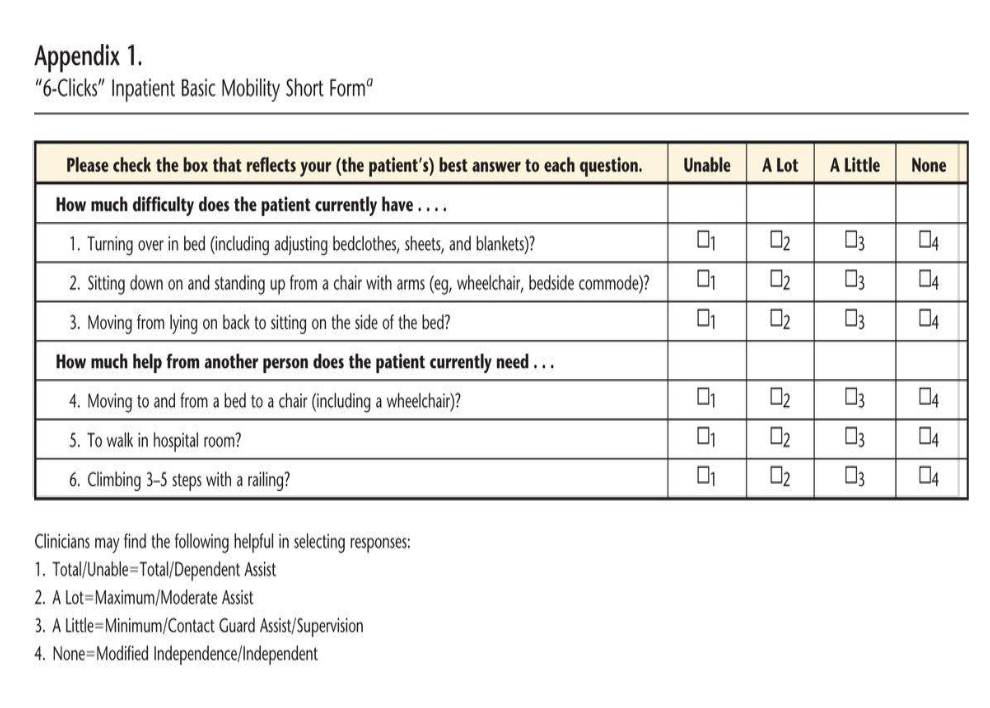
primary goals for patients
-Independent or modified independent functional mobility is our primary goal for our
patients. Most often our patients need some level of assist, and it is our responsibility to
assess the level of assist they are currently at, compare that to how they performed these
functional mobility skills prior to this episode of care/hospitalization (prior level of function –
PLOF or baseline), and work toward achieving that PLOF baseline ability. Goals are set based
on what is realistic for that patient given their current clinical presentation and what their
discharge situation will be. It is our responsibility to teach/reteach our patients how to move
with the highest level of independence rather than just move them. As such, we shouldalways ask them to do as much as they can first and then assist as needed, this is where the
teaching comes in. Remember that they cannot go home, or to another less intense level of
care, until they are able to move to the best of their ability and what their living situation will
require (i.e. lives alone vs. has someone who is able and available to assist as needed).
-Some patients come to us with reduced independence as their PLOF or baseline. Our primary
goal is still to restore the patient to their PLOF or baseline which may be some level of assist.
Often these patients require education of a caregiver on how to safely assist the patient for
the benefit of the patient and caregiver = good body mechanics! This includes an assessment
of potential equipment needs and resources. We will discuss this with discharge planning.
what task are included in bed mobility?
• positioning/repositioning (week 3)
• boosting (week 3)
• scooting (week 3)
• rolling (sequential and log) (week 4)
• supine <-> sidelying (week 4)
• sidelying <-> sit (week 4)
• supine <-> sit via long sit (week 4)
Supine <-> Sidelying
Sequential Roll: Used for all general medical patients to perform supine to/from side-lying. Patient is able to rotate throughout the trunk/spine to roll to/from side. Typically begins by bending one or both knees and then reaching across body while pushing off feet to propel self to side. From sidelying, patient rolls back into supine position leading with up shoulder or up pelvis/hip.
-Absolutes: Maintain close contact with patient. Prior to roll, make sure there is enough room to roll into a sidelying position without patient feeling like they will roll off the bed or mat. Get low with a hip hinge that allows you to be in front of the patient, and at their level, so they feel safe. Your belly button should align with theirs. Reassure the patient that you are there and will protect them. When rolling from sidelying to supine, control the roll back to supine.
Log roll: Used with patients for whom trunk rotation is not tolerated (abdominal or thoracic surgery) or is contraindicated (lumbar spine surgery). Patient is not able to rotate throughout trunk/spine and must roll as a unit, or log, to get into/from sidelying. Patient is able to bend both knees, however, must keep shoulders, hips and spine in alignment as they push off of bed or mat with feet and reach across their body. From sidelying, patient rolls back into supine position as a unit keeping spine in neutral alignment. Note that this technique for abdominal or thoracic surgery is more for comfort and is not an absolute like spinal surgery precautions (see below).
-Absolutes: Maintain patient’s lumbar spine/abdomen in neutral position. Do not allow rotation. This technique must be used for postoperative lumbar spine patients. Maintain close contact with patient. Prior to roll, make sure there is enough room to roll into sidelying position without patient feeling like they will roll off the bed or mat. Control roll back to supine
Sidelying <-> Sit
-Used for all general medical patients, including lumbar spine surgery or abdominal surgery patients, to go sidelying to/from sitting. Patient uses down elbow and eventually up arm to push off of bed or mat while bringing legs over the edge of the bed. To lie back down on side, patient goes down onto elbow while lifting legs up onto bed or mat and then lowers self down to sidelying. If patient has spinal or surgical precautions, they cannot laterally flex or twist while performing sidelying <-> sit.
-Absolutes: When assisting the patient at the upper trunk, apply pressure to patient’s trapezius/scapular region, not the patient’s neck. Once the patient’s lower legs are off the edge of the bed, place your hand at the patient’s superior hemi-pelvis to facilitate and control motion into sitting. Patient’s feet must be flat on floor once in sitting
Supine <-> Sit
Long-Sit: Used for lower extremity orthopedic patients, such as lower extremity fractures, hip replacement, knee replacement, fracture, or amputee. The PT assists the patient or the patient positions self closer to the edge of the bed/mat (enough room to lay arm flat on the edge of the bed/mat and be able to push off elbow) and on an angle such that their feet are close to the edge of the bed while their upper body moves away from the side they are getting up to. The patient then props them self up onto their elbows and begins to move trunk and legs to a more straight line perpendicular to the edge of the bed as they move their legs over the edge of the bed. While doing this maneuver, the patient pushes them self up onto extended arms to come to full sitting with feet flat on floor. To get back down, the patient boosts them self back into the bed and begins to lift legs back up onto bed while shifting hips around so that proper alignment is maintained. Once positioned in a straight line in bed, patient lowers self down onto elbows and then into supine.
-Absolutes: Maintain guarding contact with patient’s trunk throughout supine <-> sit. Maintain precautions for hip replacement.
• Posterior approach = no hip flexion past 90 degrees, no hip adduction past midline of body, no internal rotation of hip (most common - will be emphasized and all will need to know).
• Anterior approach = no extension past neutral, no external rotation, no active hip abduction
• Anterolateral approach = depends on the MD, may not have any precautions (being seen more)